

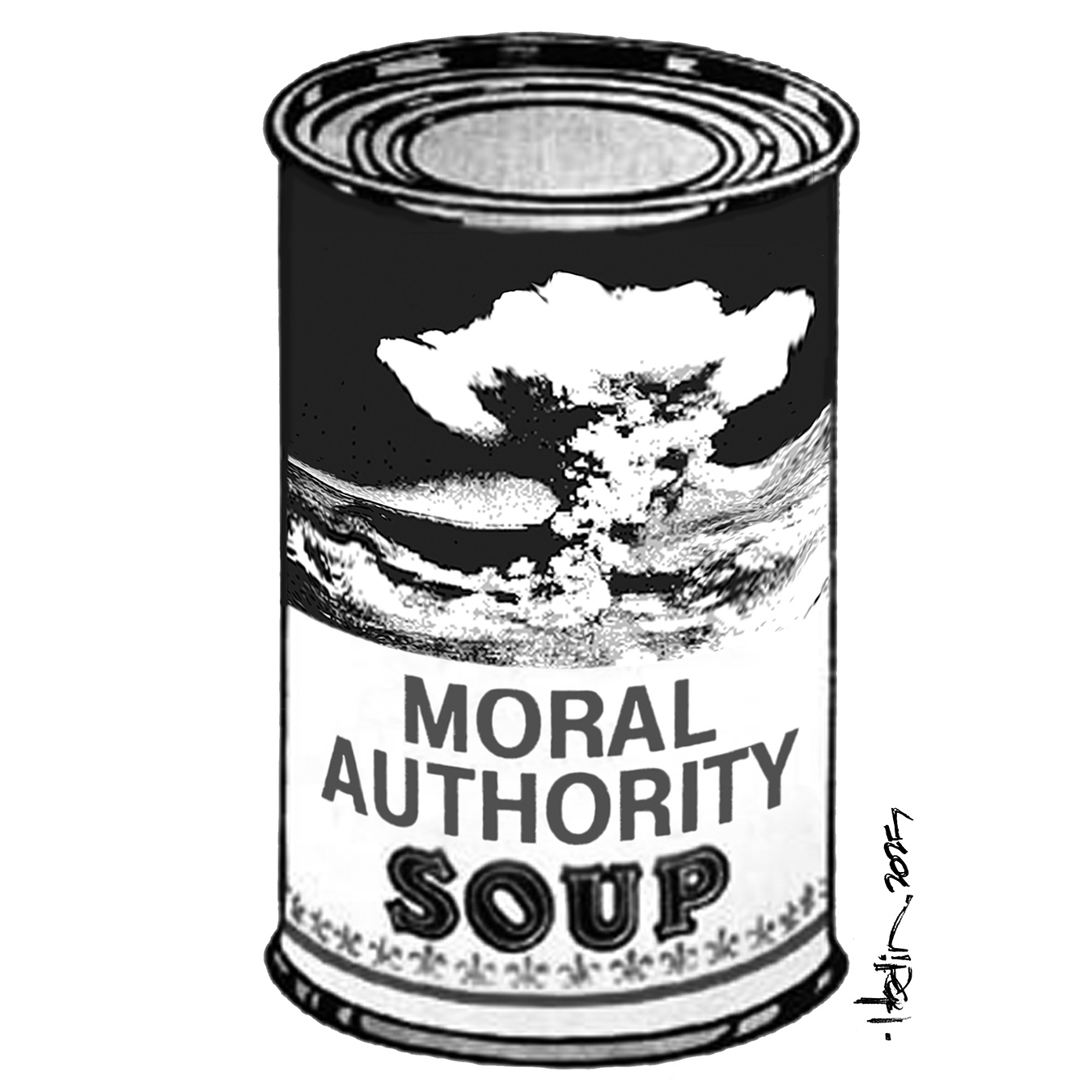
On November 5, during early morning night hours, Vandenberg Space Force Base tested an unarmed intercontinental ballistic missile (ICBM). These ICBM test launches, which occur several times a year — late at night, disturb the sleep of many folks on the California Central Coast. The missiles travel approximately 4,200 miles to Kwajalein Atoll in the Marshall Islands. I perceive these launches as wakeup calls that our human existence hangs in a nuclear balance.
On September 30, President Trump addressed nearly 800 generals and admirals at Marine Base Quantico in Virginia. Trump’s speech was long and comedic in places. It was also distressing. Consider these comments in Trump’s address regarding America’s nuclear forces:
“We were a little bit threatened by Russia recently, and I sent a submarine, nuclear submarine, the most lethal weapon ever made. Number one, you can’t detect it. There’s no way. We’re 25 years ahead of Russia and China in submarines. … I moved a submarine or two, I won’t say about the two, over to the coast of Russia.”
That’s our president bragging about his deployment of Trident submarines along Russia’s coast carrying up to 20 nuclear-armed ballistic missiles: each having the firepower to make it the “sixth most powerful nuclear power in the world” according to the U.S. Department of War.
Trump isn’t the only president flexing a nation’s nuclear muscles.
On October 21, Russia successfully tested the first nuclear-powered cruise missile, the “Burevestnik,” that can carry a nuclear warhead. The next day, Vladimir Putin put on a nuclear presentation, overseeing a test launch of an unarmed ICBM. Then on October 29, Putin announced Russia’s successful test of an underwater, undetectable nuclear drone.
Given the Russian-Ukraine conflict, one asks: Are not the U.S. and Russia insane nuclear super powers, threatening humanity?
In fact, the nuclear policies and programs of the U.S. and Russia are very similar. First, there are the nuclear arsenals and delivery systems.
Like the U.S., Russia has a triad of nuclear weapon systems: land-based ICBMs, and nuclear-armed bombers and submarines. Both nations have the nuclear force to annihilate humanity many times over.
Then there are nuclear command policies.
According to Congress, Trump has sole authority to authorize the use of nuclear weapons. So does Putin, as declared in a nuclear document titled, “FUNDAMENTALS of State Policy of the Russian Federation on Nuclear Deterrence.”
Both presidents have 24-hour access to briefcases, the “nuclear football” and “Cheget,” by which they enter codes to launch a nuclear attack.
In sum, American and Russian presidents can start a nuclear war, unimpeded by any checks and balances.
Despite this looming nuclear threat, leaderships and militaries of the U.S. and Russia justify possessing such weaponry on the basis of “deterrence,” a national defense, as they see it. Both the U.S. and Russia are modernizing their nuclear weapon systems supposedly as means of deterrence. This is ludicrous!
Both the U.S. and Russian nuclear policies include a preemptive, first strike option against a nonnuclear attack as justifiable. However, once a nuclear adversary launches a nuclear attack on another, deterrence, by its definition, disappears for the targeted recipient.
“Deterrence” also raises a related moral dilemma. I refer readers to a book by Ron Rosenbaum, How the End Begins: The Road to a Nuclear World War III.” (Simon and Schuster, NY, 2011) Rosenbaum explains how the American soldiers who will fire off the armed ICBMs — (all of whom are trained at Vandenberg) — can face a quandary if they know nuclear missiles are already coming at the U.S. A missileer may no longer see launching nuclear missiles as a defensive act, but a retaliation killing millions of people. Would it not be moral and humane for these soldiers to refuse to launch the missiles to save the lives of millions of innocent people, regardless of who they are?
The United Nations best grasps sanity when it comes to nuclear weaponry. Despite decades of treaty-making starting in the 1960s and leading into the 21st century, the world remains awash with nuclear weapons, ever at the edge of nuclear Armageddon.
In 2017, the UN took a different approach, adopting the “Treaty on the Prohibition of Nuclear Weapons” (TPNW). The TPNW, which came into force in January 2021, calls for all nations to never “develop, test, produce, manufacture, otherwise acquire, possess or stockpile nuclear weapons” or “use or threaten to use nuclear weapons”
So far, 99 nations have joined the TPNW. Unfortunately, and tragically, none are nuclear powers.
The TPNW is radical, comprehensive, and urgent. It rejects the notion of nuclear deterrence that in actuality, makes nations and peoples unsafe. The treaty recognizes the pervasive insanity that infects nuclear powers.
The U.S. brought nuclear weapons into the world, and is the only nation to have used them. In the TPNW’s vein of thinking, Americans should call for the U.S. to unilaterally disarm itself of nuclear weaponry and programs. Our nation should join and comply with the terms of the TPNW, and lead other nuclear powers in doing so.

