
Paseo Nuevo Redevelopment:
The Next Steps
Is the Plan for Redevelopment of
Downtown Mall Being Rushed Through Approval?
By Ryan P. Cruz | November 13, 2025
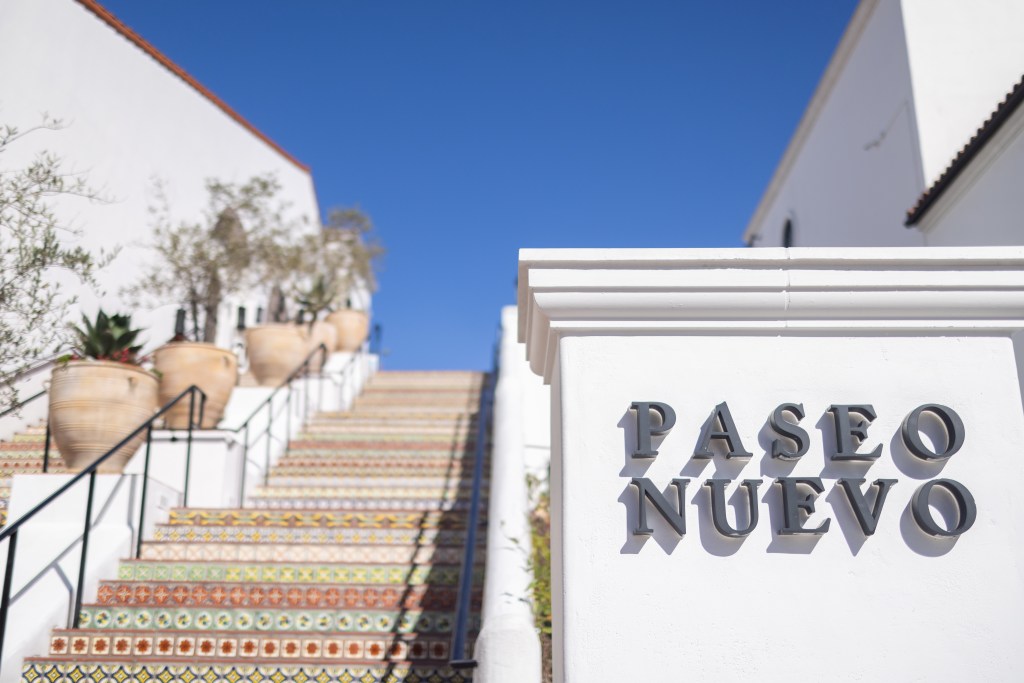
The plan to transform Santa Barbara’s Paseo Nuevo shopping mall into a mixed-used residential-retail development with 233 units of market-rate housing and 80 units of affordable housing has been presented as the city’s best chance at reviving the long-struggling mall, while bringing much-needed rental housing downtown. On December 2, the Santa Barbara City Council is expected to vote on the joint agreement with the developer. If approved, the project would move closer to final approval.
But as the council prepares for a big public hearing to consider approval, there’s been a rising wave of opposition urging city leadership to slow down and properly scrutinize this once-in-a-generation project that could be at the heart of the city for decades to come.
How Did We Get Here?
The original mall was built in 1990, following years of painstaking review, with at least nine civic committees weighing in on multiple iterations of the design. One early proposal was rejected by referendum, and another was denied by the city’s Planning Commission for being too “un–Santa Barbara.”
At the time, the plan was to bring a major retail center to downtown Santa Barbara, and the city’s Redevelopment Agency led the charge, acquiring seven acres of land in 1987 and 1988 for a cost of about $16.5 million. The city then relocated three dozen small shops and businesses to cobble together the rest of the land needed, and it spent $13 million to build two downtown parking lots to serve the new mall. After seeking proposals from 10 developers, a San Francisco–based group was selected to take the $120 million contract.
The project’s architect John Field worked with the city’s design and review boards for years, making small tweaks and perfecting the final design to ensure Paseo Nuevo matched the city’s Spanish colonial aesthetic. As one associate planner from the city’s Redevelopment Agency told newspapers when the mall broke ground in 1990: “It’s been a grueling process for everyone, but it’s kept us all employed for a long time.”
Paseo Nuevo was the jewel of downtown for years, attracting crowds to the popular department stores of the time, Nordstrom and Macy’s, and becoming home to an emerging arts scene with the Museum of Contemporary Arts Santa Barbara and the Center Stage Theater. But the explosion of online shopping, the rising rents for retail spaces, the economic disruption of the COVID pandemic, and finally, the closing of both Nordstrom and Macy’s, left the mall struggling for an identity.
The mall’s ownership became a tangled mess after the Redevelopment Agency was dissolved by the city for budgetary concerns in 2012. Eventually the company that owned the majority of the buildings in the mall defaulted on a loan held by AllianceBernstein — a Tennessee-based global investment firm with hundreds of billions of dollars in assets. In 2022, AllianceBernstein, also known as AB Commercial, suddenly found itself owning the Macy’s building and all the inline shops, and it had become responsible for all improvements to the property. A company called Shopoff Inc. acquired ownership of the Nordstrom building, and the City of Santa Barbara retained ownership of the parking lots and land beneath the mall.


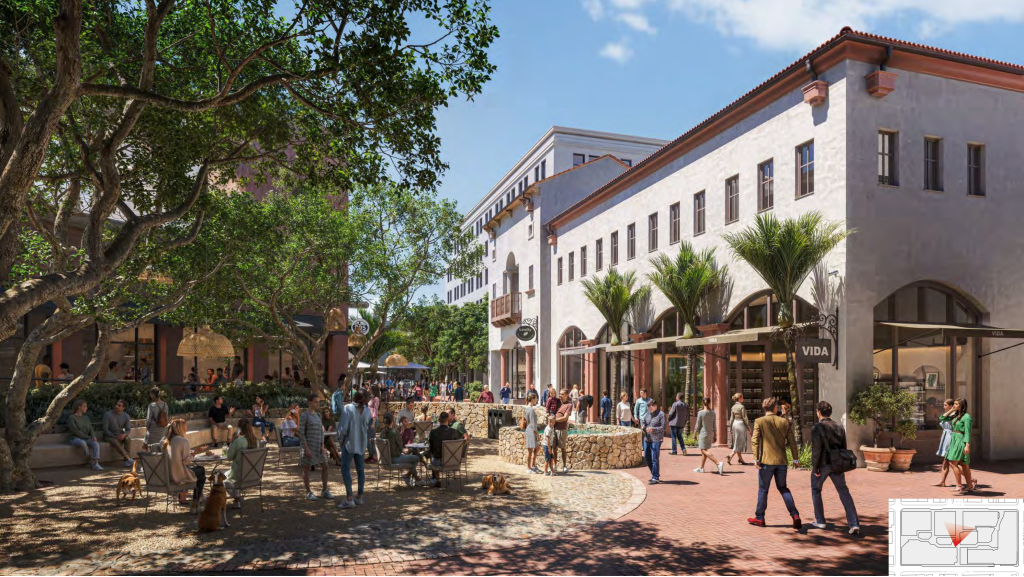
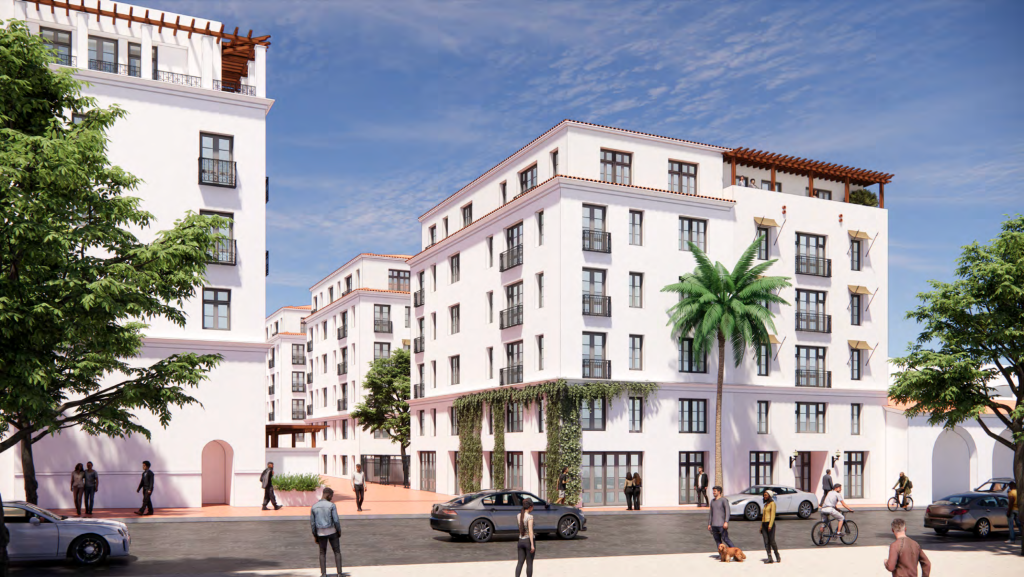
Left: A view of the 233-unit market rate residential building at Chapala and Ortega Streets. Right: A look at the proposed redevelopment of Paseo Nuevo at State and Ortega streets, with a specialty market on the first floor (Note: city staff said renderings depicting cars on State Street do not reflect any plans to reopen the street.) | Credit: The Georgetown Company/AllianceBernstein
A New Proposal
In 2023, AB Commercial began brainstorming with city staff about how to redevelop the mall. Later that year, the city council officially authorized negotiations for the new project. Any new proposal for a housing development would require the agreement of all three owners, so negotiations became a delicate dance with AB Commercial and city planners outlining the basic terms of the plan.
In March 2024, the city and AB Commercial revealed the first version, an ambitious plan to build up to 500 units of housing on top of the shops inside the mall. At the time, Santa Barbara City Council supported bringing housing downtown, but these early plans fell through after AB Commercial found that adding structures on top of existing shops would trigger an entire reassessment of the mall’s foundation. The project was deemed financially infeasible, and AB Commercial and its group of consultants and architects went back to the drawing board.
AB Commercial and city planning staff unveiled the current proposal in August 2025. The new residential housing development was downsized to two main sections with 233 units of market-rate housing and 80 units of low-income affordable housing, to be built on top of the Macy’s building and above two city parking lots.
As part of the proposed Disposition and Development Agreement outlining the project, the city would transfer its land ownership over to AB Commercial, including the use of City Parking Lots 1 and 2. AB Commercial would then finance the project and work with a housing provider such as the city Housing Authority to construct the affordable housing portion.
The new plan was presented as the preferred alternative for both AB Commercial and city administrative staff. AB Commercial now had a project that was financially viable, and city planners were hailing the project as a “catalyst” for the future of downtown Santa Barbara.
State Street Master Planner Tess Harris, who is tasked with directing the long-range plan for downtown, sees the Paseo Nuevo redevelopment as a major opportunity to bring more people to the city’s center. She often says that Santa Barbara is lagging far behind other vibrant cities, which typically have 20 to 25 percent of downtown space used for residential; in Santa Barbara, she says, just five percent of downtown is residential.
“The vitality of State Street, and the revitalization of downtown as a whole, is going to rely on people living in the space,” Harris said. “More people around makes it feel more alive and downtown is only going to work if we get significantly more housing in the area. This is just one project, but the hope is that this will fuel more investment in housing.”
City Council reviewed the updated plans on August 5, and while the council approved the overall plan and allowed continued negotiations, they raised concerns over the details of the proposal and the public outreach process. During that meeting, council members asked city staff to provide a “robust engagement process,” with public town hall meetings to allow residents to weigh in on the project. “I want us all to be on the same page and very clear about what this public engagement is,” Councilmember Wendy Santamaria said. “It’s not just informative. We need to receive that input from folks.”
Mixed Reviews
As the project made its way through a round of pre-application reviews with the city’s Historic Landmarks Commission (HLC) and Planning Commission, its members began picking the project apart, grilling staff on what they considered as inconsistencies with the city’s general plan.
At the HLC hearing on September 24, commissioners Dennis Doordan and Cass Ensberg questioned the separation of the low-income units from the market-rate luxury apartments. City staff explained that in order for the Housing Authority to qualify for
low-income tax credits to fund the construction of the affordable housing portion, all of the low-income units had to be on a separate parcel.
Still, Commissioner Doordan urged project architects, Duncan Paterson of Gensler Architecture and Clay Aurell of AB Design Studio, to downscale the project and focus on a more refined design that “avoids coding one building as barracks for workers and one building as market-rate residential.”
Commissioner Sheila Lodge — a former mayor and longtime member of city review boards — said she was “troubled” by the exemption given to the market-rate residential building allowing it to be 75 feet tall, a full 15 feet higher than the city’s charter allowed. Assistant City Attorney Dan Hentschke explained that the city had no control over the height due to a state law that allowed developers to ask for an exemption if they provided a certain number of affordable units.
On October 9, the city’s Planning Commission slammed the project during what very well may be the commission’s only chance at a proper review. The hearing was a public interrogation of the proposal, and in the process, it revealed some of the unanswered questions about how much (or how little) the city’s end of the deal was worth, and what other options were considered before this current proposal was chosen.
Planning Commissioner Lesley Wiscomb was among several commissioners to speak up against the project. She asked if city staff had considered a ballot measure to allow for a 99-year lease — long enough to make the property a better candidate for a loan. City Administrator Kelly McAdoo said city staff hadn’t been directed to pursue that option, and at this point, a ballot measure for 2026 would stall the project too long and AB Commercial could pull away completely.
“If we can’t come to a deal, the mall continues to sit as it is,” McAdoo said. “It could basically just sit there and we could have nothing — those are the factors we’re dealing with.”
Wiscomb also took exception to the perceived gift of public lands to a private company that, in essence, is trying to recoup its losses. She and other planning commissioners asked why the financial feasibility of the project wasn’t being verified publicly, with no documents presented to the review boards or to the public.
“There’s community members that are upset about the fact that this is public land that is possibly being turned over to a big investment advisory firm, with billions of dollars under management,” Wiscomb said. “There’s nothing that can be shown to the public that justifies this action.”


A 233-unit market-rate residential building and specialty market (pictured right) could be built above the empty Macy’s building as part of the proposed redevelopment of Paseo Nuevo, which developers and city planners are hoping will help bring more people to the downtown area. | Credit: Ingrid Bostrom, The Georgetown Company/AllianceBernstein
Too Much, Too Fast
Among the most vehemently opposed to the Paseo Nuevo project is Planning Commissioner and former City Councilmember Brian Barnwell. A longtime policy wonk, Barnwell let loose and spoke from the heart during that October 9 hearing. “I don’t ever remember such an ill-defined proposal coming in front of me,” he said. “This sounds like we’re desperate and we’re making a rush to judgment.”
He said he remembered the planning process for the original Paseo Nuevo mall, when the city review boards went over every excruciating detail. “We analyzed and looked at all the details,” Barnwell said. “I don’t have the sense of that here…. I just don’t think these details have been ironed out.”
This week, Barnwell penned an open letter calling the plan “dreadfully wrong” for Santa Barbara, and noting that it lacked the support of both the Planning Commission and Historic Landmarks Commission. He said the plan arrived before the Planning Commission “fully formed out of a black box, with no meaningful public input.” The project will not require another Planning Commission review.
Barnwell expressed frustration with the lack of transparency with regard to AB Commercial’s argument that other redevelopment options “won’t pencil out,” and the city’s quick acceptance of the financial analysis without public documentation. “The architect offered vague structural explanations but no evidence that other options were considered,” he said. “There was no highest-and-best-use study, no documentation, only assurances.”
He echoed the comments from his colleagues on the Planning Commission about the “lack of dignity” in the affordable housing portion of the project, which is set aside a block away from the rest of the luxury units, in an alleyway behind the Canary Hotel.
Housing Authority of the City of Santa Barbara Executive Director Rob Fredericks met with city officials and AB Commercial to work towards a plan to handle the affordable housing portion. While Fredericks is in favor of bringing more housing downtown, he had several suggestions and concerns about the current proposal.
Fredericks said the plan to use City Parking Lot 2 to supply 80 affordable units could receive funding through low-income housing tax credits, though the Housing Authority had “reservations about the suitability and density proposed for Lot 2.” Using the city lot requires a costly partial demolition, which Fredericks said should be paid for by AB Commercial, if the developer wanted to get credit for the affordable units.
He also said that 80 units packed onto such a limited footprint was “ambitious” and suggested a more conservatively sized project closer to 50 or 60 units. “The goal must be a building the community can point to with pride and residents can genuinely call home — a place of dignity and livability, not density for density’s sake,” he said.
Fredericks worried there would be a “significant gap” in financing. Even with the low-income housing tax credits, he said, the construction of 80 affordable units at Lot 2 could still require funding an extra $8 to $10 million. Since the city’s Local Housing Trust Fund couldn’t cover that with its current balance, Fredericks suggested that AB Commercial be required to contribute a cost of about $125,000 per unit to cover costs for partial demolition and site preparation.
“This contribution should be clearly conditioned within the Disposition and Development Agreement and funded concurrently with the construction of the market-rate component, to ensure that the affordable housing moves forward in real time — not as a deferred obligation,” he said.
Making the Best Deal
Following the Historic Landmarks Commission and Planning Commission hearings, the city hosted two in-person open house sessions at Paseo Nuevo, where community members could pop-in and get a closer look at the project renderings, chat with city planning staff, or leave a typed public comment on laptops set up on tables inside the empty storefront.
City Administrator McAdoo and State Street Planner Harris have been making themselves available to present the plans at public events and round table discussions, building the case for the current proposal, which they argue is the closest the city’s been in years to an actual development at Paseo Nuevo. McAdoo keeps her cool even when peppered with tough questions: Why can’t we see the financials? Why isn’t the city’s land worth more?
McAdoo explains that, as a general rule, a City Administrator doesn’t ever want to give away land. But this land — despite its location in the heart of Santa Barbara — isn’t worth much due to the encumbrances on the parcels, which limit the development options. In other ways, state housing laws have hamstrung the city’s discretionary power, stripping the review boards of their ability to demand changes and limiting the project to a maximum of five public hearings. These factors all nudge the scales in favor of developers.
Rich Appelbaum, a Distinguished Professor Emeritus of UCSB and member of the Santa Barbara County Action Network (SBCAN) advisory council, spoke about the project at several public meetings, including a round table discussion hosted by SBCAN on November 7. Appelbaum says he appreciates the tough task of city officials trying to make the best out of a complicated project, but he worries that the city is “giving away a whole lot” to make it happen. “Is this really the best deal that the city can get?” he asked.
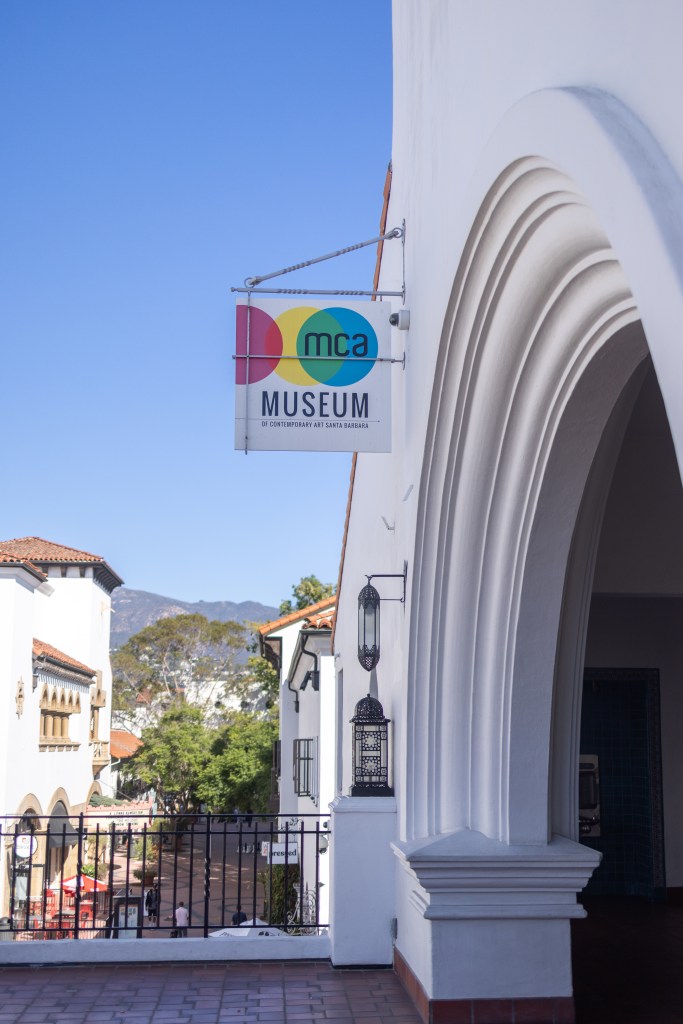
While most of the discussion about Paseo Nuevo has been about the residential portion, there have been questions about the plans for a high-end market, and about the future of the Center Stage Theater and Museum of Contemporary of Art Santa Barbara — both of which have experienced a cultural rebirth under Museum Director Dalia Garcia and MCASB Board President Frederick Janka.
MCASB board members and staff issued a statement in which they expressed support of the redevelopment of Paseo Nuevo, but asked that the arts community be supported and included in the plans for the future.
“The Board and Staff of MCASB envision a future Paseo Nuevo that integrates affordable housing with essential cultural infrastructure,” Janka said. “Without a dedicated contemporary art space, new residents and future generations risk losing more than exhibitions — they lose a creative anchor, a platform for self-expression, and a site of intergenerational empowerment.”
MCASB staff are hopeful that the owners of Paseo Nuevo and city planning staff are able to recognize the museum as a vital public good, “just as worthy of investment, inclusion, and partnership as housing itself.”
Final Offer?
On December 2, Santa Barbara City Council is expected to vote on the proposed Disposition and Development agreement, outlining the general plan for the Paseo Nuevo project and locking in the city’s commitment to transfer the land. That finalized agreement will be revealed in the meeting’s agenda, though it’s unclear whether the council will receive any more detailed documentation than was available during previous negotiations.
The city will not be able to reveal AB Commercial’s proprietary financial information, but in the recent roundtable with SBCAN, the city’s two contracted financial consultants — Dena Belzer with Strategic Economics, and Pat Flynn of the Maxima Group — provided a look into the kind of financial analysis they conducted.
Belzer and Flynn further explained the limited value of the city’s lease on the ground under the mall. “If it was a flat piece of land — no encumbrances, no existing structures or terms — it would be valuable,” Belzer said. The location is valuable, in theory, she said, but according to the State Department of Finance, the estimated value to the city is “zero.”
Flynn said she trusted AB Commercial’s assertion that no investor would lend on a ground lease so complicated, especially with a loan term limited to 40 years. “It’s a non-starter,” she said. The consultants ran several different scenarios to evaluate the financial documents and ensure the city wasn’t being exploited in the deal. They found that AB Commercial’s return on cost would likely be between 4 and 6 percent — far below the target return of 8 percent.
“We’ve tested it as vigorously as we could test — every assumption — and we actually agree with the pro-forma as they present it,” Flynn said. “It’s a very rare thing because developers tend to put their thumb on the scale, but I can say that’s not the case here.”
The City Council will decide whether to move forward with the Disposition and Development Agreement as proposed, to ask staff to add any specific changes or conditions, or to postpone entering an agreement until a later date. Approval of the agreement would not mean an outright approval of the project, and AB Commercial would still need to complete the application review process.


You must be logged in to post a comment.