

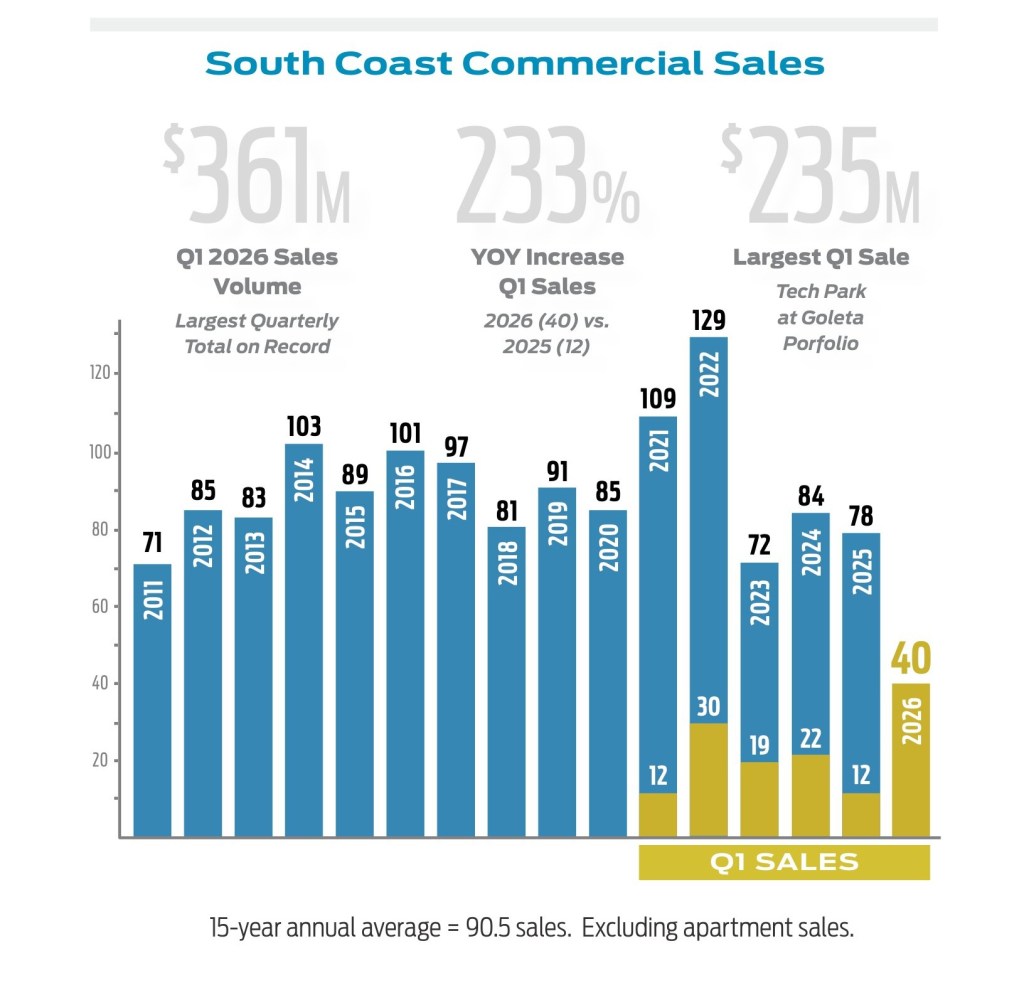
The South Coast commercial real estate market began 2026 with record-setting sales volume, totaling
approximately $361 million across 40 transactions. However, this headline figure was driven largely by
two exceptional transactions and does not fully reflect broader market conditions.
When viewed more closely, the first quarter was defined by measured, highly selective activity across
most sectors. Investment sales—while improved year-over-year—remain disciplined and targeted.
Leasing fundamentals showed modest but meaningful gains across office, industrial, and retail sectors.
Meanwhile, multifamily investment trends continue to reflect the distinct dynamics between larger
apartment assets and smaller residential income properties, particularly within an increasingly complex
regulatory environment.
The result is a market that is active, but far from expansive—with capital deploying strategically and
performance varying meaningfully by asset type and submarket.
Key Takeaways
1. Record Sales Volume Driven by Two Outlier Transactions
Q1 2026 recorded approximately $361 million in commercial sales, a dramatic increase from $33.9
million in Q1 2025. However, two transactions—the Tech Park Goleta portfolio recapitalization and The
Post in Montecito—accounted for a substantial portion of total volume.
“It was a record quarter on paper—but not a broad-based surge,” said Rhonda Henderson, Vice
President, Radius Commercial Real Estate. “When you strip out the two largest transactions, what you’re
left with is a market that’s improving—but still very selective,” Henderson added.
2. Normalized Activity Reflects a More Measured Market as Investment Activity Remains
Highly Selective
Excluding those two sales, the quarter totaled 26 transactions and just under $70 million in
volume—still an improvement year-over-year, but more indicative of a steady, selective investment
environment rather than broad-based acceleration. Capital continues to concentrate on well-located,
high-quality, and strategically positioned assets, with approximately half of all transactions occurring
off-market. This remains a market where relationships and direct sourcing are not just helpful—they’re essential.
“Capital isn’t chasing deals right now—it’s choosing them. The bar is higher, and only certain
opportunities are clearing it,” said Henderson.
3. Leasing Fundamentals Show Gradual Improvement
Leasing activity across the South Coast showed modest but measurable gains:
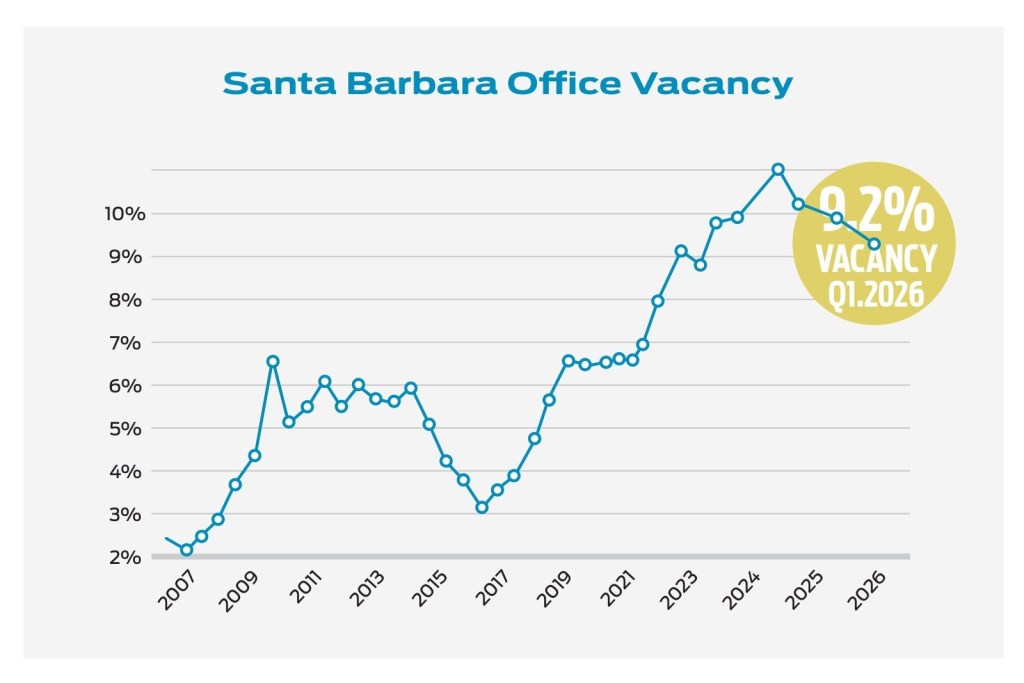
– Office vacancy declined in Santa Barbara (9.2%) and Goleta (7.9%)
– Industrial fundamentals improved slightly despite limited deal volume
– Retail vacancy remained low at approximately 3.2%
These trends point to incremental absorption and steady tenant demand, not a rapid rebound.
4. State Street Improvement More Market-Driven, Less Policy-Led
Downtown Santa Barbara’s State Street commercial corridor has seen measurable improvement in
vacancy, declining from a peak of 48 storefronts to approximately 30—closer to pre-pandemic levels.
Progress continues to be driven primarily by private-sector leasing, reinvestment, and an active project
pipeline, rather than any single policy outcome.
“State Street isn’t being ‘fixed’ by a single policy decision,” said Justin Diem, Vice President, Radius.
“What we’re seeing is steady, private-sector momentum—incremental, but real.”
5. Multifamily Trends Reflect Distinct Asset Categories
Multifamily performance continues to vary by asset type:
– 5+ unit properties: Transaction activity remains limited, shaped by rent control measures and
anticipated regulatory changes, with greater emphasis on in-place income and yield.
– 2–4 unit properties: Activity is comparatively stronger, with 17 transactions in Q1 and rising
price per unit, supported by owner-user demand and residential financing structures.
6. Small Residential Income Properties Maintain Broad Appeal
Duplexes and triplexes continue to attract both investors and owner-users due to:
– Ability to offset housing costs with rental income
– Access to residential financing
– Flexibility in use and repositioning
Average pricing reached approximately $950,500 per unit for duplexes and $585,801 per unit for
triplexes, with both segments showing quarter-over-quarter growth.
South Coast Market Summary
While the highlight of the first quarter was record-setting commercial sales activity largely due to a single
outsized transaction, the quarter is best viewed against a broader backdrop of measured market activity
across all commercial real estate sectors in the South Coast.
While total sales volume reached historic levels, that activity was heavily concentrated. Outside of those
deals, the market continues to move forward with discipline, selectivity, and a clear bias toward quality,
consistent with trends observed throughout 2025.
Leasing fundamentals provide a clearer read on underlying conditions. Across office, industrial, and retail
sectors, the market is experiencing gradual stabilization rather than rapid recovery. Tenants remain
active—particularly in well-located, high-quality spaces—but decision-making remains deliberate.
Downtown Santa Barbara reflects this dynamic in real time. Despite ongoing public debate surrounding
the future of State Street, private-sector activity continues to move the corridor forward, with leasing,
reinvestment, and redevelopment steadily reducing vacancy and improving activation.
Within multifamily, the contrast is not new—but it is increasingly visible in today’s environment. Larger
apartment assets are shaped by regulatory constraints and income limitations, while smaller 2–4 unit
properties continue to benefit from owner-user demand, accessible financing, and operational
flexibility.
Bottom Line
Q1 2026 delivered record sales volume—but not broad-based acceleration.
A more complete view of the market shows:
– Measured investment activity, with capital targeting specific opportunities
– Gradual improvement in leasing fundamentals, not a rapid rebound
– Consistent differentiation across asset types, particularly within multifamily
The South Coast remains a supply-constrained, relationship-driven market, where performance is
increasingly defined by asset quality, regulatory context, and strategic positioning.
“This has always been a supply-constrained market,” said Paul Gamberdella, Principal, Radius
Commercial Real Estate. “What’s different today is how selective it’s become. Opportunity is still
there—but it’s not evenly distributed.”
For more information, visit radiusgroup.com. DRE#01334755
Download the comprehensive Central Coast Market Report here.
###
REALTORS®: Share your industry info in “REAL ESTATE SCOOP.” Email sarah@independent.com for details.
Related Posts


You must be logged in to post a comment.