
Gay Bars Come and Go,
But the Party Continues
A Brief History of LGBT Nightlife in
Santa Barbara over the Last Six Decades
By Emily Vesper | June 4, 2026

Read more from our Santa Barbara County Pride cover story here.
For years — for decades, really — queer folks have decried the death of the gay bar. You hear it from people of all ages: older gay men and lesbians mourning their favorite haunts and twentysomethings romanticizing a club culture they never experienced. It might be just queer cliche, but it’s rooted in a well-documented phenomenon. Across the United States and the world, gay, lesbian, and queer bars are shuttering in droves.
Santa Barbara is no exception. Over the past two decades, a few bars catering to the queer community have opened — Crush Bar most recently — but none have lasted longer than a year or two. Paddy’s in downtown Ventura is the only remaining LGBT bar in the tri-county area.
It wasn’t always this way. Downtown Santa Barbara has had a history of cozy, lived-in dives to edgy dance clubs. A slate of closures in the late ‘90s and early 2000s marked the end of that chapter of Santa Barbara’s queer history — an era in which locals and visitors alike could spend their evenings hopping from one gay bar to the next.
Memories of gay nightlife in Santa Barbara take us back to the ‘60s, when men and women “in the know” would frequent the Leilani Lounge inside the old California Hotel. That’s not to say this was the beginning of the city’s queer scene — only that homophobia and harassment meant LGBT people had to convene discreetly, leaving much of Santa Barbara’s earliest queer history absent from the archives.
The scene really took off in the ‘70s. Nightlife was essentially segregated — out gay men and lesbians would rarely, if ever, visit straight bars, and vice versa — but the city’s gay bars operated with less secrecy and greater longevity. In fact, some of the most iconic bars that opened during this period stuck around well into the ‘90s.
“I was amazed at what a large gay community we had at the time, that could handle three bars,” said Charles Downs, who bartended at several in the late ‘70s. He recalls how clubgoers would walk back and forth between Trackside, a mellow lounge next to the train station, and The Pub, a rowdier joint on Helena Street that boasted a full liquor license and dance floor.
The community was tight-knit and active. Even though Santa Barbara was “much smaller and sleepier than it is now,” said Downs, nights at the gay bars could stretch late into the morning. The Unicorn would host “after hours” at 2 a.m., ceasing alcohol service and selling coffee and soda, while Trackside would open at 6 a.m. on Sundays for “Church,” absorbing the crowd that had partied until sunrise.
Downs describes a tenuous sense of freedom. “We never had any harassment from the heterosexual community, but we were harassed by the police department,” he said. “A policeman would drive by and come in and go, ‘We’re going to get this place shut down.’” Meanwhile, a number of homophobic hate crimes reportedly occurred in the area around 1979.
Still, the bars provided a lasting haven for Santa Barbara’s gay community. Gina Parvex began to frequent the scene about a decade later. The Unicorn was still kicking over on Cota Street, although it had rebranded as Gold Coast.
“People thought of it as a kind of a seedy bar. But to me, it was like a home away from home,” said Parvex. “You walk in this door, and it’s like freedom.”
Downs said The Unicorn was comfortably gender-mixed — at least, it was when he knew it — but Parvex insisted it really belonged to the ladies.
“Gold Coast was predominantly just a bunch of lesbians,” said Parvex. “Some of them were leather, biker women, but for the most part, they weren’t. It was just a great meeting place…. Have fun. Meet other lesbians. Kiss some lesbians. Date a lesbian, you know?”
The ’90s were a time of sweeping change for downtown Santa Barbara with the construction of Paseo Nuevo and development in the Funk Zone. New gay bars and clubs emerged — such as Hadess, Chameleon, Revival and the beloved Fathom, located on the 400 block of State Street. At one point, there were at least six — so many that the Independent’s 1999 Best of Santa Barbara® awards featured a “Gay Bar” category.
“Greg, who owned Fathom, was like, ‘I’m bringing L.A. to Santa Barbara.’ That’d never been done here before,” said Robert Mendez, a well-known promoter and manager at Wildcat Lounge who got his start as a doorman at The Pub. “It was the deejays from L.A., video screens everywhere, go-go boys…. It was incredible…. It really opened up people’s eyes.”
“It almost feels like glory days,” Mendez continued. “If only you could experience that loop of popping from Revival to Fathom and Chameleon to Gold Coast. Just feeling hot, walking in, and seeing 300 gay people that were all there to dance and love each other.”
But the story of Santa Barbara’s gay bars is closely intertwined with the story of Santa Barbara’s urban development. The vibrant network of downtown gay bars — at one point, six were open concurrently — proved unsustainable as rents increased. Clubs began to close, and by the early 2000s, none remained.
“In a relatively small market like Santa Barbara, splitting the scene across multiple venues made individual bars more vulnerable,” said former City Councilmember Tom Roberts, who would go clubbing at Fathom “disguised” in sunglasses and a muscle tee to reduce the chance of an impassioned constituent talking his ear off on the dance floor.
“Once a few cornerstone bars disappeared, the overall ecosystem became fragile enough that it never really recovered,” Roberts said.
Mendez was pivotal in shaping the scene that followed. In the late ’90s, he began to host gay nights at local straight bars. He rotated venues for a few years before finding a permanent home in 2003: Sunday nights at Wildcat. He named the weekly event the Red Room after the club’s striking vinyl booths.
It was a notion that would have been unheard of just a decade or so prior. “When I was 21, 22, I would never step into a straight bar. I was terrified of getting gay-bashed. It just wasn’t accepting,” said Mendez. “I think Red Room helped change that. I really do.”
Sunday nights aren’t as busy as they used to be, Mendez said. He attributes some of the decline to a shift toward day-drinking and wine-tasting in Santa Barbara, particularly in the highly gentrified Funk Zone. But the changes also reflect larger shocks to the nightlife industry, especially in the years since the pandemic. People are drinking less, while the cost of alcohol only increases; they’re staying in and spending more time than ever online.
We have good reason to remember Santa Barbara’s gay bars, which were centers of community, culture, and joy. But — to state the obvious — the queer community didn’t disappear when the bars did. If we only focus on what’s gone, we’ll miss out on the vibrant, evolving present.
“Loss can be an invitation to create something new,” said sociologist and UCSB professor Amin Ghaziani. In his recent monograph Long Live Queer Nightlife, Ghaziani argued that the widespread closure of physical gay bars and clubs created the conditions for underground queer parties and club nights to flourish. These “spatially local, roving, rave-like events” are sites of subversive possibility, said Ghaziani.
“Yes, we absolutely need to protect and preserve gay bars, but bars are not the sum total of night life,” said Ghaziani.
In Santa Barbara, a scene of queer club nights, dance parties, and drag shows is thriving. The Instagram accounts @gaysantabarbara and @queersantabarbara broadcast event listings to their networks of followers.
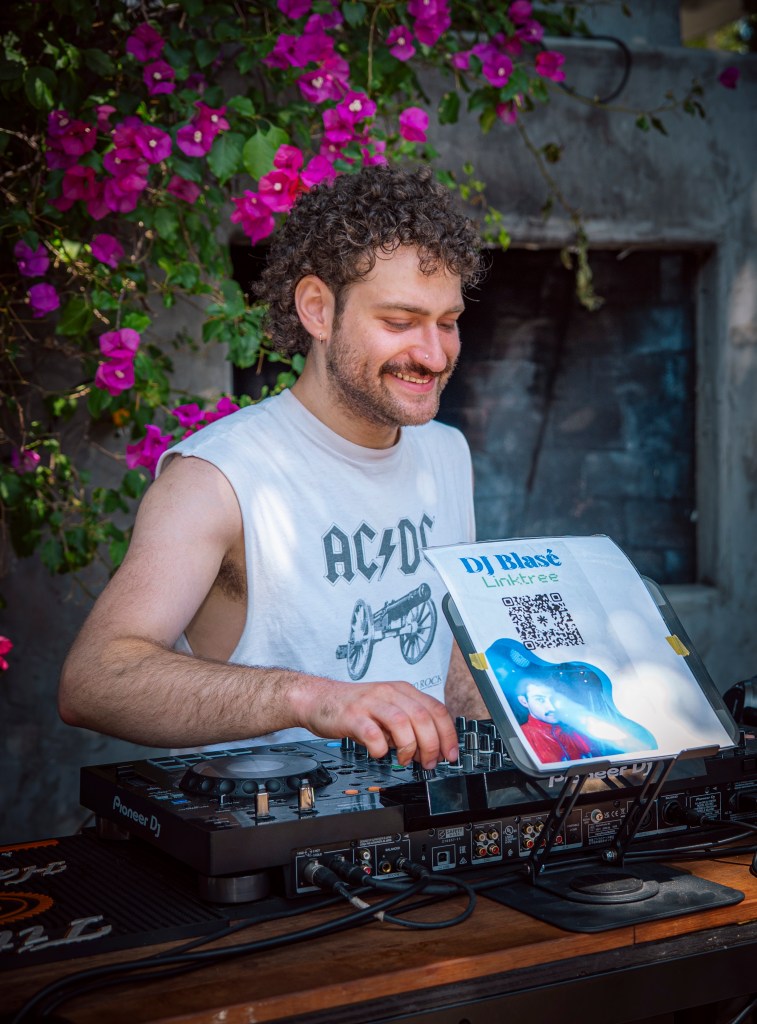
Drag show and party Barbara, hosted at Eos Lounge, has been a staple; Las Gatas Fumadas is a weekly Latinx drag show and party that debuted this month at Son Y Sabor. Another new party is Low Brow, a rave created by DJ Blasé for fans of hyperpop, electroclash, digicore, and the like. There’s Pacific Pride Foundation’s Sunset at the Canary, dance party Out and About at Seven Bar, and queer social club Birdcage, not to mention an array of one-off events. And there’s First Fridays, a “central hub” for queer nightlife that has “pretty much been at every major bar or club in Santa Barbara,” according to DJ Blasé.
DJ Blasé, known offstage as Tommy Lapidese, fell in love with Santa Barbara’s club nights and drag shows while studying at UCSB. He stuck around after graduation and began to deejay events such as Out and About.
“Having no concrete, brick-and-mortar gay bar is actually what has allowed [First Fridays], and really the gay scene and the gay community as a whole, to survive,” said Lapidese. “It’s not something that’s working against it. Movement allows the queer scene to avoid being co-opted. It allows it to be a little bit ‘If you know, you know.’”
“You know how buildings that are earthquake-proof are designed to move with the shifting ground underneath them?” continued Lapidese. “The queer scene here is designed to move, especially when the going gets tough. It’s what queer people have done for centuries.”
That scene, Lapidese said, is only continuing to grow. As a result, individual events are under less pressure to attempt the impossible task of appealing to the entire queer community. Lapidese is excited by the increase in events geared toward queer people of color, trans people, and other groups that experience marginalization within the LGBT community. He loves when deejays and drag artists get weird, wacky, niche, and freaky, refusing to sanitize their performances for a straight audience.
Queer nightlife in Santa Barbara will never stop changing; that’s simply its nature. But if anything has stayed constant, it’s the commitment to community. The scene is full of people who are creative, resilient, and ready to leave it all behind on the dance floor. In other words, it’s earthquake-proof.
Upcoming Events
Las Gatas Fumadas: Every Thursday, 10 p.m. at Son Y Sabor (409 State St.)
First Friday: June 5, 8 p.m. at Press Room (15 E. Ortega St.)
Barbara: June 12, 9 p.m. at Eos Lounge (500 Anacapa St.)
Sunset at the Canary: June 17, 6 p.m. at the Kimpton Canary Hotel rooftop (31 W. Carrillo St.)
Low Brow: June 24, 8 p.m. at Eos Lounge (500 Anacapa St.)


You must be logged in to post a comment.