


A recent essay in this paper named a real local pain. Teachers commute from Ventura. Workers drive in from Santa Maria. Young families grow up here and then leave because they cannot stay. Author Anabella Lehne was right about the symptoms. The diagnosis she offers, that Santa Barbara has too little housing and needs less regulation to build more, is the same diagnosis Derek Thompson and Ezra Klein make in their book Abundance. It is the same diagnosis behind Governor Newsom’s housing agenda, the campaign of likely next governor Xavier Becerra, and the housing positions of Trump, Biden, and Harris. It is wrong in a specific way, and the cost of getting it wrong is paid by our families.
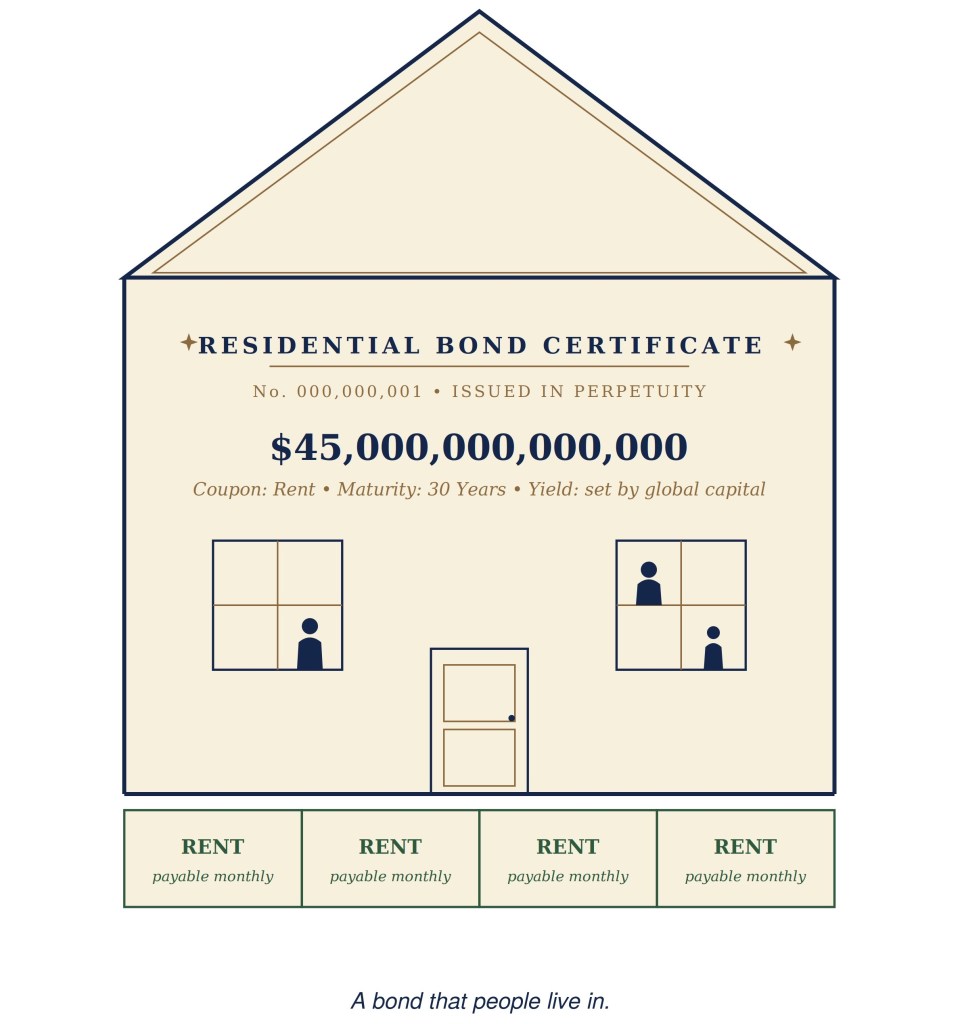
The essay called Santa Barbara a sold-out concert. A concert is a one-time event with a fixed venue size. It is not a financial asset. No one buys a concert ticket as a yield-bearing investment or takes a 30-year loan on one. Housing is none of those things. Housing is the largest financial asset class in the developed world, roughly $45 trillion on the U.S. household balance sheet alone. The price is set by global capital weighing the risk-adjusted yield on owning the existing stock against every other financial asset on offer: real estate that pays rent, stocks that pay dividends, bonds that pay interest. Housing is not a concert. It is a bond that people live in.
First-semester economics tells us what to do when demand does not fall as price rises and supply cannot scale. The textbook answer is not to wait for the market to clear because it never will. The textbook answer is price controls and rationing. We do this for drinking water, for emergency medicine, for vaccines during a pandemic. The private sector, however, does it for housing by price. Wherever demand is rigid and supply is limited by market realities, the market is not the allocation mechanism. Shelter belongs in this category, in the same textbook.
The Housing Authority’s 4,400 publicly managed or subsidized units is not evidence that managing the market has failed. Most are Section 8 vouchers, where federal money covers the gap between 30 percent of a tenant’s income and the landlord’s clearing rent. The landlord captures the value. The asset stays in the financialized market. In Vienna, 60 percent of housing is municipal social housing open to households at every income. Singapore houses 77 percent of its citizens in HDB (Housing & Development Board) flats. Sweden’s Million Programme, where my grandfather managed construction, built over a million units in a decade. Santa Barbara is not over-regulated but is greatly under-provisioned.
The cities Klein, Thompson, and Lehne would have us copy now show why the private supply-side answer cannot work. In Austin, multifamily permits fell 97 percent year over year last August. In Texas overall, single-family permits fell 12 percent in 2025 and another 21 percent in January 2026. Houston, the YIMBY model city, saw single-family permits drop 39 percent in a single month per the National Association of Home Builders. PulteGroup’s CEO said inventory and price appreciation softened Texas demand. Lennar’s co-CEO said Florida and Texas buyers needed more help than most other markets.
The drop in permits in Texas was financial, not regulatory: A worldwide rise in real interest rates raised the yield that global capital demands. It also repriced the existing housing stock downward, turning the Sunbelt’s pandemic building boom into a glut that the market would no longer absorb. Private builders stopped breaking ground on homes that no longer penciled. At the same time, no private builder builds into territory where rents would fall enough for working families to afford shelter. The math forbids it. Not the zoning. Not the building inspector. The math.
What works is no mystery: a public balance sheet that holds a large share of the housing stock. Shelter is given out by waiting list and income-indexed rent, not by auction. People object to that waiting list, not realizing that the market has one too, hidden in price. The teacher who drives from Ventura is on it. This is risk pooling, the same math we use for drinking water, schools, fire protection, Social Security, and should use for healthcare. Housing belongs in the same set.
Santa Barbara cannot solve this alone. The lever sits at the federal level. Speed up permits and the next builder will pull back when inventory rises, as Texas builders did. What Santa Barbara can do is face reality. The teacher who drives in from Ventura is not the victim of zoning. She is the victim of an ideological experiment organizing a modern economy around the price of shelter. The cure is not more of the experiment. The cure is public provision and allocation of necessary goods: shelter built and held on a public balance sheet, at the scale every country that solved this problem built it.
Kristian L. T. Blom is the founder and Chief Investment Officer of Blom Levy & Co. in Santa Barbara. He is the author of The Nordic Model of Financial Autonomy: A Handbook for Women, forthcoming Fall 2026 from Ranrike Press.


You must be logged in to post a comment.