
Healing with Horses
in a Santa Barbara Corral
Inside the Growing Practice of
Equine Partnered Coaching
By Tiana Molony | Photos by Ingrid Bostrom
June 11, 2026

Read more from our 2026 Pets & Animals cover story here.
It is a warm Wednesday afternoon at Hearts Therapeutic Equestrian Center in Goleta, where four women gather in a circle, taking turns sharing their stories — different in the particulars, as all stories are, but still familiar.
Sitting together in a round horse pen, they spoke about what they hoped to work on during this day’s session.
One woman, who’s divorced and in the midst of a long personal reckoning, muses that she finally feels ready to share her life with someone again, someone kind. Another needs to say something to her son before he moves out but is struggling to find the courage.
For me, the fifth woman in the circle that day, I simply wanted to practice staying present.
“Let’s all take a deep breath,” Melissa Costello, our group coach, interjects. “In through the nose and out through the mouth.”
The women close their eyes and exhale in unison, shedding, if only for a moment, their burdens.
Costello then says that it’s time to look at the horses.
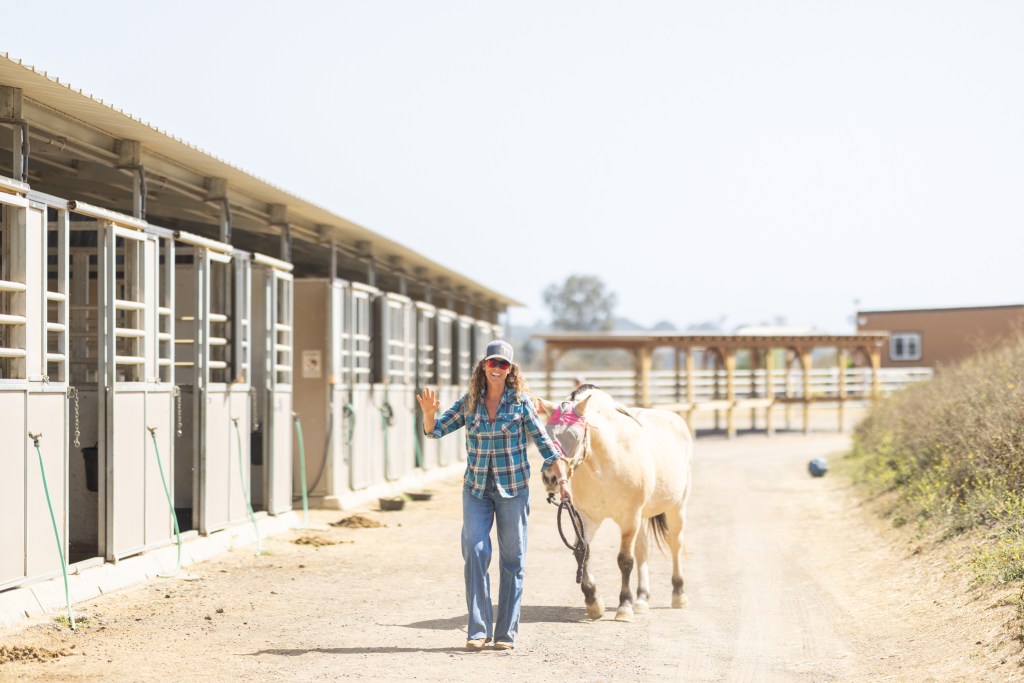
Healing With Horses
The women gathered that afternoon were there for Costello’s Sacred Horse Sister Circle, a weekly meetup of women, usually in midlife, for group equine partnered coaching — a kind of talk therapy that takes place in the presence of horses.
While other equine therapies, like those offered at Hearts, involve actually climbing into the saddle, this equine-assisted coaching is limited to interacting with horses on the ground: petting, hugging, or simply observing the animals.
When I first arrived that afternoon, the women sought to explain how deeply the experience affected them. One described it as “groundbreaking and illuminating,” but another just told me, “You’ll see.”
Costello, who started Heal with Horses in 2022, offering Equine Partnered Coaching (sometimes called Equine Facilitated Learning) in Santa Barbara, grew up around all kinds of animals but felt drawn to horses in particular. “I just would spend time around horses whenever I could,” she recalled.
A certified equine facilitated learning coach through the HERD Institute and a certified counselor of spiritual psychology through the University of Santa Monica, Costello offers both private and group equine-partnered coaching at Hearts, where she has volunteered for 8 years.
Costello works with anyone interested in equine-partnered coaching, but primarily with women going through “a major life transition.” She believes that the horses provide a space for the women to “get back into their bodies, get reconnected to themselves, and just kind of feel themselves again.”
At the circle, a central topic will run for four weeks, anything from working on boundaries to bettering communication. “We see how it unfolds.”
While animal-assisted therapy is not exclusive to horses, Costello maintains that they possess a kind of magic that pulls those around them into their orbit, often leaving them disarmed by emotions they did not expect to feel.
“There’s women who just start crying when they get around them,” she shared. “There’s just something so pure, and I say god-like, spirit-like about these animals.”
The Science and History of Equine Therapy
The idea that horses can heal people is hardly new. Variations of the practice stretch back thousands of years — Greek physician Hippocrates wrote of the benefits of riding — and for centuries, physicians prescribed horseback riding for a range of physical ailments. The modern version of equine therapy, however, took shape in the decades following World War II, gaining traction after Danish dressage rider Lis Hartel, partially paralyzed by polio, won a silver medal at the 1952 Olympics.

By the 1960s, therapeutic riding centers had begun appearing throughout North America and Europe. The North American Riding for the Handicapped Association — today known as PATH International — was established in 1969, helping to formalize and expand the practice. Over time, the work evolved beyond physical rehabilitation to address something far less visible: grief, trauma, anxiety, loneliness, the quiet burdens people carry into a round pen and hope, however improbably, to leave a little lighter.
Study after study has found that spending time with horses can reduce stress and psychological distress while improving confidence, emotional regulation, and overall quality of life, particularly among people navigating mental health challenges.
Part of what makes horses so compelling, scientists suspect, is their remarkable sensitivity to the emotional states of those around them. A study published in the National Library of Medicine suggests that horses can distinguish between human facial expressions and vocal tones, piecing together emotional cues in surprisingly sophisticated ways. They notice tension. They notice calm. They notice the things we think we’re good at hiding.
Which, as I would soon learn, can be both comforting and unsettling.
Scotty
We follow Costello out of the corral, our boots kicking up dust, and the unmistakable smell of manure permeates the air. As we walk toward another outdoor pen, we see two quarter horses, Scotty and Hank, standing in that unique way horses do — closely parallel but facing in opposite directions.
“Why do you think they are doing this?” Costello asked, as we stood resting our arms on the top rail, one boot hooked on a lower rung.
Maybe they’re using each other’s whipping tail as a free fly swatter, we mused. Maybe they’re best friends.
We turned to Costello, but she didn’t answer. Probably, I thought, wanting us to come up with our own answer. But I grew up around horses on an avocado ranch in Santa Barbara, and so I knew the truth; we were, it turned out, right about both assumptions.
We watched the horses in earnest. It occurred to me that I couldn’t remember the last time I had paused to do something as mundane as watching two horses standing. If I had been alone, maybe I would have glanced at the horses for a few seconds, but, more likely, I wouldn’t have even stopped at the pen. I would have already been scrolling on the phone tucked away in my back pocket. When I shared this with the group, they nodded, glancing at one another with smiles that seemed to me to say “See, she gets it now.”
After observing a few other horses, we walked back to the round pen. Costello brought in Scotty, who stood stoic and unflappable, apparently indifferent to the attention surrounding him — if he were a human, I imagine he’d look like Joan Didion in that one photograph of her standing, cigarette in hand, with practiced ease. I was slightly intimidated by his self-assurance.
We stood in a semicircle around him, like kids waiting to be picked in PE. Alas, after a few minutes without movement, Costello encouraged us to make the first move.
We slowly approached the horse, petting and hugging him; some of the women simply stood there, staring at him. Costello would ask us questions, having us use Scotty as our guide.
At one point, he ambled away, and we all held back.
“Why do you think he did this?” Costello asked. We agreed that maybe he just wanted to be alone for a few minutes, until he just decided to return to our group.
At the end, we reformed our circle and debriefed, focusing on Scotty’s retreat from the group. Costello said that as women, we tend to people please, to put the happiness of others — our spouses, our children — above ourselves. The horses, she said, have good boundaries; they don’t do that.
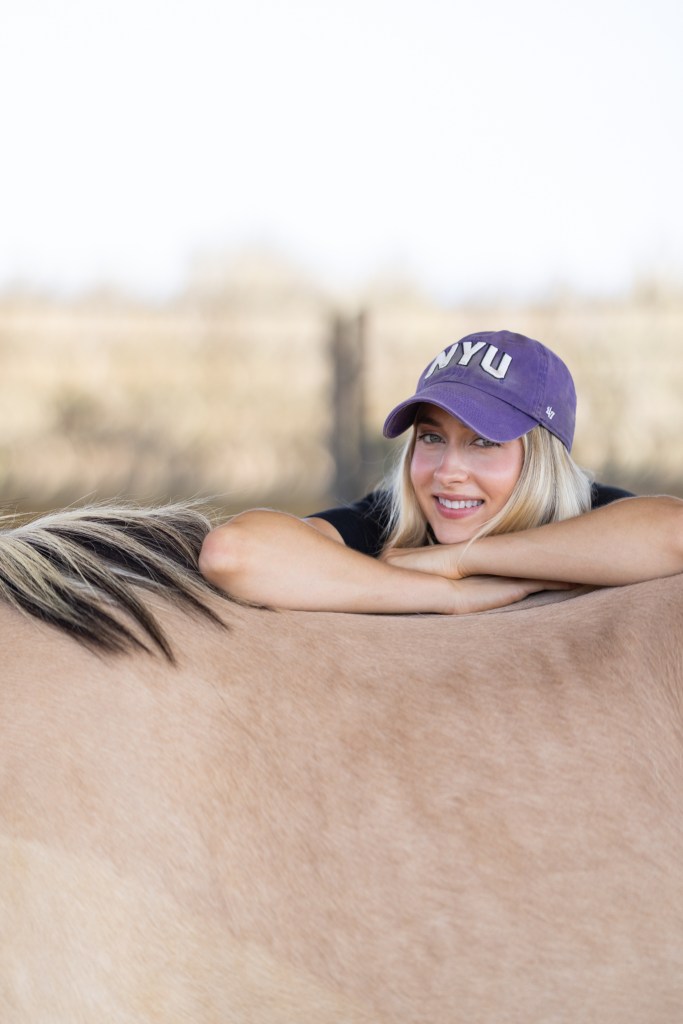
Finding Yourself
The following week, over coffee, I met with one of the women from the group who agreed to talk but asked to remain unnamed. She said she attends the women’s circle whenever she feels she needs to come back to herself.
For a long time, from the outside looking in, her life appeared to have everything in place: the husband, the house, the car, the children, and perhaps most pointedly, the money. But beneath it was childhood trauma she had not yet confronted. She turned to alcohol.
“I was extremely disconnected from myself,” she said. “I was numb. And I was also occasionally incredibly rageful, and then I’d feel guilty for being such an ugly person. Like, why am I so rageful?”
At a rehabilitation center, she, for the first time, experienced equine therapy. The horses, she said, “allowed me to stop pretending that I was, frankly, okay.” With the horses, that was no longer possible. “I couldn’t fake it around the horses.”
Frank & Susie
I knew what she meant about “not faking it” around them. While equine therapy is a new venture for me, this whole being-around-horses thing is quite familiar.
I got my first horse when I was around eight: Frank, a slightly overweight, lazy paint horse my parents bought for $1. As a young 9-year-old girl, I just wanted to be around him. Curiously, my favorite activity was washing him; there was something about lathering soap into his coat that comforted me. In retrospect, this was, inadvertently, my first encounter with equine therapy.
After about four years with Frank, he died from colic, a painful gastrointestinal disturbance that is the leading cause of death among domesticated horses.
Not long after Frank, my parents found me another horse, a Grand Champion quarter horse who came with her own ribbons. Susie, a deep chestnut mare (female horse), was feisty, unapologetically herself, and took shit from no one. We frequently found her escaping from the pasture, her head in the molasses oats. While some might find these undesirable traits in a horse, I admired her audacity. She was self-assured. She knew what she wanted, and she went for it.
In Susie, I found a best friend. Frequently, she and I would walk side by side, and I would throw my arm over her neck. My dad always joked that she deliberately lowered her head to my height so that I could reach her. I think he was right.
And then, when I was 17, Susie died unexpectedly, shattering my whole world. After that, I slowly stopped riding, and our two remaining horses, Honey and Shadow, retired to pasture. I used to visit them, but then, one day, I just stopped. Life, as life so often does, got in the way.
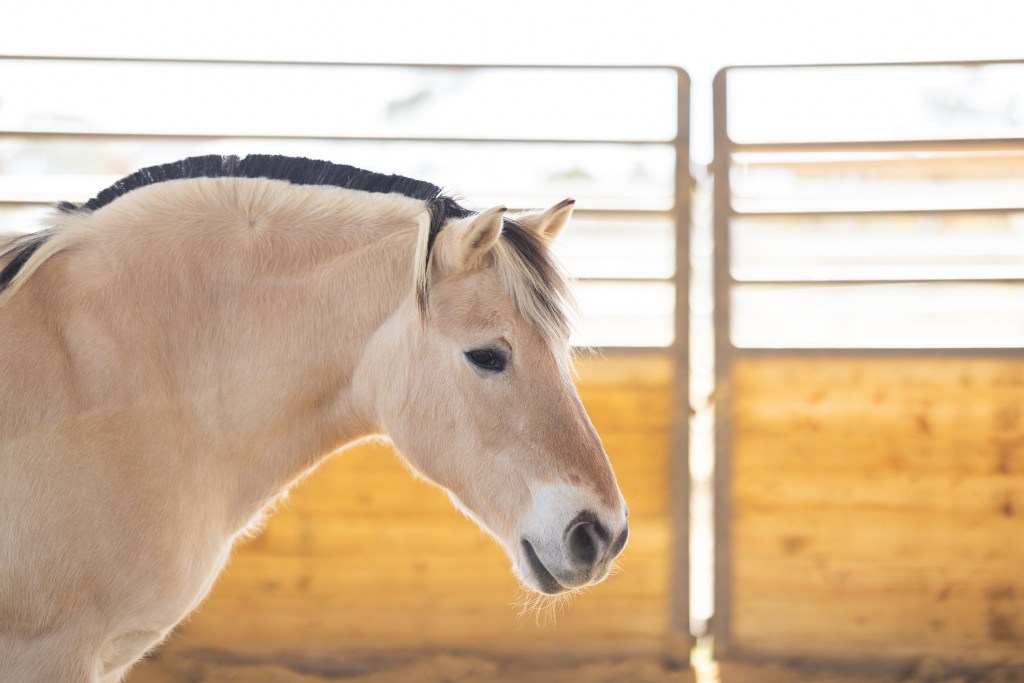
Rakel
That day with the women, I didn’t come with a specific intention, and I refrained from sharing too much about myself.
I mean, I’ve struggled with intense anxiety for most of my life. Toward the end of high school, it worsened and began manifesting as skin-picking around my nails until they bled — a condition I learned was called dermatillomania, something I have yet to shake.
So, I was open to the idea of equine-partnered coaching, not necessarily as a cure for my anxiety, but as a kind of check-in with myself, a chance to quiet the mind, if only briefly.
Thus, a few days after my session with the women, I did a solo session with Costello. I was nervous. During the group session, I could act as a kind of fly on the wall, observing and allowing the women to open up, but now it was just me.
Much like the session with the women, Costello and I started in the center of the round pen, facing one another.
“So,” she asked, “What would you like to work on today?”
I knew this question was coming, but I didn’t know how to answer it. I mean, I could give her a list of a hundred issues I wanted to work on.
“I just want to chill out,” I finally offered, hoping that might cover all the bases.
After chatting briefly, we picked a horse to bring into the round pen, settling on a Norwegian Fjord named Rakel, a breed Costello said the Vikings used to ride into battle. As I stroked her back, Costello asked me questions about my anxiety, and when I couldn’t find the answers, she directed me to look for them in Rakel.
“What do you think she would say?” I waited for Rakel to give me something, anything, but I found nothing.
I stood there with my arm around her, the way I used to with Susie, and after about 20 minutes, I started opening up to Costello, sharing parts of my life that even my closest friends didn’t know. I wanted to stop, but I was a leaky faucet; I just kept spilling it all out. In the process, I kept my arm around Rakel; she became a kind of safety net for me.
As I hugged her, I inhaled her scent — all horses have the same scent, a truly indescribable perfume which can’t really be called anything other than “horse scent.” I looked to her again for the answers to all my problems. It occurred to me then that she had none, and maybe, I thought, that was the whole point.
With my arm around Rakel, I settled my gaze on the mountains, and for a few moments, I didn’t think about everyday stresses. Instead, my mind, so often racing ahead, went quiet.
The Sacred Horse Sisters Circle is $400 for the four weeks or $125 for drop-ins. A private, 2-hour experience is $325. For more information, see healwithhorsessb.com.



You must be logged in to post a comment.