
How a Baby Finch
Got a Second Chance
Fallen Nestling’s Rescue Led to Overnight Adventure and
Hopeful Outcome at Santa Barbara Wildlife Care Network
By Tiana Molony | June 11, 2026
Read more from our 2026 Pets & Animals cover story here.
It was a warm Friday evening, the kind that promises a good weekend ahead, and I was out walking my chocolate Labrador, Maple, as I do most nights. I had my noise-canceling headphones in and was halfway through a true-crime podcast when I heard a squeak. Then another.
I searched for the source of the noise, yanking out my headphones in the process, just in time to see Maple scoop a small, defenseless animal into her mouth.
“PUT THAT DOWN!” I yelled, sprinting over to her.
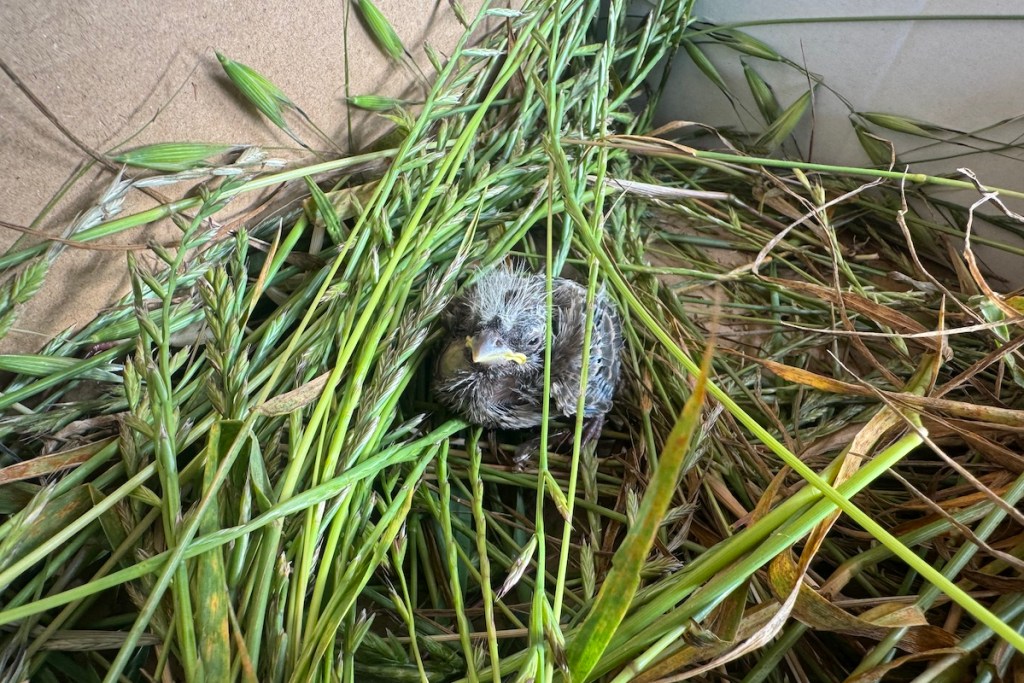
She regarded me for a moment before finally spitting out the thing — a baby bird, barely bigger than a golf ball. It was at that moment, as I watched the creature tremble in the dirt, that I knew my plans for a quiet night on the couch watching reruns of It’s Always Sunny in Philadelphia were officially dead.
It felt all too familiar, as the night before, my fiancé, Oliver, had put on Planet Earth, where an abandoned baby ostrich — knees buckling under the weight of its small frame — stumbled through the desert alone, too small, too fragile, too doomed, before finally giving up and surrendering itself to the circle of life.
I had watched through slitted eyes, bracing for a hawk to swoop down and swallow the young ostrich whole. Instead, the parents returned for their baby, and for reasons that were not entirely rational, this ostrich and my bird (yes, my bird — we haven’t formally signed the adoption papers, but I had already declared myself his mother) seemed somehow connected.
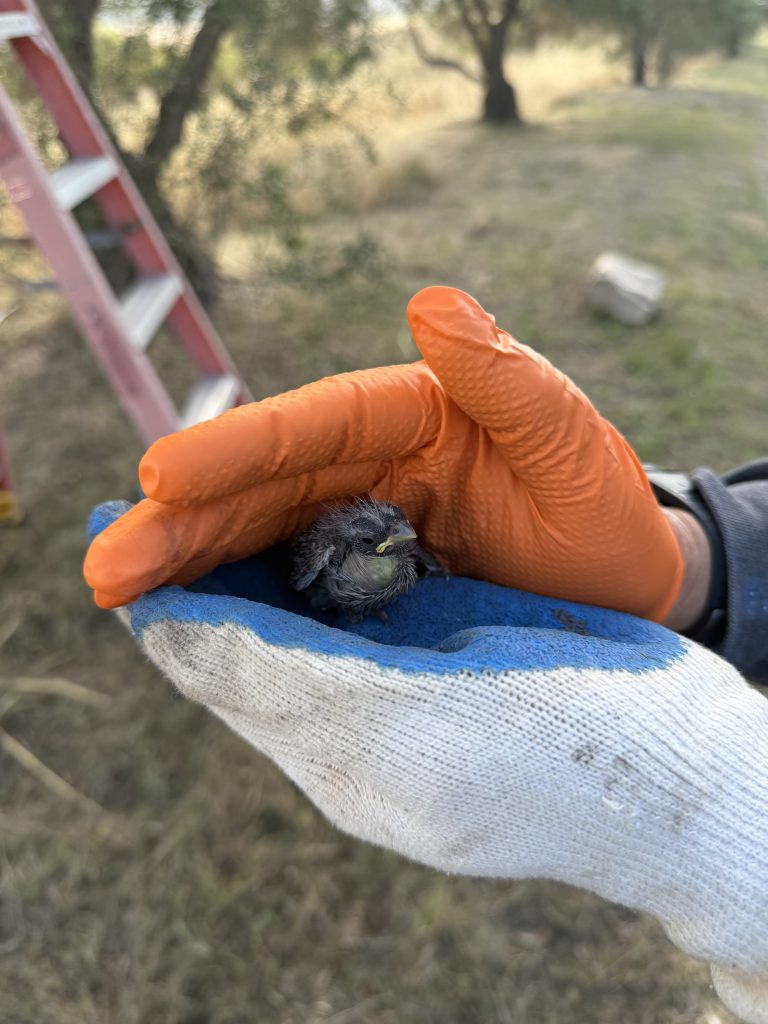
Back with my bird, I called in reinforcements, and my dad arrived with gloves and a ladder and, with the precision of removing a Jenga block, carefully placed the bird back into its empty nest, only for it to jump again.
Out of ideas, we placed it in a box with the intent of taking it to Santa Barbara Wildlife Care Network, which accepts lost or injured wildlife for rehabilitation. Unfortunately, it was already past their 4:30 p.m. drop-off time.
So, that night, illuminated by the glow of my computer, I researched everything there was to know about baby birds and discovered that my little guest was a nestling, meaning he definitely was not ready to leave the nest and would most likely die if left alone for too long. Some sources suggested that the parents might return, but there was no way of knowing for sure, so this one’s life was entirely in my hands.
The experience resurfaced a memory from eight years earlier, when I was driving along a secluded road to my sister’s house and something with wings flew in front of my car, causing me to slam on the brakes. As I suspected, it was a bird — a quail — and it was bleeding from its mouth. Despondent, I opened my trunk, reached for a brown towel to wrap it in, and laid it beneath a nearby cherimoya tree.
Now, every time I pass that spot, I think about the bird and the accident. I thought about it again that night as I said goodnight to Barry — yes, by then, the bird had a name — and hoped he’d make it through until morning.
That night, my dreams featured suspiciously frequent appearances of birds. In the morning, rubbing the sleep from my eyes, I wondered if, maybe, the whole thing had all been a dream. Unsure, I stumbled to the box in our kitchen to see if it contained a bird and discovered that it did, and that said bird was, in fact, alive.
With Barry in the passenger seat, I drove to the Wildlife Care Network, which began accepting drop-offs at 8:30 a.m. I filled out the wildlife drop-off form at the center’s vestibule and spoke into the walkie-talkie to let them know I had arrived.
“I’ve got a baby bird,” I said with the same authority of a police officer who’d just found the missing person.
The woman on the other end told me she’d “be there in a sec.”
When she arrived, I immediately began recounting the entire saga, but I could tell she wasn’t particularly interested and definitely didn’t need a detailed rundown of the previous 16 hours. Alas, I handed her Barry, and she turned to walk away.
I’m not sure why, but I had imagined there would be more ceremony to it. Some grand acknowledgment that we had survived something together over the course of a single night.
A few weeks later, having heard nothing, I decided to call for an update. As the woman on the other end searched for Barry’s records, a long pause settled over the line, and I braced myself for bad news.
“Looks like he’s currently in our songbird room,” she finally said.
I exhaled.
Barry, I learned, was a house finch. Better yet, he was healthy and spending his days with a flock of other finches. I pictured him raising hell with his roommates like a rowdy teenager at summer camp and couldn’t help but smile. It appeared that the woman sensed my relief.
“I’m happy I could give you some good news.”
Santa Barbara Wildlife Care Network is open every day from 8:30 a.m. to 4:30 p.m. For more information, see sbwcn.org.


You must be logged in to post a comment.