
Volunteer at the S’o’ Hil Xus Restoration Site
**Events may have been canceled or postponed. Please contact the venue to confirm the event.
Date & Time
Sat, Jun 13 9:30 AM - 11:30 AM
Address (map)
6969 Whittier Drive, Goleta, CA
Venue (website)
Goleta
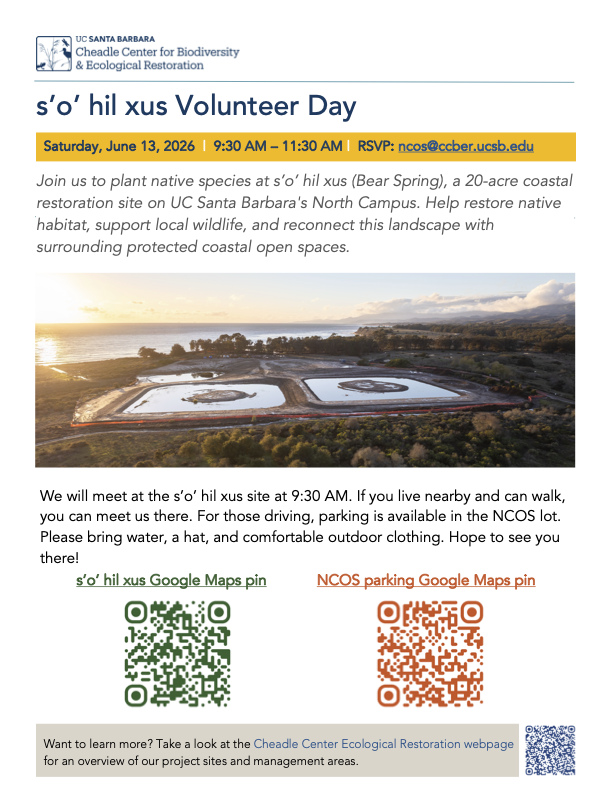
Come help the Cheadle Center restore s’o’ hil xus by planting native species and removing invasive plants.
Please arrive at the meet-up location by 9:30 a.m. The walk from the parking lot to the meet-up location takes approximately 30 minutes. Google Maps locations for both are provided below.
Please bring water and sunscreen, and wear a hat, along with clothes and closed-toe shoes suitable for outdoor work.
No tickets required! If you plan on attending, please RSVP to ncos@ccber.ucsb.edu.
We’re excited to be leading the restoration of s’o’ hil xus for public use. The name s’o’ hil xus (s-oh heel hoos) translates to “water of the bear,” or “Bear Spring,” and references the unique wetland feature located on the site. As part of the public outreach process, members of several coastal Chumash bands reviewed historic records and identified local place names, ultimately proposing a name that reflects the site’s cultural, ecological, and historical significance. The name honors the Chumash connection to the coast and reflects the importance placed on respecting and prioritizing the natural world within Chumash culture.
Formerly known as the Ellwood Marine Terminal, s’o’ hil xus is a 20-acre coastal restoration site located on UC Santa Barbara’s North Campus between the North Campus Open Space restoration site, Coal Oil Point Reserve, and Ellwood Mesa. Originally developed in the 1920s for oil storage and transport, the site contained storage tanks, pipelines, roads, and other industrial infrastructure associated with offshore oil production.
After UCSB purchased the property in 1994, plans were developed to decommission the facility and restore the site to open space and native habitat. In 2024, large-scale restoration work began with the removal of eucalyptus screening trees, oil tanks, pipelines, and associated infrastructure. Although most known contaminated soils have been removed, soil and water remediation is ongoing, with cleanup assessment and additional work expected to continue over the next 2–5 years.

