
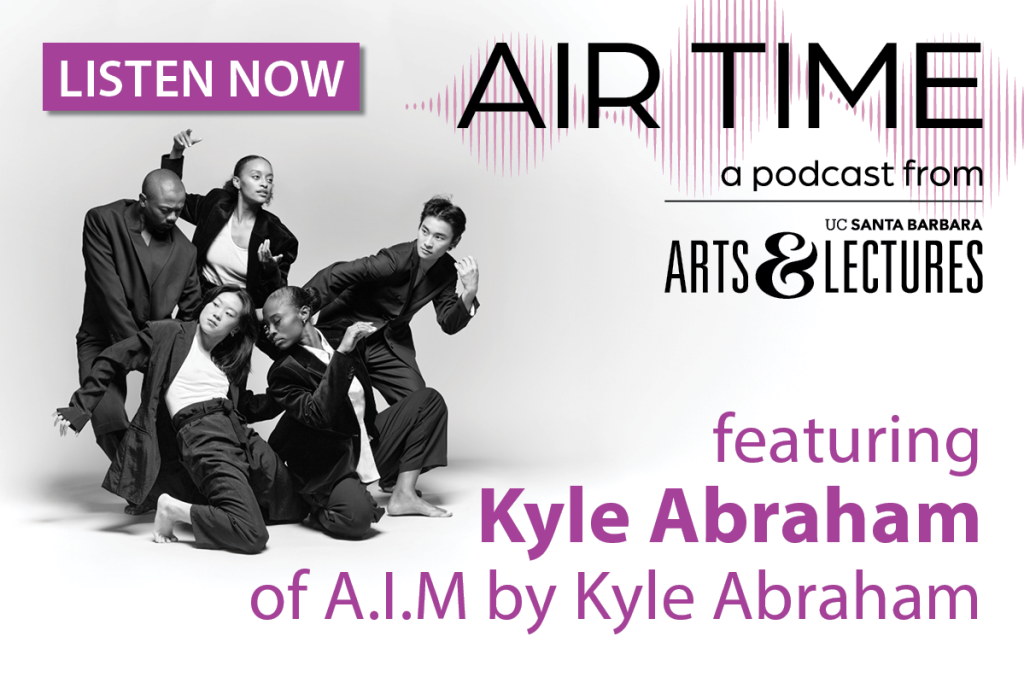
In a wide-ranging conversation on Air Time, choreographer Kyle Abraham reflects on 20 years of building A.I.M by Kyle Abraham into one of the most vital companies in contemporary dance. Speaking with UCSB Arts & Lectures’ Charles Donelan, Abraham discusses the collaborative spirit of his work, the role of live music in performance, and the sense of artistic freedom that is shaping his current creative moment. A.I.M by Kyle Abraham performs for UCSB Arts & Lectures on Tuesday, May 12 at 7:30 p.m. at The Granada Theatre. For tickets and information visit artsandlectures.ucsb.edu or call (805) 893-3535.
Charles Donelan
Welcome everyone to Air Time, the podcast of UCSB Arts & Lectures. Today, our guest is choreographer Kyle Abraham. A.I.M by Kyle Abraham will be at the Granada Theater on Tuesday, May 12, at 7:30. Thank you so much, Kyle, welcome to the show. First of all, let me congratulate you, because this is the 20th anniversary of A.I.M, and I hope people understand how much of an achievement it is to have maintained a dance company for two decades, and especially the two decades that we just went through.
Kyle Abraham
Yes indeed, I do so with, you know, a wonderful team at my side. I’ve had amazing executive directors that I’ve worked with, and rehearsal directors and dancers and collaborators of all sorts, and a wonderful technical team that really support me and have supported me over these 20 years.
Charles Donelan
It’s so important for dance as a field that there are places where dancers can grow and earn a living and find a home that have the kind of positive, intellectual, emotional quality that you’ve put into this company. It’s really impressive. We’ve got an amazing program coming. And I think it’s pretty various. You know, this relatively recent piece, 2×4, then The Gettin’ which I think is the oldest piece, although it’s been refreshed, right? And then in between, If We Were a Love Song, which is kind of this ongoing thing you have with Nina Simone. So why don’t you please walk us through what kind of an arc you are hoping that the audience will get? What comes first, what comes next, and then where does it go?
Kyle Abraham
Sure, I’d like to think it’s a fun journey for our audiences. People can be introduced to the company for the first time and join us on this experience, and people who’ve seen the company in various times, perhaps at UCSB, will be informed of new pathways that our work is taking. I think the program does take us on a nice range, starting at the beginning with 2×4. It has a visual art component by Devin B. Johnson, who designed a scenic design and Shelley Washington, who composed the score for two baritone saxophones that we’re going to have live instrumentation. It’s really fun work. It’s interesting for me, granted. Of course, my job should be fun, but that process in particular was just so much fun. The dancers and I just had such a great time creating it. And I think that comes through in the work. There’s a lot that came up for me as I was making the work.
I guess a small aside that’s a bit of irony, is when I called the piece 2×4 from the get go, it was a work for two dancers and two saxophonists, so “by four.” But then we had this thing happen in November, and it made me think about support all the more. It really felt like we all needed a lot of support. I was walking through the streets of New York after the election, and I was just like, you know, it’s not about any kind of side, but it’s about people needing to just see love and see support. And so I started thinking this: I need more dancers. So we made it four dancers, but we still had two musicians, so the title still worked as 2×4. It’s a really fun work that I am really excited to share.
And the next work on the program is If It Were a Love Song, which, you know, I hate saying, was made during the pandemic, but it was made during the pandemic; not in any way as in response to those times, but it started because I had made a solo to Nina Simone, “Ne me quitte pas,” in I think 2012, I believe it was, ironically. And I just thought about her music, and I was thinking about the ways in which I create work a lot of the times for the company, and a lot of that has to do with me videotaping myself and then sending the videos to the dancers, and then us working together on different ways to make it that much more realized.
And I thought during the pandemic I can still do that. I can send videos to a dancer in their living room or wherever, whatever space they may inhabit, and work with them one on one to make a work. And so we made a lot of it that way. The duet that you’ll see in that work was made the very first time we were in a space where we could touch. We were in what you’d call a bubble residency, where we all tested and secluded for however long, and then were able to kind of go to, I think we did Jacob’s Pillow at that time, and built this singular duet that you’ll see in that work, and the group section, which then came later at another residency, that was to follow thereafter.
But yeah, it’s all set to Nina Simone songs that were meant to be kind of thinking about love in some way. And I wanted to think about ideas of vulnerability and ownership of one’s body and self, and the ways in which we can share an exchange of love. And then, after an intermission, we… Oh, sorry, I should say that If We Were a Love Song is also performed live. We have vocalist Crystal Monee Hall performing live with us, along with Otis Brown and a slew of really, really amazing and established musicians rounding out the band for that one.
And then we get into The Gettin’, which is from 2014 with scenic design from noted visual artist Glenn Ligon. And it was part of a residency that I had at New York Live Arts for two years where I was their artist in residence, and I made too many dances, but The Gettin’ was always seen as the most successful of all the works in that period. It is a reimagining of Max Roach’s. “We Insist, Freedom Now! Suite,” recomposed or re-envisioned in some ways by Grammy Award-winning composer Robert Glasper. Yes, and we will be performing that live as well. So it’s really wonderful to have an opportunity to revisit that work and to hear people’s responses to it in a way that in some ways, good or bad, there’s still resonance that people can find in the work.
Charles Donelan
Yes, it’s such a great, powerful piece that “Freedom Now! Suite” with Max Roach. And I think she was his wife at the time, Abbey Lincoln.
Kyle Abraham
Abbey Lincoln and her amazing voice, yeah. We’ll have Charenee Wade singing the vocals for The Gettin’.
Charles Donelan
That the live music component is something that aligns so well with the values of our organization. You know, that’s one of the things that that we feel it just it has to be there.
Kyle Abraham
Yeah, it’s a real gift to make that happen.
Charles Donelan
I want to pick up on something. The last time A.I.M was here with An Untitled Love, the amazing evening-length D’Angelo composition, it was the first in-person dance performance following the quarantine for our organization. And that was a big night, emotional, you know, after all that time, to finally be back together in the theater.
But I’m going to take it a little bit different direction, because that was at Campbell Hall, which is our home on campus. But this time, you’re going to be in the Granada Theater, which is a bigger room. And maybe this is a good point of departure for you to talk about about scale, because I know you did a piece in the incredible Park Avenue Armory, one of the most extraordinary buildings in New York City, which is saying kind of a lot.
How do you keep that intimacy when you move to a bigger room, when you move to a bigger space? Because that’s something I wish I had seen, Dear Lord, that just sounds incredible. I read all the reviews, and that was one of the things that people consistently said, Is that you were able to keep that directness, the intensity of connection with the audience, even in a 50,000 square foot space,
Kyle Abraham
Massive, just massive.
Thank you for that. In the case of coming to Santa Barbara, you know over the years we have worked with Celesta, and she and I have connected around what the right space is for whatever we’re sharing. And in the case of An Untitled Love, it needed that intimacy. And it’s great that an audience was open to showing up in that close proximity to share that work with us, or experience that work with us. But with this program in particular, I think there’s so much expansiveness in the way that we’re looking at live music, and the way that these three works in particular can play into a house. But I do think that, to your question, there’s ideas of focus and care that hopefully help the work stay intimate while still being able to reach that many more people.
Charles Donelan
In terms of your own journey as a choreographer, as an artist, maybe you could reflect on how things have changed since the pandemic, and in particular, with Dear Lord, Make Me Beautiful. That title still just says something to me. There’s so many ways to take it, too. I feel like I can hear it in multiple voices with the emphasis in different places. But go ahead, tell me… from again, what I read, it involved some personal memories. Love a subject that you return to, but also aging and grief. And when you choreograph something that involves personal memories, how do you take it? Where do you choose to make things explicit or to leave them open? Does this question make any sense to you?
Kyle Abraham
Yes, it makes a lot of sense. You know, depending on the way in which someone goes about directing one’s eye or intentionality. Right? It can, at times, be so heavy handed that it doesn’t become universal. And the reverse can happen, where you make something so obtuse that no one is able to feel that connection to the work. But what I try to think about, I’ll give another example, and hopefully find our way back to Beautiful.
When I was making my second work for Alvin Ailey American Dance Theater, a work called Untitled America, which was about the cyclical nature of families that have gone in and out of the prison system, I knew a lot of the audience members wouldn’t have experienced that, but everyone, in some regard, has experienced some form of either loss or isolation, right? So for me, it was like, how can I find these ways to connect people to those themes, to address this larger experience? And so talking about, you know, interviewing people who had been incarcerated about their experience while my mother was also in the hospital, dying and not wanting to die in the hospital. It made these connections for people in that kind of way, about like this experience of isolation and longing in a way that hopefully came across on stage. I think it did for a lot of people, where, for Dear Lord, Make Me Beautiful in your question, and also thinking about, I never want to say post-pandemic, because we are forever dealing with it.
But I think there’s lots of things that were coming up for me personally, and I’m sure for others, the ways in which we were experiencing levels of empathy, I think, had a certain newness to it, and the way that I was trying to consider changes in our environment, and the changes in my body as it was aging and becoming that much more delicate, shall we say, became that much more of a kind of simmering experience. For me, it was something that was always kind of vibrating, and I allowed myself to make a work that was very much about the present.
Most of the works that I make, or have made over the years, in some ways, are addressing maybe something I experienced 20 years prior, or reflecting on something, or thinking about the future, perhaps, but this was something for me to really connect with, how I was feeling at that time, all of my fears, my insecurities, yeah, all of the essences of those things: my experience with loneliness as it pertains to aging, and the fears of aging alone, the acknowledging of my body as I’m still trying to be a dancing body, and the things that I’m not able to do, that I was able to do, and the newness, right? Because, you know, like most things, there’s some things that become refined over time. So finding those things and and trying to make the space for freedom within those new things that I’m able to access as well has been part of the journey in the 2020s to today.
Charles Donelan
Thank you so much. You know, in my role in this organization, as somebody whose main task is always to communicate to as broad an audience as possible why they need to see dance, you are such a gift because your work speaks, but then you speak well about the work, and that is so helpful to me. I like the vocabulary. It’s fun to hear about you “simmering” and also, and more to the point, maybe, is that the issues that you were just describing, the delicacy, the vulnerability that we all experience because we’re aging, all of us all the time, that is something that I know resonates, and that you don’t need any technical knowledge of dance to feel and appreciate and experience that, especially when it’s communicated powerfully.
Let’s talk a little bit about working with dancers, because you do it so well, with so many great people coming out of the company, that some of your dancers are now doing choreography themselves. Maybe you can talk a little bit about one of these pieces, in terms of how you structure the process. Think about 2×4, because there’s a lot of decisions in there. It looks like for the dancers from just the clip that I’ve seen, they have to make choices, yeah? Tell me about that.
Kyle Abraham
I was trying to explain to a friend just last night about what it is I do in making a dance. I was like, it’s “option D.” [meaning “all of the above”- ed.] Oh, and 2×4 is a good example of that, where if I was talking about If We Were a Love Song, I would record myself dancing. And so I did a little bit of that in the process. But I think at the very beginning, I started with some phrase work. So I was making some movement vocabulary that maybe lasted for, let’s say, a minute with the dancers in real time. And I would try and see, you know when originally it was a duet, everyone would learn this singular phrase that was maybe a minute sequence of movement, and from there, I would try and just continue to expand, just building in real time with the dancers. And it’s that thing like, you know, we’ve all done it when we’re kids, where maybe you say to your friend, “Okay, stand behind me. We’re going to make a dance,” right? That’s literally part of the process. You know, I’m like “you all remember it, but I’m just gonna move and let’s just see what you catch.” That’s part of it.
Then I started also thinking about these ideas of sculpture and support. Rather, I wanted to think about sculpture. How can we think about sharing weight? What does it look like for one body to manipulate another? So what happens in a way that connects to if your audience is familiar with the work of Trisha Brown, I think about the way that so much of the movement in her body is sequential. So she’s really, in some ways, moving from the bones, and the bones are moving one thing to the next, and when it’s more than one dancer, it’s the weight of one dancer onto another that, like science and physics, is affecting what then happens. So I made the space for some of that experimentation. And then there’s also a bit of tasks where I’ll say to a dancer like William Okajima, who you’ll see do some solo work in 2×4. I’ll say, okay, William, I want you to do a pass that is really fast, that goes in and on the floor like this, and maybe I’ll give an example, and then see what he comes up with. And then together, we’ll find the way. So there’s bits of that that comes into play as well.
Charles Donelan
That’s a great answer, because you anticipated my follow up, which is that the signature style of the company is collaborative. It’s clearly something that you bring, but it’s also something that you draw out from the people that work for you.
Kyle Abraham
Yeah, and, you know, I think the thing that is not spoken about is that often even if I’ve made 100% of the steps, which I have at times, it’s still collaborative. I’m not the one on stage dancing the majority of the time, so it’s that exchange that really needs to get its respect in a lot of ways. And every aspect of that is collaborative. I always want to know from the dancers. How does this feel? What do you think about this transition, even if I’m the one that’s going to make the choreographic choice of what the transition is, I’m not doing it. How does that feel for you? Does it make sense?
Charles Donelan
Does it feel clunky? One thing I notice when I watch your work that I feel is really impressive to the point of magical is I see elements from all different dance traditions, but it doesn’t feel collaged. They don’t feel, like you were saying, sequential. Do you know what I mean? How do you blend so effectively that those layers don’t pull apart; that they come together,
Kyle Abraham
I started studying dance in a classroom when I was 17 years old. And prior to that, I was this big rave kid, and I went to a lot of house parties and hip hop parties, and I was just dancing, which is another thing that isn’t spoken about that often, right? Like, people don’t think about social dance, like hip hop and all the things you’re doing, Lindy Hop and the like, as really the origins of improvisation. I’m in no way thinking about doing eight counts of whatever move, and I’m gonna do the robot for four steps. Then I’m just dancing, you know?
And so I think when I started studying ballet and modern dance and tap dance and all these different forms, it was just movement. And I was just hungry to learn all of this movement and jazz, I should definitely say for sure. So for me, when I’m creating work. Generally speaking, I’m moving with the knowledge and the training of Martha Graham’s technique, Merce Cunningham’s technique, José Limón, the list goes on and on. Lester Horton, all these things come into play. You know, all the ballet folks of George Balanchine, I know you just had the amazing and outstanding Tiler Peck there with you. But yeah, I’m just moving, and it’s only when I have to then break down what it is to dancers that may not have that vocabulary where we really want to isolate and talk about, okay, yeah, this curve is coming from Merce Cunningham. This way that we’re experiencing this movement is maybe from West African dance, or maybe this is from Katherine Dunham, and what she brought to the dance field. So all of that comes up a lot of times when we’re then breaking the steps down.
Charles Donelan
Basically, it’s such a great thing for our dance students to see your company, I think because they get the feeling, the confidence, right? That kind of thing is possible, that it can remain articulated, but at the same time coherent. You know, one.
Kyle Abraham
You know, it’s really just for your audience that nobody hasn’t studied any of those things, but listens to music. There’s validity in all forms of it, right? It’s one thing to have a favorite genre of music, but if you have a respect and love for music in general, it makes your ear that much more attuned, and it makes those pop songs that you may like all the more rich and nuanced, because you’re like, oh, I picked up on that rhythm that was from, you know, that’s an Indian rhythm, or whatever. That’s a polyrhythm. And all that becomes that much more exciting. And that’s how it is for me with dance and loving dance in all these different forms, right?
Charles Donelan
And receiving the messages of the different phrases and rhythms, both for where they came from and for where they’re going, right, where they are with what’s happening and with where it’s moving towards. We’re getting pretty close to the end, and I could talk to you all day.
Looking at where you are now, is the work becoming more kind of distilled and interior? Do you see that as a direction you’re continuing in? I’m thinking of what I know about Dear Lord in particular, but do you maybe anticipate another shift?
Kyle Abraham
Oh, that’s a rich question. I love that. So something that’s come up for me over the years, ironically during the pandemic, because I was doing so many talks over the pandemic, yes, is about my musical influences, right? People like Prince or, you know, Terrence Trent Darby. He’s now changed his name, but we, I think most people know him as Terrence Trent Darby. I think about this, the way that they would release music, right there would be a song on pop radio and a very different single on R&B radio, and you never really knew what direction the next album was going to be, but there was always still a bit of the essence of their artistry in whatever they made. And that’s something that’s always excited me. I try to think about how whatever it is I’m making is different from the thing that I just made, and how I can keep shifting and playing with these known entities.
The next work that we are making premieres in Lugano, Switzerland this summer. It’s a work called White Space with music from Jason Moran and Nico Muhly composing together for the first time. And then the work that comes after that is all set to Kendrick Lamar. It’s fun for me, and I think it’s a breath of fresh air for the dancers to be able to play in these different worlds. It’s like the umami for your food people, you know, you need these different tastes to kind of explode and be kind of like experienced over the course of time, you know, let them flame. Or let the year and the palate shift over time. So that’s part of the experience. For me, yeah, I love, I love changing the worlds however we can.
Charles Donelan
Well, I’ll say for me, your musical taste, which we have not spent enough time on in this conversation, is impeccable. And I always am so blown away by how much the music that you choose already means to me before I’ve even seen the piece, I’m like, Oh my God, you picked that. You know, always such, such great material, and that sounds like amazing things to look forward to.
I’m gonna do one follow up below. Honestly, you killed that question, but here’s the follow up on it. When you’re in the studio now, what questions are you asking that maybe you weren’t asking five or 10 years ago? Is there a way that you’re looking for new answers that is evolving?
Kyle Abraham
There’s lots of things that come up, and it almost makes me emotional, for two reasons. The first thing that came to mind is, am I staying true to my beliefs, my hypothesis? Because that is the origin of how work begins with this idea or question, right? And then for me, I do a lot of writing, and I try to come back to whatever I wrote to see if what I’m working on at that moment is still true to what inspired it. But the thing that was making me get a little emotional as I was thinking about that, is I feel so free right now, not because this world wants me to be, but because I am taking the onus and the power and the love that my parents gave me and encouragement that they gave me to be my truest self, and so the works that I’m curious about, I’m allowing myself to actually tap back into my 17 year old dance self, where there was no criticism that I was considering. I just was dancing because I loved it, and I’m back in that space again, and it feels so free, and I have total goosebumps. I feel so free.
I don’t know how long it’s gonna stay, but I feel so free, and I feel so extremely blessed right now. I feel so blessed to be able to make dance and to watch dance. After we finish this interview, I’m gonna go watch class at San Francisco Ballet. Like people can’t do that. And it’s not like I’m making a work or anything, but what a gift. I’m just so grateful. I’m so filled with so much gratitude. Yeah, I just, yeah, I’m overwhelmed in this very moment with where my life has taken me. My parents are no longer with me, you know, in terms of the physical, but what they’ve given me in my life is what makes me feel so free today, and that’s the space that I’m in. So I totally tangented from the question, but that’s where I’m at when I’m not only in the studio, but as I’m walking through life right now, I feel so free, and I know that that way of thinking is not only a privilege. It does not in any way, it’s not meant to, in any way pass over the terrible injustices that so many people are experiencing and that I’m even witnessing and that I experience. But even within that, I find ways to experience freedom.
Charles Donelan
What an incredible answer you have communicated to me the kind of excitement that I expect everybody’s going to feel when they see this amazing performance on Tuesday, May 12, at the Granada Theater in Santa Barbara for UCSB Arts & Lectures. It’s A.I.M by Kyle Abraham, so exciting and inspiring to speak with you, Kyle, have a beautiful, free day. Continue to do you, and we look forward to seeing you when you’re in Santa Barbara
Kyle Abraham
Thank you. Yeah. I’m really looking forward to it. Take care.





You must be logged in to post a comment.