Where was Burton Mound?
West Beach's Predecessor

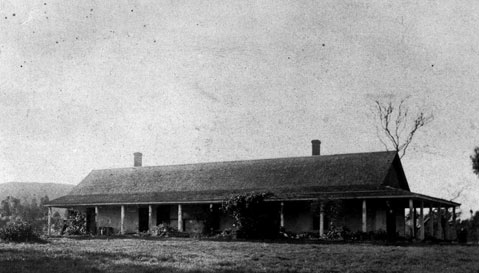
Burton Mound was located slightly inland from today’s West Beach. Much of the area was swampy, with mineral springs and affected by high tides. It was dominated by a slight rise, some 30 feet in height, which came to be known as Burton Mound. At the time of the founding of the presidio, in 1782, it was the site of one of the largest Chumash villages on the South Coast.
In August 1769, a member of the Gaspar de Portol¡ expedition gave a brief description of this village, Syuxtun, as the party moved up the coast. “This was the most populous of all the towns that we, so far, had seen; we estimated that it might contain more than 600 souls. : In no other place had we met natives so affectionate and good natured.”
By 1800, the settlement’s population was down to around 120, and by the early 1830s, Syuxtun had basically disappeared. Virtually all the area Chumash were either living at Santa Barbara Mission as neophytes or had succumbed to diseases introduced by the Spanish against which the natives had no defense. During this period what was to be known as Burton Mound was crowned by a building to store cattle hides.
In 1833, Joseph Chapman bought the property. Chapman had arrived in California as a crew member under Hip³lito Bouchard, a privateer who raided the South Coast in 1818. Chapman fell into the hands of the Spanish authorities and was imprisoned. He was paroled into the custody of the padres at Mission Santa Ines, and there he supervised the construction of a mill for the production of woolen cloth. Chapman later married into the Ortega family and also did construction work for Mission San Gabriel. Most probably, Chapman built the adobe that became such a familiar landmark to 19th-century Santa Barbarans. Chapman built the adobe on a bed of sheet lead to prevent seepage from the surrounding springs doing damage to the building.
The man who lent his name to the area, Lewis T. Burton, bought the site in 1860. Burton had come overland to California in 1831 and arrived in the Santa Barbara area shortly thereafter to trap otter. By this time, however, the small sea mammal had virtually vanished from the Santa Barbara Channel due to over-hunting. So Burton turned to ranching and the mercantile trade. In 1839 he married into the prestigious Carrillo family. He used the adobe as a combination general store, post office, and residence and surrounded it with orchards of pear, peach, fig, and olive. When Santa Barbara was incorporated as an American town in 1850, Burton was selected the first president of the Common Council. In 1865, he became one of the shareholders in the company that built the short-lived Chapala Street Wharf. Burton died in 1879.
The next major development in the area was the opening of the Potter Hotel in January 1903. Burton Mound was partially graded to make way for the luxury hostelry. The hotel boasted almost 600 rooms and, for a time, was the largest single employer in the city. The Potter enjoyed a national reputation for opulence and was a lynchpin of the area’s tourist industry.
The hotel burned to the ground in April 1921 and was never rebuilt. With the destruction of the hotel arose the opportunity to undertake an archaeological dig to uncover the remains of the long-lost Syuxtun. Chosen to head the project, sponsored by the Smithsonian Institution and New York’s Museum of the American Indian, was John P. Harrington. Harrington had grown up in Santa Barbara and was a leading authority on the Chumash. Work began in the spring of 1923, and by late summer more than 2,500 artifacts had been unearthed. It was a site of amazing anthropological richness. The finds were shipped to New York, where they remain today.
In the years following the dig, what was left of Burton Mound was graded down, the area was subdivided, and today there stands a mixed neighborhood of residential and commercial buildings. Even though Burton Mound has basically disappeared, in 1966 a plaque was placed signifying that the area is California Registered Historical Landmark No. 306, recognizing it as the former site of a Chumash settlement.