
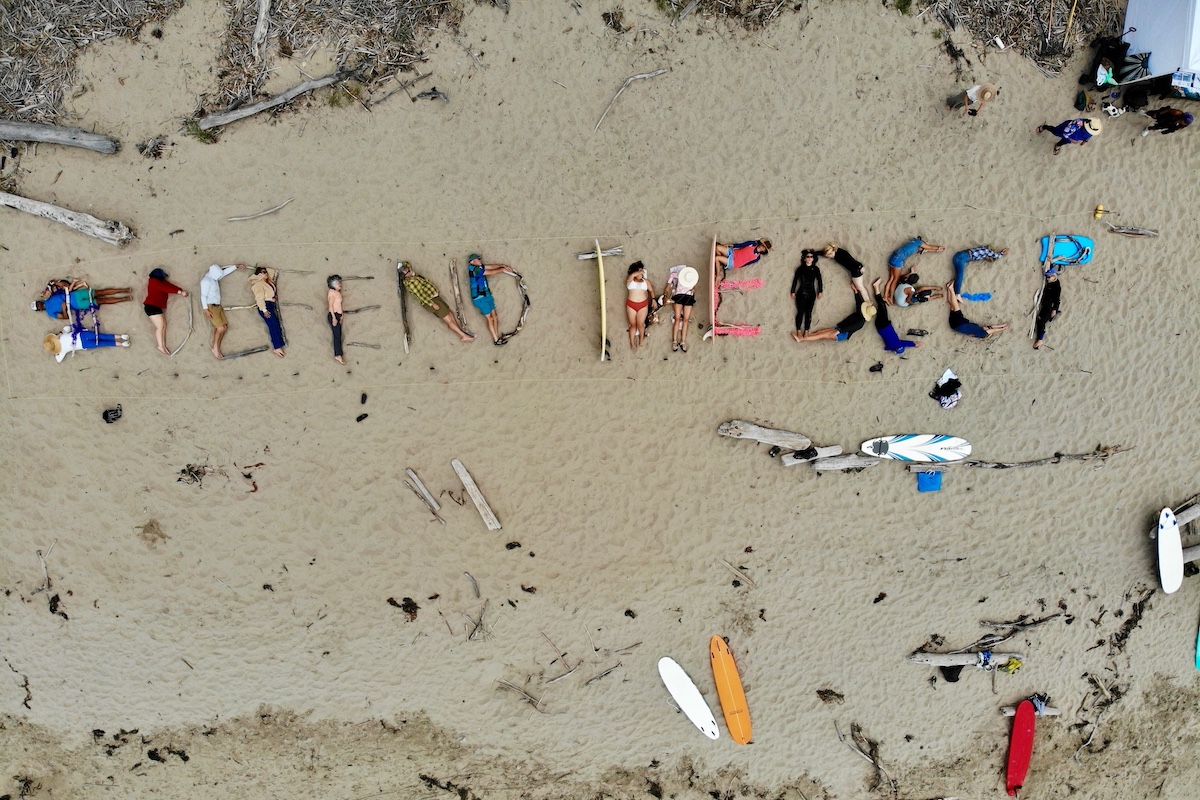
Peggy Oki — a renowned Carpinteria artist, surfer, skateboarder, and environmental activist — led a protest on Sunday at Rincon Beach to raise awareness about the consequences of deep-sea mining. The event, organized by environmental group Defend the Deep, took place in 25 cities around the globe in an effort to stop deep-sea mining, said Oki. Her group formed the words DEFEND THE DEEP with their bodies, boards, and driftwood.
This urgent activism grew out of increasing concerns about the extraction of manganese nodules from very deep waters. These potato-sized seabed rock formations, which take millions of years to develop, are concentrated with valuable metals such as cobalt, nickel, copper, and rare earth elements that are crucial for modern technologies such as electric car batteries, wind turbines, and solar panels. The activists believe that not only are deep-sea animals put at risk by the mining, but more crucial is the remarkable oxygen production and sequestration at these depths, newly discovered by scientists.
In 2013, Dr. Andrew Sweetman, a professor at the Scottish Association for Marine Science, had noticed increased oxygen levels in the darkest depths of the ocean. It wasn’t until 2024, through extensive testing, that scientists discovered this “Dark Oxygen” was coming from the polymetallic nodules scattered across the seafloor. In the ocean’s sunless depths, these nodules produce oxygen by electrohydrolysis, splitting seawater into hydrogen and oxygen molecules.
This remarkable discovery highlights the importance manganese nodules pose for the planet’s oxygen cycle. The vital role of sea floors in carbon sequestration, a natural process crucial for mitigating climate change, has only recently come to light. Disturbing these areas risks could affect the ocean’s role in regulating our climate, activists say.
Another outcome of Dr. Sweetman’s discovery was the understanding that oxygen production without photosynthesis could revolutionize the search for extraterrestrial life. This breakthrough could enable the detection of oxygen on ice-rich celestial bodies — like Europa, a moon that revolves around Jupiter; or Enceladus, one of Saturn’s hundreds of moons — expanding the scope of habitability beyond Earth and offering a method to identify life-sustaining environments where conventional signs of life are absent, researchers theorize.
Despite these ecological insights, President Trump signed an executive order in April with the intention to open U.S. waters for seabed mining. This decision poses a direct and imminent threat, the group EarthJustice stated, with the potential to devastate American Samoa’s U.S. territorial waters.
Seabed mining operates with a destructive force comparable to “bulldozing underwater rainforests,” as described by Sir David Attenborough. The mining threatens to disturb and harm sensitive marine life, from microscopic plankton to sperm whales and giant squids. The impacts include direct physical damage from machinery, smothered habitat by sediment plumes, and the disruption of largely unexplored deep-sea ecosystems.
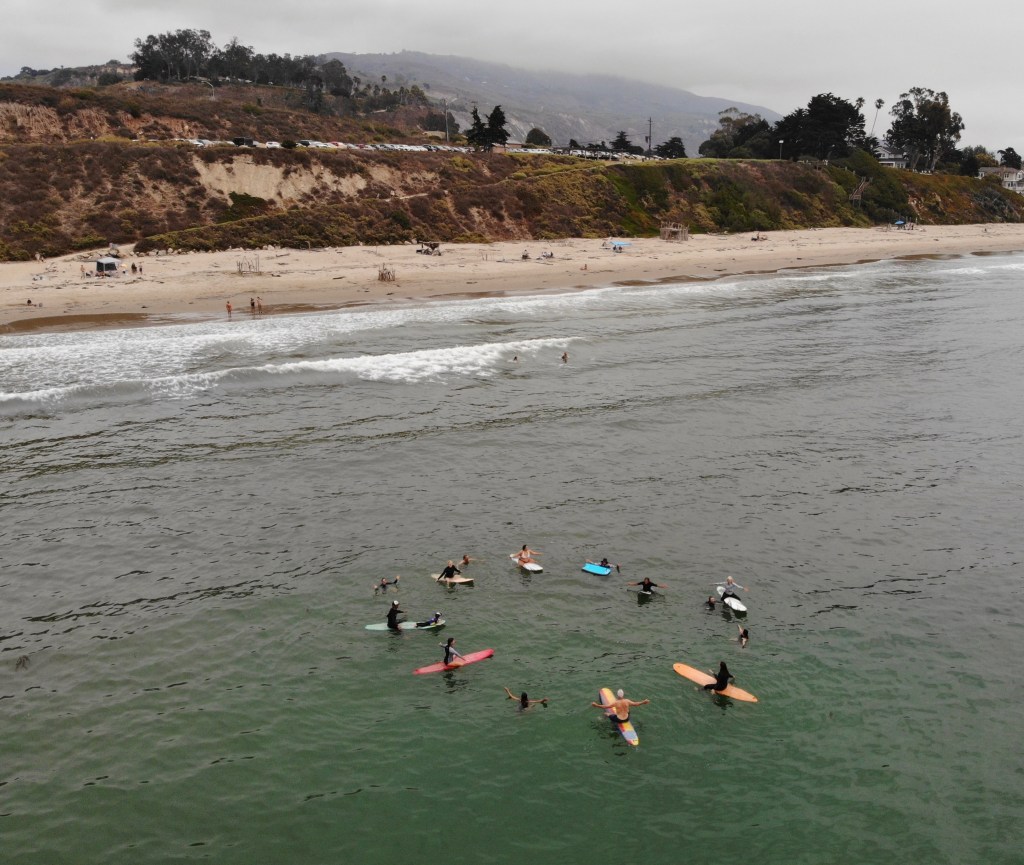
In response to President Trump’s executive order, Oki, along with volunteers and fellow activists, paddled out into the ocean together in an act of solidarity, demonstrating their commitment to protecting deep-sea ecosystems.








You must be logged in to post a comment.