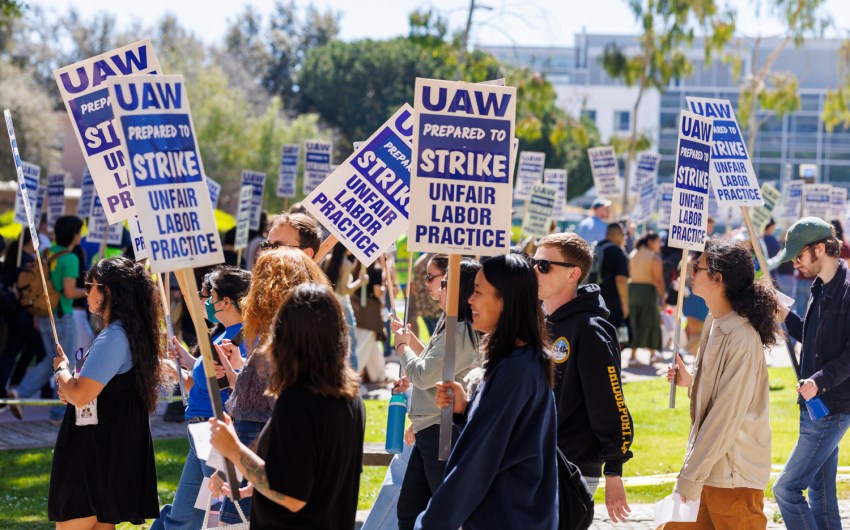
After a four-and-a-half-hour meeting at Goleta City Hall Monday night — and following a long public comment session packed with people testifying to the impacts of federal immigration enforcement on the local community — the Goleta City Council unanimously agreed to set aside $100,000 toward immigrant support services and legal assistance for families separated by deportations.
Goleta Councilmember Luz Reyes-Martín, herself an immigrant whose grandfather arrived in the country through the Bracero Farmworker Program, fought back tears as she described the recent operations seen in Santa Barbara County, from the videos of workers chased down and tackled to the stories of children crying after being left without their parents.
“It’s been a really heavy and kind of emotional couple of months,” Reyes-Martín said.
Goleta’s city council was just the latest regional legislative body to respond with an emergency meeting to address federal immigration activities and aggressive ICE enforcement in the Latino neighborhoods of Santa Barbara County. Reyes-Martín said the community felt “outrage” and “real fear” due to ICE enforcement, leaving Latino and undocumented residents afraid to go to work, make doctor appointments, take their children to school activities, or even call 9-1-1 to report a crime.
“That makes us all less safe,” she said. “That makes us less healthy and less connected as a community.”
The Carpinteria City Council had already called an emergency meeting to address ICE enforcement before the Glass House Farms cannabis facility on Casitas Pass Road became the scene of a highly militarized immigration raid on July 10. That same evening, hundreds showed up to City Hall to demand the city’s leadership — some of whom had literally stood toe-to-toe with federal agents at that raid — to officially stand with immigrants against the aggressive ICE enforcement.
That night, the City of Carpinteria set aside $10,000 toward immigrant support services, which will be awarded to nonprofits in August. That amount was considered small by some nonprofit representatives — such as La Casa de la Raza, which spends a couple thousand weekly to support its food pantry — but the $10,000 figure was twice the amount the city was originally planning to set aside on such short notice.
Last Tuesday, July 15, a couple hundred more community members and immigrant rights advocates showed up to the Santa Barbara County Board of Supervisors hearing to call for more support from the county government. The county supervisors worked through a seven-hour-long meeting to approve several new provisions to support immigrants.
“While we cannot control the federal government’s cruel and unjust tactics, we can control how we respond and show up for our community,” Supervisor Laura Capps said.
The items approved by the county include: $340,000 toward legal aid and support services for youth and families impacted by deportations; a formal request demanding detailed information from ICE about local arrests, including names of detainees and reasons for detention; a request that an ICE official appear before the Board of Supervisors to publicly answer questions; direction to strengthen the county’s legislative policies to uphold constitutional rights and forbid county agencies from sharing information with ICE; and direction to look into joining the ACLU’s lawsuit as requested by many members of the public.
The City of Santa Barbara will soon consider several potential measures to address ICE enforcement in the city. Hundreds crowded inside and outside the Franklin Community Center on July 15 (just hours after the county meeting) for an Emergency Town Hall meeting, where almost every one of the speakers during an extended public comment session pleaded with city officials to respond to the growing concerns over immigration enforcement.
It was another four-and-a-half-hour meeting, with the same sense of desperation among those in attendance. During the meeting, city councilmembers Kristen Sneddon, Meagan Harmon, Oscar Gutierrez, and Wendy Santamaria held firm in their support of the city’s immigrant community, and the rest of the council unanimously agreed to come back with multiple options for council approval.
The potential steps the city could take, as suggested by 805 UndocuFund Executive Director Primitiva Hernandez, include: an emergency proclamation; funding for immigrant support services; allowing nonprofits to use city buildings as safe spaces to conduct volunteer training; having Santa Barbara Police Department work with the Rapid Response Hotline to notify the community of confirmed ICE activity; and joining other cities in lawsuits to protect immigrants’ rights.
Santa Barbara City Council has not announced when it would consider these items.