

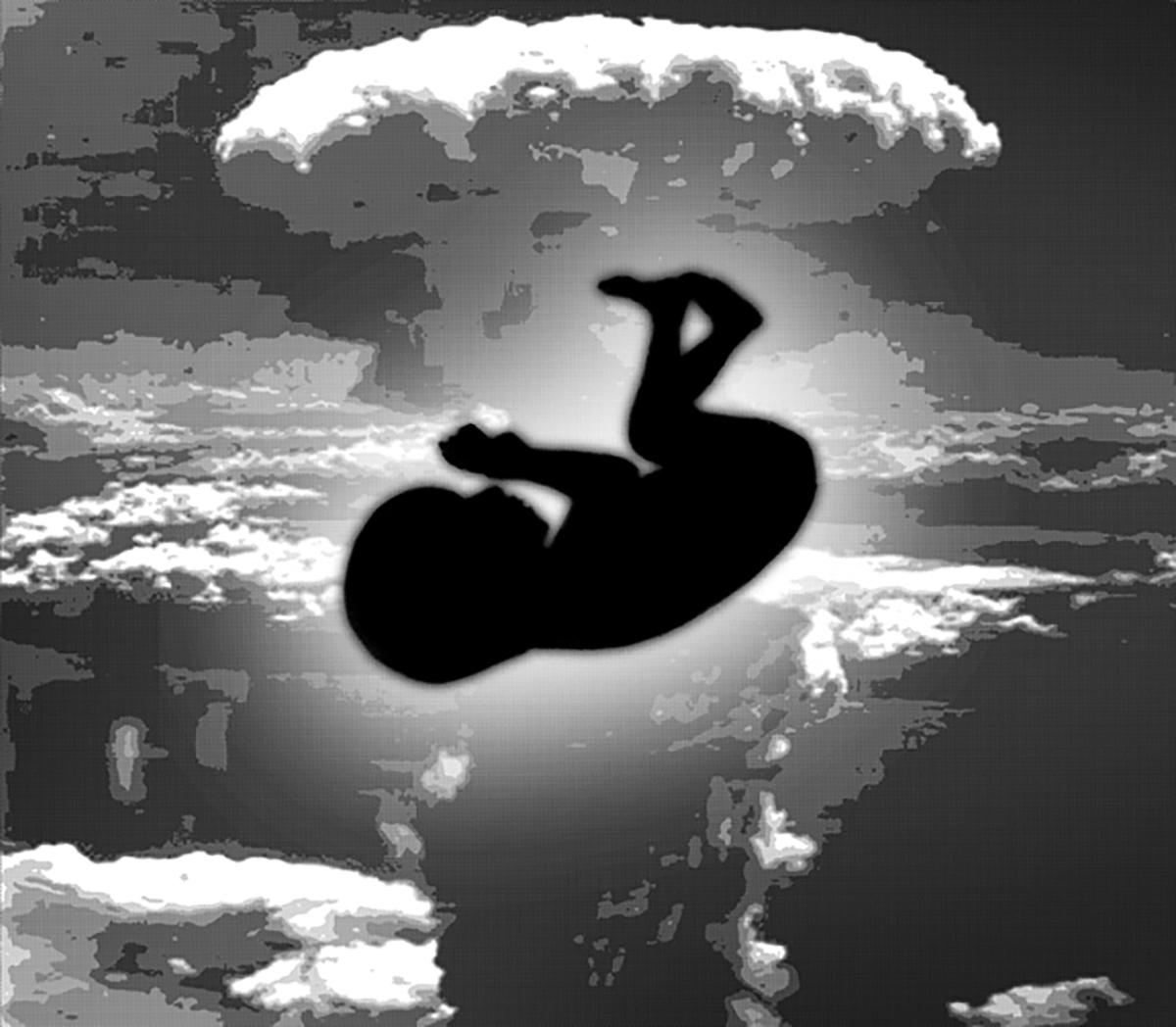
August 6 and 9 of this year mark the 80th anniversaries of the nuclear bombing of the Japanese cities of Hiroshima and Nagasaki by the United States. The bombing intentionally targeted civilians, over 200,000 of whom died from the attacks by the end of 1945.
Albert Einstein was popularly affiliated with the creation of the atomic bomb. The July 1, 1946, cover of Time Magazine portrayed him with a nuclear mushroom cloud in the background, labeled with his Special Theory of Relativity: E= mc2 (energy equals mass times the speed of light squared). That, however, was an errant depiction of Einstein, who nonetheless serves as an ideal historic figure to represent and characterize the origin, development, and significance of the Nuclear Age in which we live today.
Walter Isaacson’s compelling biography of Einstein, Einstein: His Life and Universe, describes him as anti-authoritarian, creative, and imaginative: a brilliant and unconventional theorist, unafraid to think outside the box. According to Isaacson, it was such attributes that led Einstein to revolutionize the Newtonian physics that had dominated science in the early 20th century.
Though the Special Theory of Relativity essentially equates energy and mass, it was Einstein’s revolutionary concept of time that led him to discover that immense energy could be garnered from a small amount of matter. Einstein’s innovative theorizing was a “matter of time,” in which the speed of light was a constant, but the speed of time was variable and relative.
The speed of time, according to Einstein, depends upon one’s frame of reference. Time and frame of reference also ably depict our Nuclear Age and Einstein’s role in the eventual production of atomic weapons.
At the request of other physicists, Einstein signed onto a letter in 1939 delivered to Franklin D. Roosevelt, warning the president that scientists in Nazi Germany were advancing their work on such a weapon. Roosevelt took the warning seriously and eventually authorized the expansion and coordination of efforts to assure the U.S. won the race against Germany to produce atomic bombs, i.e., the Manhattan Project.
That arms race eventually resulted in the August 1945 atomic bombings of Japan.
In time, Einstein came to deeply regret his letter to Roosevelt and what promised to become a threatening nuclear arms race when the Soviet Union detonated its first atomic bomb in 1949. In 1954, months before he died, Einstein wrote to Linus Pauling, a Nobel Prize winner in chemistry, regretting that letter as “the one great mistake in my life.”
Einstein’s life and role in the Nuclear Age contained a great paradox. He was a devoted pacifist throughout his adult life, and opposed war. Moreover, as articulated in Isaacson’s book, Einstein valued humanity over nationalism. He realized that warfare and its monstrous weapons threatened the survival of humanity, which was increasingly becoming a globalized society.
Eighty years after the bombing of Hiroshima and Nagasaki, we find our world awash in thermal nuclear weapons that if deployed, will wildly dwarf the impact of the fission bombs used against Japan. Today nine nations including the U.S. possess nuclear weapons, while six other nations host them on behalf of nations that possess them. The Federation of American Scientists estimates that nuclear warheads currently number 12,241 globally.
Bilateral and multilateral attempts to significantly limit and/or fully disarm our world of nuclear weapons have failed despite a plethora of nuclear treaties. The most prominent are the United Nations Treaty on Non-Proliferation of Nuclear Weapons of 1968, and most recently, the Treaty on the Prohibition of Nuclear Weapons that entered into force in 2021 but has been ignored by all the nuclear states.
As we move into Year 81, one wonders whether the long duration of an avoidance of nuclear war has been miraculous, or instead, deceivingly normalized.
Is this not a matter of time and frame of reference?
Some of us see humanity standing at the edge, waiting for an inevitable nuclear apocalypse to be spawned by something like the escalating NATO involvement in the current Russian-Ukraine conflict. Others, if not most, suppress such thoughts and go through life acting as if nuclear weapons don’t exist.
The U.S. has the world’s most powerful nuclear arsenal. Yet, according to the Arms Control Association, the U.S. is modernizing its nuclear weapons and delivery systems at a cost of $1.5 trillion. Is this not insane?
The U.S. brought nuclear weapons into the world, and it is the only nation to have used them. Is not our country morally obligated to resolve the nuclear quagmire that hangs over humanity?
Perhaps we could imitate Einstein’s unconventional and imaginative thought process. In that vein, should not the U.S. consider unilaterally disarming itself of nuclear weapons to inspire and lead the other nuclear states to abandon them as well?
The intercontinental ballistic missile (ICBM) system used to deliver land-based nuclear warheads is periodically tested at Vandenberg Space Force Base (VSFB). The missileers who might be called to launch the armed ICBMs in an actual nuclear conflict are trained at VSFB. A peaceful protest by the main gate of VSFB condemning nuclear weapons is scheduled for Saturday, August 9, from 1-3 p.m., with parking at Vandenberg Middle School. All peace-seeking folks are invited.

