
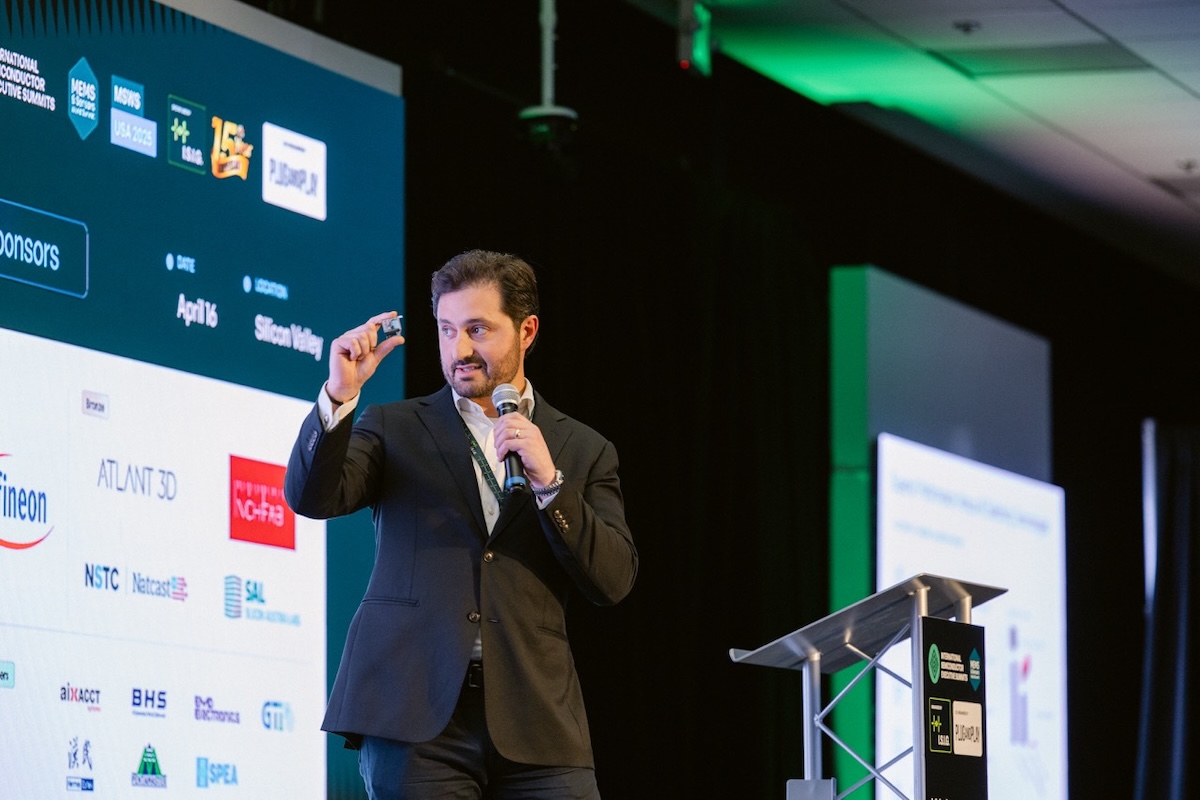
Engineers frequently wrestle with ominous-sounding challenges that have bigger effects on the planet — and your wallet — than you might think: thermal runaway, electromagnetic interference, and dielectric breakdown. The ones working at Goleta startup Cenfire, meanwhile, are taking aim at a problem that sounds straight-up spooky: “vampire currents.”
Vampire currents are the small but constant trickles of electricity that leak from plugged-in devices, even when they’re powered off — and they add up. Globally, an estimated 13,140 terawatt-hours of electricity are wasted every year this way. That’s more than 1.5 times the annual energy use of the United States.
Cenfire, a spinout from Goleta-based MEMS foundry Atomica, says it has a solution: a tiny solid-state switch that all but eliminates these losses. CEO Seena Partokia describes the technology as “a high-efficiency valve for electricity” — a silicon-based alternative to traditional mechanical relays that’s smaller, faster, and longer-lasting.

Compared to a common electromechanical relay like the Panasonic AGN200A03 — which is about the size of a stack of six nickels and takes roughly half a second to switch — Cenfire’s MEMS (micro-electro-mechanical systems) switch is smaller than a grain of rice and flips on and off in microseconds. “Several orders of magnitude faster,” said Partokia. It doesn’t wear out like traditional relays because of its small size and low mass. “You don’t have to worry about reliability”
The idea of eliminating power waste at the hardware level could have wide-reaching implications. “There are [more than] five billion power adapters globally,” said Partokia. “Even a small reduction in leakage across all those devices could have a massive climate and economic impact.”
Cenfire has begun pilot deployments with partners in aerospace, consumer electronics, and energy — though the company is not yet publicly disclosing details about its manufacturing roadmap or broader distribution timeline.
Partokia, who previously worked in power semiconductors and at MEMS relay firm Menlo Microsystems, said that making switches more efficient could unlock smarter battery management in electric vehicles, reduce energy loss in data centers, and even improve performance in satellites.
Cenfire is part of a growing number of hardware startups tapping into the region’s engineering talent. With UCSB’s strong materials and electrical engineering programs — and a tech history that includes aerospace, semiconductors, and defense — Goleta is and has been a hub for energy innovation.
The company’s name — Cenfire — is a nod to one of the earliest MEMS switches: Centurion, a now-defunct IBM design. “Our approach outperforms it in every way,” said Partokia. “The team joked that we were setting Centurion on fire.”
Though Cenfire is still quite young, its focus on tiny switches is earning big attention. With global energy efficiency mandates tightening and the demand for resilient, low-power electronics rising, Partokia sees an opening.
“Switches are everywhere,” he said. “If we can improve them, we can make a difference everywhere too.”










You must be logged in to post a comment.