
Eating Lunch with Santa Barbara’s
Gay and Lesbian Seniors
The Pacific Pride Foundation’s
Lavender Elders Group Share
Reflections on the Past, Love for the Present, and
Hope for the Future of the LGBTQ Community
By Callie Fausey | Photos by Ingrid Bostrom
August 21, 2025
Read more from our 2025 Active Aging Guide here.
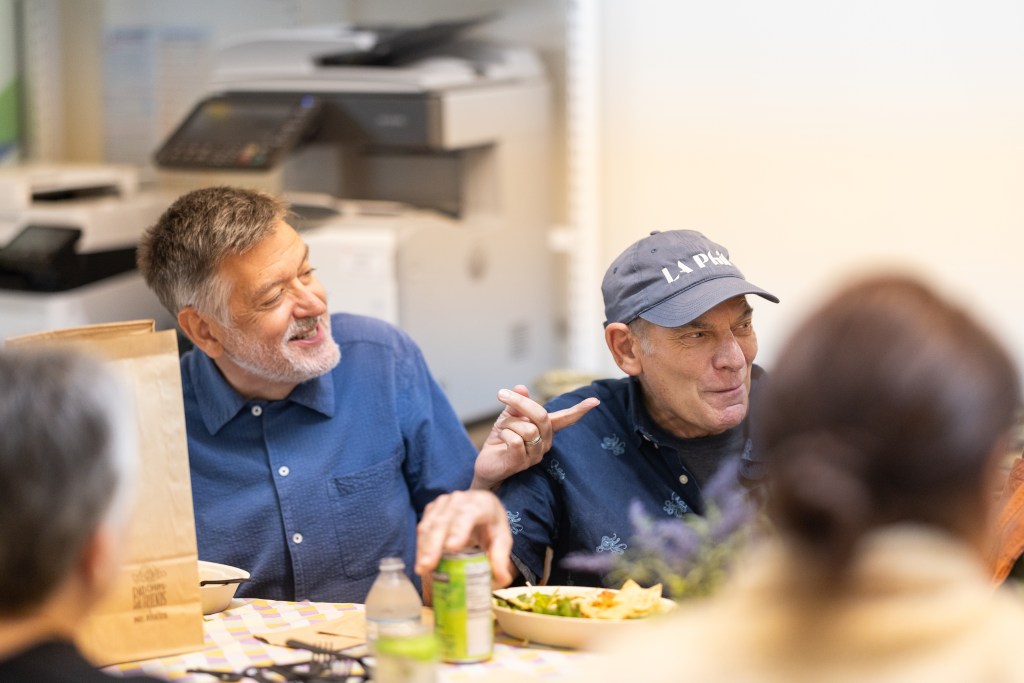
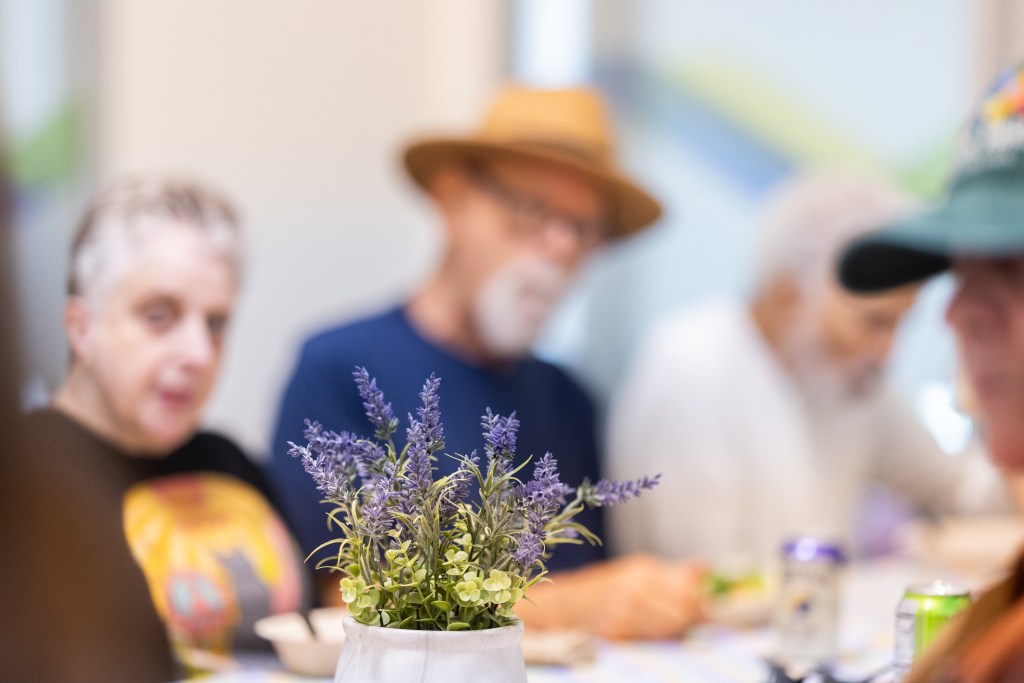
At Jill’s Place on Santa Barbara Street, a gaggle of gays and lesbians files into a corner booth to eat lunch.
The diner’s menus receive momentary glances between observations about the lesbian, gay, bisexual, transgender, and queer (LGBTQ) community and how so much has changed and yet so much has stayed the same.
Most of them exited the closet decades ago. Everyone is older than 50.
“I’m gonna change it up and have the French dip,” proclaims Hathor Hammett, a 78-year-old lesbian who refuses to go by “gay” or any other term. It’s an interesting contrast with the young LGBTQ community now, who use terms like “queer” and “gay” interchangeably, and who lovingly, or at least jokingly, call each other “faggots” and “dykes.”
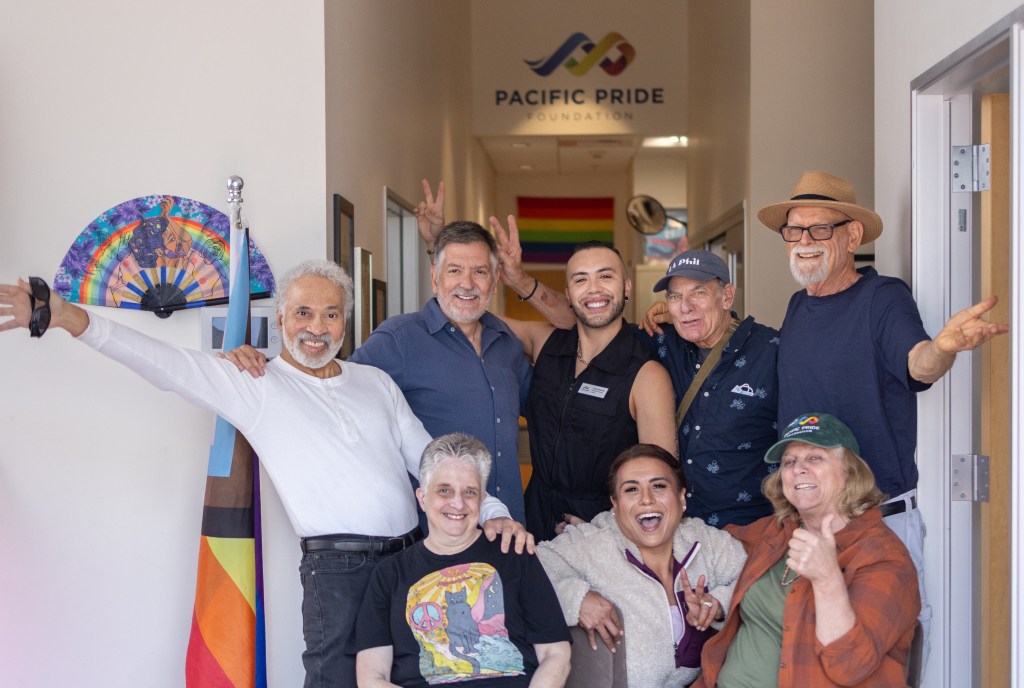
Hammett is a member of the Lavender Elders group, created for LGBTQ seniors and organized through the Pacific Pride Foundation (PPF), who meet every other Thursday for lunch and community.
“We fought like hell for that word [lesbian] to be included,” she notes, slightly hunched over the table, with an expression that says “I look tougher than I am” and “You might never guess I’m a sweetheart who makes masks for Solstice and sings at the bedsides of the dying.”
“I am not gay,” she declares. “I am a lesbian.”
Another woman at the table pipes up, “Sometimes I can say I’m gay,” Gina Vansteyn, 64, adds. “I’m a woman that loves another woman. I’m a woman that stands up. I’m a woman who cares about everybody.”
Bites of history and love lives and preferences and opinions and praise for Chappell Roan bounce around the booth in strings of conversations.
The group includes Philip Prinz (who introduced himself as “Prince Philip,” one L), 76, and his husband, Kent Hanson, 63 — they are the only couple. Sitting next to them is Michael Downey, 78. And clustered near Hammett and Vansteyn is Gail S., 74, and Yasmin Adawi, 65.
The conversation’s appetizer includes personal anecdotes, such as Vansteyn’s secret “lesbian friend” at Dos Pueblos High School back in the ’70s. She flashes a self-satisfied smirk at the mention of their clandestine picnics behind the school.
“We spent a lot of time out in the field smoking pot, drinking, and kissing…” she pauses, then adds, “…whoever.” Again, that smirk.
After a tumultuous life of love, including her first marriage to a man and losing her wife, Diane, to cancer, Vansteyn’s now seeing a young woman she met on a dating app, whom she gushes over. “She’s a model,” she tells me at lunch with a coy smile.
Gail S. is also a widow. She grew up in Santa Barbara and met her partner when she moved up north to get her law degree. “Neither of us was the wife. Neither of us was the husband. I took out the garbage, but she killed the bugs,” she laughs.
They were together for a long time, and after gay marriage was legalized (nationwide in 2015), they tied the knot and moved back to Santa Barbara for retirement. Sadly, her wife died of a stroke only one and a half years into their marriage.
“I was barely used to using the word ‘married,’ ” she says. “But I’m a resilient person. I don’t necessarily feel like a senior — as I’m sure many people at this table would say — but here I am just figuring out what I want to do next with my life, as a part of this group. I am lavender; I am an elder.”
Pride in the Past
That was in July, when I first had the pleasure of meeting and learning about this incredible group of people. The Lavender Elders are vibrant and overflowing with stories — some sad; some frightening; some powerful; some funny; some full of love and hope; some all of the above. While most members have been out for decades, the group has also adopted people who came out later in life, only once their forehead developed wrinkles and their hair grayed.
They reminisced about the long-lost days of gay bars in Santa Barbara, many of which closed down in the early 2000s. Hammett favored a lesbian bar called the Odyssey, and Vansteyn recalled when the Independent used to run “Man Seeking Man” or “Woman Seeking Woman” dating ads back in the day.
Despite a healthy gay scene in town, the last bar standing that could be considered something akin to a gay bar is Wildcat Lounge, which has kept up its long-standing tradition of hosting LGBTQ nights every Sunday. Drag queens frequent the joint, men dance with men, and women flirt with women while classic pop songs play in the background.

In a 2007 Independent article, Hannah Tennant-Moore praised the Wildcat in the context of the disappearance of local gay bars like Trackside, The Pub, Gold Coast, Chameleon, Fathom, Revival, and Hades in the decade prior.
“I don’t know what the deal is,” promoter Robert Mendez, who started Wildcat Sundays, told Moore at the time. “It’s so funny [that a full-time gay bar can’t survive here]. There’s a huge gay scene.”
Moore thought that the casualties could likely be chalked up to finances, or potentially homophobic staff at some bars’ gay nights. But that was 2007. Much has changed.
Young queer people nowadays don’t have as great of a need for designated spaces to meet one another, the Lavender Elders mused. They can set their online dating profiles to match their sexual preferences. Some people basically scream their sexualities from the rooftops, or at least put the corresponding pride flag in their bios on Instagram.
“They’re not experiencing the fear of getting beaten up that some of us sitting at this table felt,” Gail noted. However, she added that amid the current political climate, queer people still cannot let their guard down. “We’re in a town that’s always been a lot about tolerance, but even so, we can’t be complacent.”
“I came out in ’68,” Hammett chimed. “There was nothin’ for us. I mean, nothing. You were lucky if you didn’t get killed. You could actually get arrested for being a lesbian.”
That was before the majority of U.S. States had decriminalized homosexuality, which was only fully decriminalized in 2012. It was before Harvey Milk, one of the first openly gay elected officials in U.S. History, won his seat on San Francisco’s Board of Supervisors in 1977.
It was before the Atascadero State Hospital on the Central Coast stopped prescribing “gay aversion” therapy treatments for gay men (labeled as sexual deviants).
It was before the AIDS epidemic swept through the country beginning in 1982 — something the Lavender Elders remember well.
Many of the lesbian women at the table could vividly recount their experiences helping AIDS patients. Lesbians played a vital and often overlooked role in caregiving and advocacy, particularly for gay men with AIDS, as lesbians were seen as the lowest-risk category for the disease — “use that as a party pickup line,” Gail joked. Doctors and healthcare providers were hesitant or downright refused to provide care for HIV patients, whether that be for fear of infection or just straight-up prejudice.
“Many of us [lesbians] were separatists,” Hammett recounted. “We really didn’t do anything with the [gay] men at all, and that was fine with everybody. And then AIDS hit.”
At their August meeting, this topic was the main entree, alongside the Chipotle catered to the PPF headquarters on Anacapa Street. Some stories were hard to swallow.
“I remember just watching the life drain out of them,” Vansteyn said, choking up. She compared it to the early days of COVID — with the fear, the unknowing, and the misinformation.
Ron Alexander, 76, joined the group for the August lunch. “I’m trying to think of when I first tested positive for HIV,” he said as soon as we sat down to speak, following the group’s post-lunch painting session.
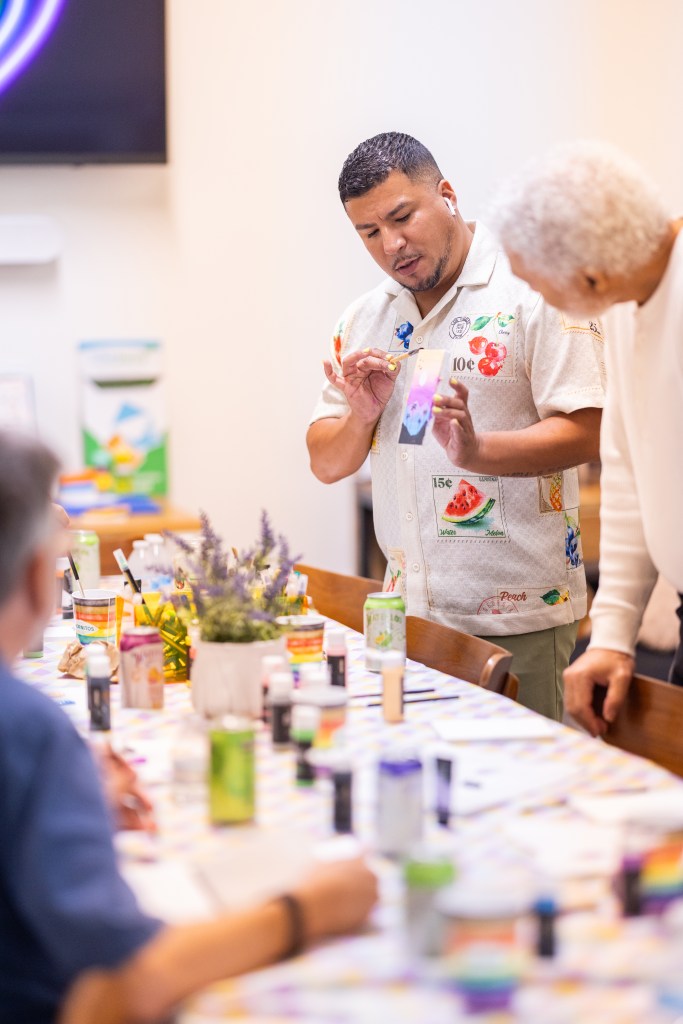
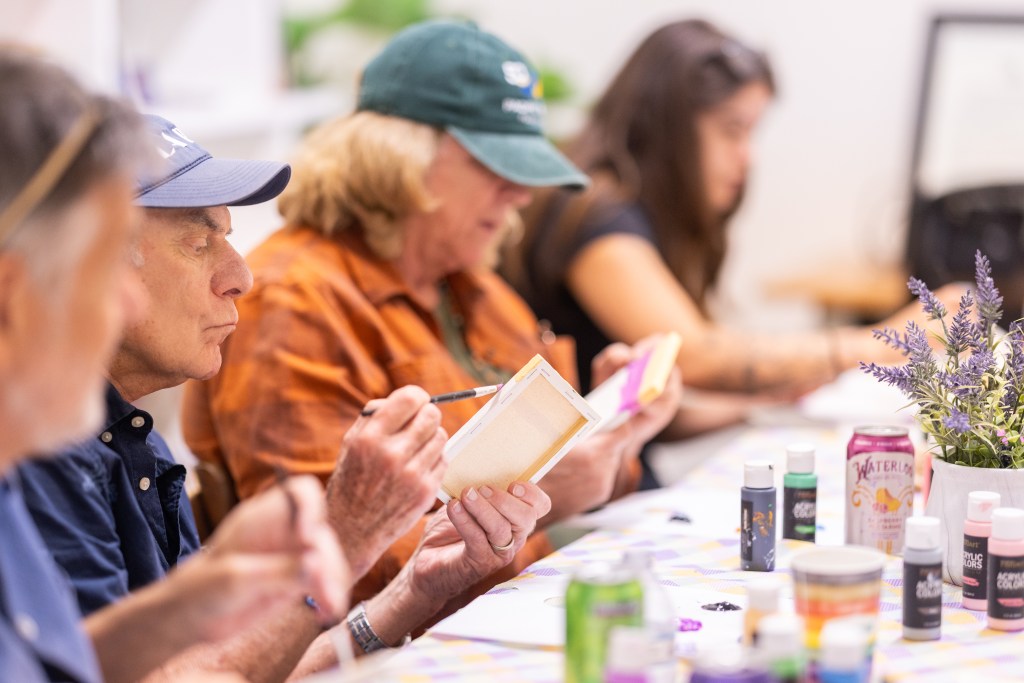
Alexander gently put down his mini canvas and paintbrush, his half-painted sunset of yellows, purples, and blacks staring at the ceiling. He fixed his neat, fashionable fedora — a hard thing to pull off nowadays, but he wore it well, like a cherry on top of his tall, slender frame.
After getting his doctorate in psychology at UC Santa Barbara, Alexander started his first counseling job at PPF back in the 1980s when it was a “Drug and Alcohol Abuse Counseling and Referral Center for Gay Men and Lesbians,” then called Western Addiction Services Program.
During the epidemic, PPF provided multiple services, including free, anonymous HIV testing as one of the county’s first test sites; HIV education and prevention; and even a food pantry for low-income HIV-positive people and their families.
When Alexander worked as a counselor, he spoke to a lot of men with AIDS, but as an HIV-positive man, he inevitably had very personal experiences with the disease, as well.
He described meeting Michael Gonzales — who started Santa Barbara’s famous Summer Solstice Parade — at The Pub, one of Santa Barbara’s bygone gay bars. They dated for six years, before eventually going their separate ways. But they remained close friends, and Alexander was by his side when Gonzales died from HIV in 1989.
Alexander, like many of the Lavender Elders, found real love, though. He met Gary, his husband, in 1987. Gary was by his side as he battled HIV, when, for the first half of Alexander’s struggle with the disease, there were no treatments. “My T-cells were going down; I thought I was going to die,” Alexander said. “So, I stopped working. And Gary supported me the entire time.” But Alexander was able to recover and grow old with Gary, who is still by his side.
Deja Hartley, PPF’s Director of Programs, mentioned that, at her age (she’s in her thirties), she remembers growing up around the same time as the epidemic, but she is now also on the frontlines of the groundbreaking PrEP medication that is used to prevent HIV.
Looking around the table, she lightheartedly added, “A lot of people don’t know that folks over 55 are sexually active,” prompting laughs and “hms” of affirmation from the group.
Pride in Its Fifties
While most corporations hung up their Pride flags as soon as the calendar flipped to July, the Lavender Elders and PPF celebrate pride year-round, and PPF prefers to host its big Pride celebration in August as to not compete with other major cities during Pride Month in June. This year, for the organization’s big 50th anniversary, the theme is “Rooted in Pride: Embracing Our Past and Empowering Our Future.”
At their first August lunch, Philip Prinz noted, “They need to do more protests across the country. There’s not enough now.”
Hartley was quick to respond, “Well, we have one big protest on Saturday, August 23, at Chase Palm Park, from 11 to 7,” referring to the Pride Festival. “Pride is a protest, honey.”
Julio C. Roman, the executive director of PPF, wanted to host a celebration that honored the members who paved the way for the organization. Prior to Roman taking the helm last year, he said the Lavender Elders had been on a hiatus for about a year and sought to revive the group.
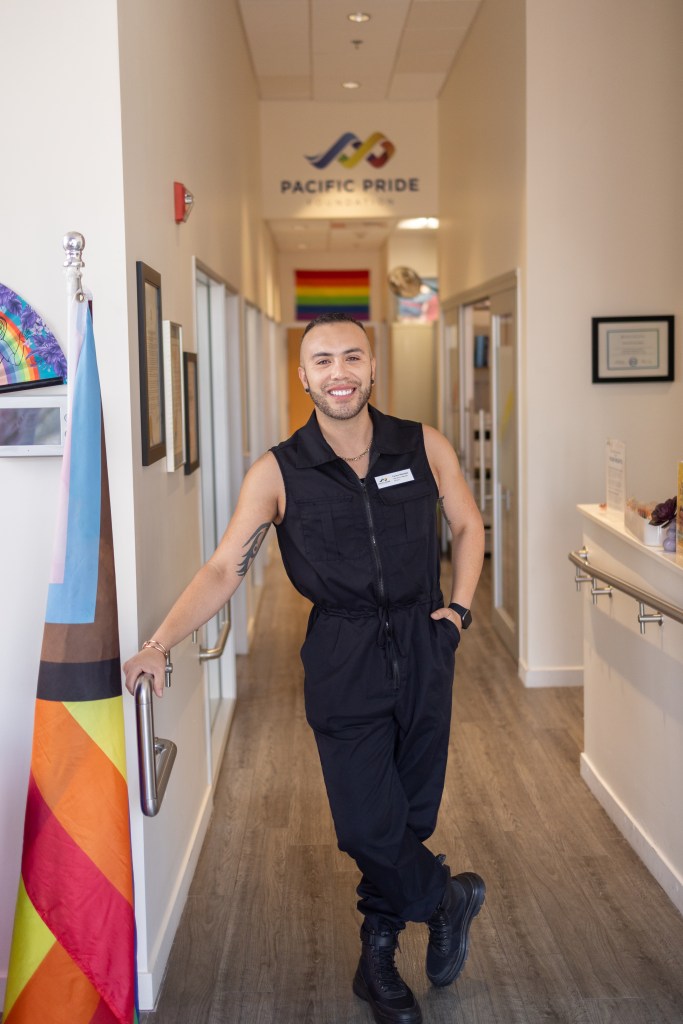
“They’re a treasure trove of stories and lessons,” he said. “Many elders have been longtime members of PPF — as the new ED, I’ve been getting a lot of advice, some solicited, some unsolicited,” he laughed. “They have an unfiltered lens on life.”
The Lavender Elders started more than 30 years ago with potlucks at a local church, and have welcomed many vivacious, kind people in the time since. For context, lavender, both the color and the flower, is a long-standing symbol of queer culture and resistance, particularly within the lesbian community.
The group helps fill the gap for older people in the community who may not be able to attend social events, parties, and festivals. It counters concerns around social isolation for LGBTQ people older than 50, who are twice as likely to be single and live alone.
According to the National Institutes of Health, self-pride and community connection are associated with positive outcomes for older LGBTQ people, including higher quality of life and lower internalized homophobia.
Prinz and his husband, Kent Hanson, love being a part of Lavender Elders. They moved from San Francisco to Santa Barbara three years ago, and the group has been “very important for us, particularly as newcomers and particularly being queer, to get involved in the community,” Prinz said.
But most of the group is still active in the community in other ways, as well. Prinz is a part of the Santa Barbara Gay Men’s Chorus, which is hosting a Pride Cabaret on Thursday, August 21, and 7:30 p.m. (the night of this story’s publication). Michael Downey wrote and performed a one-person play called The War Shirt at Marjorie Luke Theater, which was about achieving closure with his father when he died in 1994 and his “reflections on my sexuality as a gay African American man coming into adulthood amid the turbulent events of the 1960s,” Downey said. And Hathor Hammett, alongside making masks for Solstice and singing in the Threshold Choir, has volunteered for the Santa Barbara’s rape crisis center and sat on the board of the Santa Barbara Women’s Political Committee for a decade, among other things.
“Almost as soon as we moved here, somehow, Philip found out about it [the Lavender Elders]. It’s been great,” Hanson said. “You know, it’s always been a little group, but I think it’s growing, and with Deja [Hartley] at the helm, it’s really getting more structured.”
Find out more about the Lavender Elders and Pacific Pride Foundation’s upcoming events at pacificpridefoundation.org.


You must be logged in to post a comment.