
Hockey for Life
At Ice in Paradise, Santa Barbara’s
Players over 60 Prove That Age Is Just
Another Number on the Scoreboard
By Tiana Molony | Photos by Ingrid Bostrom
August 21, 2025
Read more from our 2025 Active Aging Guide here.
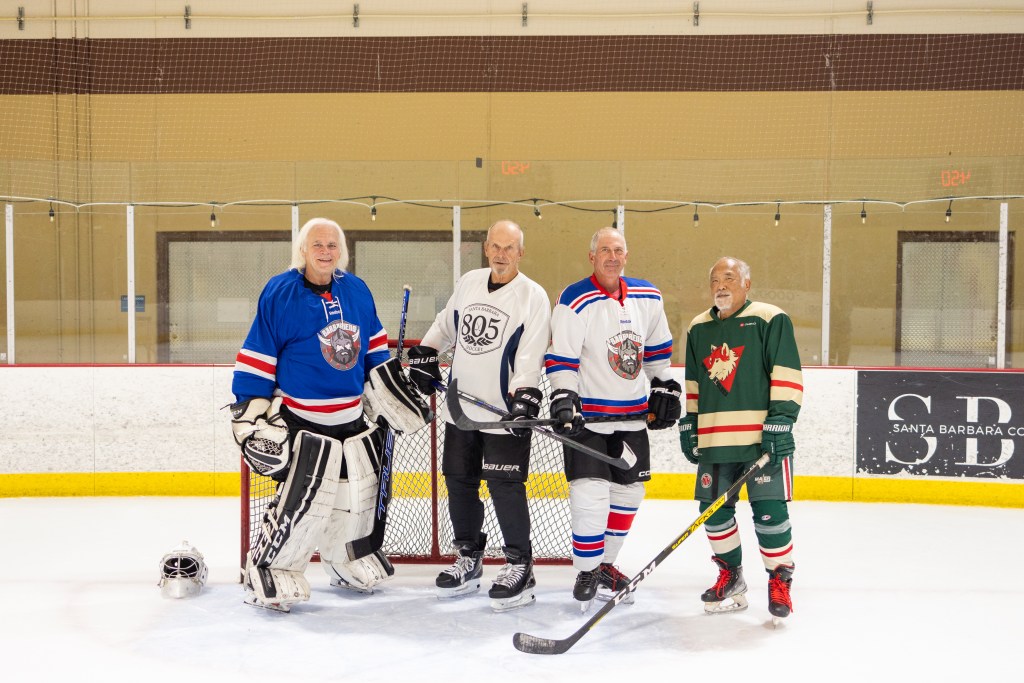
It’s a regular Thursday evening, and 64-year-old Santa Barbara urologist David Laub just finished a day of surgery. After a long shift, most might opt for a quiet night in, perhaps spent on the couch in front of the television. Not Laub. Instead, he’s at Ice in Paradise playing pickup hockey with a group of older guys whose love for the game outweighs any desire for rest.
“I can tell you, I might be exhausted after a day at work,” Laub admits, “but then go to the rink to play hockey. I may be really tired going into the rink, but I’ll get the energy, and then I’ll feel really invigorated afterward.”
Laub is just one of roughly three dozen players older than 60 who are members of Ice in Paradise’s Adult Hockey League, which welcomes men and women over 18 but has become a haven for players decades beyond that age.
Because the program is open to players across all skill levels, the league is divided into skill-based divisions to ensure fairness. “That way there’s something for everyone, wherever your skill level is,” explains Ice in Paradise’s Adult Hockey Director Joe Dionisio. This means a 74-year-old might be skating shoulder to shoulder with someone 40 years his junior.
The range of participants is surprisingly wide, with many players in their fifties, sixties, and even early seventies — a fact that might seem surprising, but isn’t. Senior hockey is a big enough scene that tournaments like the annual Snoopy’s Senior World Hockey Tournament attract players from across the country. Ice in Paradise even hosts its own annual Presidents’ Day senior tournament, welcoming players from all over the United States to compete in over-50, over-60, and over-70 divisions. Even 80-year-old Jack Norqual, Ice in Paradise’s primary benefactor, hits the rink for the over-70 games.
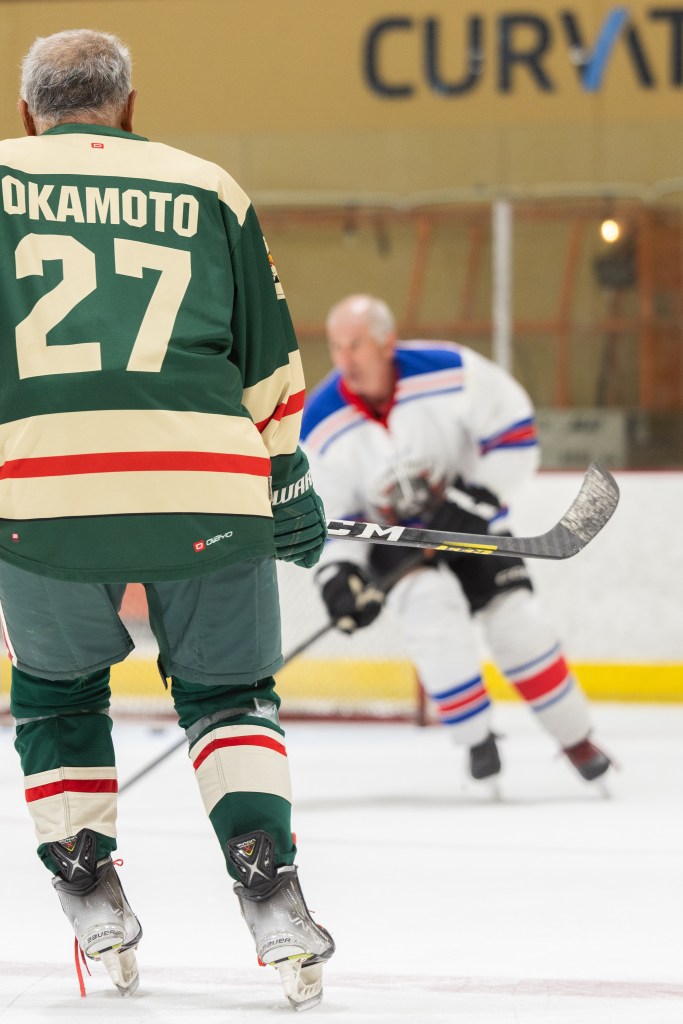
For the older players in the adult league, the rink isn’t just a place to stay fit — it’s a way of life. Some have been skating for so long that they can’t remember a time without hockey. That much is true for 74-year-old Douglas Okamoto, a Japanese Canadian-American, who learned to skate on an ice rink in his backyard almost 70 years ago. “I graduated from my backyard to pond hockey on a frozen lake,” he recalls.
While the physical aspect of the game is a driving force for the older players, the camaraderie that comes with playing a team sport in older age is priceless. Over time, the locker room banter and rink-side conversations have become lifelines for players navigating the quieter chapters of midlife and retirement.
“It’s a chance to socialize,” reflects goalie Roger Hemman, 64, who had just returned from the annual Snoopy’s Senior World Hockey Tournament in Santa Rosa. “And what’s one of the most valuable things to me is, I’m socializing with people of all generations.”
Okamoto agrees: “It keeps you active mentally. And nowadays, that’s how I socialize.”
Norqual — Chair Emeritus at Ice in Paradise — spent 22 years on the U.S.A. Hockey board. Though he lives in Minnesota during the summer, he returns each winter to his home in Montecito. In Santa Barbara, the 80-year-old can often be found at the rink twice a week, lacing up for Thursday night pickup hockey with a group affectionately known as “The Boyz of Santa Barbara.”
Even as one of the oldest players out there, he’s still going strong. Like the other players, what keeps him coming back, above all, is his teammates. As he puts it, “The friendships have really kept me going and to keep me playing…. Hockey is a game of great camaraderie.”
If you’ve watched hockey or attended a high-level game, you might wonder why — or in this case, how — someone would choose to keep playing such a physically demanding sport in their later years. The hockey that probably first comes to mind involves excessive pushing, shoving, and, sometimes, blood-stained ice. While traditional hockey — especially in the NHL — often condones and even celebrates full contact, all leagues at Ice in Paradise are “non-checking,” meaning body checks are illegal.
This makes the game more enjoyable and safer for players — especially the older crowd. “It’s more like basketball,” explains Dionisio. “There’s body contact, but you can’t hit someone in basketball.” Still, even without the hits, the sport does demand a high level of physical fitness.
Which is why, for many of the players older than 60 in the league, hockey is just one way they stay moving. Most of them regularly play tennis and golf and work out at the gym to maintain peak physical fitness — motivated by the notion that staying active outside of hockey enables them to continue playing in old age.
Many of the older players hit the rink regularly for pickup and league games. The pickup games, which occur on numerous days a week across different groups, are more casual than the league games. “It’s a friendly game without referees,” explains Laub. “But it can get a little chippy here and there, but we all enjoy each other.”
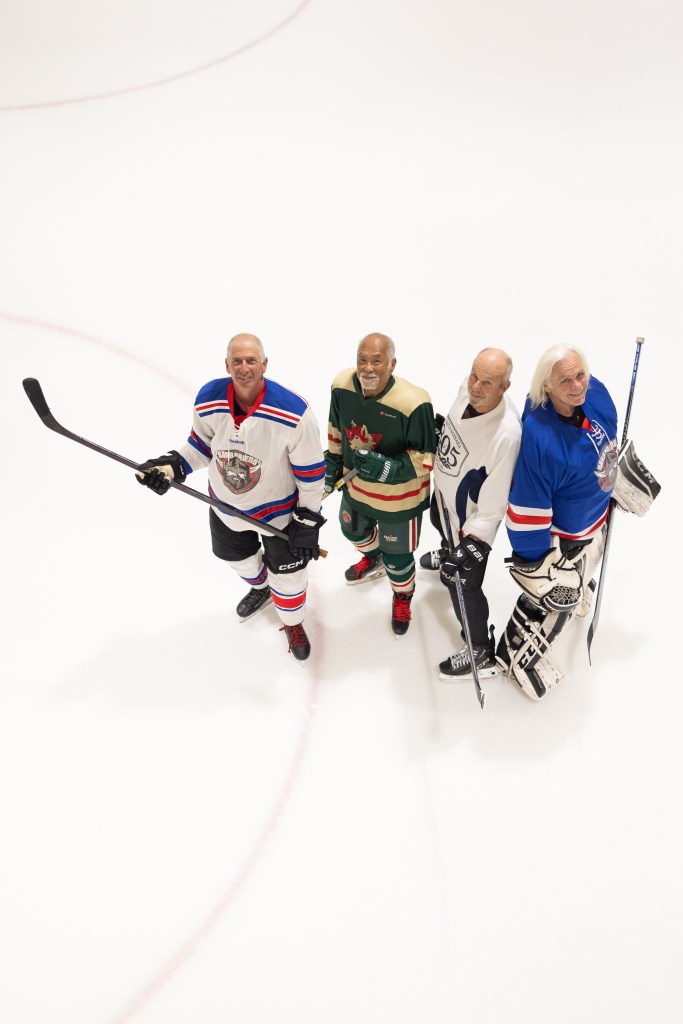
At one of the Thursday night pickups, a few players in their seventies and sixties are joined by some players in their late forties and late thirties. The older folks appreciate playing with younger people to maintain the game’s speed. As 74-year-old David Chancey reminds me, the tempo of the game matters. “Everybody likes playing with the speed of the game,” he says. “If you get too many old guys, it’s too slow.”
While there are cuts and bruises here and there, and Laub having to “stitch a few people up in the locker room,” serious injuries are rare, though, like in any sport, inevitable. That held true when, in December 2023, Okamoto collided with a goalie, resulting in a collapsed lung. He was subsequently rushed to the hospital, where he made a full recovery.
However, the seemingly career-threatening injury didn’t stop him from getting back on the ice — ironically, he returned better than ever. “We joke that that injury cured my COPD,” Okamoto quips.
Injuries aside, the fear of stopping, of slowing down, remains a quiet undercurrent among many of the senior players. “I mean, I’ve never not played,” admits Laub. “I’ve always been afraid that if I stop playing, I would never be able to get back into it.”
However daunting aging can be, for them, it isn’t an excuse to slow down; it’s a challenge to keep going. Chancey sees it this way: “It’s either [playing hockey] or sitting in bed watching TV.”
While their bodies may be slowing down, none of the players I spoke with have any plans to stop — quite the opposite. They share a common mindset: they’ll quit only when their bodies force them to, which, for this group, is still a long way off.
“I told my wife I would take a year at a time,” Okamoto recalls. “It’s worked so far.”



You must be logged in to post a comment.