

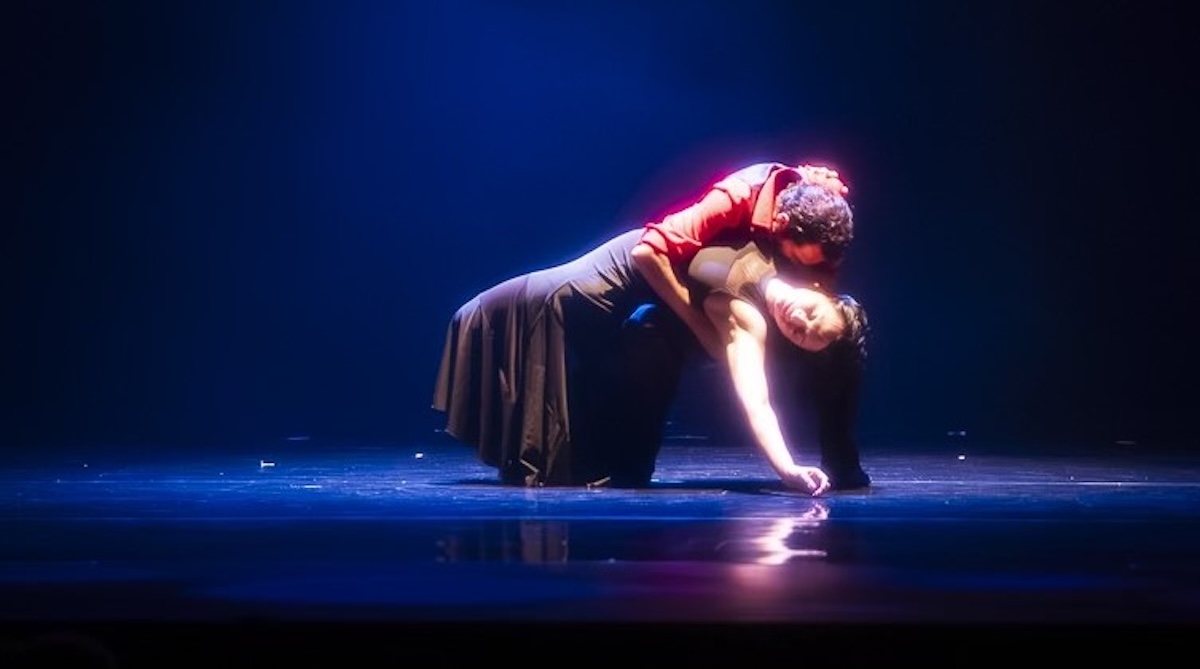
Prologue: Imagine a dark stage. Malena — danced by international tango champion Fernanda Ghi — stands alone in a spotlight, in silence. Wearing a black dress, she holds a red satin shirt draped over her arms. She looks over her shoulder towards Malena — danced by Selah Dance Collective dancer Rachyl Pines — who appears, as if in a dream. As the two Malenas exit the stage, “Tango” Malena looks longingly at “Contemporary” Malena, who does not appear to see her.
This moment of silent tension set the tone for the rest of the performance: a constant contrast between the intense embrace of tango and the freedom of contemporary dance, as the protagonist, Malena, embarks on a journey of self-discovery, looking for the balance between freedom and the embrace.
After the prologue, the powerful Selah dancers, directed by choreographer-scholar Meredith Ventura, appeared on stage, in stark black and white outfits, dancing to the haunting, neo-classical sounding “Quintett N.1” by Dustin O’Halloran.
The show proceeded with interleaved tango and contemporary scenes, contrasting the two worlds, until the two Malenas meet.
The tango dancers are all international champions, with numerous awards behind their names. Ghi’s partner Silvio Grand, and international champions Zoya Altmark and Martín Almiron were all powerful, sexy, and grounded. Ghi and Grand danced the leading roles, while Altmark and Almiron danced supporting roles, providing a context in which to understand the world of tango. Except for the “red shirt conversation,” the couples danced only with each other, like island universes.
The conversation of the Red Shirt: Early in the program, Ghi and Grand danced with the red satin shirt which was introduced in the prologue, skillfully passing it back and forth by sliding their arms into and out of the sleeves as they danced. The red satin shirt, Ghi explained, symbolizes the embrace. Malena is flirting with the idea of going into and out of the embrace. Later, Altmark and Almiron joined them, passing the shirt between all four as they danced — the only time when the two couples interacted. In the end, Grand ends up alone, wearing the red shirt. He has chosen to remain with tradition.
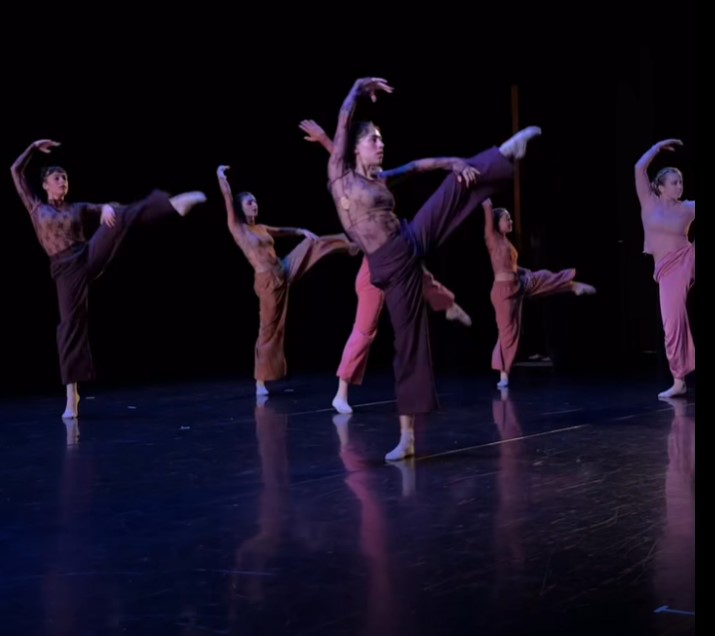
When the Selah dancers returned to the stage, they had changed from the opening black and white to muted earth tones. In their second piece they danced to Vivaldi’s “Summer,” re-envisioned by Max Richter. Richter’s version gave extra momentum to the original baroque sound, adding a sense of urgency.
Ventura’s choreography is endlessly fascinating. The dancers often danced in canon — sometimes one row started, and the next row came in. Sometimes a movement was started by a few dancers in different locations, and then the canon proceeded in seemingly random pockets, when suddenly all the dancers came together, dancing in unison. Their athletic bodies seemed to float around the stage, falling weightlessly, then rolling and rising in one movement as if propelled by an inner force. Their extensions defy gravity. One can almost see the energy swirling around them, as if their movements stir up vortices in the air.
Pines was beautiful as the young Contemporary Malena. Innocent, graceful, and playful, at times standing out as the soloist, and at other times melting back into the group. She does not know what is in store for her, that the other Malena is watching her, perhaps in a dream, until they meet in the second act in the space between their separate universes.
The contrast between Ghi’s strong, grounded Tango Malena and Pines’s ethereal Contemporary Malena added a sense of poignancy to Tango Malena’s yearning to be free. It was almost as if she was dreaming of a younger self, with fewer worldly cares, wanting to break free of the social burdens placed on women, symbolized by traditional tango.
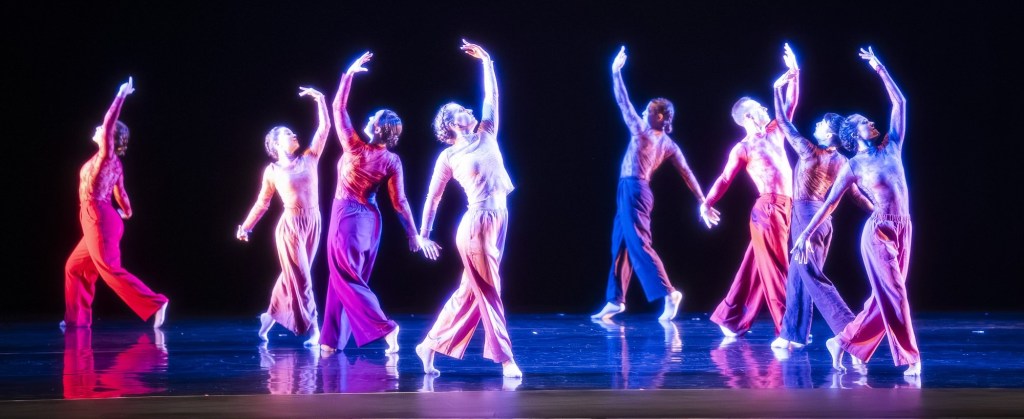
The costumes added to the contrast between the two worlds. The contemporary dancers each wore matching shirts and pants, men and women indistinguishable by their dress. In contrast, the tango women always wore dresses, while the tango men always wore pants and shirts. The costumes underscored the difference between heteronormative tradition and gender-neutral freedom.
The two worlds lived in different soundscapes, too. The contemporary scenes were danced to Vivaldi’s “Four Seasons” and the neo-classical sounds of Dustin O’Halloran and Uno Helmersson, while the tango scenes were danced to the sometimes-dissonant contemporary sounds of Astor Piazzolla’s “Four Seasons of Buenos Aires.”
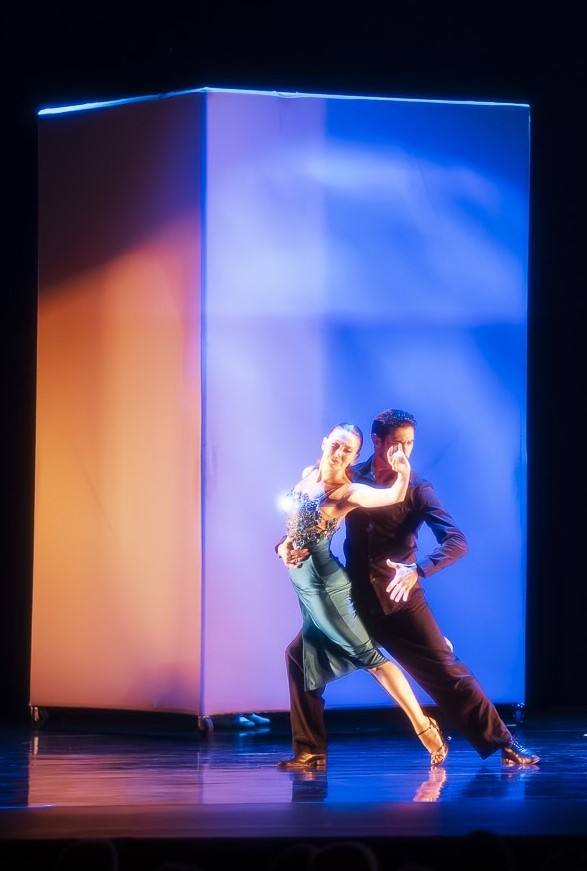
As the second act opened, two huge, white, hinged screens, looking like giant dance hall pillars, dominated the stage. Sometimes they provided a narrow “hallway” through which dancers danced, and sometimes they were moved closer or farther apart by dancers behind them (as evidenced by their feet peeking out from underneath). The spectacular lighting effects colored the whiteness of the pillars in sky-and-sunset colors.
Ghi and Silvio led the second half dancing to the drums of Candombe, a musical style which is described as Afro-Uruguayan. Now considered an essential element of tango, candombe is said to both honor the ancestors and stand as a symbol of resistance. At first, the partners danced separately, then came together, dancing a playful tango to the candombe drums. The music for this piece was written by Ruy Folguera, brother of Nomad Tango director Alejandra Folguera.
The lighting, designed by Maria Fliagina of State Street Ballet, was spectacular. Poor lighting can ruin a show; adequate lighting is barely noticed; but spectacular lighting not only supports and highlights the dancers, but participates as a performer in its own right. There was one truly memorable lighting effect which I have never seen before, which preceded one of the Selah scenes: A dozen (give or take) orange-yellow inverted-cone shaped lighting spots appeared on the back curtain, high above the stage, which stood out from the overall muted orange glow. Into this pool of lights, the Selah dancers entered, in their muted-earth-tone outfits, as if entering a temple.
The climax of the show was the meeting of the two Malenas, as if a window was opened between their two universes. At first Contemporary Malena recoiled from the touch of Tango Malena, as if not trusting her. As they danced together, they seemed to enjoy the flavor of each other’s style more and more, until at a high point in the music Tango Malena lifted Contemporary Malena into a head-down, feet pointed-in-the-air ‘Selah special’ lift!
After the meeting of the two Malenas, Arianna Hartanov, one of the most multi-faceted, dramatic dancers in Santa Barbara (see my reviews here and here), danced a solo. Alone on stage, Hartanov brought a different energy to the story, neither in a couple nor in a group, conveying a sense of urgency to Malena’s struggle. I noticed a theme that wove through her solo: a high extension, followed by a contraction and a collapse to the floor, rising again in one sweeping movement, like waves breaking and rising again. What was the significance of that sequence of movements in the life of Malena? Was it reaching and yearning, but afraid to fail? Or perhaps symbolizing a metamorphosis, the death of the old self, signaling the rebirth of Malena?
Did the two Malenas meet in a dream? Or did it really happen? When each Malena returned to her world, she was changed. Tango Malena found herself dancing with her partner again, but in a freer style. Contemporary Malena returned to her world of muted earth-toned costumes, but wearing a plain dress instead of her previous gender-neutral outfit.
In the end, the two worlds coexist. The tango dancers are still dancing with the same partners, but in a freer style than before, while the contemporary dancers, dancing behind them, seem to be acknowledging them.
You cannot touch without being touched.
Click here for more information on Selah Dance Collective and here for more information on Nomad Tango.
Related Posts





Premier Events

Sat, Mar 07
2:00 PM
Santa Barbara
Autobiography of a Yogi, the Legacy of Yogananda

Sun, Mar 08
6:30 PM
Santa Barbara
6th Eco Hero Award Brock Dolman & Kate Lundquist

Mon, Mar 09
6:00 PM
Santa Barbara
ART 4 GRIEF Support Group

Sat, Mar 14
7:00 PM
Santa Barbara
Red, White, & Blues II: The American Songbook
Sun, Mar 15
3:00 PM
Santa Barbara
Red, White, & Blues II: The American Songbook

Sat, Mar 07
12:00 PM
Santa Barbara
Spring 2026 Healing Arts Faire

Sat, Mar 07
7:00 PM
Carpinteria
The Magic’s In the Music

Sat, Mar 07
7:30 PM
Goleta
UCSB Arts & Lectures Presents Arturo Sandoval Legacy Quintet

Sat, Mar 07
7:30 PM
Goleta
Jazz Concert with Wayne Bergeron
Sun, Mar 08
10:00 AM
Santa Barbara
Fairytale Weekend at the Zoo

Sun, Mar 08
1:00 PM
Santa Barbara
SB Craftivists “Resist with Love KNOT Hate Knit-In

Sun, Mar 08
4:00 PM
Santa Barbara
Brawlin’ Betties: Love v. Luck Scrimmage

Sun, Mar 08
7:30 PM
Santa Barbara
SBAcoustic Presents Natalie Gelman & Mark Legget

Mon, Mar 09
6:30 PM
Santa Barbara
Science Pub: Cyborg Jellies Exploring Our Oceans

Thu, Mar 12
6:00 PM
Santa Barbara
Poetry, Typewriters, and Collage Workshop
Sat, Mar 07 2:00 PM
Santa Barbara
Autobiography of a Yogi, the Legacy of Yogananda
Sun, Mar 08 6:30 PM
Santa Barbara
6th Eco Hero Award Brock Dolman & Kate Lundquist
Mon, Mar 09 6:00 PM
Santa Barbara
ART 4 GRIEF Support Group
Sat, Mar 14 7:00 PM
Santa Barbara
Red, White, & Blues II: The American Songbook
Sun, Mar 15 3:00 PM
Santa Barbara
Red, White, & Blues II: The American Songbook
Sat, Mar 07 12:00 PM
Santa Barbara
Spring 2026 Healing Arts Faire
Sat, Mar 07 7:00 PM
Carpinteria
The Magic’s In the Music
Sat, Mar 07 7:30 PM
Goleta
UCSB Arts & Lectures Presents Arturo Sandoval Legacy Quintet
Sat, Mar 07 7:30 PM
Goleta
Jazz Concert with Wayne Bergeron
Sun, Mar 08 10:00 AM
Santa Barbara
Fairytale Weekend at the Zoo
Sun, Mar 08 1:00 PM
Santa Barbara
SB Craftivists “Resist with Love KNOT Hate Knit-In
Sun, Mar 08 4:00 PM
Santa Barbara
Brawlin’ Betties: Love v. Luck Scrimmage
Sun, Mar 08 7:30 PM
Santa Barbara
SBAcoustic Presents Natalie Gelman & Mark Legget
Mon, Mar 09 6:30 PM
Santa Barbara
Science Pub: Cyborg Jellies Exploring Our Oceans
Thu, Mar 12 6:00 PM
Santa Barbara


You must be logged in to post a comment.