

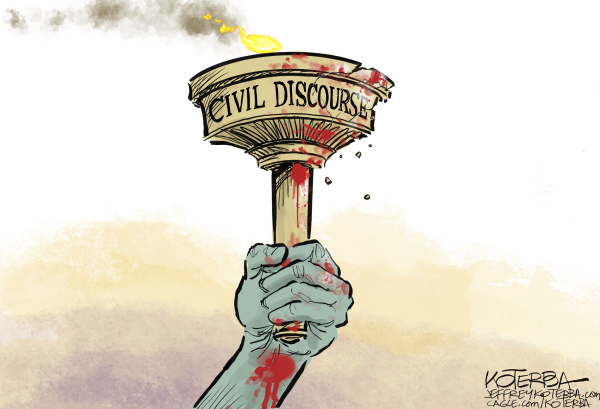
Charlie Kirk was killed because he was effective at what he did. He engaged people in the arena of ideas in an era that has often replaced thought with rhetoric.
I watched a news commentator talk very derisively about what a divisive and polarizing figure Kirk was. The implication was that his violent death was inevitable and, by extension, his own fault. For a moment I thought he was talking about Martin Luther King or Jesus or some other historical figure whose powers of persuasion were so effective at mobilizing people that the only viable way to stop them was to ensure their death.
I did not know Charlie Kirk nor paid all that much attention to him. His audience was the younger generation who often felt not just unheard but unwelcome, particularly on college campuses. Our universities have been moving in the direction of intolerance for decades. The only D I ever received in college was from a Sociology professor with whom I dared to debate his assertion that the purpose of the Vietnam war was to advance American imperialism.
This was in 1973 as the war was winding down. While our goals in Vietnam were based on flawed assumptions and even more flawed strategies, I did not believe that they were based on the idea that we wanted to replace the French in Indochina. When I challenged the professor’s assertion, he became visibly angry and suggested that my limited intellect might prevent me from seeing so obvious a truth. After that interaction, my papers, which had been As and Bs, became Cs and Ds.
Even then academia was moving to a place where the search for truth and understanding was being replaced by dogmatic theology that should not be challenged. By 2015, when I was the undersheriff in Santa Barbara County, I attended a campus meeting at UC Santa Barbara in the aftermath of a sexual assault. I was dismayed to learn that there were words that should not be uttered out of fear of offending or “triggering” someone. If anyone in the audience took exception to something a speaker said, they only had to raise both hands above their head and wave them. This was to signal the speaker that their language was unacceptable.
It was into this environment that Charlie Kirk stepped with his “Prove Me Wrong” tour. I occasionally watched his videos before his death, and a lot more over the last couple of days. He never raised his voice, he never cursed or demeaned the people who talked to him, regardless of how insulting they might have become. What impressed me was how few were the angry who seemed to hate him as opposed to the majority who cheered him on. I was never clear about whether they were cheering the essence of his ideas or simply appreciating someone who could gracefully stand up to the loud bullies who dominate intellectual discourse in our modern age.
In many of the places he appeared, there would be a petition demanding that the university ban his appearance because of his dangerous or divisive rhetoric, which was ironic. His tour was not called the “watch me prove myself right” tour, but rather the “let me give you a chance to prove me wrong” tour. He was called a Nazi and a misogynist whose words constituted hate speech. Even after his death, the commentators and the writers who used these terms never pointed to anything specific that would justify these labels, they just said he was a ”right-wing provocateur” as if that explained everything.
Charlie Kirk was a person of deep faith who seemed committed to living out that faith. He never apologized for his beliefs, nor did he demand that you embrace them. Rather he said simply here I am and here is what I believe. He had to know that what he was doing was not just controversial but physically dangerous. Given that we know how much he appeared to love his family, he certainly could not have been without fear. Nevertheless, in the words of the prophet Isaiah, he said, “Here I am Lord, send me.” Courage, someone told me a long time ago, is not the absence of fear, but rather action in the presence of fear.
In the political world that we live in, we do not debate policy anymore. Rather, those who perceive themselves as tolerant and understanding enclose themselves in an intellectual bubble in order to shut out people and ideas with whom they disagree. On the fringes, we find the screamers who demand that anyone who does not embrace their orthodox theology, regardless on which end of the political spectrum it lands, must be silenced and turned away.
I worry about the future of our country when I see polling data that suggests that 32 percent of young people believe that violence in the service of political ideals is justified. Even worse, they believe the First Amendment should be modified to ensure that no one is exposed to hate speech. We have come a long way, and not in the right direction since the days when the ACLU defended the Nazi party’s right to march in Skokie, Illinois.
Charlie Kirk’s sin was that he would not turn away and he would not be silenced. He sat alone at his table and said, “Prove me wrong.” At least one man decided that since he could not do that, he would kill him. And so, he did.

