
The OG of Art Revolutions Comes to
Santa Barbara Museum of Art
From Monet to Matisse to So Much More:
Superstar Impressionist Show Lands in S.B.
By Cheryl Crabtree | October 2, 2025
Read more of the 2025 Fall Visual Arts preview.
“This is not a gouté, or a buffet — this is a banquet of every major Impressionist artist,” says Paul Hayes Tucker, a professor emeritus at the University of Massachusetts, Boston, who has spent decades studying and teaching about Claude Monet and Impressionism and now resides in Santa Barbara.
The exhibition he’s referring to — The Impressionist Revolution: Monet to Matisse from the Dallas Museum of Art, on view October 5 through January 25, 2026, at the Santa Barbara Museum of Art (SBMA) — began in 2024 at the Dallas Museum of Art, which boasts one of the nation’s best French Impressionist collections. Timed to mark the 150-year anniversary of the first Impressionist exhibition of 1874 in Paris, it presents the evolution of a movement that began with that first exhibition and continued through the early 20th century, influencing generations of artists and altering the trajectory of global art.
Bringing a show of this importance to Santa Barbara is quite an honor. It traveled to Mexico City before arriving, and we are the only West Coast U.S. site to host the exhibit, thanks to SBMA’s close connections to the Dallas Museum of Art and its curatorial staff.
“The Impressionist Revolution: Monet to Matisse from the Dallas Museum of Art coming to Santa Barbara is a once-in-a-lifetime experience. These are extraordinary paintings that won’t be here for long,” says SBMA Director/CEO Amada Cruz. “This is a rare opportunity to view masterworks by Claude Monet, Vincent van Gogh, Henri Matisse, Paul Gauguin, Piet Mondrian, Berthe Morisot, and Edvard Munch, all in the same space.”
Tucker also raves about the show, which he says is a phenomenal event in a city of our size. “Dallas is sending serious pictures. For example, the Pissarro (‘Apple Harvest, 1888’), is one of his best, and Monet’s ‘Water Lilies’ (1908) is one of only four in the world on a round-shaped canvas. And there are still lifes from Manet, Monet, Renoir, Cézanne, and Caillebotte, all produced within 10 years of one another, all in the same place at the same time.”
When the exhibition leaves, it will travel to Nashville, Tennessee; Québec, Canada; and Richmond, Virginia before returning to its Dallas home.
Who Were the Impressionists, and Why Were They Renegades?
This exhibition is a rare opportunity to learn about different facets of the Impressionists, whose works, although considered in our times beautiful enough to adorn everything from posters and cookie tins to soap containers and placemats, were not a style but a movement that emerged in the 1870s, launched by a collective of cutting-edge artists. At the time, their works were not considered beautiful by period standards. (For additional details of the group’s background and artworks in the show, the exhibition guide, authored by Nicole R. Myers and published by Yale University Press, is available for purchase.)
Until the first Impressionist show in 1874, the only public venue to show artwork was at the prestigious, French-government-run Paris Salon, an offshoot of the French Academy of Arts that presented a jury-selected exhibition of artworks, usually once a year. At the time, France and most of the world adhered to a rigid, structured assessment of art based on hierarchies of both media (painting was at the top of the pyramid) and genre (with history, religion, and mythology at the top, followed by the human figures, with scenes of everyday life, landscapes and still life ranked at the bottom). The jury typically selected works that reflected the values the government wanted to instill in the nation.
The movement’s roots actually began in 1867 during the World’s Fair in Paris, when Gustave Courbet and Edouard Manet opened their own show just outside the fairgrounds, in opposition to the show inside, because the government-run jury wanted to control it. Courbet and Manet’s model inspired the Impressionists, who opened their first exhibition in Paris in 1874. The core members, which included Berthe Morisot, Edgar Degas, and Claude Monet, were friends and acquaintances who wanted to find a way to support themselves outside of the conservative, French-government-run fine arts system. Some of their works were accepted regularly to the Salon, while other members were rejected. They all sought more artistic freedom to experiment and a chance to make a living.
The group threw traditional artistic norms out the window. Instead of religious scenes and war campaigns, they focused their interpretations on the world around them: life in nature and the countryside, the beaches, the parks, and also the cities that were drawing workers away from the fields and into the cities, as this was the dawn of the Industrial Revolution. The Impressionists also used different artistic styles. They used short, staccato brushwork, applied quickly to the canvas, not smoothed over and without varnish finishings. Instead of muted earth tones that were the norm since the Renaissance, they chose bright, pastel hues that represented the optical sensation of light moving in nature. At the time, subjects such as horse racing and jockeys, cityscapes, and farmers represented lower social classes, which didn’t please traditional judges.
The Impressionist Revolution starts with the Impressionists’ first exhibition in 1874; the first half is devoted to the Impressionist Era from then until their last group show in 1886. The name of the collective arose from Claude Monet’s “Impression, Sunrise,” painted in 1872. A Parisian critic called the group the Impressionists; later, they accepted it as their moniker.
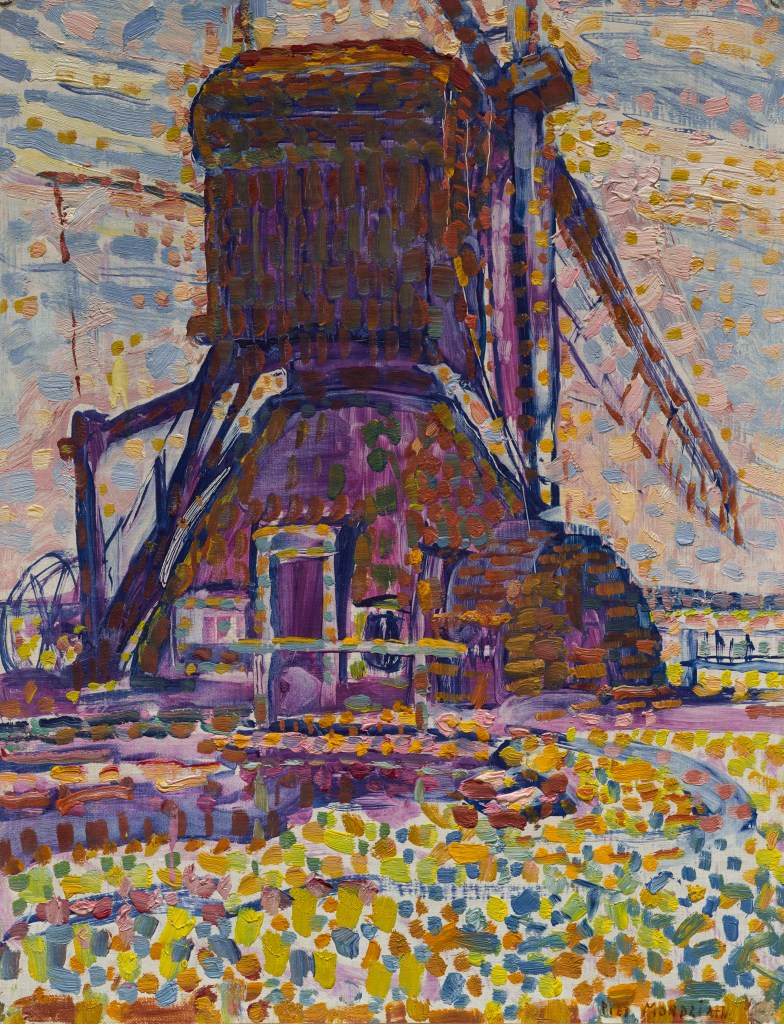
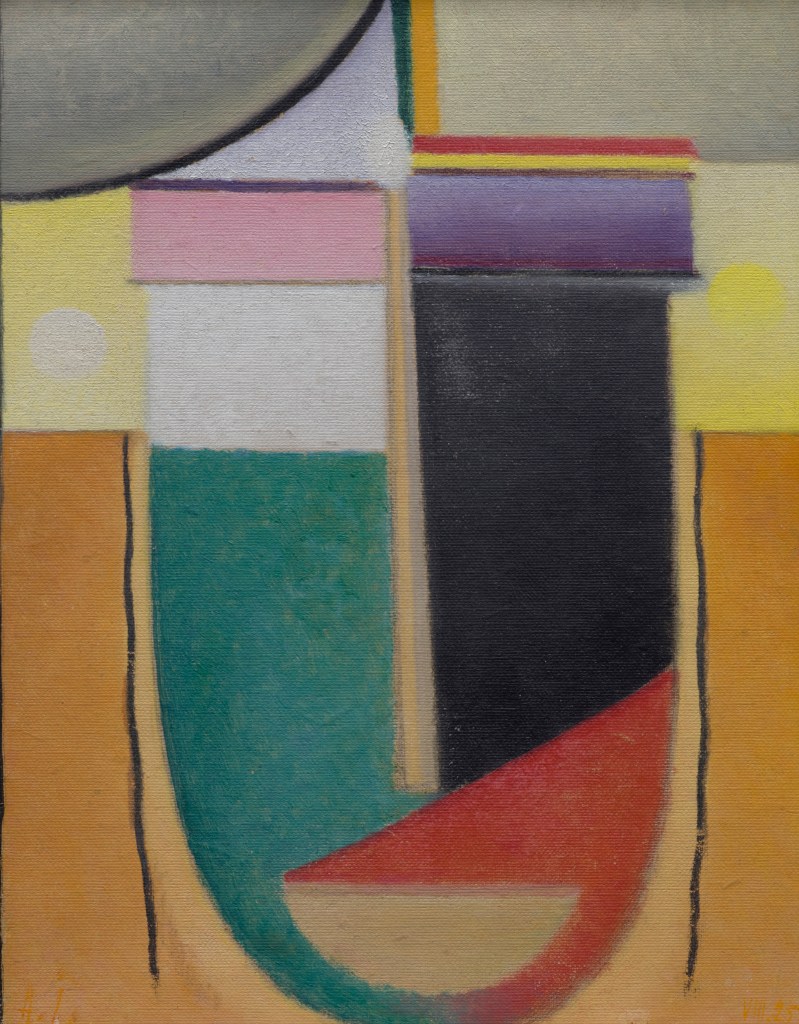
The second half of the show is devoted to the subsequent works of artists who were influenced by those radical renegades and introduced a new avant-garde in the early 20th century — including Henri Matisse, Piet Mondrian, Alexej von Jawlensky, Vincent van Gogh, and Pablo Picasso.
Exhibition Highlights
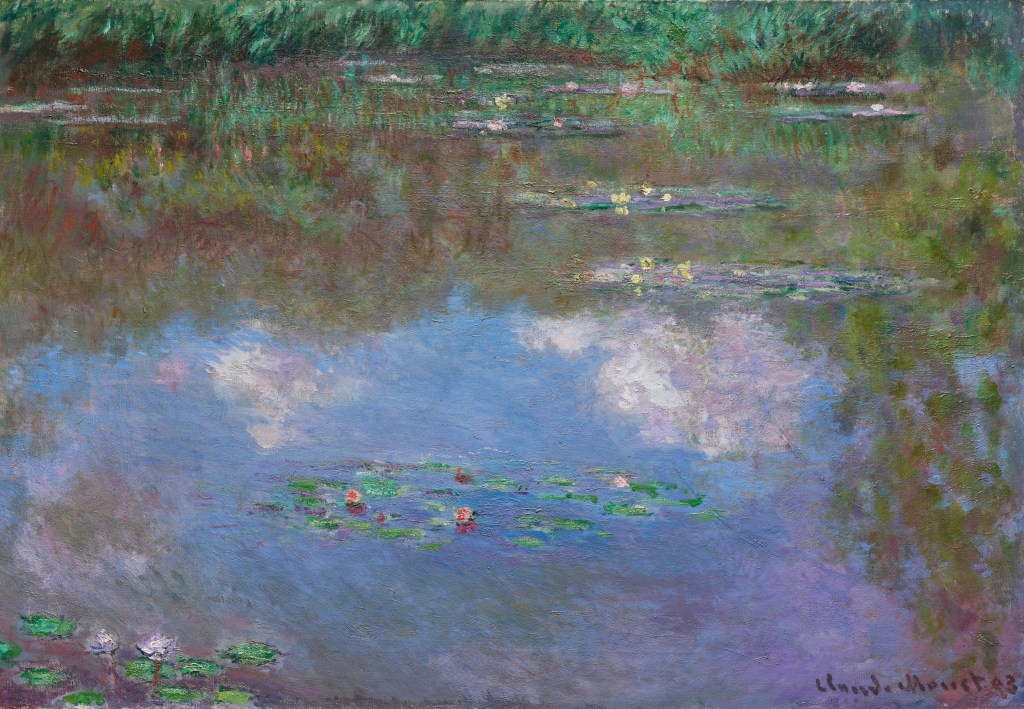
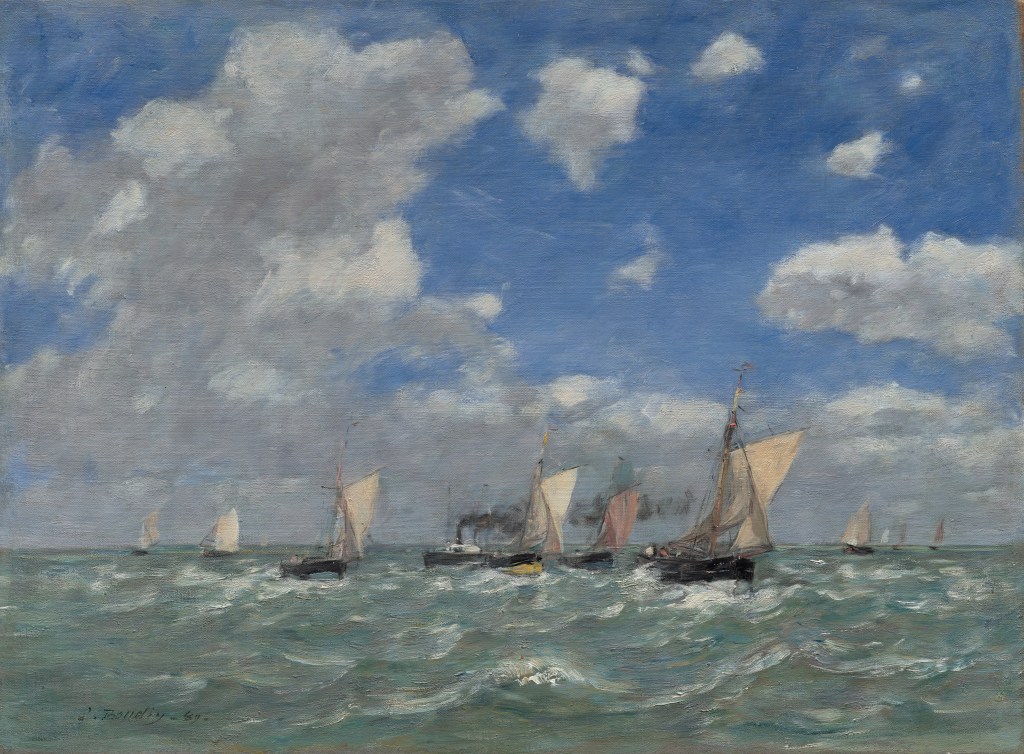
The show includes nearly 50 works of art. Standouts include: Camille Pissarro, “Apple Harvest” (1888); Claude Monet, “Valle Buona, Near Bordighera” (1884); Vincent van Gogh, “Sheaves of Wheat” (July 1890); Claude Monet, “The Water Lily Pond (Clouds)” (1903); Henri Matisse, “Pont Saint-Michel” (1901); Gustave Caillebotte, “The Path in the Garden” (1886); Paul Signac, “Mont Saint-Michel, Setting Sun” (1897); André Derain, “Fishing Boats at L’Estaque” (1906); Eugène-Louis Boudin, “Open Sea” (1899); Edvard Munch, “Thuringian Forest” (1904); Gustave Caillebotte, “Yellow Roses in a Vase” (1882); and Claude Monet, “The Pont Neuf” (1871).

Encore: 19th-Century French Art from the Santa Barbara Museum of Art
Presented in tandem with the traveling exhibition, Encore: 19th-Century French Art, is a distinct but related exhibit that reflects the quality and range of SBMA’s French art holdings and its impressive collection (25,000 pieces, rivaling those in major cities and practically unheard of in a city our size). Encore presents 40 works of art, and this is the first time SBMA has displayed all four of its Monet landscapes (three donated by Katharine Dexter McCormick and one by Lady Leslie Ridley-Tree) at once in a single exhibition.
This is a really big deal, for a number of reasons, according to Tucker. “To be able to have four Monets in Santa Barbara is absolutely dazzling,” he says. “Monet is one of the world’s most popular and sought-after artists, and the opportunity to see them is just dazzling.” He adds that the two Monet paintings set in London — “Charing Cross Bridge” and “Waterloo Bridge” — are of particular import because they reflect Monet’s continued interest in patriotic subjects and were painted during a pivotal time in Monet’s life when he had left France in response to the Dreyfus affair (a political scandal that rocked France and revealed growing anti-Semitism in Europe), which deeply disheartened him. Another reason not to miss this once-in-a-lifetime opportunity, according to Tucker, is, “Between the two companion exhibits, there are 11 Monets in the house! That’s unprecedented!”
SBMA’s team of Chief Curator James Glisson, Curatorial Assistant Andrew Witte, and former Curator of Photography and New Media Charles Wylie curated the show. “Encore aims to present the depth and breadth of our esteemed collection in a fun, accessible way,” says Glisson. “It doesn’t include just paintings — you’ll see everything from photographs and lithographs to magazines and coasters.” He adds, “The team decided a geographic approach was the best way to present the eclectic group of artworks. So, the exhibition is like a virtual tour of Paris, the French countryside, and beyond. A map of Paris and a film collaged from some of the 2,500 artworks in the collection that were made in France between 1850 and 1940 with a period soundtrack immerses visitors in the life and music of that period.”

Your virtual journey through Encore includes a wide swath of Europe. It begins in Italy and the French Riviera and continues up to Paris (including the Eiffel Tower, Montmartre, the Louvre, Notre Dame Cathedral), through the French countryside and along the shores of Normandy and Brittany. The journey concludes with virtual visits to the Netherlands and Germany, before ending in London, a favorite Impressionist hangout. Along your route, you get to view works by Degas, Monet, Matisse, Morisot, Caillebotte, Sisley, Boudin, and Tissot.
On view is one of the greatest paintings in the SBMA collection: Henri Matisse’s “Pont Saint- Michel,” originally a gift from one of the SBMA founders, Wright S. Ludington. The show is also a rare opportunity to see “On the Beach at Fécamp” (1874) by Berthe Morisot.
Other standouts include Claude Monet’s “Villas in Bordighera,” which viewers often say looks like Santa Barbara. “It’s colorful, light-filled — Monet went to the south of France to see if he could paint those landscapes, which were very different from those in Normandy,” Tucker says. “He wanted to see if he could capture ‘fairylike light’ — he wanted to improve on Impressionism, to see if they could ‘paint anything’ — to respond to and elevate all aspects of the country.”
Claude Monet, “Afternoon on the Seine” (1897) is another notable piece, according to Tucker. “This was at the tail end of a group of 21 paintings he did while floating on the Seine in the early morning, trying to capture mist dissipating at sunrise. This one was at the tail end of the series because it’s clear and brilliant. Also, the Seine represents the lifeline of France.”
Also noteworthy are: Paul Signac, “Herblay–The Riverbank” (1889); Berthe Morisot, “Young Girl Hanging a Bird Cage in a Tree” (1890); and Albert Sisley, “Saint-Mammès, Banks of the Seine” (1885).
Visit sbma.net for full details on the full slate of public programs, performances, and other activities.
Events
Saturday, October 4, 5:30-7:30 p.m.
A French-themed party — The First Impression: Paris by Night — kicks off the show with champagne and appetizers, live music, photo booths, and early access to the special exhibitions.
Sunday, October 5, 10 a.m.-noon
Members can preview the exhibition before it opens to the public. Family-friendly activities will take place in the on-site Art Learning Lab.
Sunday, October 5, noon-1:30 p.m.
Attend a special lecture, “That 1870s Show: In Conversation with Curator Nicole R. Myers,” where she will dispense juicy tidbits about the scandalous origins of the Impressionist collective and their rebellious renegade actions.
Saturday, December 6, noon-1:30 p.m.
Don’t miss this fascinating conversation with Paul Hayes Tucker, an influential art historian, curator, and author, lauded as one of America’s foremost authorities on Claude Monet and Impressionism. He taught at the University of Massachusetts, Boston, and now lives here in Santa Barbara.
Sunday, January 6, 2026
Also make a point of attending a talk with Sebastian Smee, a Pulitzer Prize winner and art critic for The Washington Post who will speak about his views about the Impressionists and the Parisian environment. He is the author of Paris in Ruins: Love, War, and the Birth of Impressionism.
Get Your Tickets Early
Visitors need to purchase additional admission tickets for these special exhibitions, all set for designated viewing times, with entry on the hour from 11 a.m. to 4 pm. Prices are $30 for adults; $25 for seniors; and $21 for youth 6 to 17 years old. Students, teachers, and children under 6 are free. Docents will guide daily tours for the public throughout the exhibition run. Note: Members receive one complimentary visit to the exhibitions.
Editor’s Note: This story has been updated to reflect that due to popular demand, Museum members receive one complimentary visit to the exhibitions. For more information, see sbma.net/visit/planyourtrip.




You must be logged in to post a comment.