

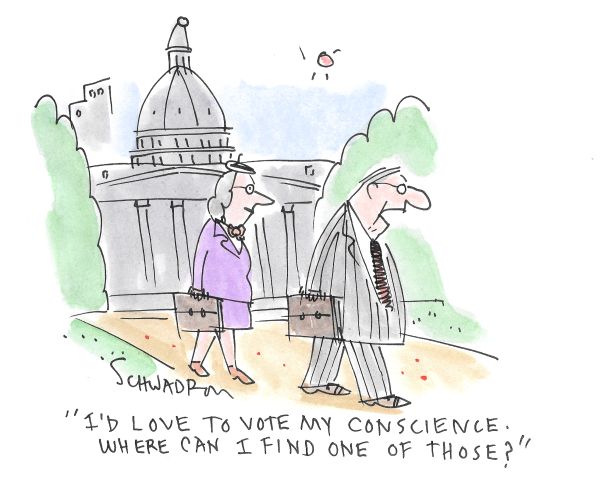
“At what point then is the approach of danger to be expected? I answer, if it ever reach us, it must spring up amongst us; it cannot come from abroad. If destruction be our lot, we must ourselves be its author and finisher.” —Abraham Lincoln, Address to the Young Men’s Lyceum of Springfield, Illinois, 1838
Voltaire once said, “Common sense is not so common.”
Nearly three centuries later, that bit of irony feels less like wit and more like warning. In a country that prides itself on independence of thought, far too many Americans have surrendered that independence to political tribalism. Decisions aren’t guided by reason or facts but by which side happens to be yelling loudest.
Common sense — real common sense — isn’t complicated. It means taking a step back, looking at the evidence, and asking, “Does this make sense?” But in today’s America, facts have become negotiable, truth is measured in likes and retweets, and reasoned debate has been replaced by reflexive outrage. We’re not thinking anymore — we’re reacting. And reaction, without reflection, is the enemy of common sense.
What’s worse is that we’ve learned to justify it. We tell ourselves that our side must be right because the other side mustbe wrong. That’s not logic; that’s tribalism dressed up as conviction. It’s the kind of thinking that blinds us to reality and allows misinformation to take root.
Voltaire would have understood this all too well. He lived in a time of censorship, fear, and rigid orthodoxy. Yet he never stopped challenging authority or insisting that reason, not passion, should guide society. He believed that truth could withstand scrutiny — and that any idea afraid of scrutiny probably wasn’t worth defending. That’s the spirit America was built on: the freedom to question, to doubt, to reason together.
Somewhere along the way, we’ve lost that habit. We’ve confused strength with stubbornness and clarity with volume. We’ve become so determined to win arguments that we’ve stopped trying to understand them. And in the process, we’ve misplaced something deeper — our sense of shared purpose, the moral compass that points us toward what’s fair and decent.
Common sense, at its core, depends on humility. It’s the recognition that none of us has a monopoly on truth, that wisdom often begins with the words, “I might be wrong.” When humility disappears, arrogance takes its place. When facts are replaced with feelings, when loyalty replaces logic, the result isn’t just confusion — it’s corrosion.
We can see it everywhere: in politics that rewards outrage over ideas, in media that profits from division, in a public discourse where compromise is treated as weakness. The louder the noise, the harder it is to hear the still, small voice of reason.
Common sense alone won’t fix everything, but it can clear the fog. It reminds us that facts matter, that decency matters, that truth is not an opinion tailored to fit convenience. When we lose sight of that, we lose the thread that holds us together.
The founders believed that reason and virtue were not luxuries but necessities—that a free people must govern not just by law, but by conscience. They understood that democracy is not sustained by force or fear, but by the moral courage to think clearly and act justly.
Through the morass of misinformation, disinformation, spin, and political bias, America is looking for its soul — the soul the founders intended as direction, not domination; as conscience, not convenience.
The only question that remains is this: will we find it — or surrender to the passions and prejudices that Lincoln warned could destroy us from within?
Jim Lichtman’s weekly commentaries can be found at ItsEthicsStupid.com. He is the author of “Trust and Confidence—Inside the Battle Between The Secret Service and Ken Starr.”

