
Peace in Practice at Montessori
How Montessori Education Nurtures
Emotional Intelligence and Global Citizenship
By Tiana Moloney | November 20, 2025

Read more from Schools of Thought 2025 here.
At Montessori Center School, peace isn’t treated as a lofty ideal or a poster that hangs on the wall — it’s woven into the everyday rhythm of the classroom. Long before students begin learning world languages or working with Montessori materials, they are learning how to listen, collaborate, and treat one another with respect.
These early lessons shape everything else that follows. As classrooms move through their three-year cycles, children learn not only academic skills but also how to be thoughtful members of a community, navigate conflict with empathy, and build genuine connections across differences.
For this Schools of Thought issue, Montessori’s Head of School Vanessa Jackson sat down with us to share more about the school’s unique approach.
You describe Peace Education as the foundation of Montessori learning — not an add-on. Can you give a concrete example of what that looks like in a classroom on an ordinary day? Montessori peace education is a holistic framework that nurtures empathy, collaboration, cultural understanding, and emotional regulation as foundational life skills. At Montessori Center School, our classrooms are organized in three-year cycles, which provides amazing opportunities to nurture socialization among children through the lens of peace education.
This shows up in practical ways all week long: older children guiding younger peers with grace and patience, daily community meetings where students resolve conflicts using respectful dialogue, and cultural studies that immerse children in global traditions, geography, and stories. These experiences create a lived practice of peace, not just a lesson about it. When students learn to care for one another, care for shared materials, and honor diverse perspectives, they’re building the internal capacities needed to thrive in a multicultural world.
Dr. Maria Montessori believed education was the most powerful tool for creating peace. How does that philosophy translate into a modern school setting in 2025, especially in a world that feels increasingly polarized? As we step into an AI-forward era — where creativity, compassion, and ethical decision-making will matter more than ever — this foundation becomes even more critical. Children who grow up practicing empathy and understanding the interdependence of all people and the environment are primed to become innovators who understand how to uplift the communities they’re part of. They know how to act with both confidence and compassion.
Political polarization tends to occur when people become increasingly anchored in rigid identities and lack meaningful opportunities to practice perspective-taking. Montessori peace education directly counters these forces by cultivating the habits of mind that help children learn to collaborate across differences; resolve conflicts using structured, respectful language; and take responsibility for the impact of their choices on the community.
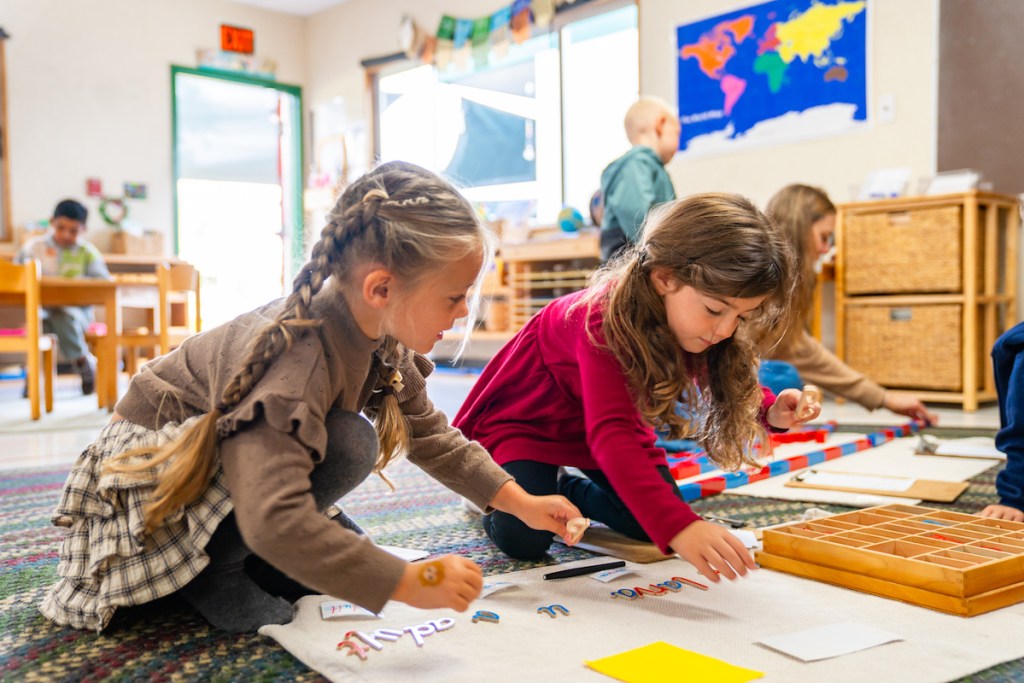
Many schools today talk about social-emotional learning (SEL). What makes the Montessori approach different from mainstream SEL programs? What sets Montessori apart from mainstream SEL programs is that Montessori peace education is not a once-a-week lesson or a separate packaged curriculum — it is the lived fabric of the classroom. Montessori environments intentionally cultivate emotional intelligence, empathy, and conflict resolution through daily, developmentally appropriate practice rather than scripted instruction.
Because children remain with the same peers and teachers for three years, they build genuine relationships and learn to navigate differences with real responsibility and continuity. Tools like the Peace Table, grace-and-courtesy lessons, mixed-age collaboration, and purposeful independence help students internalize self-regulation, respect, and social awareness organically. Instead of teaching children how to be peaceful, Montessori allows them to experience peace — and to carry that experience into the wider world.
You offer both Spanish immersion and Mandarin instruction. How early do students begin learning those languages, and what does “immersion” look like in practice? Children at our school begin learning Spanish and Mandarin as soon as they enter the Toddler program—as early as 18 months of age— when their brains are naturally attuned to absorbing language through meaningful, real-world interactions. In a Montessori environment, language learning isn’t about memorizing vocabulary lists; it’s about hearing, speaking, and using the language organically throughout the day as part of classroom life. Teachers give lessons, read stories, sing songs, and hold simple conversations in the target language, while children work with hands-on materials that make grammar, phonetics, and cultural context concrete and intuitive. The method is connected to Montessori peace education: By learning another language through authentic human connection, children develop empathy, cultural humility, and a natural sense of global citizenship from their earliest years.
Our Spanish immersion program currently serves children from age 3 through 2nd grade and is expanding through 6th grade, with the goal of Spanish and English biliteracy and bilingualism by 6th grade. The simplest way to think about our Montessori Spanish immersion classrooms is to envision a Montessori classroom — but conducted in two languages rather than in one. All morning, the teachers and students communicate and learn in Spanish, working together with Spanish language materials and tools. Gradually, as students reach kindergarten and beyond, they begin to work in English in the afternoons. By 3rd grade, the language split approaches 50-50.
There’s a robust body of research highlighting the myriad benefits of language immersion for young children: cognitive flexibility, bilingualism, cross-cultural appreciation, and confidence in learning. Montessori lends itself beautifully to immersion because, in addition to the two teachers in each classroom, children learn from one another as well as from the richness of the Montessori language materials.
See mcssb.org.


You must be logged in to post a comment.