

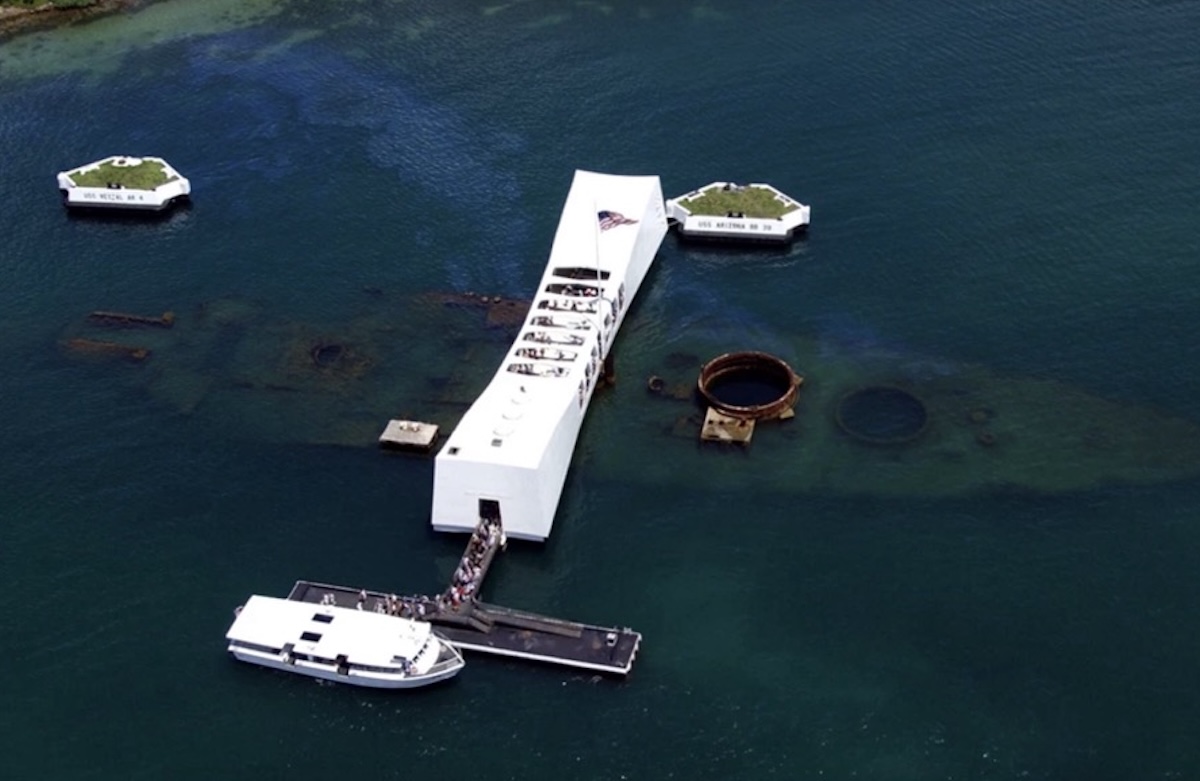
“This is not a tourist attraction; this is a memorial,” a uniformed sailor said as a motor launch slowly ferried our family and others toward the submerged remains of the battleship Arizona. It was just days before the December 7 anniversary of the attack on Pearl Harbor, and the boat was silent as we approached the resting place of 1,102 of the seamen killed onboard when World War II dawned for the U.S. The white ship-like monument sat quietly over the wreckage of what had been a state-of-the-art battleship. Across 84 years, our visit would witness solemn history and for a 7-year-old, provide some cognitive dissonance.
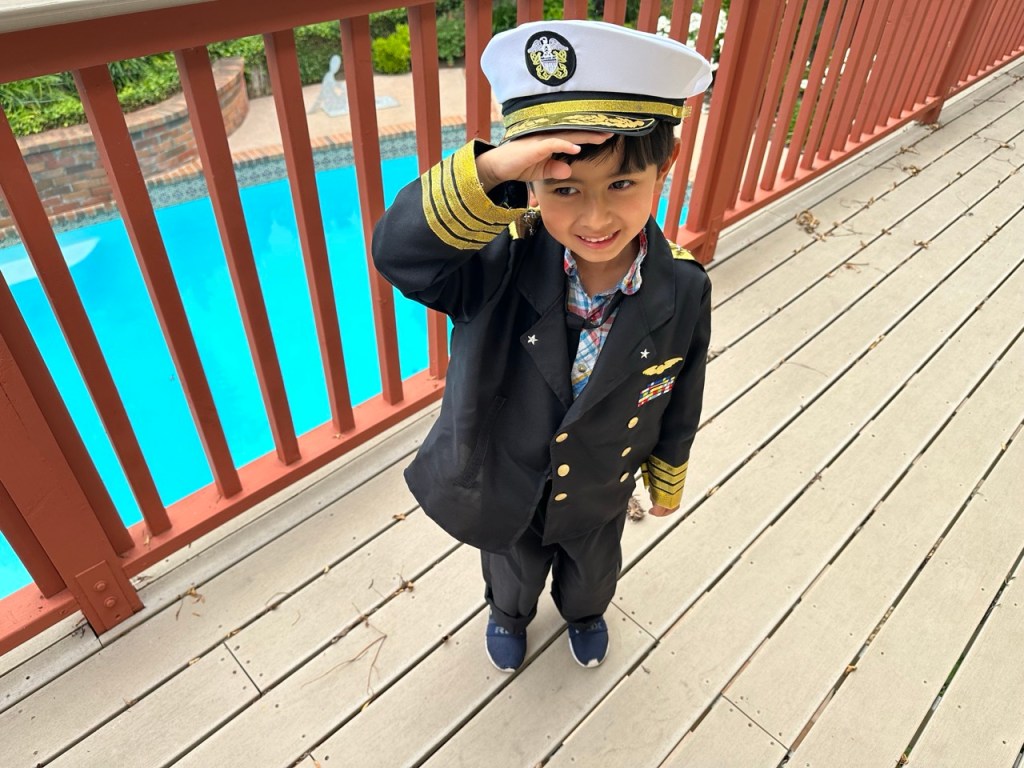
You may have seen young Samson Peck at Stearns Wharf, cosplaying a uniformed admiral, trading salutes with passersby as the Lil’ Toot waterfront taxi blows acknowledgement. The former volcano explorer has moved through fascination with the Titanic into fixating on the weaponry of World War II. Are you smarter than a 2nd grader when it comes to knowing which model of the B-17 bomber had chin gun turrets?
In Honolulu, our watery tour would include a tale of two submarines, a naval titan, and a tribute to a catastrophe.
Beginning in tourist-centric Waikiki, the Atlantis IV, a Captain Nemo–ish commercial submarine, took us down more than 100 feet. Sunken structures and even a large plane — ironic in light of subsequent stops, a scrapped Japanese-made Mitsubishi YS11 airliner — provide artificial reefs that attract coral and fish as large as sharks.
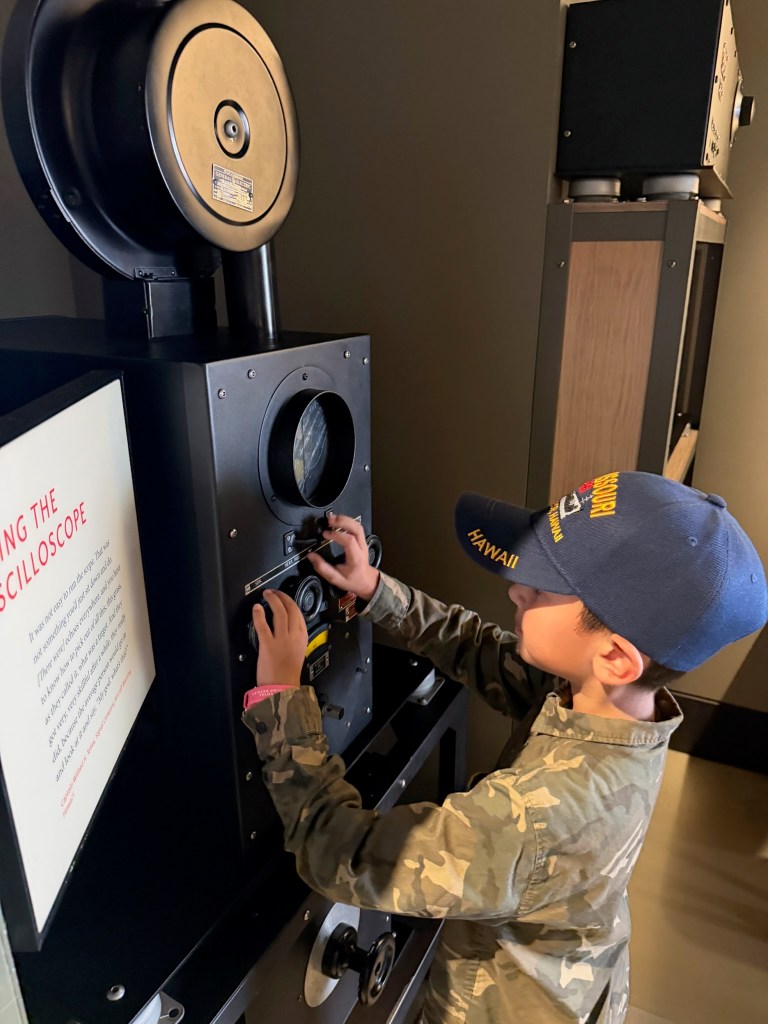
Initially, Sam said, the blue-lit 64-passenger sub “felt kind of scary, like my chest tightened.” But he mellowed out. “I liked seeing the wing and the engine of the plane. Lots of stuff growing on it. It was kind of odd — a plane is meant to fly, not go underwater.” If you’re au courant with the latest kid slang, he was happy when the craft was “‘6-7’ [feet] below the surface.”
Shifting to Pearl Harbor, we climbed down into and shimmied through the tight quarters of a second sub. The USS Bowfin served during both the Second and Korean Wars, its log claiming 44 enemy vessels sunk. “It was nice walking through all the rooms,” Sam said. “It was tight. The torpedoes were smaller than I thought.” Another thought dawned about life during wartime. “It felt shocking, the idea of being underwater for so long.”
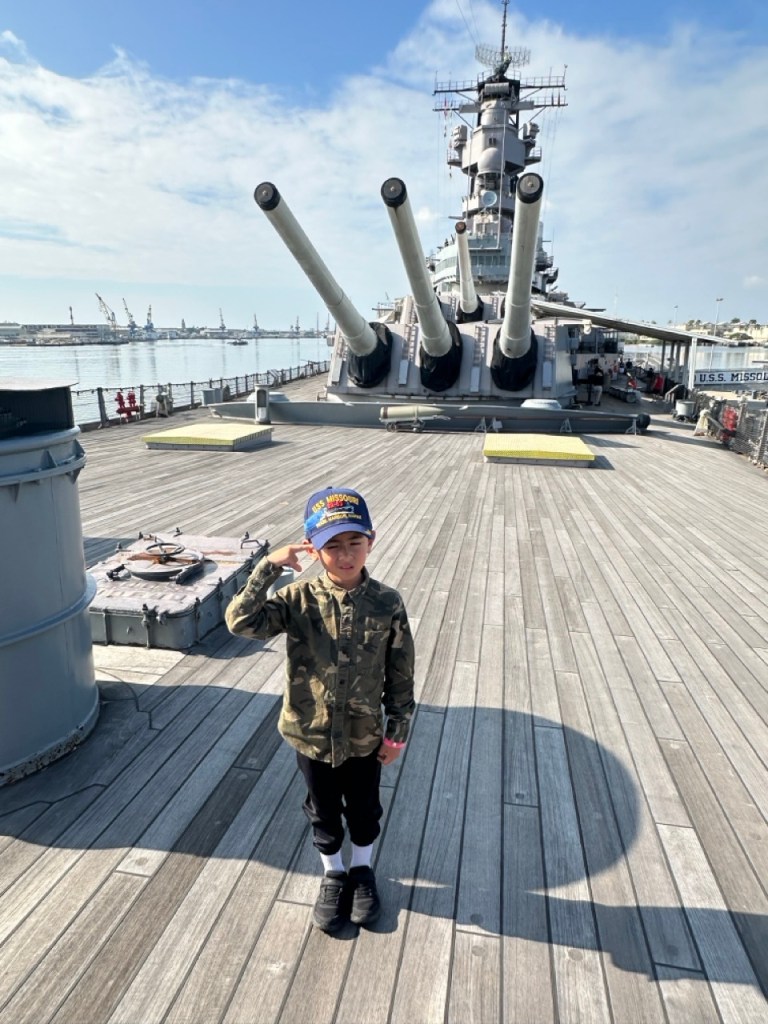
Moored at Ford Island, the USS Missouri dwarfed both subs. Launched post–Pearl Harbor, this massive “Mighty Mo” served long enough to be retrofitted with missiles during Desert Storm. “The guns were huge, like 15 times my height,” Sam said, impressed.
But the price of war intensified. A kamikaze Zero fighter, dispatched in desperation as Japan’s defeat loomed, struck the Missouri during the 1945 Battle of Okinawa. While an alert crew minimized damage, our tour guide stressed that the ship’s captain had ordered a warrior-to-warrior military burial at sea for its pilot.
Sam was puzzled. “I saw the mark that the kamikaze left. Why didn’t they jump out at the last second? They were sacrificing themselves to kill more people for their country.”
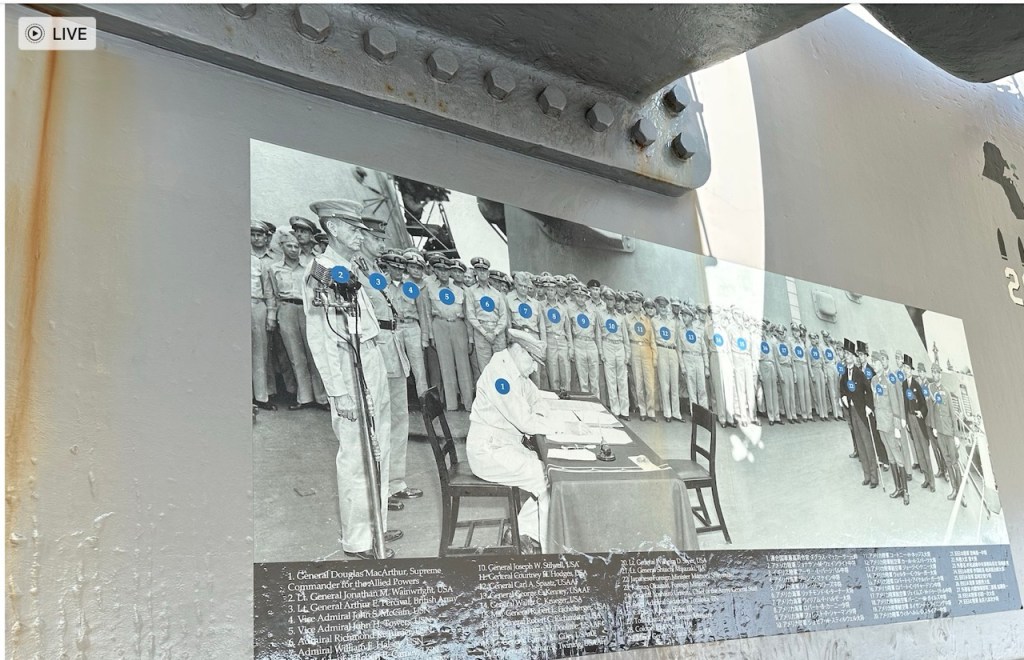
A high point on the Missouri marked the war’s close. The Surrender Deck, where Japanese and Allied representatives formally ended World War II, was enhanced by photos and the document that would begin Japan’s reconstruction as a democracy. “I loved it a lot,” Sam said. “It was really historical.”
Sam distinguished between past aggressors and current-day visitors. “I was nice to the Japanese people even though they attacked and made me cry. The people there were civilians.”
As we prepared to leave the Missouri, a generational moment happened: the USS Nimitz, a modern aircraft carrier, was tugged past us toward safe harbor. “It was really striking,” Sam said. “It was so big, carrying so many planes.”
Finally, the Arizona. After a short film at the Visitor’s Center contextualized the events of that Day of Infamy, we reached the memorial. A rusted turret and a few other manifestations of the sunken ship is all that can be seen from above, and Sam noted that the 185-foot memorial is smaller than the 608-foot ship it commemorates. But the magnetic draw is a wall featuring the names of all who rest below the water — including four sets of brothers, a father-son pair and survivors who chose to be interred there after offshore deaths. (The last survivor of the assault died in 2024.)

Our little visitor stood alone before a large wall next to a large wreath. “I saluted the names to honor their sacrifice,” Sam said.
Later, Sam cried about an experience that had both enriched and tempered his fascination. “I feel bad that all the people died. I don’t like weapons as much.”
Abe Peck lives in Santa Barbara but is a professor emeritus in service at the Medill School of Journalism/Northwestern University in Illinois. He’s traveled for Rolling Stone, Outside, Travel Weekly and The Chicago Sun-Times.
Samson Peck is a 2nd grader at Mountain View Elementary.
If you go:
Tour packages abound, or attraction tickets for each stop can be purchased online. To see the Arizona costs just $1 per person, but reservations need to be made through recreation.gov. More than 4,000 people a day can visit, so provide flexibility even if that results in a barrage of emails. For more information, contact nps.gov/pearl harbor.
Related Posts

Premier Events
Mon, Mar 09
6:00 PM
Santa Barbara
ART 4 GRIEF Support Group

Sat, Mar 14
7:00 PM
Santa Barbara
Red, White, & Blues II: The American Songbook
Sun, Mar 15
3:00 PM
Santa Barbara
Red, White, & Blues II: The American Songbook
Mon, Mar 09
6:30 PM
Santa Barbara
Science Pub: Cyborg Jellies Exploring Our Oceans
Thu, Mar 12
6:00 PM
Santa Barbara
Poetry, Typewriters, and Collage Workshop
Thu, Mar 12
6:30 PM
Santa Barbara
An Evening of Wild Hope: PBS Film Screenings
Thu, Mar 12
7:00 PM
Santa Barbara
Lights Up! Presents: “The Addams Family”
Fri, Mar 13
6:00 PM
Santa Barbara
GLOW X: A High-Definition Neon Experience
Fri, Mar 13
7:00 PM
Goleta
Peace Event
Sat, Mar 14
7:00 PM
Santa Barbara
The Vada Draw
Sat, Mar 14
7:00 PM
Santa Barbara
Lights Up! Presents: “The Addams Family”
Sat, Mar 28
All day
Santa Barbara
Coffee Culture Fest
Mon, Mar 09 6:00 PM
Santa Barbara
ART 4 GRIEF Support Group
Sat, Mar 14 7:00 PM
Santa Barbara
Red, White, & Blues II: The American Songbook
Sun, Mar 15 3:00 PM
Santa Barbara
Red, White, & Blues II: The American Songbook
Mon, Mar 09 6:30 PM
Santa Barbara
Science Pub: Cyborg Jellies Exploring Our Oceans
Thu, Mar 12 6:00 PM
Santa Barbara
Poetry, Typewriters, and Collage Workshop
Thu, Mar 12 6:30 PM
Santa Barbara
An Evening of Wild Hope: PBS Film Screenings
Thu, Mar 12 7:00 PM
Santa Barbara
Lights Up! Presents: “The Addams Family”
Fri, Mar 13 6:00 PM
Santa Barbara
GLOW X: A High-Definition Neon Experience
Fri, Mar 13 7:00 PM
Goleta
Peace Event
Sat, Mar 14 7:00 PM
Santa Barbara
The Vada Draw
Sat, Mar 14 7:00 PM
Santa Barbara
Lights Up! Presents: “The Addams Family”
Sat, Mar 28 All day
Santa Barbara


You must be logged in to post a comment.