
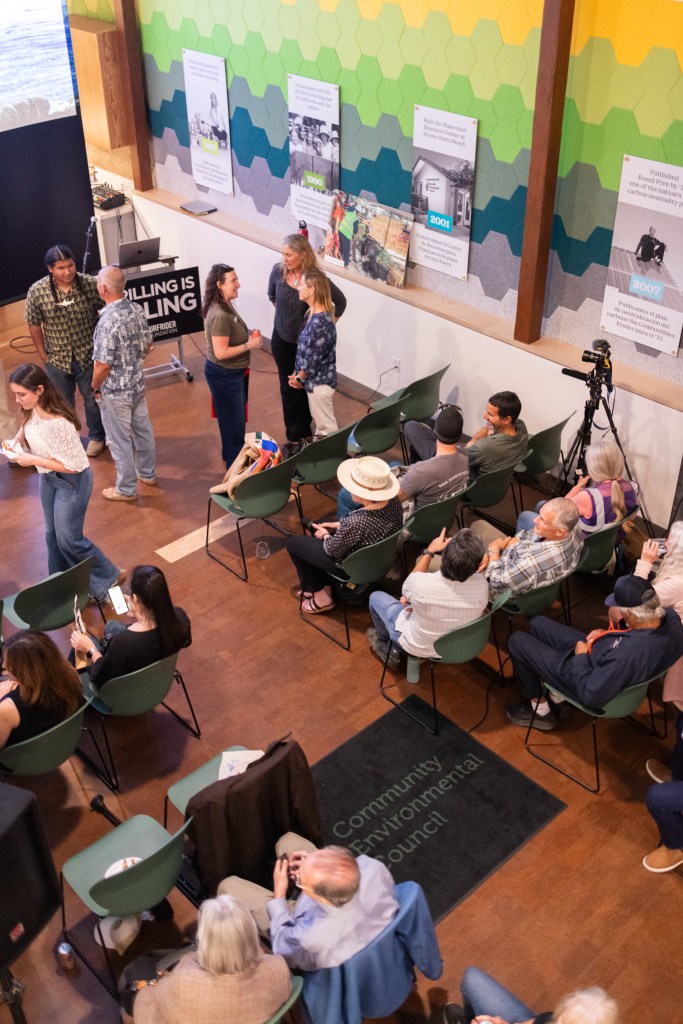
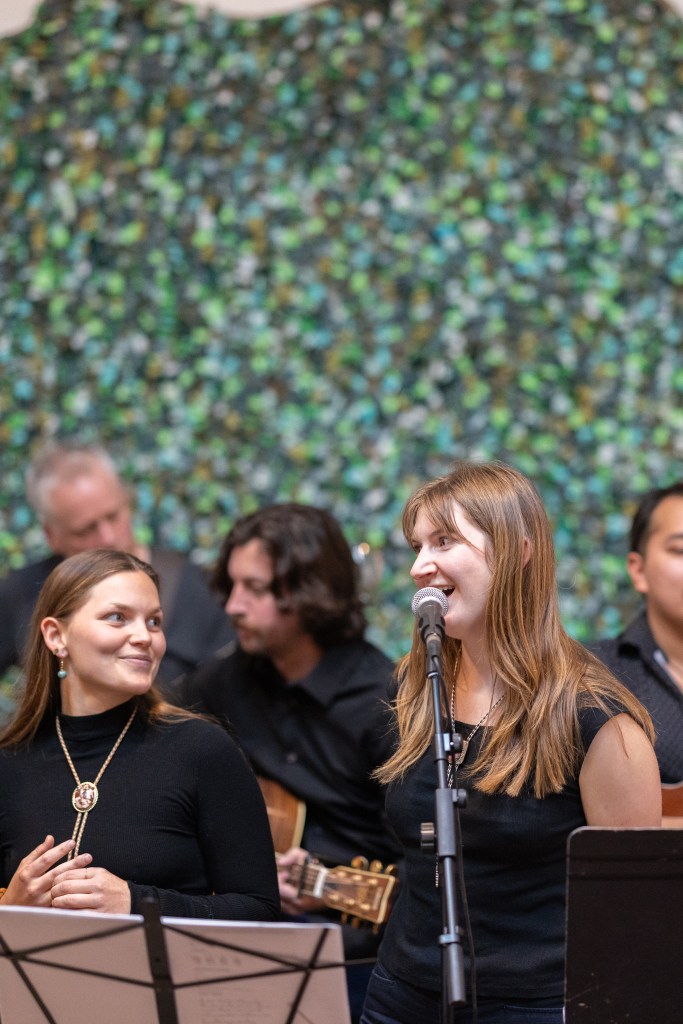
On Friday night, Santa Barbara’s environmental community packed into a place aptly named the Hub — not to be persuaded, but to align, and, by design, to do so “upliftingly.”
The People’s Hearing on a recently released federal offshore drilling project drew a packed room of students, elders, tribal leaders, elected officials, business representatives, and a celebrity advocate, united less by novelty than by memory. Many speakers acknowledged it outright: This was preaching to the choir.
But as the night made clear, choirs matter — especially when the stakes are generational, the threat is federal, and, in Santa Barbara’s case, people understand and have witnessed the profound dangers of an oil accident.
Hosted by the Environmental Defense Center, the People’s Hearing centered on a draft offshore oil and gas leasing plan released in November by the U.S. Department of the Interior that would reopen much of California’s coastline to new offshore drilling.
The proposal includes six leases that will be opened to bidding off the Pacific Coast beginning as early as 2027, despite decades of opposition from California communities and officials. This meeting at the Hub was part of a 60-day comment period that closes January 23.
“This is the first step in a four-stage process to oil production under federal law,” said Maggie Hall, deputy chief counsel at the Environmental Defense Center, who opened the evening with a detailed overview of the federal plan. “Leasing, exploration, development and production.”
Hall explained that while no new leasing has occurred off Southern California since 1984, the draft program, proposed on Thanksgiving, includes the entire Pacific region with the potential of three leases specifically in Southern California waters.
The Environmental Defense Center is coordinating with a broad coalition of national organizations to submit a collective sign-on letter opposing the plan. The group has urged local governments to formally oppose the proposal and is now calling on individual Californians to submit written comments which will be collected by the Surfrider Foundation and sent to the Department of the Interior. Essentially speak now or forever hold your peace.
“The Santa Barbara Channel has been dubbed the Galápagos of North America,” Hall said, citing its biological diversity and protected status, including the Channel Islands National Park and two national marine sanctuaries. “All of these resources are threatened by new drilling.”
Hall emphasized that the plan is distinct from — though not entirely unrelated to — Sable Offshore Corp.’s efforts to restart oil production off the Gaviota Coast, noting that new federal leasing would expand the infrastructure and risk profile already haunting the region. “This takes us backward,” she said, calling the proposal incompatible with energy policy and climate goals.
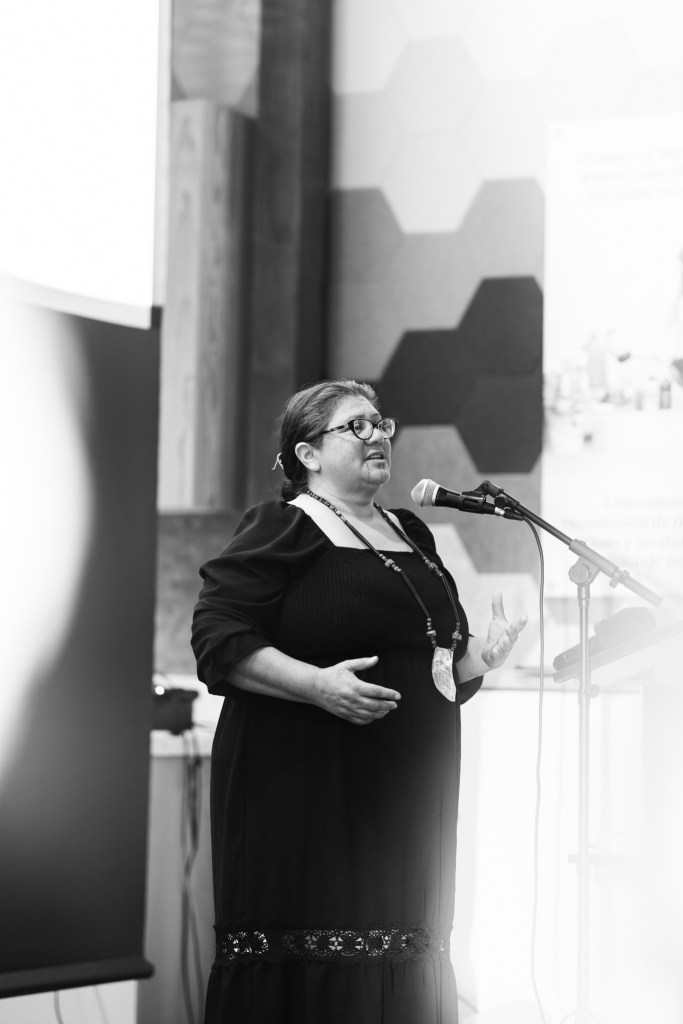
Mia Lopez, a Chumash land and water protector, cultural educator, and member of the Coastal Band of the Chumash Nation, took the chance during her land acknowledgement to do just that.
“Our people were removed from our islands of origin,” Lopez said, describing the forced displacement of Chumash communities under colonization. “Today, it’s still happening — but now it’s happening to more than just us.”
Lopez connected offshore drilling to a broader dislocation: from land, from water, from responsibility. “If people have forgotten their connection to the earth,” she said, “they can no longer connect to other people.”
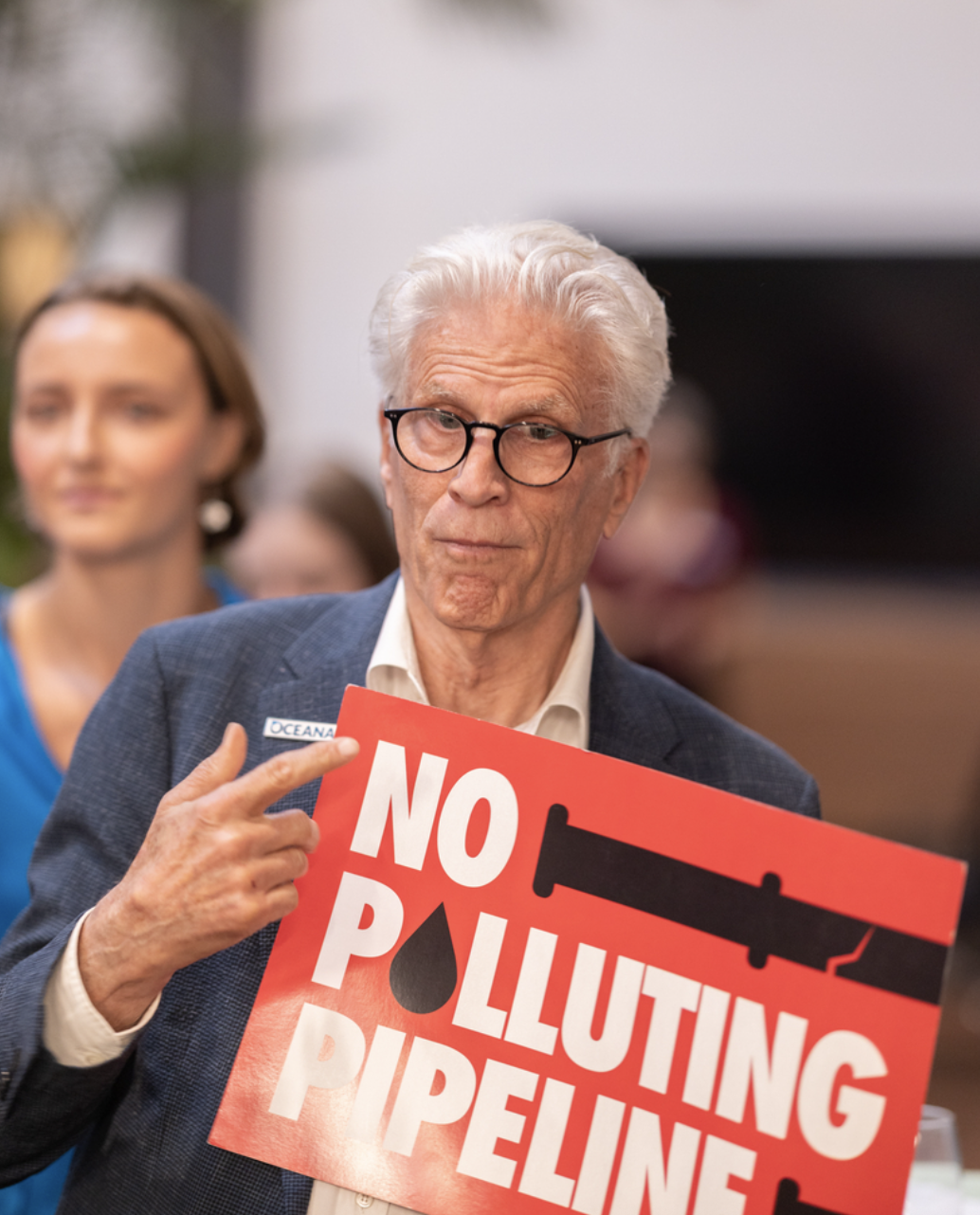
The sheer range of people in the room — young and old, lawyers and fishermen and even the front man of Cheers, Ted Danson — reflected the depth of Santa Barbara’s attachment to its coastline. “We keep repeating the same pattern,” said Veronica Mendoza, a Chumash lineal descendant, referring to the catastrophic pollution and two infamous oil spills caused by over the past half-century. “It’s insane.”
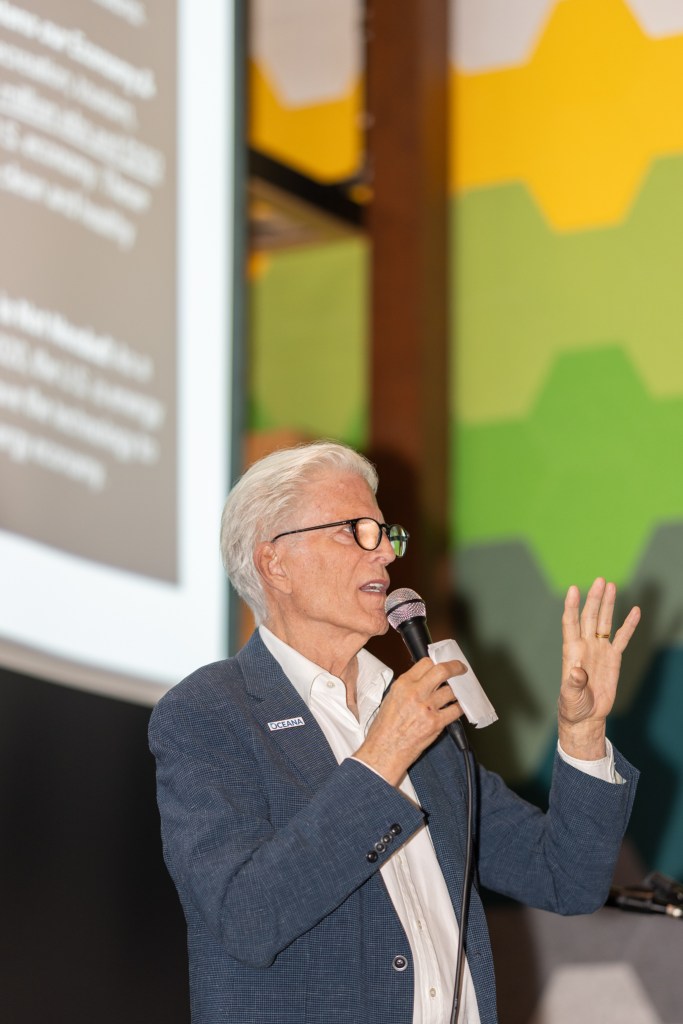
Mendoza recalled the 1969 Santa Barbara oil spill — “when the ocean turned black” — and the way catastrophe forced the country to confront the costs of extraction.
A longtime ocean advocate, Danson brought humor and self-awareness to the microphone, joking that he has often become the public-facing spokesperson for ocean issues– using his platform to pull scientists onto larger stages.
Danson spoke about learning to pair emotion with expertise — “heart with science” — and about choosing persuasion over anger. “There are people on both sides of the aisle who love their coastal towns,” Danson said. “If you come from anger, it rarely works. You fight with love — and you remind people of what’s at stake.”
Danson thanked the audience not for agreeing, but for caring — “for letting me be in a room with so many kind, dedicated people” — reinforcing the sense that the gathering itself was the message.
Elected officials then joined the chorus.
Congressmember Salud Carbajal called the federal plan “reckless” and unnecessary, pointing to Santa Barbara’s lived experience with oil disasters, including the 2015 Refugio spill, which occurred during his tenure on the Board of Supervisors.
“We are here tonight to say together, unequivocally, our coastline is NOT for sale,” Carbajal said. “Some places are just too damn special to put at risk.”
Assemblymember Gregg Hart framed the moment as both familiar and urgent, recalling visiting oil-slicked shores as a child after the 1969 spill.
“We are embracing the past in a really stupid way,” Hart said, criticizing what he described as a federal abandonment of science and common sense. On a lighter note, he reminded the audience who they have placed in government — including Representative Carbajal and newly elected Senate President pro Tempore Monique Limón — underscoring that the “Central Coast is the center of the political universe, and we are going to use that power.”
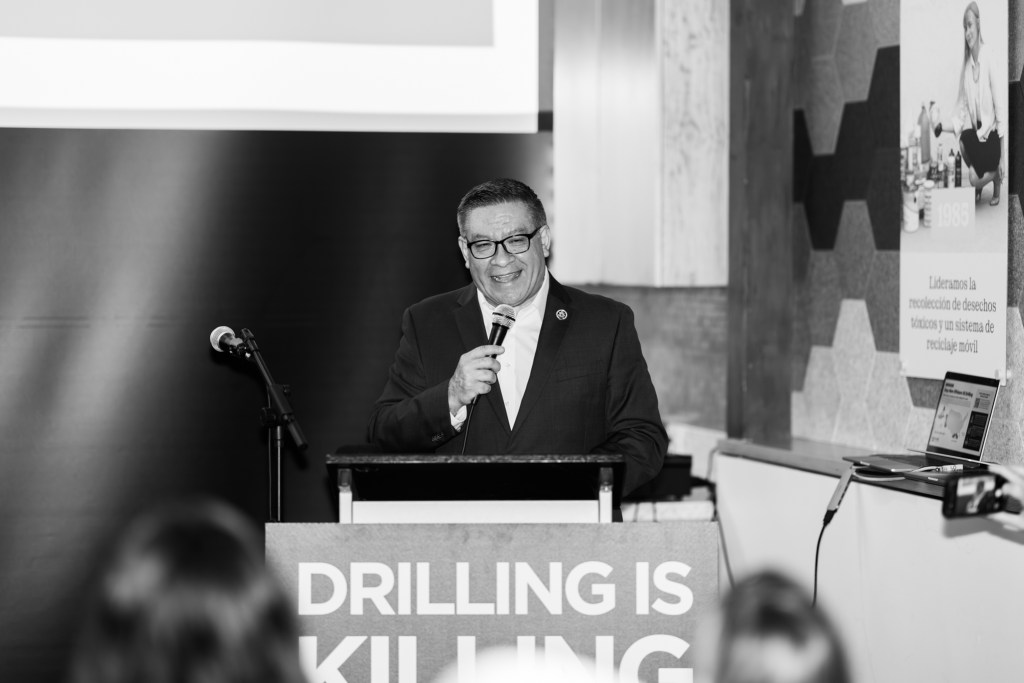
County Supervisors Laura Capps and Joan Hartmann echoed the call to action, emphasizing both people power and political timelines. Capps pointed to November 2026 as a critical inflection point — not just for offshore drilling, but for political leadership more broadly.
“This is a people’s hearing,” Capps said. “And the people have shown up.”
By the end of the night, the speakers reflected the room itself: a Patagonia representative spoke of economic dependence on clean coastlines; fishermen described climate impacts on their livelihoods; students from UCSB and local high schools invoked their futures — some acknowledging they came for the issue, others joking they came “because you might just be a fan of Ted Danson.”
The range of voices underscored the central argument: offshore drilling is not an abstract debate here. It is historical, cultural, economic, and ecological — and, as Mendoza put it, not just a view or a landscape, but the land and water that allow us to live.
The People’s Hearing did not pretend to convert skeptics in the room. Instead, it functioned as something more strategic: a public record of resistance, and a reminder that even when the choir already knows the song, it still needs to sing — loudly enough to be heard far beyond the Hub.
Related Posts

Premier Events

Thu, Apr 09
7:00 PM
Santa Barbara
POSTPONED – Journey Within: Wisdom & Meditation with Gurudev – POSTPONED
Fri, Apr 10
2:00 PM
Santa Barbara
Music & Meditation SB – Concert April 10, 2026
Sun, Apr 12
11:00 AM
Solvang
Santa Ynez Valley Home + Build Showcase

Sun, Apr 05
10:00 AM
Santa Barbara
Easter Brunch at Brass Bear

Tue, Apr 07
7:30 PM
Solvang
ABRA Cadabra – ABBA Tribute Band
Wed, Apr 08
11:00 AM
Santa Barbara
True Story of Fremont Foxen & the San Marcos Pass

Wed, Apr 08
1:00 PM
Santa Barbara
Día de los Niños

Wed, Apr 08
2:00 PM
Santa Barbara
Online Talk: The Work of a Fashion Curator w/ ASU FIDM Director
Thu, Apr 09
6:00 PM
Santa Barbara
Chaucer’s Books – Poetry Night

Thu, Apr 09
7:00 PM
Santa Barbara
CWC Docs: The Other Roe

Thu, Apr 09
7:30 PM
Santa Barbara
Doublewide Kings Benefit Concert
Fri, Apr 10
7:00 PM
Ventura
Rubicon Theatre Presents “Somebody to Love”

Fri, Apr 10
7:00 PM
Santa Barbara
Unity Singers’ Spring Concert
Thu, Apr 09 7:00 PM
Santa Barbara
POSTPONED – Journey Within: Wisdom & Meditation with Gurudev – POSTPONED
Fri, Apr 10 2:00 PM
Santa Barbara
Music & Meditation SB – Concert April 10, 2026
Sun, Apr 12 11:00 AM
Solvang
Santa Ynez Valley Home + Build Showcase
Sun, Apr 05 10:00 AM
Santa Barbara
Easter Brunch at Brass Bear
Tue, Apr 07 7:30 PM
Solvang
ABRA Cadabra – ABBA Tribute Band
Wed, Apr 08 11:00 AM
Santa Barbara
True Story of Fremont Foxen & the San Marcos Pass
Wed, Apr 08 1:00 PM
Santa Barbara
Día de los Niños
Wed, Apr 08 2:00 PM
Santa Barbara
Online Talk: The Work of a Fashion Curator w/ ASU FIDM Director
Thu, Apr 09 6:00 PM
Santa Barbara
Chaucer’s Books – Poetry Night
Thu, Apr 09 7:00 PM
Santa Barbara
CWC Docs: The Other Roe
Thu, Apr 09 7:30 PM
Santa Barbara
Doublewide Kings Benefit Concert
Fri, Apr 10 7:00 PM
Ventura
Rubicon Theatre Presents “Somebody to Love”
Fri, Apr 10 7:00 PM
Santa Barbara


You must be logged in to post a comment.