

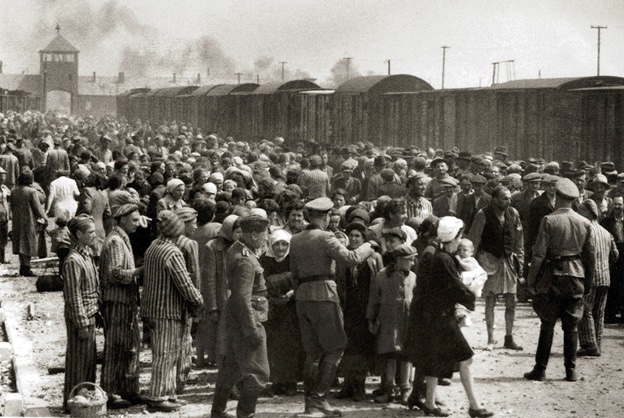
At 3 p.m. on Saturday, January 27, 1945, the 332 Red Army (Soviet) Rifle division arrived at the gates of hell near a small town in Poland called Oswiecim in Polish, or Auschwitz in German. The term Auschwitz no longer refers to a town but to a darkness in human history when humanity ceased to exist.
Auschwitz was a complex of about 40 Nazi concentration camps of which Auschwitz — also known as Birkenau — was designed for one purpose and that was to help implement the “final solution” or the murder of all Jews in eastern Europe and then eventually in the entire world. Jews were murdered in many ways: being worked to death, starvation, mobile killing units or Einsatzgruppen, “medical experiments,” and mass killings on an “industrial scale” in gas chambers using poison gas of varying kinds. Auschwitz used Zyklon B.
World War II started on September 1, 1939, with the German invasion of Poland. At the time, Poland was home to the largest number of Jews of any country, more than 3.3 million Jews or about 10 percent of the Polish population. By end of the war in Europe, VE (Victory in Europe) Day, on May 8, 1945, more than 90 percent of the Jews in Poland had been murdered, most in the death camps of Belzec, Sobibor, Treblinka, Majdanek, and Auschwitz.
On the day the Soviet army division entered Auschwitz, sunset was at 4:27 p.m. In the Jewish calendar this day was the 13th of Sh’vat. The day was Shabbos or the holiest day of the week for Jews. Each Shabbos is unique during the Jewish year, as a different portion of the Torah is read. That Shabbos was special — Shabbos Shirah, or the Shabbos of Song commemorating the biblical passage through the splitting of the Red Sea or the remembrance of the Jewish people being liberated from slavery in Egypt.
Of the 1.1 million people murdered in the Bikenau gas chambers, the vast majority, about 1 million, were Jews. About half of these were children. There are no known survivors of the Birkenau gas chambers. After being murdered the bodies were cremated in an attempt to leave no trace of their crimes. For the Nazi murderers, efficiency was important. It took about 10 minutes to murder the 1,000 in each gas chamber, and the cost to kill each person was the equivalent of about one penny.
Prior to liberation, the SS guards had left between January 17 and 21, taking about 56[PL1] ,000 survivors on a death march in the middle of winter. About 7,000 prisoners remained behind in the death camp when the Soviet Army opened the gates on January 27. Many of the 7,000 died within the next few days from the effects of starvation, though the Soviet and allied forces tried to save them.
About two-thirds of all Jews in Europe were murdered by early 1945, or one-third of all Jews worldwide. Six camps among the approximately 1,000 “concentration camps” used gas chambers to mass murder Jews. These six camps were Auschwitz-Birkenau, Belzec, Chelmno, Majdanek-Lublin, Sobibor, and Treblinka. Three million Jews were murdered at these death camps, along with tens of thousands of Siniti and Roma, Soviet prisoners of war, and Poles. Three million more Jews were murdered by mass shootings, in ghettos, by starvation, and through sheer brutality. In total 6 million Jews were murdered. In the sickness of National Socialism, Jews needed to be completely eradicated, from the unborn to the elderly, for one reason only; they had the lineage of being Jewish.
Further German plans after the genocide of the Jews in all of Europe was to replicate the death camps and their mobile killing units worldwide. This same sickness, the same call to “kill the Jews,” is still with us today as it was for more than 1,000 years before Auschwitz existed.
When I grew up, I thought such an ideology would never again return to the civilized world. I was wrong. It never died. It just became socially unacceptable to speak of such an ideology. There is a “thin veneer” where hate is submerged just beneath the surface temporarily.
Perhaps if we remember the words of Santayana, “Those who cannot remember the past are doomed to repeat it” in 1905 in his work The Life of Reason, then we will understand that when we forget the violence of the past, we invite the violence of the future.
For anyone who tries to understand the present and bears witness to the current slaughter of Christians, Yazidis, Kurds, as well as Jews and other religious and ethnic minorities in lands afar will understand. Do not look away. Do not go silently into the dark night of hate but fight against it so that ultimately light will prevail.

