
We Keep Us Safe:
The People Fighting to Keep ICE Out
of Santa Barbara
Rapid Response Network Volunteers Protect Their Neighbors,
Stand Up for Immigrants
By Ryan P. Cruz | March 5, 2026
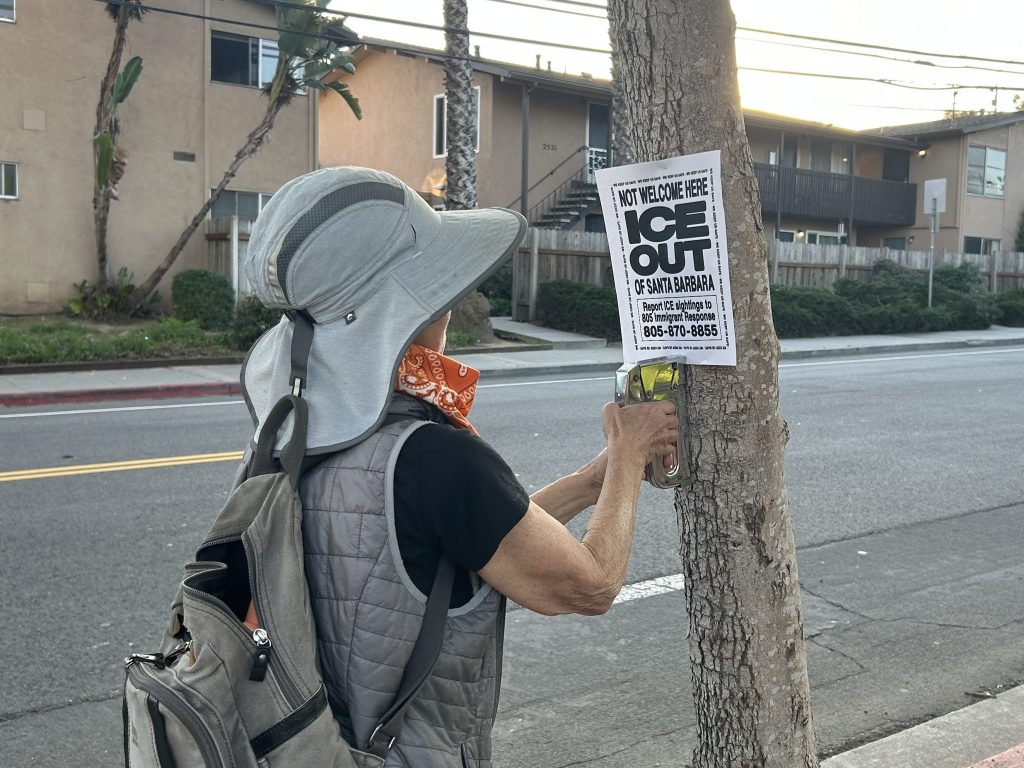
If they weren’t morning people before, they are now. They wake up in the dark of morning, pull on warm clothes, and slip into comfortable shoes. They climb into cold cars and drive over to meet up in spots known only to those on encrypted messaging channels. There, they huddle together and sip coffee or nibble pastries before dispersing in pairs to take to the streets for their morning patrols.
They’re the watchers, volunteers who drive the streets every morning to patrol their own communities for potential U.S. Immigrations and Customs Enforcement (ICE) presence in neighborhoods all across the Central Coast — particularly in areas targeted by federal immigration enforcement, with high populations of working-class Latino residents.
These volunteers — mothers, fathers, young professionals, college students, and retired longtime locals — have dedicated countless hours to defending their communities from ICE enforcement, not only through daily morning patrols, but through weekend canvassing events, evening defense training sessions, and public demonstrations raising awareness about the impact of immigration enforcement in the region.
Since the beginning of the second Trump presidency, these community defense groups and Rapid Response Network volunteers have been on the front lines when ICE arrives in Santa Barbara County. They are often seen in videos wearing bright orange bandanas or hats, blowing whistles, and yelling through bullhorns, always demanding ICE officers show a warrant or identify themselves.
We Ride at Dawn
I was invited to tag along on an early morning patrol in Eastside Santa Barbara, one of the areas hit hardest by ICE enforcement. Just one day before our ride-along, chaos erupted in the same neighborhood, where ICE clashed with community members, leading to a hectic situation in which one agent pepper-sprayed a neighborhood woman, Beth Goodman, in the face.
Morning patrols typically take place between 5 a.m. and 8 a.m., the times ICE has most often been seen making arrests. In 2025, there were more than 1,500 ICE arrests on the Central Coast, and Rapid Response volunteers say the overwhelming majority of arrests have occurred when people are on their way to work in the morning.
My guide on today’s mission is an Eastside local, born and raised, who asked her name not be published, not just due to the risk of ICE making her a target for participating in a community patrol, but more so because her children don’t exactly approve of their mother potentially ending up pepper-sprayed, in handcuffs, or in a federal detention center for facing off against the masked agents. “My daughter’s worried,” she tells me as we start our patrol just after 6 a.m.
Patrollers work in pairs, allowing the driver to focus on the road while the passenger keeps a lookout for suspicious vehicles and watches for alerts on a group chat connecting all the patrol groups. By now, there’s a pretty sophisticated guide to identifying ICE vehicles, which often have dark-tinted windows, are seen in groups, and typically drive aggressively through neighborhood streets. Before long, patrollers say it becomes easy to spot cars that don’t belong.
known After months of documenting ICE activity, Rapid Response groups have collected a list of “known ICE vehicles,” which have been documented in operations on the Central Coast and arriving at the regional ICE field offices in Santa Maria or Camarillo. On most days, spotters stationed near the facilities can identify exactly which vehicles have been seen leaving in the morning before they arrive in neighborhoods less than an hour later.
This morning, the group chat was quiet — a good thing, considering the eventful morning patrollers had in this same neighborhood less than 24 hours earlier. By 6:21 a.m., the sun is just starting to rise as we roll down Alisos Street near Cacique. The only people out are delivery drivers and a few folks warming up their cars. We take a photo of the mostly empty corner to post on social media, letting the public know there’s no ICE vehicles around today.
On days when ICE arrives, the entire network jumps into action. Hotline operators receive real-time reports, verify ICE involvement, and dispatch legal observers to document the scene and provide assistance to detainees and family members. When patrollers spot ICE vehicles, they are trained to follow at a safe distance while documenting any important details to relay to dispatchers. These include info on the number of vehicles/agents; any information on their uniform, equipment, or clothes; and the exact location and time of the incident.
“Everybody has their own comfort level, but we try to follow them and find out where they’re going,” my guide says. By now, it’s 6:35 a.m., and we stop at the corner where ICE officers pepper-sprayed Goodman a day earlier. It’s also where my guide on today’s patrol used to walk to school.
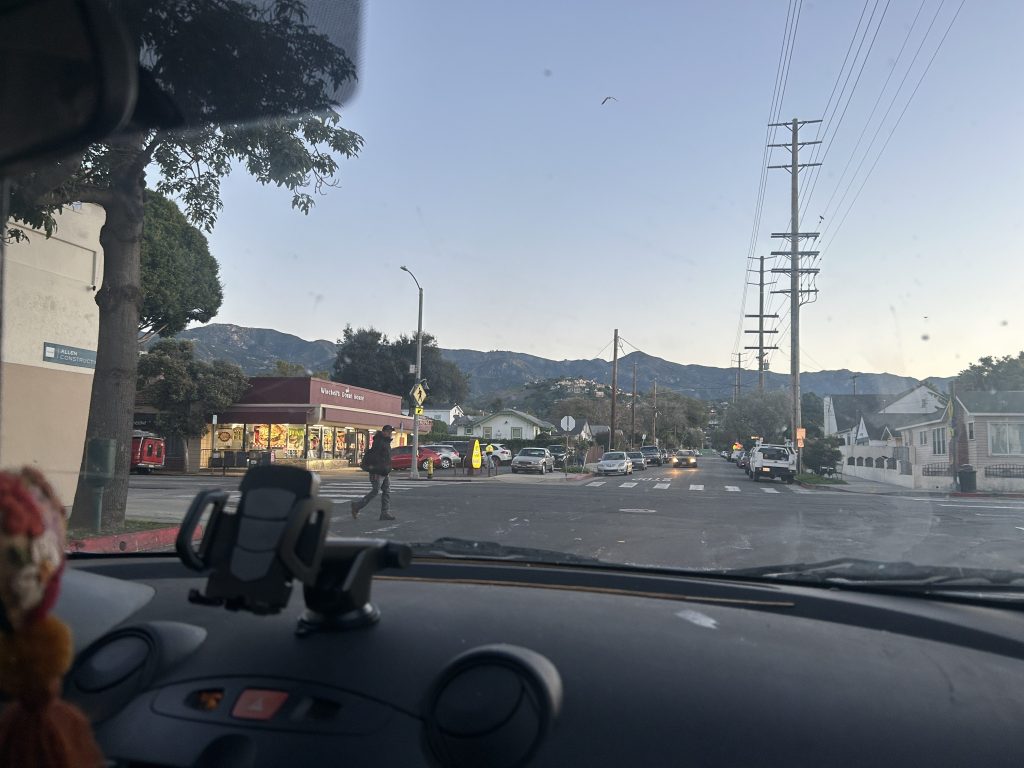
Several community patrollers and volunteer observers told me it can be difficult to keep emotions in check when confronting ICE officers face-to-face. Anthony Rodriguez, an SBResiste volunteer, community leader, and safety officer for Our Lady of Guadalupe — home to a large congregation of Latino and Spanish-speaking parishioners — said it’s important to remember the main goal is to protect community members.
“We’re not here to fight them,” Rodriguez said. “We’re here to get them out the right way, blow whistles, make noise, and inform neighbors.”
Back on morning patrol, we pass Franklin Elementary School. The sun is now bright, and neighborhood people are out on walks with strollers and dogs. “We have to learn how to hold back when it escalates,” my guide says. “ICE likes to get into a back-and-forth, so we have to focus on de-escalation. We’re all aware of the harm being done, and we’re angry. It’s hard not to go off…. But we’re in a different time. We have to be careful, and we have to think about making it worse for the people getting detained.”
After months of daily patrols, Rapid Response volunteers have become familiar with some of the agents. One agent in particular, known by volunteers as “Buttermilk,” has become notorious for his aggressive nature and for wielding a big canister of pepper spray when confronting legal observers. In one viral video recorded at the Santa Barbara County Jail, this masked ICE officer pops the cap off his spray canister and tells one observer: “I’m not a man of many words. Move out of the way or you will be pepper-sprayed.”
There’s no love lost between Rapid Response volunteers and federal immigration enforcement. Community observers have seen firsthand how ICE officers appear to operate with their own set of rules. Few were surprised when just last week, former ICE official Ryan Schwank came out and called the immigration enforcement system “deficient, defective, and broken,” and revealed that recruits have been taught to operate without warrants.
In Santa Barbara, community defense groups such as 805 UndocuFund and SBResiste reported that of the nearly 90 arrests that occurred within the City of Santa Barbara in the past year, there were only seven instances of ICE officers displaying warrants signed by a judge.
ICE did not respond to questions about community defense groups, but federal officials have voiced criticism about rapid response networks and individuals who show up during active enforcement operations. White House Border Czar Tom Homan described the actions of legal observers following ICE vehicles, making noise, and holding know-your-rights seminars as “domestic terrorism. “They call it ‘know your rights’; I call it ‘how to escape arrest,’ ” Homan said during an interview on CNN.
At the end of the daily patrol, groups from all over the region post “all clear” messages to their shared network of followers, letting them know there were no ICE sightings in the hotspots of Carpinteria, Eastside, and Westside Santa Barbara as well as Old Town Goleta. These posts are shared daily by 805 UndocuFund, SBResiste, ICE Out of Goleta, Carp Sin Fronteras, and a number of independently run social media pages whose daily patrol reports have become just as essential as the weather app.
A quiet morning is the best these patrollers can hope for. The lack of official arrest numbers from ICE makes it difficult to measure the true impact of their work, but on several occasions, the presence of Rapid Response volunteers has directly prevented arrests of undocumented community members. That gives my morning patrol guide a bit of optimism in the face of a daunting battle ahead, with ICE bringing on thousands of recruits and sitting on billions of dollars of funding. “Hope is really important,” she says.
Of the nearly 90 arrests that occurred within the City of Santa Barbara in the past year,
there were only seven instances of ICE officers displaying warrants signed by a judge.
Spreading the Word
Over the past year, 805 UndocuFund and associated organizations within the 805 Rapid Response Network have grown to more than a thousand volunteers. Each week, these groups host more public gatherings and training sessions to get the word out about how community members can help protect their neighbors.
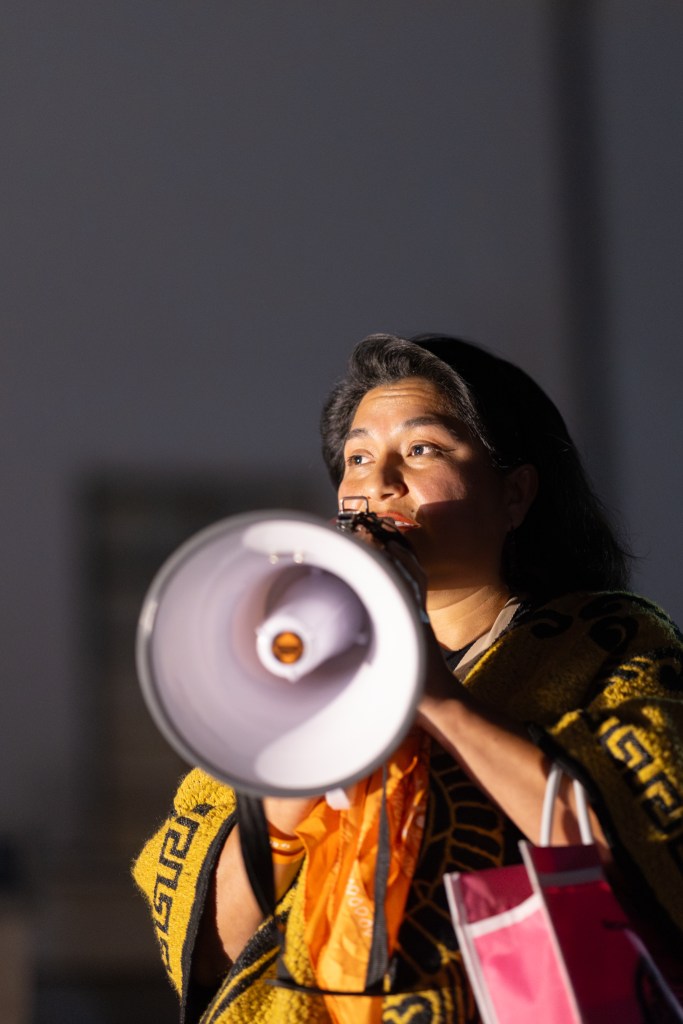
As federal immigration enforcement tactics increase in intensity across the country, more volunteers have jumped to join in the fight to keep ICE out of their communities. With the killings of Renee Good and Alex Pretti — two American citizens that appeared to be acting as legal observers in Minnesota — and the recent pepper-spray incidents in Santa Barbara, the level of public anger is at a high point.
“Your frustration and anger is justified,” 805 UndocuFund Executive Director Primitiva Hernandez said in response to a recent incident in which ICE arrested a legal observer and pepper-sprayed an 80-year-old attorney in downtown Santa Barbara.
“What’s happening is not normal. But there are ways and places where you can funnel that frustration, and where you can take action to protect your community,” Hernandez said. “Rapid Response is more than patrolling, more than responding, and there are a lot of efforts happening all over the 805 to keep communities safe.”
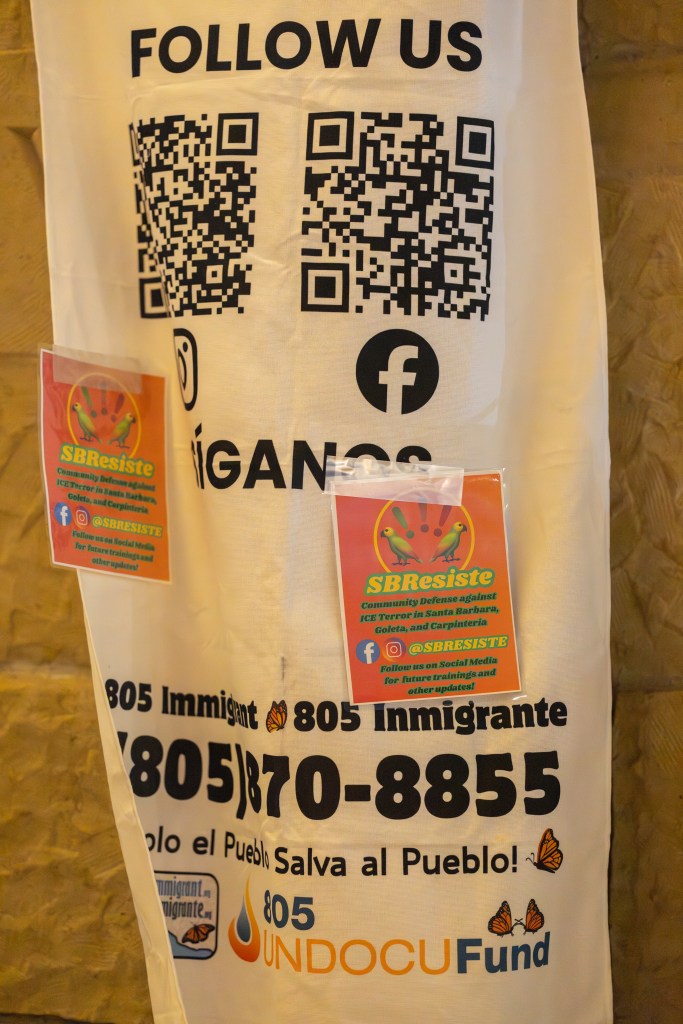
On weekends, volunteers with 805 UndocuFund and SBResiste canvas impacted areas, hang up posters with the hotline number, and let people know how they can help monitor and protect their own neighborhoods.
SBResiste volunteer Lee Heller, a retired attorney and community organizer, helps with some of these canvassing events, which are often a good starting place for volunteers who are unavailable or not yet ready to participate in morning patrols. On one recent afternoon, more than 40 volunteers met up on Santa Barbara’s Westside to knock on doors and pass out information.
Many of the new volunteers have been inspired to join after seeing videos of ICE arresting community members across the nation. They represent the diversity of the movement, from longtime residents to new transplants, people from Latino, Black, white, Asian, and Indigenous backgrounds, and everybody from fresh-faced college activists to working-class moms to retired professionals and respected community leaders.
“This movement is deeply grassroots,” Heller said. “These are people that are responding to what’s happening to our neighbors, friends, and family members. A lot of the people themselves are young, people of color, passionate, and willing to put in extra time.”
There’s also a strong contingent of older retired Santa Barbara residents, who may not be in danger themselves but have offered to support their immigrant neighbors with their time or disposable incomes.
“We are all responsible for fighting back, regardless of whether we feel endangered,” Heller said. “We all have a responsibility to respond to what’s happening in our backyard.”
During the canvassing, Heller hung up posters with big block letters demanding “ICE OUT OF SANTA BARBARA” on utility poles outside an apartment building where a man was taken by ICE just a few days earlier. Rapid Response volunteers said the man was detained by ICE officers who were waiting near the man’s car when he went to move it during morning street cleaning. Today, a couple of kids are running around playing tag on the same block.
Heller said these random arrests keep people from shopping in areas such as San Andres Street on the Westside, Milpas Street on the Eastside, or near Old Town Goleta. Businesses have to contend with lower sales or employees being targeted; landlords can suddenly find themselves without a tenant, and at-risk families are keeping their kids home from school or missing doctor’s appointments.
“We all pay the price for that,” Heller said. “When people are afraid to leave their homes, how does the world change?”
A New Wave of Volunteers

Over the past few months, groups such as SBResiste, Unión del Barrio, and 805 UndocuFund have joined forces to host training sessions in different parts of the region. These sessions have been led by experienced volunteers with decades of experience fighting for and alongside marginalized groups. One SBResiste organizer, Chelsea Lancaster — a longtime fearless advocate for many political movements in Santa Barbara — has witnessed some of the most intense ICE incidents on the Central Coast. She was at the scene when ICE agents pepper-sprayed an attorney and arrested legal observer Jack Randmaa, who has been accused of slashing the tire of an ICE vehicle. Another time, she was stopped by CHP after following an ICE vehicle away from Eastside Santa Barbara.
On one rainy night in February, Lancaster and a few other SBResiste organizers helped lead a training session for more than 100 new volunteers. Priority number one, she told them, is preventing community members from being taken.
“We’re really proud that in Santa Barbara, we’re chasing ICE out…,” Lancaster said. “Those kidnappings in Santa Barbara within our locus of control are going down. We’re here to flex that muscle, so y’all know your rights and how to be there safely when you’re protecting our community.”
Rapid Response volunteers are encouraged to document and record ICE activity, but not to block, touch, or interfere physically in any capacity. They are trained to speak calmly and assertively, to ask the ICE officers to identify themselves for the record, and to inform anybody being approached or detained of their three major rights: Do not open the door. Do not say anything. Do not sign anything.
Lancaster warns volunteers to be prepared to face pushback from ICE officers who might try to prevent legal observers from filming. “We will assert our rights to film and follow ICE,” she said. “One thing that ICE does is they lie. We’ve been in all these encounters where they tell you that you can’t follow them or you can’t film. That’s all bullshit. We are here to keep our community safe and keep each other safe.”

Ana Arce, an SBResiste organizer, denied claims that Rapid Response observers follow ICE agents back to their personal vehicles or to their homes. “Don’t follow them to their house,” Arce said during one recent training session. “But if they’re still in an ICE vehicle, and they’re still out in the community, it’s very important to keep track of them.”
Volunteers are taught how to differentiate between judicial warrants — which are signed by a judge and allow agents to enter a property — and an administrative warrant, which is informally referred to as an “order of removal” and can be signed by an ICE agent. The administrative warrants, which are most prevalent with immigration operations, do not allow agents to legally enter a property without consent.
Administrative warrants are considered a “big red flag” for Rapid Response volunteers. “If it has an ICE agent’s name on it, instead of a judge,” Arce said, “then you know 100 percent it’s fake, not valid, and cannot be used to arrest somebody.”
Informing the community of verified ICE activity, and being transparent about false alarms such as local law enforcement operations that can be confused for ICE, are some of the network’s most effective actions. By quickly sending observers out to check into reported sightings, and by quickly posting updates, the groups let the public know whether to be concerned or not.
The recent training sessions have been packed with community members willing to lend a hand, whether that involves signing up for morning patrol, working as a hotline operator, accompanying at-risk residents to appointments, or doing outreach in their own neighborhoods.
“If you want to be involved, we have a job for you,” said SBResiste organizer Ana Garcia. “Don’t push past your comfort level,” she cautions new volunteers.
Lately, community defense groups have taken a more direct role with advocacy, holding public demonstrations and calling on local elected officials to do more to support immigrants. Lancaster has not held back in her criticism of local law enforcement, saying that it seems they are often prioritizing the safety of ICE officers over community members.
“What we’re really trying to do is shine a light on the collusion that’s happening between the police department, the Santa Barbara Sheriff’s [Office], and the CHP in terms of assisting in ICE operations,” Lancaster said. “We don’t care what they say. We got it all on film.”
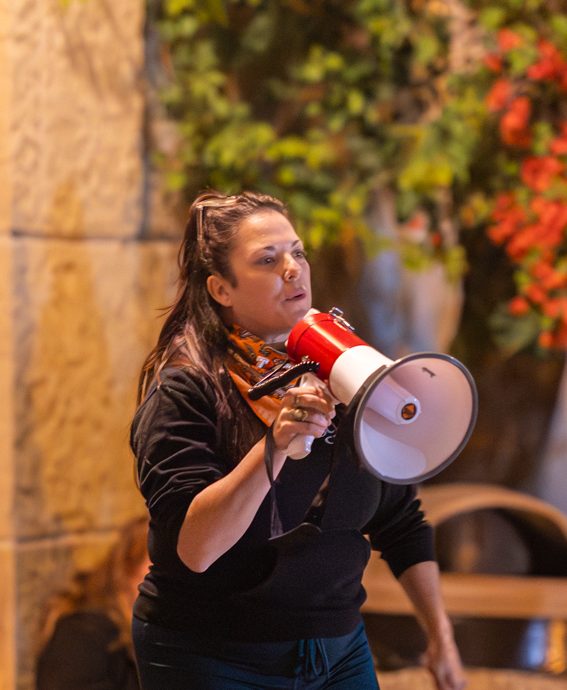
But local law enforcement officials have been adamant they do not assist with immigration enforcement, and SBPD stated it was not notified of ICE’s presence prior to either of the two recent pepper-spray incidents in the city.
Rapid Response volunteers have begun to notice that their work seems to be yielding results. In both pepper-spray incidents, ICE left the area without arresting one undocumented person. While it’s hard to consider this a total win, one volunteer said ICE officers seemed frustrated by the speed and strength of the community response.
This shift has been felt in daily patrols as well. In recent weeks, ICE has not been seen entering the central areas of the city as much. Instead, the majority of arrests for the past several weeks have occurred by ICE agents waiting outside the county jails.
“ICE agents regularly change their tactics, but these last two weeks have been eerily different for the region,” 805 UndocuFund posted in a statement on its Instagram page. “Nonetheless, our teams are prepared and ready. Keep supporting the Rapid Response efforts, get involved, and most importantly keep supporting families.”
To learn more about the 805 Immigrant Rapid Response Network, donate, or to find out about upcoming training and community events, visit the social media pages for 805 UndocuFund (@the805undocufund) and SBResiste
(@sbresiste).





You must be logged in to post a comment.