
The Hands-On Hard Work
of Mazette Wines
Surf Rat Brewer-Turned-Vintner Zach Petersen
Breathing Life into Tiny and Timeless Vineyards
By Matt Kettmann | May 7, 2026

Read more from our Santa Barbara Culinary Experience cover story here.
The oldest commercial vineyard in the Santa Ynez Valley is now in the hands of the region’s youngest vintner, and that’s just what it needs.
Zach Petersen’s energy is rivaled only by his optimism, which is why this proprietor of Mazette Wines just signed a decade-plus contract to farm the 11 acres that remain of Viña de Santa Ynez.

“I’m a pretty do-it-yourself person, and this is a pretty do-it-yourself process,” explained the Dana Point–raised surf rat who worked as a brewer before finding wine four years ago. “There’s obviously an endless amount of work to do here, and I haven’t even scratched the surface.”
First planted by the Bettencourt family on a gentle slope along Refugio Road in 1969, the vineyard was also home to the seminal Santa Ynez Valley Winery, where Fred Brander started his career in a former dairy barn. For the past quarter-century, it was the headquarters of Kalyra Winery, whose pioneering Australian founder Mike Brown took a step back from wine after suffering a stroke in 2024. (He’s been recovering since, and Kalyra now sells wine through their Buellton tasting room.)
The vines — mostly replanted by Brown more than a decade ago, aside from some original sauvignon blanc that’s now nearly 60 years old — didn’t get much love in recent vintages, so Petersen’s current work is all about rehab. “I’ve been shoot-thinning for weeks,” he said of strategically trimming the plants. “But I’m definitely very happy with the way things are going.”
Though his biggest project yet, Viña de Santa Ynez is just one of the vineyards Petersen farms for Mazette, which he founded in 2024. He’s assembled a patchwork of much smaller “pocket” plots around this geographic heart of the valley — two acres of sauvignon blanc here, three-and-a-half of grenache there, tallying more than 17 in total. “That’s how I got my start: backyard plots and the stuff so small no one cares about,” said Petersen. “It’s been a scrappy go at things, working to cobble together quality vineyards that have somehow been neglected, overlooked, or left behind.”
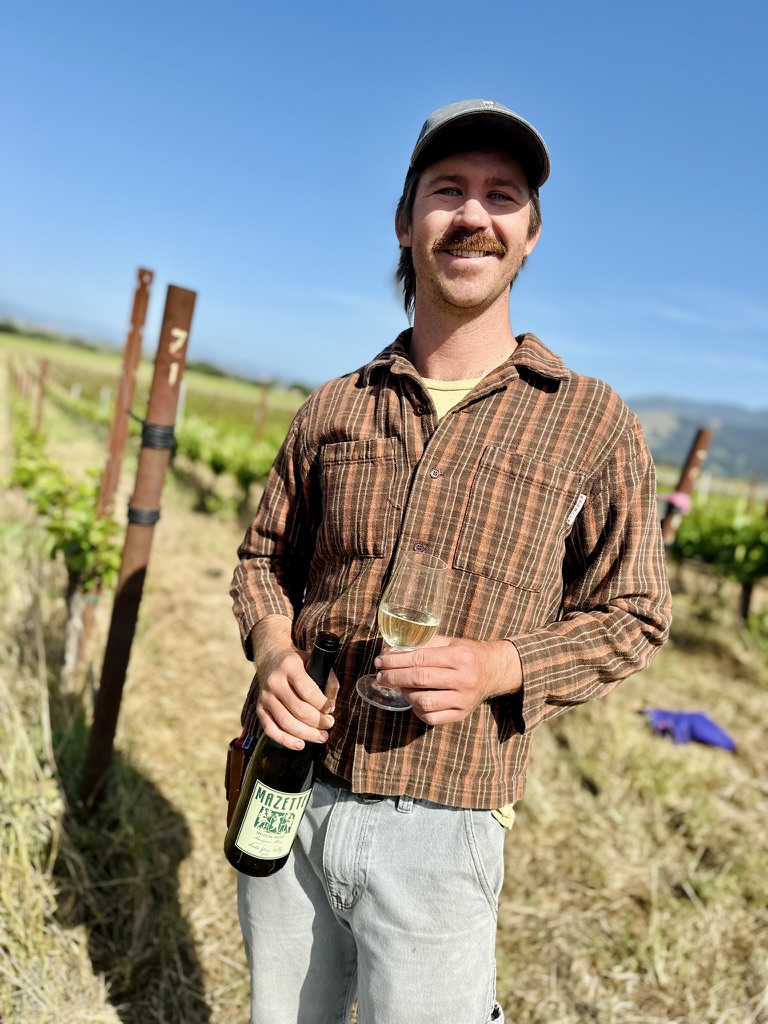
Mazette’s tight lineup of seven modestly priced wines centers on grenache, syrah, and sauvignon blanc, of which he has grown the most fond, despite not really liking it when he started in wine. “If I had to make one wine forever, it would be sauvignon blanc,” Petersen told me on a sunny afternoon at the old vineyard sipping that wine. “It’s the variety that responds most to your farming efforts. You can’t do much to it in the cellar. If it’s vegetal, it’s gonna taste vegetal.”
He sees sauv blanc as a “mirror of how it was grown,” able to “translate minerality and site nuance in a way that excites me endlessly.” It lays all your cards down, like a restaurant that serves roast chicken. “Most chefs don’t put a roast chicken on the menu,” he said. “But if they do, then you know it’s gonna be real good.”
A lifelong maker of such things as bows and arrows, soapbox cars, and surfboards, Petersen first worked as a brewer in Los Angeles, Mammoth Lakes, and Reno, but got interested in wine after visiting the Santa Ynez Valley with his sister in 2002. He could talk the fermentation talk with winemakers, and quickly understood that the wine industry was more interested in sustainably minded innovation than beer, yet also more dependent on nature itself.
Petersen gained cellar experience working for Sandhi and Domaine de la Côte in Lompoc and then with “cowboy-type winemakers” in Australia and the famed Domaine Alain Graillot in France’s Rhône Valley. Today, he works at Cosecha Farming, learning all about mostly Sta. Rita Hills vineyards from its founder Chris King. He’s applying those lessons to his Mazette sites, which he’s farming regeneratively.

“Rehabilitating vineyards is inherently regenerative,” he said. “Taking land that has been left alone is the perfect time for me to help steward the vines back to balance, however messy that may look at first. It is less about controlling the vineyard with perfect planning and more about guidance.”
One day, that should show in the bottle. “I hope that my farming efforts ultimately lead to vines with clear expression and wines that carry that vitality,” he said. “For me, the only way to get there is by doing the work, walking the walk, and being present for every step.”
As we enjoy his excellent Central Coast–style vermouth, Petersen explained that such work will require replacing some of the vines — such as the three why-in-the-world rows of table grapes — and planting a fruit tree orchard and pollinator garden with native cover crops and grasses.
“I’m just trying to breathe life into a place that clearly wants to be part of this,” he said, referring to the enduring legacy of Viña de Santa Ynez. “I have faith in the site.”
See mazettewines.com.
SBCE Grand Tasting: May 16 @ El Presidio
Mazette Wines is just one of 42 wineries pouring at the Santa Barbara Culinary Experience’s Grand Tasting on Saturday, May 16, 2-5 p.m. (1 p.m. VIP entry) at El Presidio de Santa Bárbara State Historic Park. There are two winemaker panels during the event: Fresh Faces, featuring Mazette’s Zach Petersen and three other relative newcomers, and Pinot Noir vs. Chardonnay in the Sta Rita Hills. Tickets are $35 (non-alc); $105 (general admission); and $125 (early entry VIP). See sbce.events/grand-wine-tasting.


You must be logged in to post a comment.