
The Masterpiece Life of
Meredith Brooks Abbott
The Reigning Matriarch of
Santa Barbara’s Plein Air Painting Scene
By Roger Durling | Photos by Ingrid Bostrom
May 14, 2024
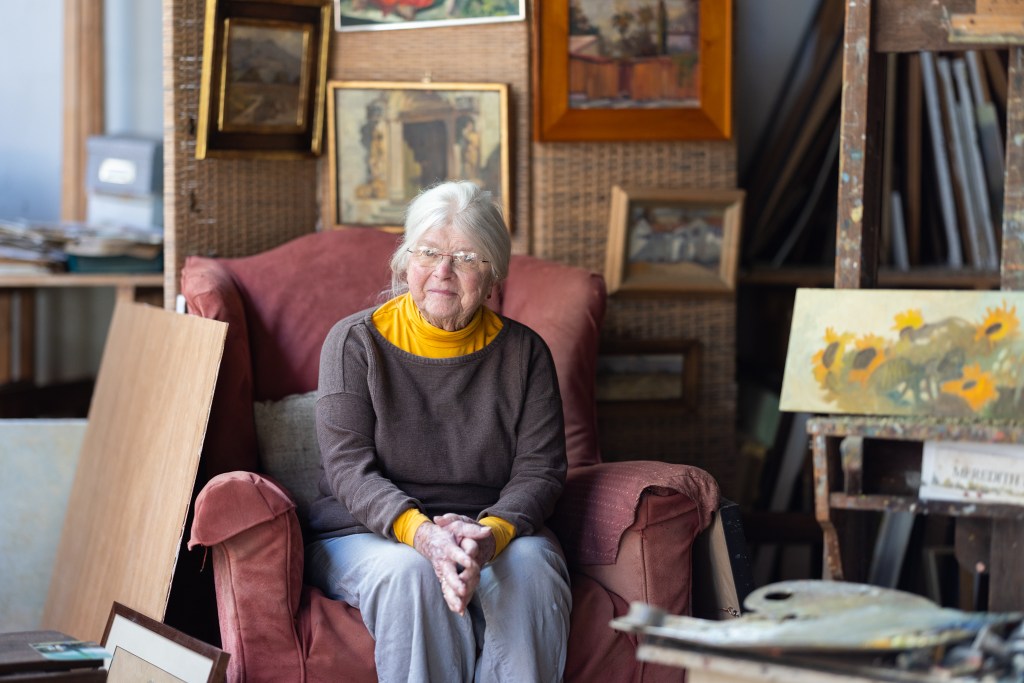
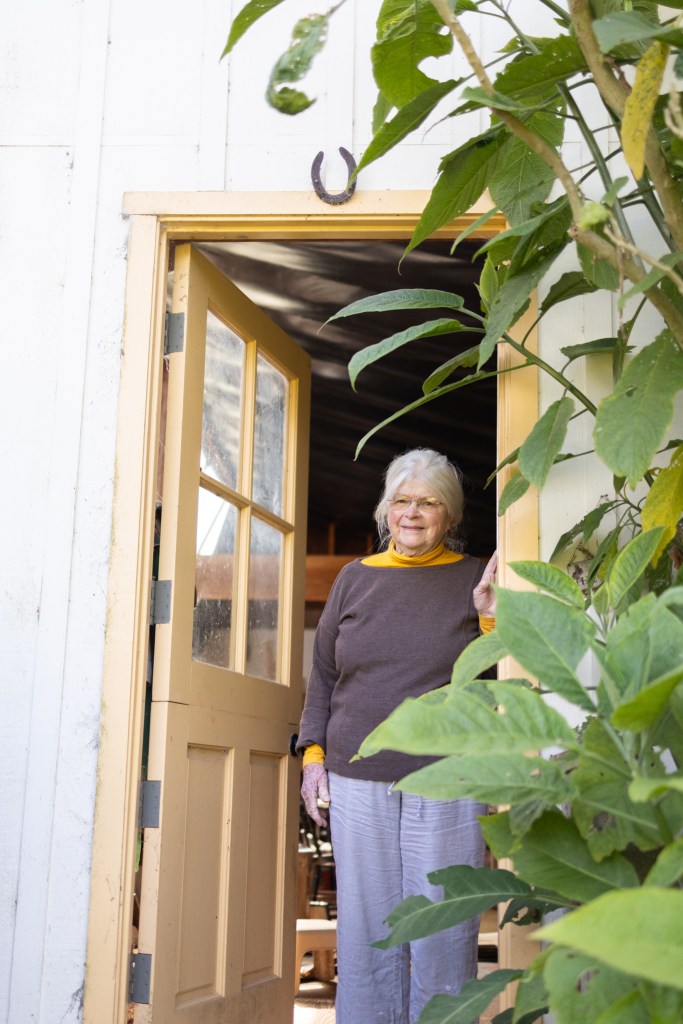
As I drive to Meredith Brooks Abbott’s 55-acre ranch in Rincon Canyon, I find myself thinking about the legendary painter Monet and the garden that he built in Giverny, northwest of Paris. The serenity of Giverny allowed Monet to shift away from the unruliness of painting outdoors and provided the master painter with a calm, comforting, and highly organized environment. Similarly, Brooks Abbott built herself a garden adjacent to the Victorian farmhouse dating from the 1870s that she shares with her husband, Duncan. She dug a pond in it and placed her studio near the main house. From the threshold of her artistic quarters, you can study the interplay of water, sky, and light — allowing you to focus on the imminence of the experience.
Her garden blends effortlessly with the surrounding natural vegetation of the Carpinteria Valley — and Meredith seems to have organized the color palette in its flora — creating an intimate, personal landscape of her own. I couldn’t help but assess that her home, her meticulous garden, and her studio form a “living laboratory,” where one of Santa Barbara’s most respected artists has honed her inimitable oeuvre while also raising her beautiful family of both ranchers and artists. Her farmstead has become integral to her remarkable artistic career, and at the same time, it has breathed purpose into her life.
“I once wrote that as a farmer gathers sustenance for the body,” fellow painter Arturo Tello tells me, “the landscape painter gathers food for the soul. Meredith lives that line. Her idyllic farmhouse, with orchards, gardens, chickens, koi pond, and a detached north-light studio heated by a wood stove, is an authentic, in-tune-with-nature existence that feeds her work directly.”
I’ve long venerated Meredith Brooks Abbott’s impressionistic paintings that document, through landscapes and still lifes, fleeting moments in Santa Barbara — a place she’s known and observed well for her 70 years as an artist. The way she encapsulates the fog and other atmospheric conditions on her canvases is remarkable. Painting primarily en plein air, her brushstrokes are rapid, loose, and vibrant, conveying energy and texture. She’s developed a palette that is immediately recognized as her own, seizing the radiance of the Carpinteria sunlight and earthy tones of its chaparral.
“What’s important about her paintings is that they are meditations of the land that in most instances is the land she was raised on, and where she raised her children,” says Susan Bush, contemporary curator at Sullivan Goss Gallery, where Meredith exhibits her work. “Her sense of place, the way she knows every hill and valley, every old oak tree, or the brief window when the Matilija poppies will be blooming, can only be achieved by her having resided in this area and studying it with her artist’s eye for as long as she has.”
On an early morning visit in April, as I pulled into her driveway, I noticed a great-looking 1966 Mustang prominently parked. I am greeted by Freddie, Meredith’s sweet-natured Labradoodle, and he guides me directly toward the art studio. Her husband, Duncan; her daughter, artist Whitney Brooks Abbott; and the matriarch of the local plein air painters herself, Meredith, are busy arranging canvases — they’re helping her prepare for her current solo show at Sullivan Goss Gallery, appropriately titled Capturing Our Time. The exhibit coincides with the publication of the book Enduring Impressions, which the gallery has spent almost two years putting together, compiling information and images from Meredith’s many collectors.
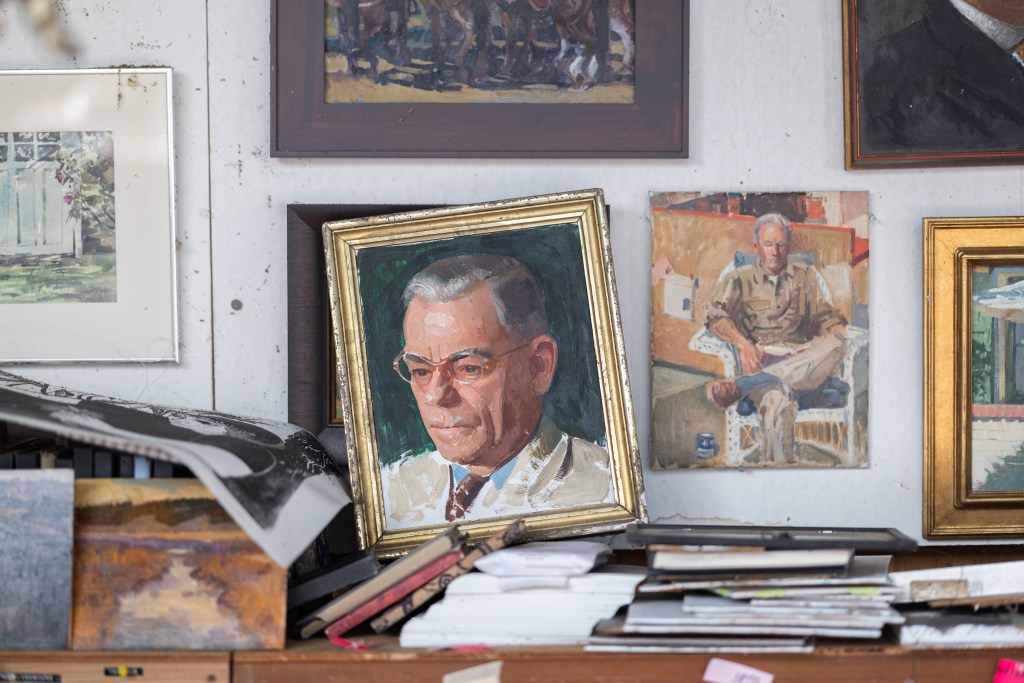
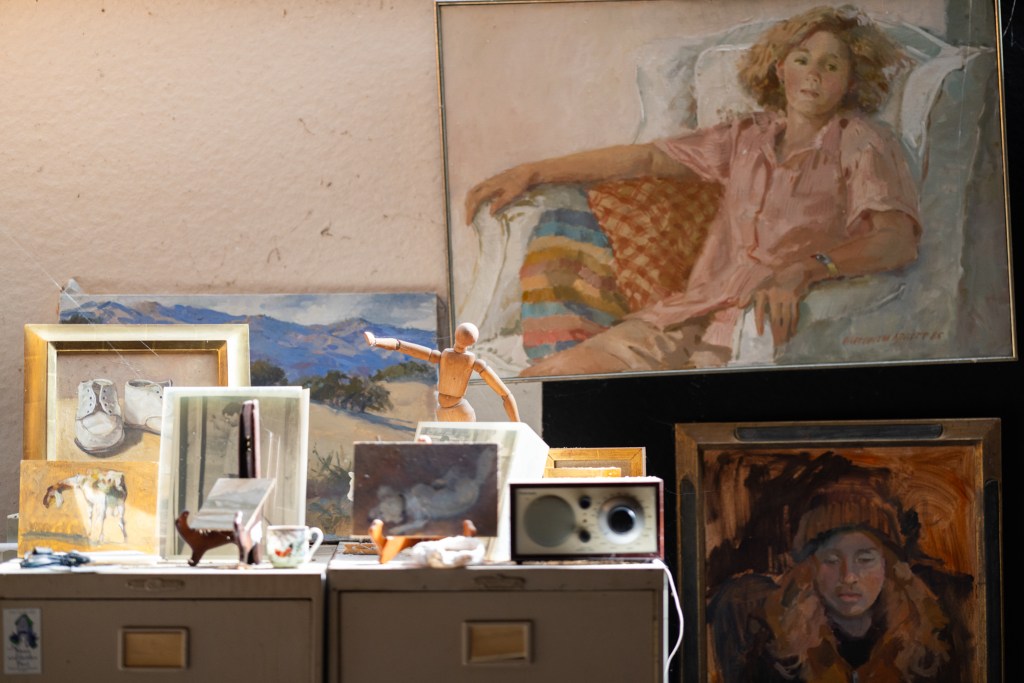
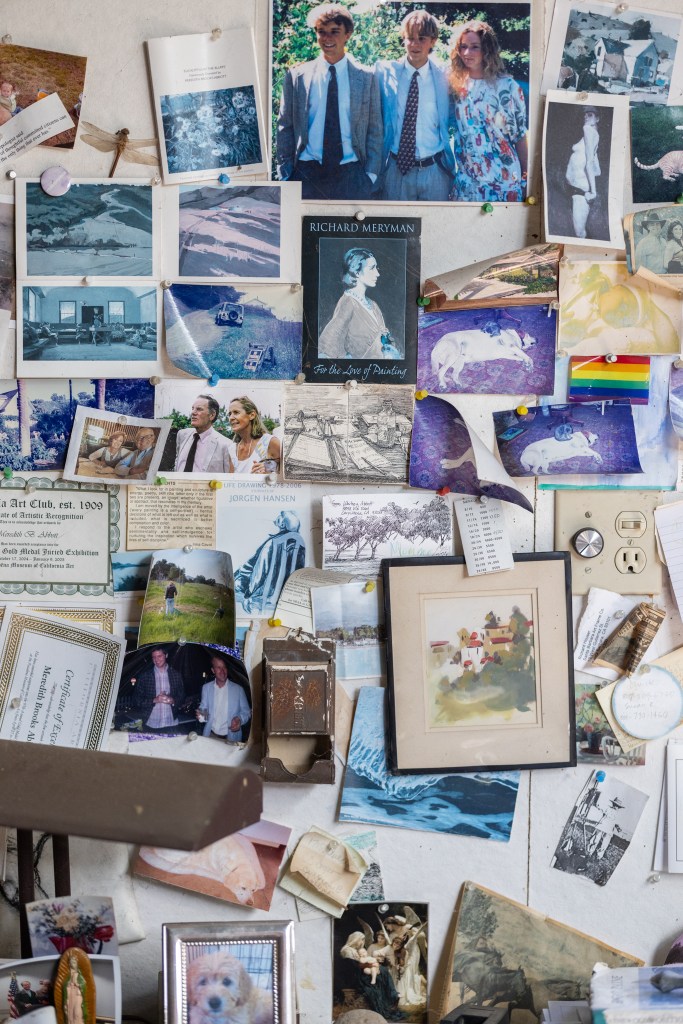
Encircling the artist’s easel, the studio walls are garlanded with numerous works by her as well as a self-portrait of Richard S. Meryman Sr., renowned portrait and impressionist artist. “I painted with Meryman when I was young, and I was his driver,” Meredith reminisces as I admire the painting of her mentor. “He would get commissions to paint fancy places in Montecito, and I would mostly paint the gardens.”
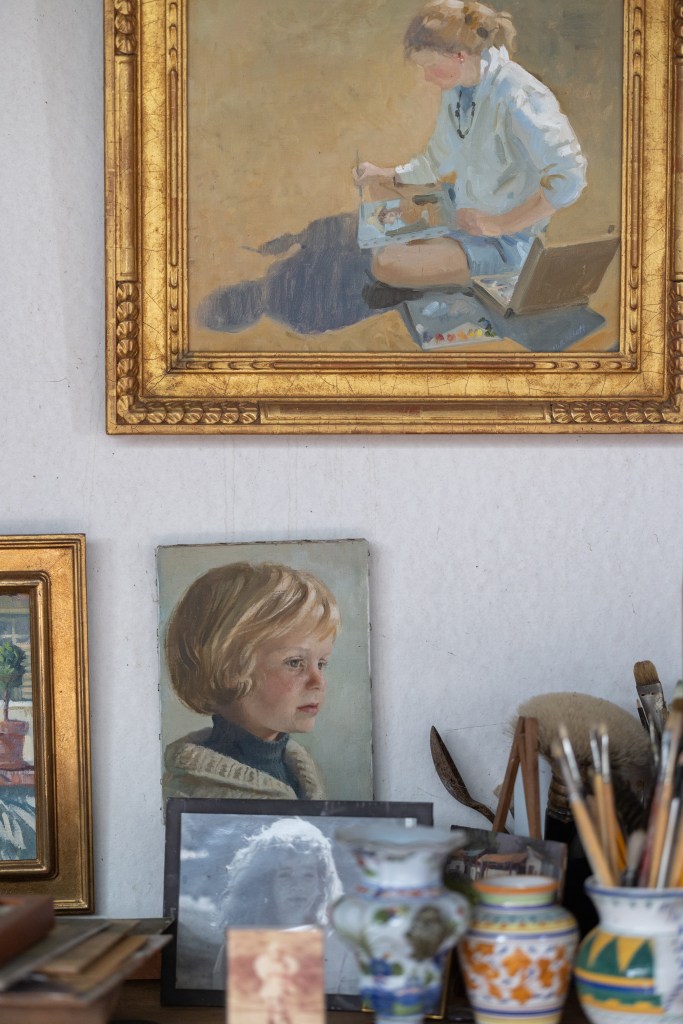
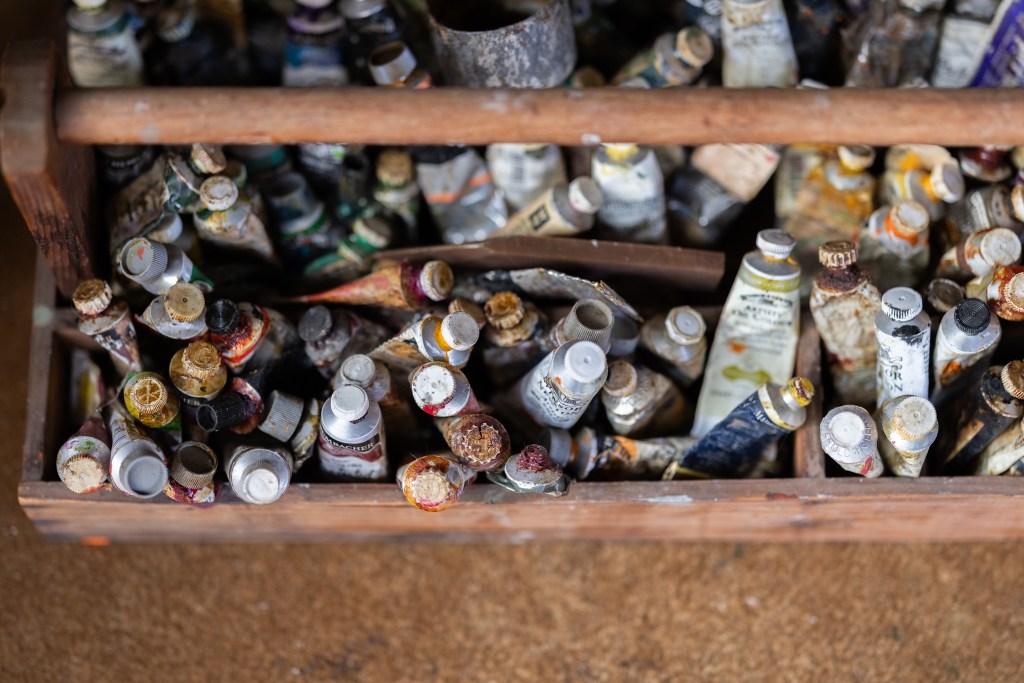
There are several portraits of Whitney at different stages of her youth. One stands out: the young woman wearing a Russian hat. Whitney would gift posing time to her mother for birthdays and holidays. The welcoming smell of turpentine permeates the room. A large north facing skylight bathes the space with a soft glow. All of it creates a “masterpiece factory” atmosphere. While primarily a plein air painter, Meredith uses this studio to rework canvases, store her collection, and manage her artistic output — becoming a blend of workspace and personal haven. When she was commissioned by the Monterey Inn in 1978, the studio was expanded to accommodate larger canvases. Standing inside of it, one is immediately walloped by the aura of creativity. The interior is an intimate time-capsule glimpse into her artistic process. She notices me taking it all in and says, “Painting makes my everyday worthwhile.”
Lovingly curated by Sullivan Goss, the exhibit Capturing Our Time includes paintings from the 1990s to the present day, and can be seen as a celebration of the artist’s enduring legacy.
“Her subject matter has always been diverse,” says Marlene R. Miller, who has known Meredith since 1985 and represented her at the Arlington Gallery. “From works created around their avocado ranch and Victorian-style home in Carpinteria, to landscapes while involved with the Oak Group, to colorful still lifes and flowers, to portraits. Her favorite subjects, however, are moody and foggy landscapes.”
All of these offerings can be seen on display in her latest solo show at Sullivan Goss. Her robust and emotional landscapes are prominently featured, but it is a wall grouping of several of her still lifes of flowers that took my breath away. I cannot recall a more beautiful display in an art gallery. They have been hung in an old-school salon fashion, underlining the classic and timeless mastery of the auteur. They blend strong composition and vibrant color with symbolic meaning, such as the beauty and the fleeting nature of life.
Meredith was born in North Los Angeles in 1938. Her father, Robert Larkin Brooks, was a businessman who leased the San Miguel Island for the grazing of a flock of 1,000 sheep and owned a large ranch in Santa Barbara. “He smelled like lanolin,” Meredith recalls. Her mother was Hope Palmer from Lakewood, New Jersey, and her betrothal to Robert Larkin Brooks can still be found in the archives of The New York Times. On May 3, 1923, the paper wrote, “The bride is one of the most prominent members of Lakewood’s younger set.” Meredith’s parents moved to Santa Barbara in 1940. Robert Larkin Brooks owned 52 acres in Carpinteria. Originally, her dad planted lima beans, for they were a big thing at the time. The family eventually sold everything but 12 acres.
Future husband and wife Meredith and Duncan grew up together in Carpinteria. Meredith lived on Hilltop Ranch, while Duncan lived at the bottom of the canyon. Duncan’s father bought the property in 1922, and it is this house where Duncan and Meredith still live today. Meredith and her siblings grew up riding horses among the lemon groves, chewing road tar, and filling sketchbooks. Meredith went to Marymount (now Riviera Ridge), and she would do a lot of projects such as painting sets for the school plays. She got a high school diploma by doing these sorts of creative projects.
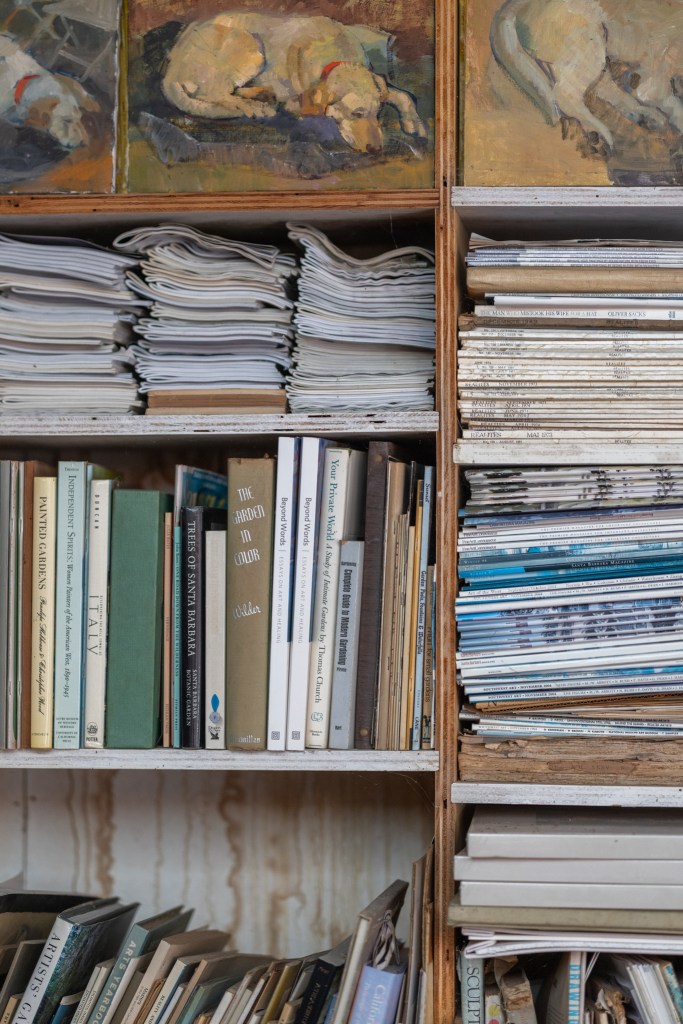
She attended Scripps College in Claremont, but returned home to take care of her ailing father. While back in Santa Barbara, she continued studying with artists Douglass Parshall, Richard S. Meryman, and Clarence Hinkle. Hinkle had a studio on the Riviera, and Meredith remembers it fondly because he had live models. Determined to graduate from college, she got a degree from the Art Center School in Los Angeles.
In 1962, she moved to the East Coast because she couldn’t find a job in the arts in Santa Barbara or in Los Angeles. In New York, she worked as an illustrator in the advertising field and took night classes at the Arts Students League. Her sister Hope Brooks was there, and she married Richard S. Meryman’s son, who was a writer for Life magazineand Andrew Wyeth’s biographer. Meredith would often spend her weekends traveling to visit Meryman Sr.’s studio in Dublin, New Hampshire. There, she assisted the artist in completing portrait commissions, and she would do some of the commissions that Richard Meryman didn’t want to or couldn’t do. These included the wives of governors, and she also painted two governors.
In the ’60s, Duncan became a portfolio manager and worked in San Francisco for Bank of America. While Meredith was in New York, he would send her articles about San Francisco by Herb Caen to entice her to join him there. She and Duncan had a lot in common besides growing up together in ranches in Santa Barbara, as both of their families were involved in the arts. His mother, Margaret Hunt Abbott, was the chair of the Santa Barbara Museum of Art. Both of Meredith’s sisters, Hope and Whitney, became woodcutting artists.
In 1970, Meredith moved to San Francisco. “He married me for my car,” Meredith says mischievously. It is the classic Mustang that still sits in their driveway. While in Northern California, she got a job updating textbook illustrations to include African American people while continuing to do portrait commissions, and to paint gardens. The day they married, Duncan and Meredith bought a house in Mill Valley. On the weekends, the young couple would drive deep into Marin to paint landscapes. A gallery in the area started to represent her.
Duncan and Meredith had three children — twins Robert and William, and Whitney. In 1974, the family returned to Santa Barbara, for Duncan decided to manage his family’s avocado ranch. “It was time to come back,” Duncan says.
“I have always felt great while painting outdoors,” Meredith says. “My favorite song is ‘Don’t Fence Me In.’ It doesn’t get any better!” When she first returned to Santa Barbara, she did some portraits but eventually stopped taking commissions and dedicated herself to her landscapes and still lifes.
In 1979, Walter Silva started showing her work in his Gallery De Silva in Montecito. “It was a breakthrough for me,” she says. Painter Arturo Tello remembers this time: “I met Meredith when I first moved to Carpinteria back in 1979. I was taking an adult ed landscape painting class with James Armstrong, who was a partner with Mr. Walter Silva, owner of Gallery De Silva in Montecito, and I began working there. They specialized in early California painters with a few living artists, including Meredith Brooks Abbott. Meredith’s work seemed to me to be on a par in quality with the dead artists, so I started calling her ‘the late Meredith Abbott.’ ”
Tello, Meredith, and fellow painter Marcia Burtt started a friendship forged by working outdoors together. Eventually, Arturo and Ray Strong would start the Oak Group and Meredith became a member, among others. Established in 1986, the Oak Group was the first group of artists exhibiting to preserve open spaces. They still actively fight to protect land for wildlife, recreation, ranching, and farming. Its painters make visual records, drawing attention to lands we stand to lose and generating funds to protect them.
On one of the days I met with Meredith, she and Whitney were planning to go painting at More Mesa because the land is being threatened by imminent development. Half of the proceeds of the sales of their paintings will go toward the preservation of the open space. “I have such a strong love for landscapes,” Meredith confesses. “I like being alone. You’re pretty much by yourself. I like being outside. I like documenting areas that are changing. Drawing attention to development, to the changing culture, to the changing of access.”
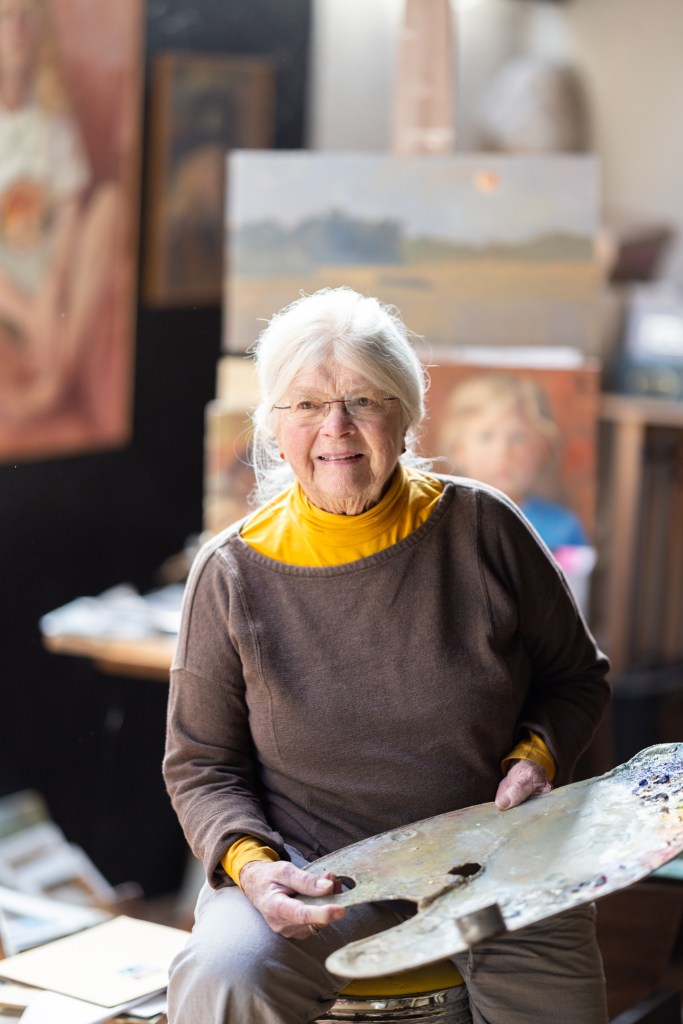
Meredith’s reputation as one of Santa Barbara’s greatest artists bourgeoned. In the mid-’80s, Marlene Schultz started showing her work at the Arlington Gallery, followed by Maureen Murphy on Coast Village. Her work would be shown in Oak Group shows at the Easton Gallery, and eventually, she found her permanent home at Sullivan Goss Gallery, where the exhibit Capturing Our Time is her seventh solo show.
“Meredith’s work is compelling for a number of reasons,” said her colleague Marcia Burtt. “She has a way of turning an ordinary vista into something special just by the way she paints it. She knows how to make a simple, two-dimensional form out of something complex and fussy, and on the other hand, she knows how to focus on something we might overlook and make it formidably voluptuous. A vase of eucalyptus branches, for example. Meredith has a unique ability to see a tiny section of landscape miles away and bring it forward to take up a canvas, giving her the ability to create paintings of subjects no one else sees.”
On my last visit, I sat with Meredith, Duncan, and Whitney on their lovely porch overlooking the garden that Meredith built. Her studio is next to us, and the intrinsic power of the mountains is in front of us. There’s a pause in our lively conversation. We all seemed to be taking in the surroundings and the beauty of that mid-April morning. Meredith breaks the silence: “Sometimes, I feel the mechanics of painting were better when I was younger, but now I come from a different place because of my life experience.”
Capturing Our Time is on view at Sullivan Goss Gallery (11 E. Anapamu St.) through June 22. See sullivangoss.com.



You must be logged in to post a comment.