
Talking Love Triangles with TC Boyle
Santa Barbara’s Wizard of Words’ Latest Novel, No Way Home,
Zigs and Zags Its Way to a Timely Destination
By Leslie Dinaberg | Photos by Ingrid Bostrom
May 21, 2026

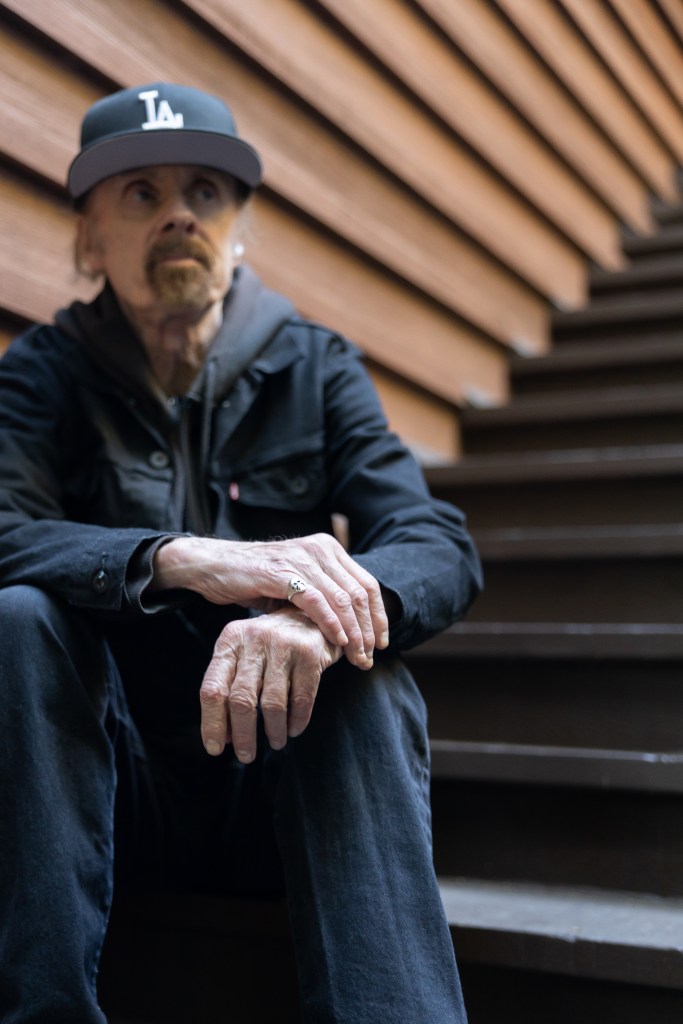
Not only is T.C. Boyle delightful to talk to, but he lives in a gorgeous redwood Frank Lloyd Wright–designed house in Montecito (his first in California). Plus, he gave me snacks and bubble water as we sat on the porch overlooking the forest of trees that surrounds his domain, and he talked to me about his writerly life and living in Santa Barbara for 30 years.
I was nervous as hell to talk to this prolific literary legend, but it turned out to be quite fun.
The impressively fruitful author of 12 books of short stories and 20 novels, including his latest work — No Way Home — a rivetingly cinematic, twisted love triangle set in the harsh desert shadows of the Hoover Dam, says he has no intention of slowing down.
“I liken this creative process to a kind of drug addiction, a heroin addiction. You come to the end of something, and it’s so exhilarating. I mean, it’s like getting off stage if you sang an opera, but you got a monkey on your back, and you’ve got to start again with a new one. That’s my life. That’s all I want to do.”
He’s been doing it since the 1982 publication of Water Music, a wild ride of a novel about the adventures of Ned Rise, thief and whoremaster, and Mungo Park, explorer, through London’s seamy gutters and Scotland’s scenic highlands, to their grand meeting in the heart of darkest Africa. Boyle calls it his favorite of his books and says it’s the one that taught him to follow his imagination. “It is completely wild, completely out there, circling the planet. And so, it’s my sentimental favorite. I learned how to write a novel while writing that one. And of course, it’s wild and hilarious and bizarre, but also dwelling on my themes, which are environment and colonialism.”
He adds, “It’s magic to me to discover these stories. I don’t know what they’re going to be, where they come from. You can see, if you would look over all my work of what I believe in, of course, and there’s a lot of ecological and political things in there, but I believe that the novel is there to seduce you, not to lecture you. That’s the hard thing.”
While No Way Home isthreaded with thought bubbles about environmentalism, our dependence on water, the housing crisis, and the vagaries of the healthcare system, the serious issue themes take a backseat to the seductive character dynamics in his latest work. It is told from the close third-person perspective of each of the three leads: Terry, an L.A. medical resident who is abruptly informed that his mother has died; Bethany, a manipulative, barfly receptionist in need of a place to live; and Jesse, Bethany’s ex-boyfriend, a cocky, vengeful middle-school teacher with aspirations of being a writer.
Boyle describes this narrative technique as a favorite. “I like their point of view to be very focused on them.… So, you’re in their mind, you’re in their bitching and who they are and what they want, and then you counterpose it with the other character and what was the other character thinking…. The novel I’m writing now also operates in this way with opposing points of view, and it’s great.”
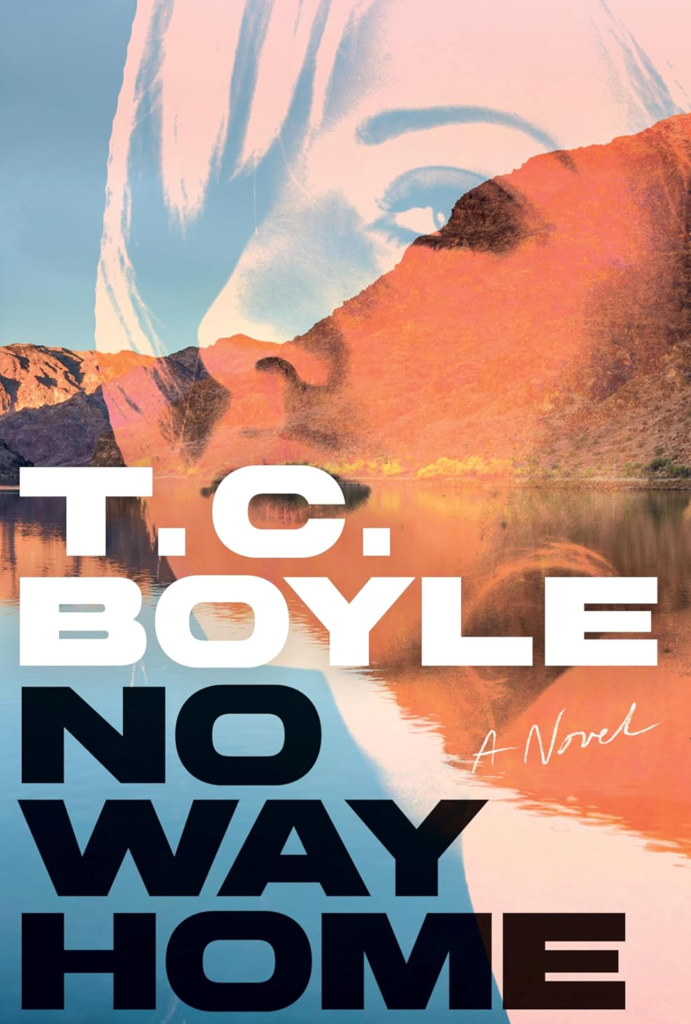
There’s no real good guy or moral center among the trio, about which Boyle says, “They’re complicated. Yes, none of them is a good guy, and some of them are kind of bad in a lot of ways.… Every story is totally different. And this one … it evolves into a love triangle. What does that mean? Jealousy and the violence and so on. After all, we are just big apes, you know.”
He continues, “I just follow the story, and that’s the way this went. The hardest thing for me is to create a character who is good that we would all think, this is a good person — and I am. I am a good person. My friends are good people, but it’s difficult to write a good person.
“I write characters who are more decent, but mainly I love people like Jesse. I love the punks. I can relate to the punks because I was a punk, you know, and they seem like they’re the easiest characters for me to get into.”
He continues, “I become them, and they become me. I’m living them. I’m living with them.”
Part of his getting into the rhythm of the characters is the nightly ritual of reading his work out loud.
“There’s music to it. So, I read to my wife just to hear it. I don’t want her to say, ‘Oh, you got to change it.’ No, I don’t want that. I just want to hear how it sounds out loud again, which is why I love to perform on stage, right?” he says. “It’s got to be rhythmic, and the language, in my view, anyway, has to be beautiful. That’s why I don’t ever really like genre work. Because it might be a great story, but it’s written so poorly. It’s like the cinematography in a movie is the marrow of it. It’s what you see and what you appreciate, as well as the characters and what they do. So, it’s very, very important to make beautiful prose, as beautiful as I can make it.”
While the publicity part of a writer’s life isn’t for everyone, Boyle says he likes the spotlight.
“Most writers are introverts, but I’m not. I love the stage. I love to perform. It’s wonderful. I love to be in the audience, too. I love to hear a story out loud. It reminds me of my mother reading to me when I was a kid, and it’s a beautiful thing. Most others don’t like it. Most others don’t do it well, but I love to do it, and I hope that I’m doing it well and turning the audience on. It’s fun. It’s a whole different experience.”
With complicated storylines, how does he choose what to read?
“Normally, I read something humorous in public, because I figured, you know, if they’re laughing, they’re probably not asleep,” says Boyle. With novels, “I just read the beginning, because I don’t want to stand up there and give them an explanation, and say, ‘Well, Cassie was married to Joe, and then he died of cancer, and his dog died, and then he ate a child and was sent to prison,’ ” he laughs. “I like to just give them the beginning, and if it’s good, maybe they will want to read the rest of the book.”
While he dedicates himself to writing fiction — “I write seven days a week, 365 days a year, unless I’m off on a gig somewhere” — Boyle consistently rotates between short stories and novels. “This is why you can see the pattern in my career from the beginning, a novel, a book of stories, a novel.”
He has a new collection coming out next spring, his 13th, with 12 new stories in it: half of which were written before No Way Home and half written afterward. And short stories don’t evolve into novels, or vice versa, he says. “I’m very rigid in that way.”
And very disciplined. Even if things are happening in the world that he’s compelled to address in his fiction, “I would never work on two things at once, for fear of not getting done with one or the other,” Boyle says.
Although, he does use historical materials to provide a framework — examples include San Miguel and When the Killings Done, about the Channel Islands; The Women, which centers around Frank Lloyd Wright, the architect who designed Boyle’s home; Riven Rock, about Santa Barbara’s McCormick family; and Road to Wellville, about Dr. John Harvey Kellogg and the early years of the health food movement — Boyle says he doesn’t believe in outlines and lets the stories guide the way. “I do like to give you the history for the most part, as I see it, the real history, because it’s so fascinating. But that doesn’t mean that I can’t create the characters and have them do whatever they want. There are no rules.”
He continues, “Novels are just free form, and I never know what it will be. I find a subject, for instance, like Blue Skies. The environment is being destroyed, which I’ve written about, of course, obsessively throughout my life.”
The environment is also at the roots of No Way Home, and Boyle originally thought that his aspiring writer character Jesse would write the history of the Hoover Dam as a book within the book, “but it wasn’t working,” he says. “It was impeding this story, which is kind of, I guess, a love triangle, neon noir kind of thing. I didn’t know that. It just just started to happen. So I make adjustments as I go along, but I never know what’s going to happen, where it’s going or what it’s going to be.”
While his output is tremendous and the joy he gets from writing is clear, it’s not all sunny skies for Boyle. “I’m tormented constantly the entire time I’m writing anything, and every day, I rewrite what I’ve written the day before to kind of get in that mood and see where it’s going to go,” he says. “Sometimes I move forward; sometimes I move backward. But what I want is to have a finished product because of the joy of that.”
A true lover of literature, Boyle was a Distinguished Professor of English at the University of Southern California from 1978 to 2017, and loves interacting with students. “I got my PhD, but I didn’t want to be a man of letters. I didn’t want to give speeches; I didn’t want to go to meetings. I just want to be an artist and to make these stories because that is my life,” he says.
“It’s fascinating to me again, where they come from, when they define, as I said earlier, to find it all come together. Because the way I’m working, it could all collapse, you know. I could be in a mental hospital. But so far, they’ve come together.”
Reflecting on his decades as a writer, I asked Boyle if he ever imagined he’d have the life he has now.
“Who could imagine what they’d do when they’re old,” he says. “I feel lucky to be here and doing this, yeah, and not having a boss and doing what I want and writing my books. Yes, you’re a young writer. You want fame and fortune; you want to be recognized. I still want that. But the old writers who come to the workshop would tell us, well, it’s not so much glamour. What it is, is just the work itself.… Ultimately, just doing the work is what counts, because it gives you something to do. It’s all artificial. Whatever we do is artificial because we live in a mystery and we’re going to die, but we need to have something to do.”
T.C. Boyle will be reading excerpts from and discussing his new novel, No Way Home, along with a short discussion with Leslie Dinaberg, on Thursday, May 28, at 5 p.m. at the Santa Barbara Museum of Art (1130 State St.) as part of its Parallel Stories lecture series. See sbma.net.


You must be logged in to post a comment.