
The Doctor Will Walk with You Now
A Weekly Stroll with Dr. Jennifer Hone
Offers More than Exercise
By Tiana Molony | August 21, 2025
Read more from our 2025 Active Aging Guide here.
A decade ago, endocrinologist Dr. Jennifer Hone had an “Aha!” moment that altered the way she viewed her profession. She realized that while many people wanted to improve their health, they lacked structured opportunities to get moving.
Specifically, Hone became frustrated with the medical profession’s tendency to label patients as “noncompliant” when they don’t follow medical advice. “I just found that when I watched other people — other teachers and students — taking care of people with diabetes, that they were missing something,” she said.
Hone’s background in endocrinology and diabetes led her to realize that traditional medical approaches often fail because they’re too strict and don’t consider patients’ individual lives and barriers. Instead, Hone believed physicians should be more hands-on and specific with patients about concrete changes they can take to improve their health. “We have to really understand that person’s life,” she said, “And figure out what’s important to them and then help them find ways to incrementally change in ways that help them achieve their health goals.”
This realization led Hone to develop what she thought was a nascent idea: the concept of walking with a doctor. The benefit was twofold: She could get out and support her patients, and they could get in their daily exercise. However, she quickly found out that while her idea was great, someone had already thought of it.
The program, aptly named Walk with a Doc, originated in 2005 by David Sabgir, a cardiologist from Columbus, Ohio. When Hone discovered the existing program, she decided to adopt it rather than “reinvent the wheel.” Twenty years after its inception, it’s now expanded internationally, with walks now held in every U.S. state.
In 2014, through Walk with a Doc, she introduced the program to Santa Barbara. It evolved into a community event open to everyone, regardless of health status. Hone runs the walks as a volunteer, making them inclusive and welcoming to people of all fitness levels.
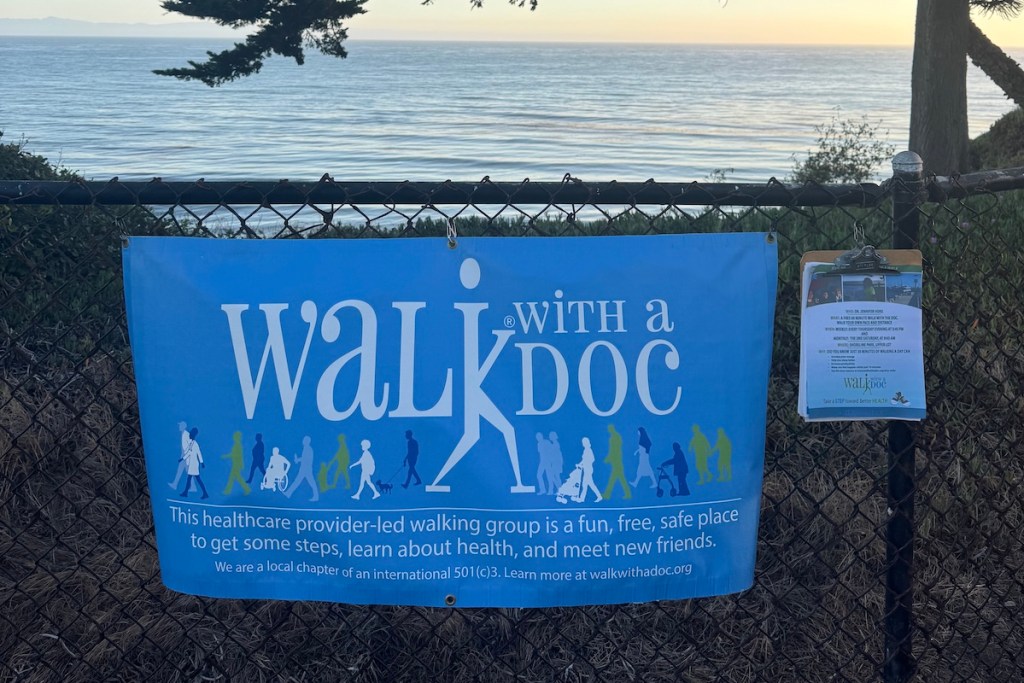
Currently, the walks take place every Thursday at 6 p.m. at Shoreline Park. Attendees meet Hone in the second parking lot, farthest from the marina. She’s hard to miss — she’s usually standing next to a blue sign on the fence that reads: “Walk with a Doc.” The route begins there and continues along Shoreline Park, past the marina, and out to the jetty. The round-trip distance is approximately 3.4 miles, taking about an hour and a half to complete. “So, it’s really intended to be a way to get out and enjoy the beautiful Santa Barbara weather,” she said. “We are so fortunate, and this particular walk route is so gorgeous.”
One Thursday evening, I joined her and other walkers on the route. Hone, a fellow dog lover like myself, chose this particular spot not only for its unmatched ocean views but also for the abundance of dogs. Luckily, Hone is as dog-crazy as I am and wanted to stop and pet just about every furry friend that passed by.
What I thought might be a chat about health-related topics turned into an enjoyable conversation between two strangers getting to know each other, covering a variety of issues — from our backgrounds and where we grew up to our pets and bird species, about which Hone seemed to be very knowledgeable.
While people do ask her health questions, she avoids providing specific medical recommendations. However, health topics aren’t entirely off the table. She’s comfortable discussing general health topics, such as explaining the rationale behind health-related news. Her approach is to encourage dialogue and help people understand health concepts, while always making it clear that she cannot and should not provide personalized medical advice during these community walks.
For 10 years, she has run the program independently, driven by her passion for helping people improve their health through movement and social interaction. It’s become a way to break down barriers, create community, and promote health through social connection, movement, and personalized support. “I feel like I get more out of it than other people do at this point,” joked Hone. “It’s a reason to get off the couch, get moving, and make friends.”


You must be logged in to post a comment.