
When Students Lead, Change Follows
Backed by the Santa Barbara Education Foundation,
Students Create a Zine Amplifying Queer Voices
— and Learned Lessons in Leadership Along the Way
By Tiana Moloney | November 20, 2025
Read more from Schools of Thought 2025 here.
Founded in 1985 by a group of parents, the Santa Barbara Education Foundation (SBEF) began as a grassroots response to widening funding gaps in public schools.
Today, the nonprofit continues its original mission to support students in the Santa Barbara Unified School District through programs that foster academic success, artistic expression, and personal growth. One of its most distinctive efforts, says Interim Executive Director and Programs Manager Katie Szopa, is the student grant program, launched just a few years ago and open to high schoolers in grades 9-11.
Unlike traditional school grants awarded to teachers or administrators, this initiative puts funding directly into students’ hands, encouraging them to design and lead projects that serve their campus communities. Individual grants hover around $500, and as overall funding has grown, so has the number of student-led projects the foundation can support.
Beyond the financial boost, the program is intentionally structured as a hands-on lesson in real-world skills. Students are responsible for creating proposals, submitting applications, meeting deadlines, managing a budget, and collaborating with peers and teacher advisors. That process, says Szopa, is just as valuable as the finished product.
“I feel like it’s really teaching students to advocate for themselves,” Szopa explains. “To be able to figure out what they need to execute a project.” She notes that grant recipients often walk away with a working knowledge of planning, communication, leadership, and follow-through skills that extend far beyond the classroom. “We feel this is a great program that really supports students and develops them.”
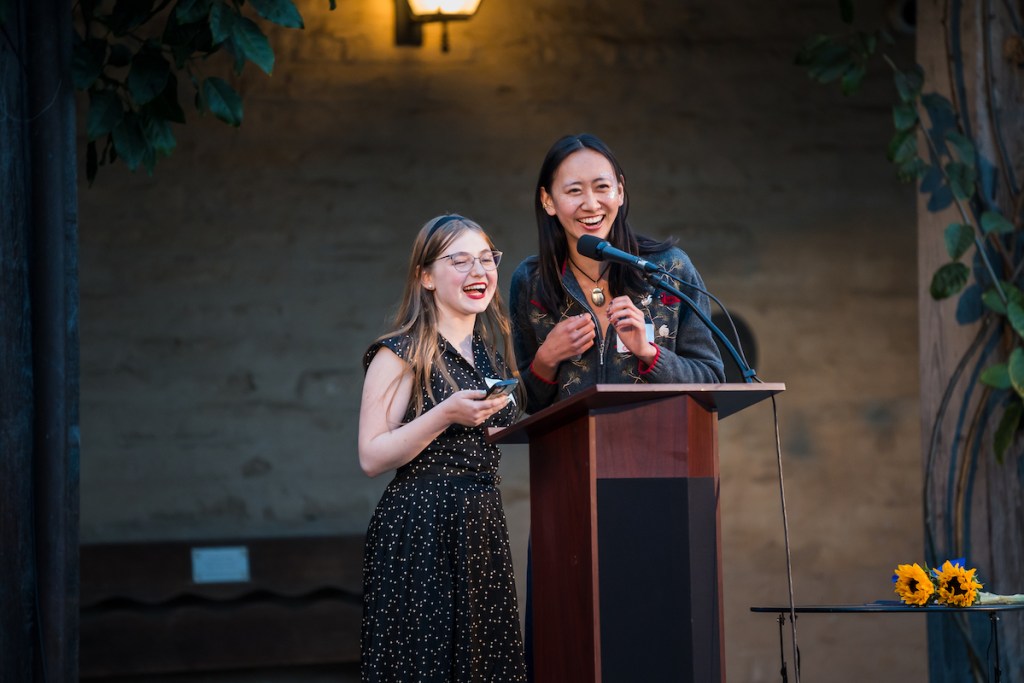
For former San Marcos High School students Isabelle Chabinyc and Chelsea Miao, that sense of purpose took shape in the form of a student-run zine created through their campus Gender and Sexuality Alliance (GSA). With backing from the foundation, they were able to publish and distribute the zine — an outlet for queer and allied students to share writing, art, and experiences — something that likely wouldn’t have existed without the financial and logistical support of the grant program.
For this story, Chabinyc and Miao answered questions about how the Santa Barbara Education Foundation impacted them.
What inspired the two of you to launch a zine through the GSA at San Marcos High? We were inspired by the Writers Society club on campus and their annual student poetry zine. The club has participated in all three years of our Pride Week event, which was inspired by [Gay, Lesbian & Straight Education Network’s] Day of Silence, where students remain silent to support LGBTQ+ students and spread awareness about the oppression they face in schools. Creating a zine seemed like a natural way for many individuals in the GSA and on campus to share their passions. The SBEF grant allowed us to distribute the zines at our Breaking the Silence celebration free of charge.
What have you both learned about leadership, organizing, and peer engagement through this experience? Leading a team to plan the same event for three years will teach you a lot about how to excite a large group. Every year, we gained more experience. Be it navigating administrative environments, honing our public speaking skills by talking at staff meetings, or improved our advertising by consolidating information through graphics, posters and flyers.
Although, the most profound thing we learned is that we cannot slow down until every student has access to a supportive space on their path to self-discovery. Seeing the smiles (and so, so many rainbow stickers) everywhere on Day of Silence is a glaring example of the good student organizations can do, especially with the support of organizations like SBEF.
In your grant proposal to the SBEF, what vision did you outline? What change were you hoping this project would create on campus? Our vision, as always, is to provide a safe space for queer and ally students on campus, while uplifting the LGBTQ+ voice. To accomplish this, the GSA has regular meetings open to all students, and we’ve regularly hosted larger school events — however, one avenue we hadn’t yet explored was art as a form of activism. The zine was a way for us to share our thoughts on the printed page. It allowed us to honor the historical figures before us, compiled with the experiences and works of our students today. Honestly, we had so many exceptional artists and writers in our club; this was just a way we could platform and brag about our amazing, talented members.
All in all, we wanted to showcase how important LGBTQ+ and student media is. Just as you might hear the queer voice from the loudspeaker at our Pride Week festival, we hope you can hear it between the pages of our zine.
What was the budgeting process like? Were there things you wanted to include but couldn’t afford with the grant money? Our budgeting process was probably more simple compared to other student projects. Our only real expenses were the cost of the design program to make the zine, and the physical printing cost. For these purposes, the SBEF grant was the perfect amount of funding for us. We’ve previously received larger grants for larger projects with more detailed budgets. But for our zine, and for what I find is most projects in school clubs, the SBEF grant is the perfect match in terms of funding and student accessibility.
See sbefoundation.org.


You must be logged in to post a comment.