

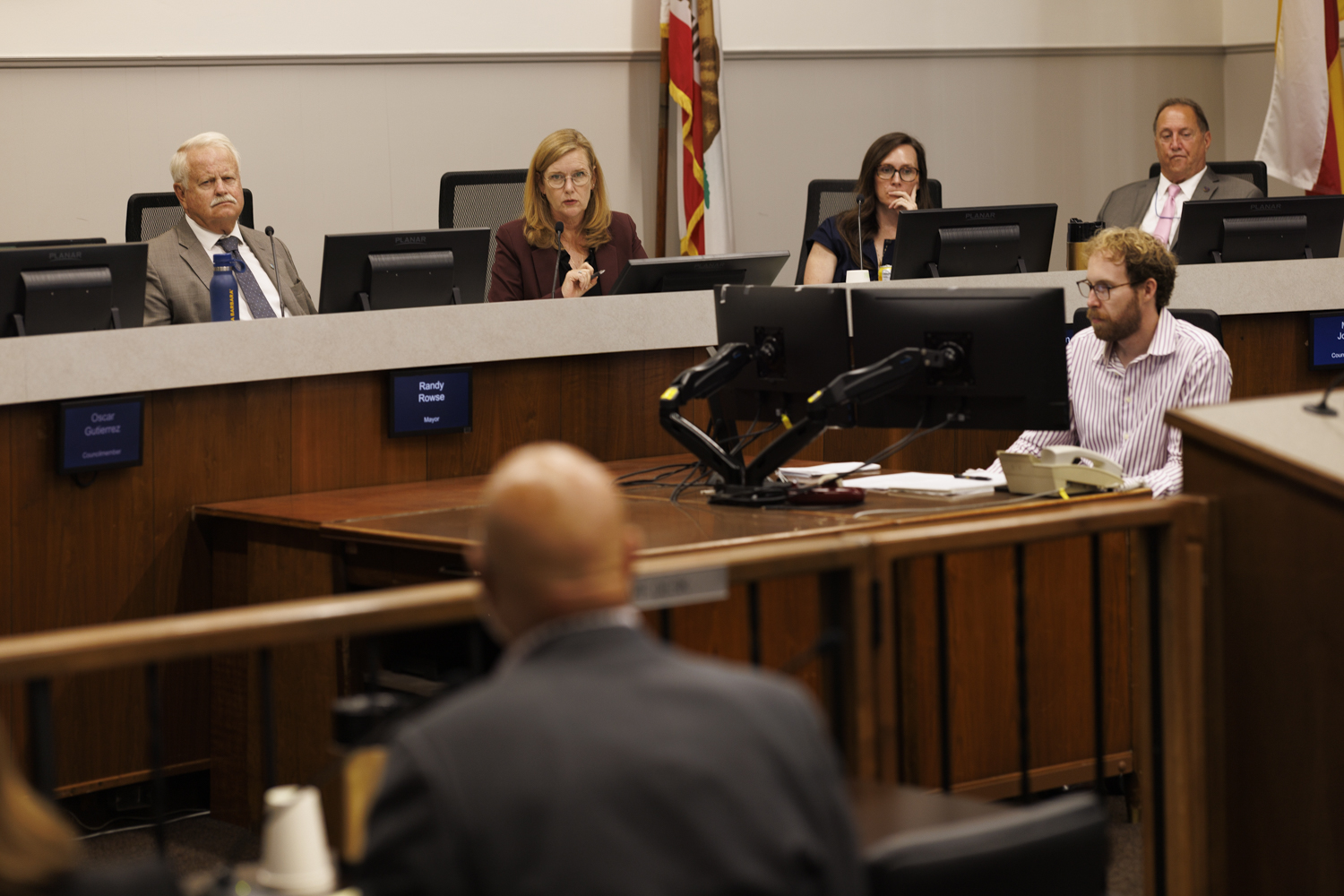
IT ISN’T PRETTY: Whatever happened late Tuesday night in the City Council chambers was a whole lot of things. Historic? Monumental? Seismic?
All of the above.
But pretty? Not even in the same area code.
With Tuesday night’s vote, the fat lady has sung. But it still ain’t over. Next week, the City of Santa Barbara’s mayor and six councilmembers — many barely on speaking terms and several not at all — have to do it all again.
The “all” here refers to the new jam-packed Rent Stabilization Ordinance the council passed — though just barely — this Tuesday’s long-day’s-journey-into-night. Whatever passes for consensus among the councilmembers nearly blew up multiple times over whether affordable housing developments and housing units rented to tenants who receive Section 8 Housing vouchers should be exempted from the new ordinance’s many complex and far-reaching protections. Neither councilmember Meagan Harmon nor Wendy Santamaria — two of the council’s most ardent proponents of rent stabilization — would budge. Things got all Sergio Leone. The only thing missing was the tumbling tumbleweed.
Harmon insisted that federal law already baked rent control and below-market rents into the Housing Authority’s rental rates. To add yet another layer of regulatory bureaucracy, Harmon warned, would chase away the landlords whose properties are desperately needed to house tenants with Section 8 vouchers. Santamaria countered that Housing Authority’s track record of turning a blind eye when inspecting the premises of Section 8 tenants was troubling. What are we saying, she asked, that we don’t care about such tenants?
In the end, Harmon, who has beenpushing for rent control long before Santamaria was ever elected, prevailed. The Housing Authority and Section 8 housing providers will be exempt.
It’s hard to write about this ordinance because it has so many movable parts. Most immediately, it limits landlords to rent increases no greater than 60 percent over the consumer price index or 3 percent whichever is less. That’s among the lowest formulas throughout the state.
If landlords object that that will not allow for a reasonable rate of return, they can take their case to a new rent board. That appeals process will take almost a year to complete. Of the board’s seven members, the new ordinance requires that at least four be tenants. The ordinance does not require any specified number of landlord representatives on the new panel.
Stacked deck?
Why not empanel an even number of each with an odd number of homeowners to break the tie? Not one councilmember broached that question.
Councilmember and ardent rent stabilization proponent Kristen Sneddon — now running for mayor — expressed surprise to learn last night just how complicated and messy it will be to figure out what is or is not a fair rate of return.
Frankly, I was surprised to learn she’s surprised. Tuesday night seemed really late in the game for this sort of realization, considering that Kristen has been involved in this process going on nine years now.
Seems kind of basic.
There were a lot of other surprises. For example, it is expected on average to cost $27,000 to complete this rate-of-return appeals process. We have no real idea how many landlords will file an appeal, but inside City Hall, they’re squeezing out porcupines over this.
Under the ordinance, there is another appeals process to determine how much landlords are entitled to recoup for necessary capital costs. Those appeals are expecting to cost $13,400.
And lastly, the ordinance allows tenants concerned they’re no longer getting the same level of service — or habitability — to file an appeal with the new rental board to get their rents lowered. We have no idea how much these appeals will cost. Or how many there will be. But we do know that in a typical year, the city’s code enforcement officers currently handle 1,600 code enforcement investigations that can take up to 18 months. And there are currently two vacancies in the department handling these investigations.
The ordinance the council tentatively approved Tuesday night is not the most aggressive, comprehensive, and expansive ordinance in the entire state. It is, however, right up there at the top. And it is by far the most sprawling and aggressive right out the gate. Other communities started smaller and expanded over time; Santa Barbara is starting big with the idea of modifying as it goes.
What could go wrong?
Don’t get me wrong. I think rent control is a necessary evil in a housing market as rabid as ours. When we cease blushing at the excess and the escalating inequalities, rent control becomes necessary and inevitable. According to the Bureau of Labor Statistics, the amount of wealth accruing to American workers has just fallen to the lowest level since 1947. In the past 25 years, after-tax corporate profits have risen 800 percent. In that same period, labor’s slice of the pie has shrunk 18 percent.
Supporting rent control in general is one thing. Supporting this proposal is another.
As a kid, I was taught not to eat anything bigger than my head; this is more like a basketball. Early on, we were told the costs for administering this program — initially projected at $154 per unit — would be split evenly between tenants and landlords. Now, we learn the costs for all these appeals — $27,000 for rate of return, $13,400 for capital expenditures, and who the hell knows how much for habitability appeals — has not been included in that $154 figure. One thing’s for certain: It’s going to be a lot more.
Imagine how nasty collecting that will get. In the meantime, City Hall will be on the hook for an indeterminate amount.
That’s what’s called a blank check.
Next Tuesday, the ordinance comes back for a second reading and a final vote. Councilmembers have gotten as sick of the issue as they are of themselves. Hard to imagine any last-minute corrective efforts.
Surprise me.
Related Posts







Premier Events

Sat, Oct 03
9:00 AM
Santa Barbara
Fall Plant Sale and Master Gardener Workshop

Sat, Oct 03
7:00 PM
Santa Barbara
Clean Comedy at Carrillo Recreation Center
Sat, Nov 14
7:00 PM
Santa Barbara
Clean Comedy at Carrillo Recreation Center
Sat, Dec 05
7:00 PM
Santa Barbara
Clean Comedy at Carrillo Recreation Center

Thu, Oct 01
11:00 AM
Santa Barbara
In Studio: Julie Anderson Mathias

Thu, Oct 01
7:30 PM
Santa Barbara
Robert Plant with Saving Grace and Suzi Dian

Fri, Oct 02
5:30 PM
Santa Barbara
Pet Blessing at Trinity Episcopal Church

Fri, Oct 02
8:00 PM
Santa Ynez
Comedian Ron White Performs at Chumash Casino Resort

Sat, Oct 03
9:00 AM
Goleta
Out of the Darkness Suicide Awareness Walk

Sat, Oct 03
10:00 AM
Santa Ynez
Chumash Intertribal Powwow Returns

Sat, Oct 03
10:00 AM
54th Santa Barbara Old -Time Fiddlers’ Festival

Sat, Oct 03
11:00 AM
Santa Barbara
OktoBEERfest at Dutch Garden Restaurant!

Sat, Oct 03
12:00 PM
Santa Barbara
Reclaim Your Radiance Fall 2026 Healing Arts Faire

Sat, Oct 03
12:00 PM
Santa Barbara
CWC Docs: “SURFILMUSIC” (2026)
Sat, Oct 03 9:00 AM
Santa Barbara
Fall Plant Sale and Master Gardener Workshop
Sat, Oct 03 7:00 PM
Santa Barbara
Clean Comedy at Carrillo Recreation Center
Sat, Nov 14 7:00 PM
Santa Barbara
Clean Comedy at Carrillo Recreation Center
Sat, Dec 05 7:00 PM
Santa Barbara
Clean Comedy at Carrillo Recreation Center
Thu, Oct 01 11:00 AM
Santa Barbara
In Studio: Julie Anderson Mathias
Thu, Oct 01 7:30 PM
Santa Barbara
Robert Plant with Saving Grace and Suzi Dian
Fri, Oct 02 5:30 PM
Santa Barbara
Pet Blessing at Trinity Episcopal Church
Fri, Oct 02 8:00 PM
Santa Ynez
Comedian Ron White Performs at Chumash Casino Resort
Sat, Oct 03 9:00 AM
Goleta
Out of the Darkness Suicide Awareness Walk
Sat, Oct 03 10:00 AM
Santa Ynez
Chumash Intertribal Powwow Returns
Sat, Oct 03 10:00 AM
54th Santa Barbara Old -Time Fiddlers’ Festival
Sat, Oct 03 11:00 AM
Santa Barbara
OktoBEERfest at Dutch Garden Restaurant!
Sat, Oct 03 12:00 PM
Santa Barbara
Reclaim Your Radiance Fall 2026 Healing Arts Faire
Sat, Oct 03 12:00 PM
Santa Barbara


