
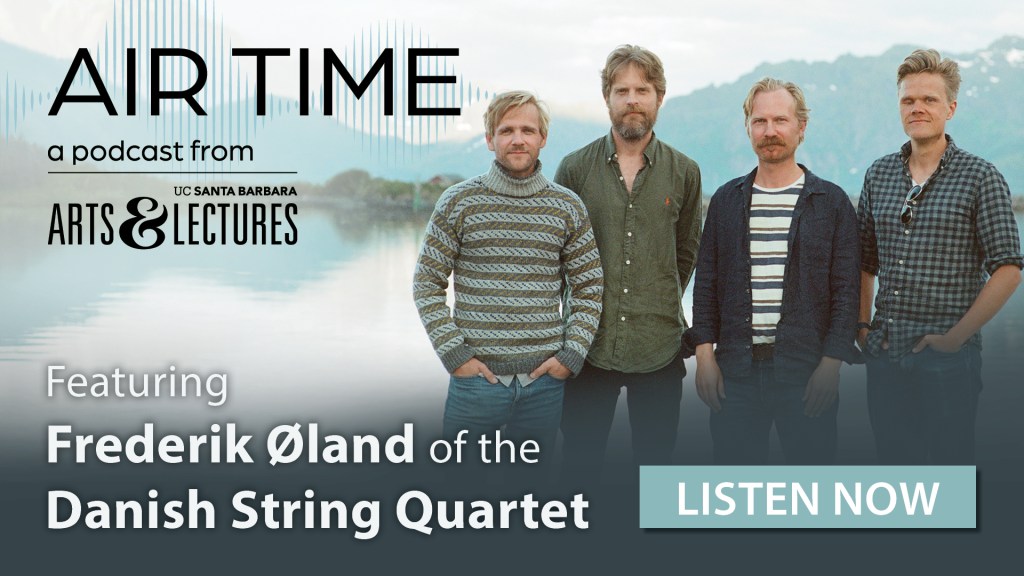
In this episode of Air Time, violinist Frederik Øland of the Danish String Quartet joins host Charles Donelan to discuss a long-evolving collaboration with the Danish National Girls’ Choir — an ensemble he describes as a “living organism” that continually pushes the limits of choral sound.
What began as a midsummer experiment in Denmark has grown into an ambitious, shape-shifting program that blurs the boundaries between voices and strings. Øland reflects on the quartet’s fascination with the unexpected: the choir’s ability to move from pure, “angelic” tone to something raw, even unsettling; the ensemble’s own impulse to disrupt expectations of what a string quartet can be; and the thrill of creating music that leaves audiences wondering what, exactly, they are hearing.
At the center of the conversation is in wildness, a new work by Pulitzer Prize–winning composer David Lang, co-commissioned by UCSB Arts & Lectures. Øland describes the piece as meditative yet dramatic, built on repetition, silence, and text drawn from Thoreau and Hans Christian Andersen. In performance, time seems to stretch and dissolve — an experience he likens to a journey that changes the listener’s state of mind.
The program also highlights music by contemporary Nordic women composers and traditional sources, curated as a kind of sonic exhibition of “strong women in art.” Along the way, the quartet sings, drums, and embraces a spirit of experimentation that has made them a favorite in Santa Barbara and beyond.
Throughout, Øland returns to a central idea: music as a space of trust, risk, and discovery. In Santa Barbara, he says, the quartet feels free to “do strange and crazy things” — and to invite audiences into something genuinely new.
The Danish String Quartet and the Danish National Girls’ Choir will perform on Friday, April 10, at 7 p.m. at The Granada Theatre in Santa Barbara. The concert is presented by UCSB Arts & Lectures.
Charles Donelan
Welcome to Air Time, the podcast of UCSB Arts & Lectures. Today’s guest is Frederick Øland. He’s one of the violinists with the Danish String Quartet. The Quartet will be in Santa Barbara on Friday, April 10, with the Danish National Girls’ Choir for a concert at the Granada Theatre at 7 p.m. presented by UCSB Arts & Lectures. Welcome, Frederik.
Frederik Øland
Thank you very much, and thank you for having me. We can’t wait to come back.
Charles Donelan
You are our favorite and special String Quartet, and we actually had a version of this concert before. I had to go back and check, because it feels like it was just very recently, but it was actually November of 2019 that the Danish National Girls’ Choir was here with the Danish String Quartet. A lot of things have happened in the meantime, and you have been extraordinarily productive. The group has done all kinds of fabulous projects, and we’ve seen you in the meantime as well. The Keel Road album, and I think the Prism album series were finished in that time, and the Doppelgänger project as well. Honestly, it’s amazing how much you’ve been able to do. Let’s begin by talking a little bit about how you met the Danish National Girls’ Choir, and where you first encountered them. Let’s revisit that summer, 2018; does that sound familiar?
Frederik Øland
Yeah, that sounds about right. It’s been a long relationship with them now, and it’s one that we really treasure. As far as I recall, we got invited for their midsummer concert, and we knew them, of course, being Danish. This is a choir that every New Year’s Eve they get broadcast on a special where they sing a couple of songs, and everybody in Denmark is watching that. You know, it’s just past midnight, everybody sings along. It’s like they’re a national treasure. That’s also what they’re mainly known for. And I think that for us, that was also the way we mainly knew them.
So we turned up to this summer concert. We said yes, because we thought it was a great challenge, and, and something that we had we hadn’t done before. And you know us, we like to do stuff that we haven’t done before. So we thought this would be good, and I very clearly remember this from the first rehearsals, and definitely the concert: This was not just a nice girls choir. I think that was a little bit how we knew them, and what you kind of expect just hearing the words “girls’ choir,” you’re expecting something nice, right? Angelic, maybe. But these girls are just incredible, and all the people that are around them, they’re so ambitious, quality is just like within their framework as an organization, and they push the limits of what this ensemble can do.
I remember hearing sounds that I was very much not expecting a girls’ choir to produce, everything from almost like screaming to these very high pitched sounds that were borderline uncomfortable but also really cool, and we just, we went away from that experience very inspired and wanting to do more. And luckily enough, we’ve been able to do just that. It’s been, I don’t know how many different productions with them now, but each and every one of them is special. And also, because each time it’s new people, there’s new people in the choir. I think they have to quit when they’re 22 or 23, something like that. So there’s new people in there. It’s like a living organism, many changes, but they keep on pushing what is possible for a choir like this.
Charles Donelan
I reviewed my interview from 2019 with Asbjørn, and there was a phrase in there that I actually did not fully understand until I looked at it again just now. He said something about “Beauty and the Beast.” At the time, I thought he must have meant the girls and the guys in the string quartet, but he actually meant the choir could be both the beauties and that they could sound like a beast. I guess some of the time he was talking about them. One of the things I remember most from the 2019 concert was the Schnittke Quartet No. 3 that the group arranged to incorporate the chorus. Was that the beginning of the kind of thing that you’re going to be doing when you come in April? How did that relate? Because that was really a stunning new kind of music. I think that that was created for that particular arrangement, right?
Frederik Øland
Well, that arrangement was really a fun one to do. We felt it was something that we really wanted to do, because it was inspired by this early music. And who does early music better than a choir? And when you have a choir, let’s just do it. And so we thought that was a perfect fit. This exact part is not going to be part of this concert, but we’ve been doing something along those lines without really repeating ourselves. I’m not going to spoil too much, of course, but the first part of the concert will be more or less like an introduction of the different ensembles that are on stage, so them and us, and then slowly weaving those two ensembles, meshing the sounds of those two into each other and developing new textures, developing new sounds. We just did the first concert this Saturday in Copenhagen, and I had some friends that were there, and they had some really nice comments. They were saying that this meshing of sounds at one point, they were trying to figure out what and who made the sounds on stage, and they had a hard time doing that. And they also told me that sometimes there were sounds that they didn’t really understand, like, “What is that sound? What is making that sound?” And they couldn’t really figure it out. And that’s great to me, because then it’s like a whole new thing, right? We put some stuff into the boiling pot, and then something comes out, and nobody really knows what it is, but it’s really interesting and cool.
Charles Donelan
That’s a great answer, and also a great opportunity for a transition to talking a little bit about the David Lang piece, because this is very exciting for us. We are one of the organizations involved in the commissioning of this piece. That’s something that we’re very proud of as an organization that we’re working with you and with other organizations that support the composition of new music, and this is going to be the U.S. premiere of that piece. So I assume you did it on Saturday. Is that right? In wildness, it’s called.
Frederik Øland
We did it in Copenhagen, and it’s a great piece. I can’t wait to do it more. And if I can just say, I think coming back to Arts & Lectures, this has become like a home to us. We really feel at home here, and this connection that you also talk about, where you trust each other, right? That’s the feeling we get coming to you guys. We feel like we can be ourselves there, and we can do strange and crazy things and you’ll embrace it. And hopefully that’s the case this time as well. Who knows? Maybe it’s different. I hope not.
But that’s how we feel, right? And that’s just a really amazing relationship to have, because it’s inspiring, and it creates all these opportunities for new music, actually, and new stuff for us to do, and we know we have a place to do it. So I just wanted to say that, because that’s something that we talk about and that we’re very grateful about.
This piece by David Lang is part of that whole relationship. I think it’s a consequence of that relationship, and it’s been many years underway, and we’ve been waiting patiently, and now we’re here. The thing with new contemporary music is when you’re commissioning a piece, you don’t know what you’re getting right? You can talk about a concept, or you can talk about soundscapes and who’s involved and all this stuff, but basically you don’t really know what you’re getting. So it’s always very exciting opening that sheet music for the first time, and having a look. In this case, it’s something that’s…. Let me see how I put this without spoiling too much, because I don’t want to take the whole thing away from people. But this, to me, feels like a meditative piece of music. It feels like a piece of music where the now expands.
We were practicing our own parts in the quartet, and we had to go in and look at the score, because we were thinking, “What is on top of this?” Because it was kind of bare, almost, and very repetitive in some of its motifs. And, and and it actually didn’t really make sense without the choir, but then the choir got on, and then we got to play it a few times at rehearsal, and then in a full concert hall, and in the Danish national radio concert hall. And then it really took shape. And I think it’s an extraordinary piece of music. Again, I can refer to my friends that were listening to it. They told me that it felt like they lost track of time in the best possible way. Yes, it’s something that allows you to be both present and non-present at the same time. And I think that’s a really cool quality about a piece of music.
It’s a little bit like the Schubert Quintet that does the same thing, right? You can’t stay 100 percent aware the whole time. But that’s really not the point of it either. It’s like a journey: You listen through it, and when you’re done, you’re in a different state than what you were before. And I think that’s the sign of something good, right? Yeah, and then there’s the poems in there that the choir recites. I think those are very powerful words, too. I probably shouldn’t talk too much about what I get out of them. I will leave that to the audience, but I think it’s a very powerful statement,
Charles Donelan
Yes, and that’s a wonderful and very flattering comparison to compare it to the Schubert quintet. We’re excited to hear it. Now the work that David Lang has done on his source material; he started with the Henry David Thoreau essay. It’s about walking, but also these Hans Christian Andersen poems are also about going into the wilderness and walking in the woods. One thing I noticed — we were sent the libretto — is that, in this version, the voices of the women, the chorus, they’re speaking and It seems like directly to the audience. It’s a form of direct address, and it feels like a very challenging thing to say. I mean, at one point, it’s about the idea that you don’t just leave culture, but you leave your friends and family. It’s not just about being in nature. It’s about a journey that’s very risky. It almost seems like it’s about taking a risk. Does that come out in the music? Do you feel that this is about making a leap or taking a chance by going someplace that you’ve never been?
Frederik Øland
I can tell you that this piece of music feels both like I already said, like a meditative or, yeah, like a transparent piece of music, but it’s also in its transparency and definitely within its silences, it’s a very dramatic piece of music. So the girls recite these poems, but often in between lines there’s complete silence. So you go from something that’s a dramatic text, and then everything stops, and there’s complete silence in the hall, and it’s almost like uncomfortable silence sometimes, right? It’s a long, long silence, so everybody’s just like caught. And you feel like everything you do on stage matters, because if you do a small wrong movement or sudden movement or something, you break that fragile drama. It’s a very high-intensity drama as well, but without yelling or screaming; it’s a different kind of drama. Yes, so in that way you can definitely put it up against what you’re saying, like that.
Charles Donelan
Damn. Very interesting. The other composers on the program, like Anna Thorvaldsdottir, Lotta Wennäkoski, Caroline Shaw, and Astrid Sonne, a lot of them are women. Was that intentional? Was that part of the original idea? How were they chosen? How did you arrive at that?
Frederik Øland
That was definitely a strong idea, and something that we kept through the whole thing. We wanted to showcase strong Nordic women and a lot of contemporary stuff as well. And when you go through that first part of this concert, you’ll just go through some powerhouses of both contemporary music, but also historic music. There’s some folk music about Danish women in there as well. And I think this first half is incredible too. I think it’s really fun to do, and we even get to … well, I might spoil it a little bit. Personally, I get to play the drum, like a big drum, in the first half. Yeah, and I’m not very good at it, so I had to practice, but it’s really fun.
We also get to sing a little bit in the Quartet, like Viking singing, which is, I think that’s like, that’s a nice, what? What’s that called? The counterpoint to the girls singing. All of a sudden, you have these rusty men’s voices. And don’t worry, it’s very short. You won’t have to listen to it for a long time. But it’s really fun to do. Going through this first half is like going through, I mean, I’m imagining going through a museum where that showcases strong women in art. So this is just with music, but it’s still curated, right? So the journey you take through it, we thought a lot about what piece comes after the other. We thought a lot about the transitions. Sometimes you’ll go from something avant-garde almost into something very, you know, like beautiful soundscapes, but that’s cut off by something very contemporary, you know. So it’s like we thought a lot about that, those transitions, and I think it works out really well. It’s very fun to do. I can’t wait to do it again and again with the girls’ choir.
Charles Donelan
Oh, that sounds so great. You know, we had another good friend of Arts & Lectures, Yo-Yo Ma, and he was here about three weeks ago. And it was also an evening where there were several commissions that Arts & Lectures was involved in and and on a couple of them he sang, and it was very effective, and I don’t think everyone was expecting it,
Frederik Øland
But that’s also what’s fun to do, right? Playing around what is expected of these two examples. Because we talked about this too, as a string quartet, we’re kind of like, not victims, but we’re subjects of the same way of thinking as people think of a girls choir, we think of girls’ choir, something nice, beautiful voices, angelic. The string quartet sometimes is thought of as something nice, background music for a glass of red wine and nice conversation. Don’t disturb us too much. Just play some nice music. That’s kind of what you know people get with the string quartet. And if you tell people you’re going to listen to a Haydn quartet, you know exactly how it sounds and what you’re expecting of it. So we love playing around those expectations and we really get to do that in this concert. It’s why, for example, we’re singing or playing the drum, which is not traditionally part of playing your string quartet set.
Charles Donelan
That’s one of the reasons I think that your group has been such a favorite of the Santa Barbara audiences, is because you do come in with this attitude that you’re both going to do everything that a string quartet is expected to do, and then often in the same evening, just going to blow that up and do something else. And I love that the group has this spirit of experimentation and defying, or at least maybe disrupting expectations. I wonder if you could talk a little bit about how you played, I think, in almost every venue in Santa Barbara, and even maybe some that no one else really plays. I’m thinking of the time that you played in the Rockwood, in the little small club there, kind of in the forest in Rocky Nook Park. Maybe you could reflect a little bit on this concert, which is in the grand Granada, the big hall, you know? But you’ve done multiple shows for us in Campbell. What does it mean to come back to the Granada, and how do you think about when you leave Denmark accompanied by 50 beautiful, strong singers. What does it mean to come to a place like this and have this hall, and express your culture, your identity, your musical ambitions?
Frederik Øland
So, like I said, this feels like a second home to us. We know people there. We know you guys. We know where we usually live. We know our way around the different places. We know where to go and eat all this stuff. You know that that comes together as a place that you want to go to, basically, right? So getting to bring the girls’ choir this time is a big honor for us. And we love that we get to do it, and that you guys trust us enough to do it. I feel like we could say stuff to you guys, like, “We have this really amazing fun idea. We don’t really know how it’s going to turn out, but we’re pretty sure it’s going to be fun and exciting,” and you guys will be on board, because you hopefully trust our judgment, right?
That’s an incredible feeling, and that’s so inspiring that that makes us want to try it more, try harder, and next time we come back, we want to do something extraordinary and really fun, but basically just we get to be ourselves, and we get to be who we want to be as musicians. And this project just underlines that this is something that we really want to do, that we’ve been wanting to do for a long, long time, and now that we’re finally doing it, it feels incredible. I think this evening will be one that will be remembered. I hope so, because it’s something extraordinary, not just because of us, but because of this like melting pot of different examples of different ideas, of different musics, right, and it’s gonna be so much fun presenting it in the big Granada. I couldn’t dream of a better place to do it for the first time. Fantastic.
Charles Donelan
Well, we really cherish this relationship, and especially the attitude that you just expressed, which is that we are a safe place for your biggest, wildest, most exciting impulses. You know, when you were here in 2019 with the girls’ choir, one of the things that we talked about was that we hoped that this collaboration was something that more people could see. And so this time, you’re going to take it to several other places as well. Is that correct?
Frederik Øland
That is very correct. And that’s something that really feels good too, because we had the exact same experience last time we did it with you guys there and afterward, we thought it’s kind of crazy that we don’t do this someplace else, right? It was such a big operation, right? It felt really fun. And this time around, we’re doing it, I think it’s four or five different places. We end up in Carnegie Hall, big Carnegie Hall in New York City. This time we get to present it to a broad audience across the States. And I think this is what it deserves. This is definitely what the choir deserves. And we feel great being part of their presentation in the States as well.
Charles Donelan
Yeah, that’s wonderful and so satisfying. So is there anything else that I have overlooked that you would like to mention right now? I do have a couple of more kind of fun questions for the end that I’ll throw out.
Frederik Øland
Are you ready to go with the fun one? Yeah, let’s do the fun ones.
Charles Donelan
Well, I’m going to ask you to introduce the band, but I want you to introduce them by their order. What beer would they order? Say again, which beer would they prefer? Are you an IPA guy?
Frederik Øland
Yeah, I can do that very quickly.
Charles Donelan
Okay, beautiful. Thank you.
Frederik Øland
So we have Rune [Tonsgaard Sørensen], and that’s the other violinist. He prefers a hoppy IPA, okay? And we have Asbjørn [Nørgaard] on viola. He goes for the local lager; he’s more of like a clear beer kind of guy. And [Fredrik Schøyen] Sjölin on the cello. He’s more like the Irish kind of stout guy. More often than not he’ll go for Guinness if that’s available. Myself, maybe the other guys should talk about me. I don’t know, I like a good IPA as well. Maybe more on the bitter side, but just one, and then I’ll transition into a more straight up lager, or a Pilsner.
Charles Donelan
Excellent. Well, we have you covered. So thank you so much, Frederik. Really fun talking to you. I’m going to say again for my listeners that this has been UCSB Arts & Lectures’ Air Time, and my guest today is Frederik Øland. He plays the violin in the Danish String Quartet. He will be in Santa Barbara with the Danish String Quartet and the Danish National Girls’ Choir on Friday, April 10, at The Granada Theatre at 7pm. I look forward to seeing you all there. And thank you so much, Frederik, it was just a wonderful, charming time speaking with you. We look forward to seeing you soon.
Frederik Øland
Thank you very much, and thanks for having me. This was super fun. Thank you!








You must be logged in to post a comment.