It isn’t often the Board of Supervisors sees their meeting room filled for an item on their agenda. But the words “spay” and “neuter” on the agenda have always provided plenty of spark, and this time was no exception.
County residents are split on the potential of a new ordinance regulating the removal of the reproductive organs of cats and dogs — referred to as spaying of females and neutering of males. After nine months of meeting, listening, and learning, an 11-member task force has returned with a “be a responsible owner” law, as termed by task force chairman Dr. Ron Faoro. Under the proposed ordinance, pet lovers may own an intact cat or dog with a veterinary certificate to purchase an unaltered-animal license. Owners without the certificate must spay or neuter their cat or dog.
Pet owners who are convicted for crimes against animals or domestic violence, possess an animal that has been impounded or cited at large three times in a year, or have been found guilty of allowing a dog to run free resulting in injury to another animal or human would not be eligible for the license.
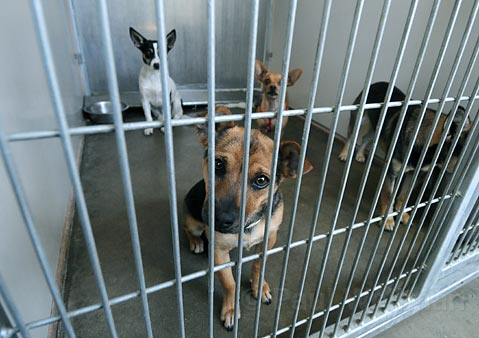
The ordinance concept comes at a time when Santa Barbara County shelters are facing increasing numbers of unwanted or lost animals. Michele Mickiewicz, interim Public Health Department director, said that despite expanding shelter spaces, adding more staff, and benefiting from the assistance of additional volunteer programs, the number of animals has continued to grow beyond capacity.
The Santa Maria Animal Center, for instance, has a daily capacity for 124 dogs and 150 cats. On any given day, the number of cats is more like 190, while dogs are up to 150. The number of dogs that county animal shelters take in has gone up 16 percent — or 644 more dogs — from five years ago, while the number of cats has gone up 17 percent. In the past year, 24 percent of dogs that passed through Santa Barbara County shelters had to be euthanized, while 38 percent were adopted and 38 percent were reunited with their owners. The goal of the ordinance is to not only decrease the number of animals in shelters, Mickiewicz said, but also to raise awareness of the responsibilities that come with pet ownership.
The decision to recommend the ordinance to the supervisors was not without controversy, as the task force voted 6-5 to move forward with the concept. “Everyone probably knows we were a divided task force,” Faoro explained. Those for the concept represented 75 combined years of working on animal welfare issues and at shelters, he said, while those against the concept, although enthusiastic, “do not have any experience working in the shelters.” Many supporters said the ordinance would be a new tool to combat the problem. “It encourages those who are irresponsible to be responsible,” said veterinarian Dr. Scott Smith.
Opponents of the ordinance say they are against anything that mandates what they can do with their own pet. Indeed, task force member Lisa Kenyon said that a single message she heard loud and clear during her nine months on the task force was that the decision to spay and neuter should be one between a veterinarian and owner. Los Alamos resident Chris Rather echoed the sentiment, stating, “[R]equiring a veterinarian’s permission to keep my animals intact, and let’s be clear, that’s what this ordinance says … takes away the right and responsibility to make a major medical decision on behalf of my animals.”
Some opponents called the task force flawed and biased, while others reiterated there was no evidence that mandatory spay/neuter laws have been generally successful in reducing the shelter population in other jurisdictions where ordinances existed.
Because of the public interest, the supervisors are holding a second hearing on the issue on November 10 in Santa Maria, where the supervisors will likely make a decision on the issue.
Double-clicking on any word or phrase in this story will open a reference window with definitions and links to other reference material.

Print friendly
E-mail story
Tip Us Off
iPod friendly
Comments
Bookmark This
Previous Month


Comments
Discussion Guidelines
penelopebianchi (anonymous profile)
November 6, 2009 at 12:36 a.m.
This is a necessary ordinance, a very unobtrusive one, that addresses IRRESPONSIBLE pet owners who let unaltered pets roam. 100's of animals are euthanized locally because there are not enough homes for them and people are giving up their pets for economic reasons as they consider their pets a piece of "property" rather than a personal "responsibility".
We have to do this for the animals! The ordinance gives us a choice, but a responsible person knows the many benefits of spaying/neutering their pets.
Readers say: Thumbs Up: 0 of 1 • Thumbs Down: 1 of 1
sbsue (anonymous profile)
November 6, 2009 at 11:08 a.m. (Suggest removal)
SBSue, no doubt you are an animal lover and even possibly a fellow pet owner. I have two spoiled rotten dogs and two equally cherished indoor cats.
Yes, legally, animals are considered property, and there are a number of reasons this is a good thing and needs to remain the case, all benefiting our pets and those of us who own and love them. The only folks who will benefit from "guardianship" laws will be trial lawyers and administrative agencies.
Now to address your erroneous belief that yet more government intrusion into our family's lives via mandated surgery will somehow end euthanasias and loose pets, let me see if I can show you how Mandatory Spay/Neuter bear zero effect on these issues.
Irresponsible pet owners are what they are. Forcing me, a responsible pet owner, to inflict a possibly risky (ALL surgery is risky, despite what Ron Faoro and others who will benefit financially from this proposed law will have you believe) and invasive procedure on my pets will not have ANY effect on your irresponsible neighbor with the perpetually loose dog or cat who poops in your garden.
It is NOT "very unobtrusive" to force a surgical procedure (not to mention unfunded mandate) upon me, you, or anyone else in the false hopes of coercing irresponsible pet owners into suddenly and miraculously becoming good pet owners.
Using EXISTING laws...which are NOT being enforced (leash and humane care laws) WILL deal very effectively with these people.
Also, forced sterilization (has a creepy ring to it, doesn't it?) does not begin to address the economy or lack of homes, which you also mention. May I also add that Santa Barbara county is an extremely dog unfriendly area for renters; try renting housing with a pet...worse of all...a medium to large sized dog. If you can find housing with your pet, you will pay very dearly for it, and you will most likely be allowed only one pet, and that one under 15 pounds. It is a horrific decision for a family to make, and not always taken as lightly as you portray, nor because people "...consider their pets a piece of "property" rather than a personal "responsibility". "
Forced sterilization addresses none of these issues. What it does ensure is a nice income for Ron Faoro and other veterinarians who will benefit greatly from the endless flow of dollars from those pet owners who can afford to pay for surgery, while the pets of those wgo can't will be dumped on the streets, in rescue, or at shelters.
Readers say: Thumbs Up: 0 of 0 • Thumbs Down: 0 of 0
Holly (anonymous profile)
November 7, 2009 at 6:38 a.m. (Suggest removal)
Forced sterilization also ensures more money will flow to enforcement agencies and administrative entities, and also will give law enforcement and animal control carte blanche to enter your home and property without your permission, peeking in your yard and windows to find pets while you are at work. This was shown on KEYT awhile back, complete with a very proud Animal Services employee showing how he goes around at midday when he knows people are at work, peeking into yards and windows, looking for bowls and toys and "presence of pets", and banging on doors when he knows no one is home in order to goad dogs into barking so he can "note this for future enforcement when the spay laws pass" as well as cite the owners for any license infractions.
As we speak, there is an organization which vets in some counties are being forced to share rabies vaccination data with which then keeps track of said data, then shares it with law enforcement agencies in that county. Reason? To track dogs for licensing purposes and anticipated future forced sterilization legislation. All your personal information is out there and will be used against you.
Voluntary sterilization is a good option with many benefits. Mandatory, forced sterilization benefits an entire group of special interests who will make a tidy income from this enforced and unfunded mandate.
Readers say: Thumbs Up: 0 of 0 • Thumbs Down: 0 of 0
Holly (anonymous profile)
November 7, 2009 at 6:39 a.m. (Suggest removal)
Families will suffer, pets will suffer. My rescue will be buried in dogs surrendered by families who can't afford to or won't subject their pets to surgery, or who are just tired of being criminalized by special interests for the sin of owning a pet. It becomes such a burden that people can no longer cope, and have to make the painful decision to just not have any pets at all.
We need to pull together to create a supportive environment which ENCOURAGES responsible pet ownership, not legislate it out of existence...which is actually what some of the special interests and corporations funding these types of legislation actually want. Ron Faoro and friends are just the unwitting tools of the pet extinction movement. They mean well...and also see income opportunities, but the end result is homeless and dead animals.
If you really want to help, get busy working to change the hostile rental climate for starters.
Work to start a fund to help owners get vet care for their pets; it is now so insanely expensive that pet owners often simply have to euthanize their pets rather than pay to heal them from various illnesses.
Go to a school or hospital with your pet and visit. Convalescent homes also love pet visits; when my mother was in one, she and the other patients lit up when I came with my dogs.
Help the shelters and local rescuers with donations of needed items and your time, or a few dollars if you can spare them. Teach people to buy dogs from shelters, rescues, or responsible, ethical breeders instead of less-desirable sources.
Stop buying the sales pitches of vested interests who are unwitting mouthpieces for much darker interests. Hug your pets. Get informed. Protect them and protect pet ownership for future generations.
Readers say: Thumbs Up: 0 of 0 • Thumbs Down: 0 of 0
Holly (anonymous profile)
November 7, 2009 at 6:39 a.m. (Suggest removal)
What I see here is that one situation begets another: People abdicate responsibility in their personal lives so society passes more laws. Whether it's more gun laws, anti-drug laws, requirement for yet more forms of I.D. to be shown, or in this case, The State will force sterilization. It's simply easier to give up being responsible because the government will take care of all our problems, but the source of the problem gets worse when that happens so it requires even more state-run intrusion into our lives. Likewise, when you pass more laws, it creates more of a boondoggle for government employees, (and what a wonderful job the government has done of managing itself) so in addition to the $$$ the vets make who sterilize these animals, think of the money spent to hire people to enforce these laws. Also, Holly is right about Santa Barbara being very pet-unfriendly which they do in the interest of "quality of life" (my quotation marks for emphasis) while the human population explodes in the name of progress. (So what does it all mean in the end?)
Ask yourself the following question: What were we doing as a society before we felt the need to pass all these various laws.
Yes indeed, "forced sterilization" has a creepy ring to it.
Readers say: Thumbs Up: 1 of 1 • Thumbs Down: 0 of 1
billclausen (anonymous profile)
November 7, 2009 at 3:39 p.m. (Suggest removal)
Post a comment