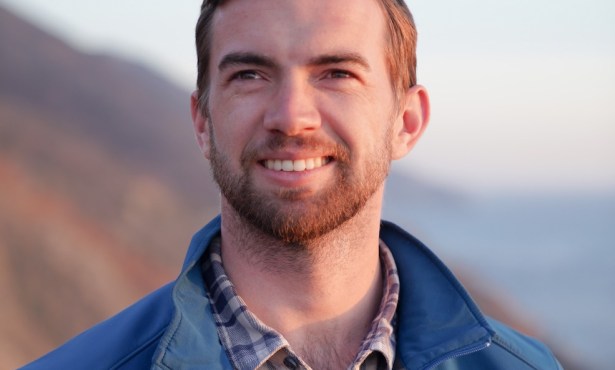
“Regardless of your own personal worldview, making public policies that maintain the separation of church and state makes the world a better place.” This was the message from Sean Faircloth, executive director of the Secular Coalition of America, who spoke at fundraiser held at a private residence in Santa Barbara on October 7. The Secular Coalition is an advocacy group that lobbies for separation of church and state on behalf of 10 member organizations. Organizer Anne Rojas-Keenan said, “I was very pleased by the responses to the invitations. I think people paid attention to what Sean had to say and it’s nice to have a person of a caliber and class as Sean representing secular interests.”
Faircloth’s speech, entitled “One Nation Under the Constitution,” covered current public policy issues the coalition is addressing, such as proselytizing both in the military and in federally funded faith-based initiatives; and eliminating religious exemptions in child safety laws and business regulations. “There should be no special exemptions for religious reasons,” Faircloth said. “Everyone should be treated equally under the law.”
Faircloth also talked about the coalition’s more long-term goal of getting greater participation by people who believe that separation of church and state is vital. “The demographics are changing, more people are identifying themselves as nontheistic, and yet they tend to be underrepresented in politics,” he said. He cited the case of Jessica Crank, a 15-year-old Tennessee girl who died in 2002 of bone cancer after her mother opted to treat her with prayer rather than medicine. Tennessee law has a provision allowing such religious exemptions. “These are issues that can energize a Joe Six-Pack to take action against these laws,” said Faircloth.
Sean Faircloth began to rethink his views on religion when, as a child, he was reading a copy of the Children’s Bible and came to the story about God asking Abraham to sacrifice Isaac. “It made me wonder, is it moral to ask a father to kill his own son to prove his piety?’” Later, after auditioning for a production of Inherit the Wind and receiving the part of Henry Drummond, he realized that things hadn’t improved as much as they should have since the 1920s. “There are still places,” he said, “where separation of church and state is not the law of the land.”
The attendees shared Faircloth’s views. John Coppejans said, “Religious groups have had too much influence in Washington and I don’t like it.” Mary Wilk, a board member of the Humanist Society of Santa Barbara, noted that getting people involved in such organizations is problematic. “Generally, people who share our views don’t join groups,” she said. “They tend to be individualist thinkers and they don’t realize there are organizations that share their views.”
Several students from UCSB also weighed in. Nathaniel Padgett, a senior, said, “Something like the Secular Coalition of America is necessary to help bring a voice to nonreligious groups in the United States. We’re built to be a nation that’s secular, which has separation of church and state.” Fellow student Meli Wasserman added, “It’s important to keep religious ideology out of the classroom.”

Print friendly
E-mail story
Tip Us Off
iPod friendly
Comments
Share Article
Myspace


Previous Month


Comments
I am in agreement with this secular quest. And since this is a continuous movement and people are questioning those in politics with a "religious" perspective translating into how the governed are governed, we should carefully consider our current and local city hall elections.
I am very willing to accept those with strong "faith" values in government but only when those values are democratically principled. We already have council member Francisco who I am extremely skeptical of his fairness for many of his actions but most notably for his participation in the hateful 'Yes on 8' campaign that discriminates against gay and lesbian couples. What is troubling is that Francisco is very close to council candidate Michael Self.
People need to understand that at the local level all kinds of issues come into play including access to family planning clinics, decent wages, domestic partnership benefits, treatment of the "least among us." In tough times what will be cut by the "tough love" religious right candidates? What laws will be enforced or not enforced.
Back to the mysterious Van Wolfswinkel campaign to buy Santa Barbara and install his slate of candidates. My gut tells me that this is a right wing stealthy campaign to take over our council. Is this a right wing slate with one token social liberal at the end of the billing on the campaign literature?
Michael Self and her popular but anti-democratic principled and dictatorial public speaking is cautionary enough. But this association with Dale Francisco and Van Wolfwinkel's slate should give pause to those in this "secular" movement especially those that I see supporting these candidates. And a caution to those in this Secular movement, Secularism does not necessary equal good democratic representation.
DonMcDermott (anonymous profile)
October 11, 2009 at 8:01 a.m. (Suggest removal)
"The demographics are changing, more people are identifying themselves as nontheistic, and yet they tend to be underrepresented in politics,"
So because of the capricious nature of changing demographics the interpretation of the constitution should be altered?
This is the same old story of people scapegoating Christians for the ills of society by pointing out extreme cases such as what happened in Tennessee. You know perfectly well that the case in question is a fraction of a percentage point of Christians.
The only thing that makes sense is that I am in agreement about Faith-Based Initiatives. I think this idea imposes one's denominational views onto others, and also, Christianity is not dependent on getting $$$ from the government whether it's a right-wing Southern Baptist church or a left-wing church such as the Episcopal Church.
What is ironic is that the people who protest the most in support of the separation of church and state are usually people that favor big government. Go figure.
billclausen (anonymous profile)
October 11, 2009 at 5:54 p.m. (Suggest removal)
Go figure what? I favor government helping people. I favor keeping church and state separate. Why is this a paradox?
pk (anonymous profile)
October 11, 2009 at 7:54 p.m. (Suggest removal)
In answer to above post, because with increasing the size and scope of government, more things are likely to fall under the category of the church/state argument.
billclausen (anonymous profile)
October 12, 2009 at 1:18 a.m. (Suggest removal)
If God belongs anywhere, it's at home and in churches - not on currency or in pledges of allegiance. How about starting this movement by expunging those? Unfortunately, the vicious Christian-types insist that everyone should be infected with their brand of mental imbalance and would no doubt respond by expressing their Christian love with violent acts.
Pagurus (anonymous profile)
October 12, 2009 at 1:22 a.m. (Suggest removal)
billclausen: Some examples?
pk (anonymous profile)
October 12, 2009 at 9:18 a.m. (Suggest removal)
Faith Based Initiatives is one example of how the churches could fall under the control of the Feds. (Should the churches be venal enough to take the $$$ which is one of the reasons I oppose this) More land being acquired by the feds means more possibility of people going ballistic if someone puts up a cross. If the land is private, those same people risk only being offended.
There is the argument that school vouchers--a psychological reaction to the miserably failed public school system-violate church/state when in point of fact it's ultimately the parents and *not* the government who decided which-if any-"religious" school the kids are sent to by their parents. (People on the left and from what I can see every Democratic politician hate school vouchers) More government school domination via endless $$$ by the taxpayers without accountability and a good dose of lies about the violation of church and state seems right up the alley of those good progressives.
billclausen (anonymous profile)
October 12, 2009 at 3:13 p.m. (Suggest removal)
If a church didn't want to put up with the strings attached to federal money, "big government" couldn't force them to take it.
How would the feds acquiring land lead to people putting up a cross on that land?
If big-government "progressives" are so ideologically opposed to vouchers, why would they promote them?
pk (anonymous profile)
October 12, 2009 at 9:06 p.m. (Suggest removal)
How would the feds acquiring land lead to people putting up a cross on that land?
I didn't say that. I just used that as a theoretical example of the fact that more private ownership would mean less chance of a church state issue.
If big-government "progressives" are so ideologically opposed to vouchers, why would they promote them?
I didn't say that either.
billclausen (anonymous profile)
October 13, 2009 at 3:28 a.m. (Suggest removal)
You said that if the government acquires land, there's a greater possibility of people being offended by "someone" putting up a cross on that land. Who is the "someone" who will be putting up a cross on the government's newly acquired land?
I agree that your final paragraph is a little hard to figure out. You start by talking about vouchers, then say that Dems and people of the left (who are presumably big-government types) hate them, and then attack "government school domination" via $$$ and lies about the church-state issue, so I assume that this has something to do with big-government types using the vouchers they hate to dominate the schools.
pk (anonymous profile)
October 13, 2009 at 7:04 a.m. (Suggest removal)
Who is the "someone" who will be putting up a cross on the government's newly acquired land?
Isn't there some controversy going on (maybe it's resolved) in San Diego about a cross on federal land? I'm pretty sure it was down there. I think this was about five years ago.
billclausen (anonymous profile)
October 13, 2009 at 3:36 p.m. (Suggest removal)
I think it was in a public park.
billclausen (anonymous profile)
October 13, 2009 at 3:37 p.m. (Suggest removal)
That cross was put up 75 years ago in the Mojave National Preserve as a war memorial. The case is now before the Supreme Court, which is likely to rule on narrow legal grounds that would avoid the church-state issue.
It isn't likely that the government today would take private land for public use through eminent domain and then let people put a cross on it, although Justice Scalia did express the bizarre belief that a cross is an acceptable symbol under which to honor Jews and other non-Christians.
pk (anonymous profile)
October 13, 2009 at 4:28 p.m. (Suggest removal)
"although Justice Scalia did express the bizarre belief that a cross is an acceptable symbol under which to honor Jews and other non-Christians."
He did? What was his justification?
billclausen (anonymous profile)
October 14, 2009 at 4:12 a.m. (Suggest removal)
Here's the report of his comments. He offered no further explanation of his reasoning:
"It's erected as a war memorial. I assume it is erected in honor of all of the war dead," Scalia said of the cross that the Veterans of Foreign Wars built 75 years ago atop an outcropping in the Mojave National Preserve. "What would you have them erect?...Some conglomerate of a cross, a Star of David, and you know, a Muslim half moon and star?"
Peter Eliasberg, the American Civil Liberties Union lawyer arguing the case, explained that the cross is the predominant symbol of Christianity and commonly used at Christian grave sites, not that the devoutly Catholic Scalia needed to be told that.
"I have been in Jewish cemeteries," Eliasberg continued. "There is never a cross on a tombstone of a Jew."
There was mild laughter in the packed courtroom, but not from Scalia.
"I don't think you can leap from that to the conclusion that the only war dead that that cross honors are the Christian war dead. I think that's an outrageous conclusion," Scalia said, clearly irritated by the exchange.
pk (anonymous profile)
October 14, 2009 at 7:49 a.m. (Suggest removal)