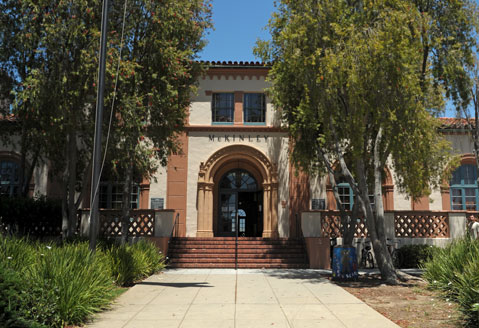
One of the best views of Santa Barbara can be seen from the balcony of the McKinley Elementary School library. Look ahead, and you see the foothills spread out in a mosaic of red-tile roofs dotting the Riviera. Look down, however, below your feet, and you see a jumble of colorless, high-density apartment houses stacked on top of each other, satellite dishes jutting out like prosthetics. Those apartments make up Santa Barbara’s poorest neighborhood, the lower Westside, and that is where most of McKinley’s students live. Every morning, you can see the young children heading “up the hill” to go to school.
The 80-year-old, stately, arcaded building, one of the most beautiful in the district, sits on a picturesque perch across the street from Santa Barbara City College. Originally intended to serve the pleasant, middle-class neighborhoods on the Mesa, McKinley is now attended by few if any of the children living in those homes. Today, 98 percent of the students are Hispanic, and 90 percent are eligible for free or reduced lunches. Kindergarten teacher Elizabeth Brooks, who grew up on the Mesa and attended McKinley when it was “lily-white,” explained, “Now I have kids who have never held a pair of scissors and don’t know how to hold a book.”
With such a challenging demographic, it’s no wonder that in the 2004-05 school year, McKinley fell into Program Improvement (PI), the federal designation for underperforming schools. The PI label is a bit like quicksand. Every year, more schools get caught up in it, but few can ever escape. In the 10 years since the No Child Left Behind legislation went into effect and troubled schools began to be identified as PI, only one in Santa Barbara County — Isla Vista Elementary — had ever been able to remove the stigma. Currently seven elementary schools of the 13 in the district have been declared PI. But something surprising happened. When tests scores were released this fall, the California Department of Education informed McKinley that its students had improved so much that it was no longer categorized as PI. While nobody was looking, the school had turned itself around.
Much of the credit for this unexpected accomplishment has gone to McKinley’s principal, Emilio Handall. As a senior at UCLA, Handall volunteered at the East L.A. high school where the hero of the film Stand and Deliver, Jaime Escalante, taught calculus. There, Handall became convinced that teachers were still ignoring Latino students’ true potential. Fueled with a sense of mission, Handall has spent the better part of his 13 years in education developing methods that work effectively with a Latino student body. Though he brought this conviction to McKinley, what really made the school a success was not just one principal who had something to prove, but teachers who rolled up their sleeves and worked very hard.
Climate Change
Handall had not been a good student when growing up in Carpinteria. His home life wasn’t ideal, and school was not a comfortable place for him, especially because there were no Latino teachers. But in high school, he bonded with his football coach and math teacher Lou Panizzon, who grew up poor but made something of himself. (Today, Panizzon is a member of the Carpinteria school board.) A Vietnam vet, Panizzon inspired the young Handall to join the army. “For me,” recalled Handall — “college was like Disneyland. … That’s not where I belonged.”
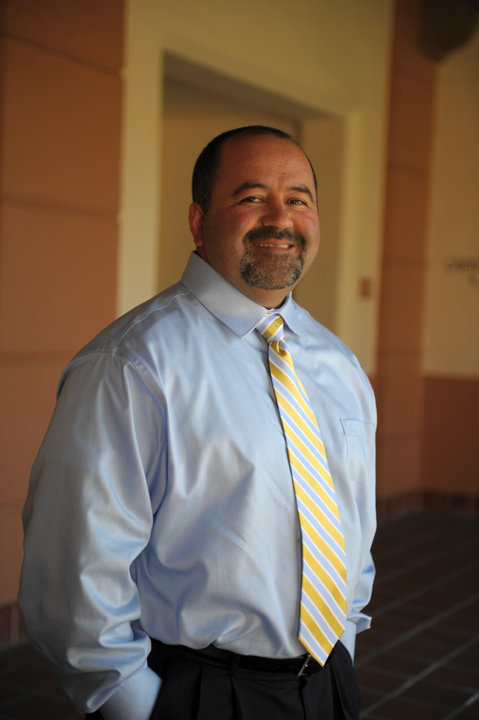
Handall finally did get a college degree, and after working as a school substitute, he decided to pursue a teaching credential. He felt he could make the most difference on the elementary level because grade schools employed so few Hispanic male teachers. And that’s where he began, first in Oxnard, where he had success as a teacher. But later in Port Hueneme, when he advanced into administration, he began to find it was more difficult changing an entire school culture. Since then, he has learned that to make significant change, the problem must be approached from two directions: Both the parents and the teachers have to make substantial shifts in their current thinking. The whole school and all the families must work together to make academic culture a vital factor in the life of the child.
First, Hispanic families have to be familiarized with how American schools work and what is expected of both parent and student. At McKinley, Handall implemented programs that were able to accomplish both. To help the families, he brought to the school two effective initiatives with substantial funding from regional nonprofits, particularly the J.S. Bower Foundation: AVANCE, a Texas-based program that has had great success helping parents prepare their infants and toddlers for kindergarten, and Padres Adelante, which helps parents navigate the American educational system.
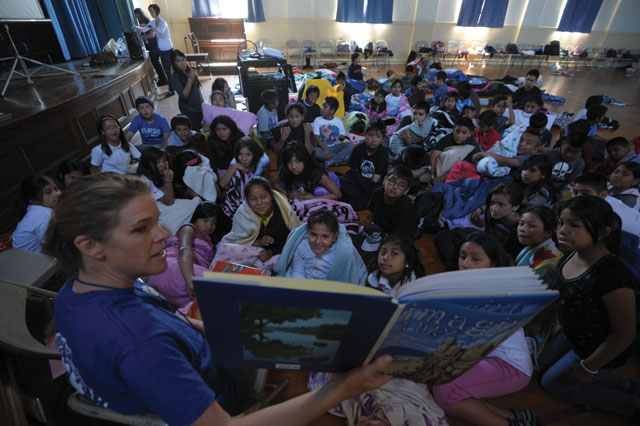
Mirabel Canales, mother of two students and Adelante volunteer, believes these programs have been remarkably helpful for the parent body. Parents are already learning about practical matters essential to their children’s future, such as how the college application process works. Illustrating this shift, the hallways at McKinley are now lined with university pennants, and longtime teacher Deidre Bluitt said, “The climate’s changed. Kids want to go to college.”
Handall’s next task was to bring his teachers together as a team to hone more effective classroom techniques.
Pangaea
Changing a teaching culture isn’t always smooth sailing, though. And at first, Handall attracted scrutiny from the union and even drove off some teachers. One of his goals, however, was to persuade those who stayed to work as a team.
Take, for instance, the 1st grade instructors whose kids come in barely literate and — if McKinley’s educators reach their goal — leave reading 80 words per minute. (The state standard is 60 words per minute.) At McKinley, where 86 percent of the students are English-language learners, that is a tall order.
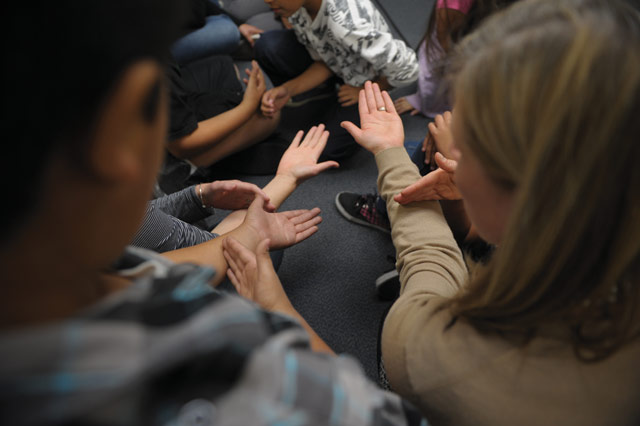
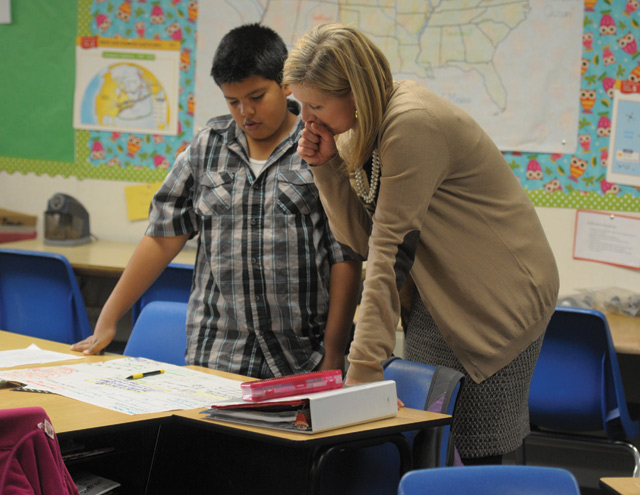
This was the challenge a group of 1st grade teachers discussed one March morning as they sat in a semicircle on children’s tiny chairs. In overwrought bureaucratese, this meeting is called a Professional Learning Community (PLC). The idea behind it is that teachers work as a team responsible for every student in their grade, not just those in their own classrooms. Thus, when they meet, teachers are expected to calibrate their lessons, making sure that their students are all on the same page. This is fairly standard practice in the district now, but it wasn’t when Handall came on in 2008. In an act of scheduling jujitsu, he freed up one-and-a-half hours every week so that all the teachers from each grade level could meet during a school day as a team.
At PLC meetings, teachers negotiate fair assessments by which to measure their students’ progress, setting goals and creating monthly reports to be shared with the principal. At this meeting, with four more months left in the school year, the teachers focused on the fact that they had not quite met their target of having 75 percent of the students reading 40 words per minute. They began scrutinizing a list of struggling readers and discussing possible interventions.
It’s this sort of rigorous data collection that has played a large role in bringing McKinley’s students up to grade level. This isn’t to say that nothing had changed inside of the classroom. As Handall, who loves to turn a metaphor, put it, McKinley was filled with “islands of excellence” when he arrived, and he wanted them to form a “Pangaea.” In other words, it was a free-for-all in which each teacher did his or her own thing. Handall was determined to install an overarching educational theory.
Big in Japan
If you ask Layne Wheeler, president of the Santa Barbara Teachers Association, he believes McKinley’s success should be credited to the Quality Education Investment Act (QEIA), which sends an extra chunk of cash to the lowest-performing 20 percent of schools in California for seven years. Handall agrees that QEIA was helpful. The primary purpose of the money is to reduce class sizes, so it led to an influx of new teachers. But it also offers funds over which principals have some discretion. Handall spent all of his on professional development. “If you had to put your money anywhere,” he said, “it would be in instruction.”
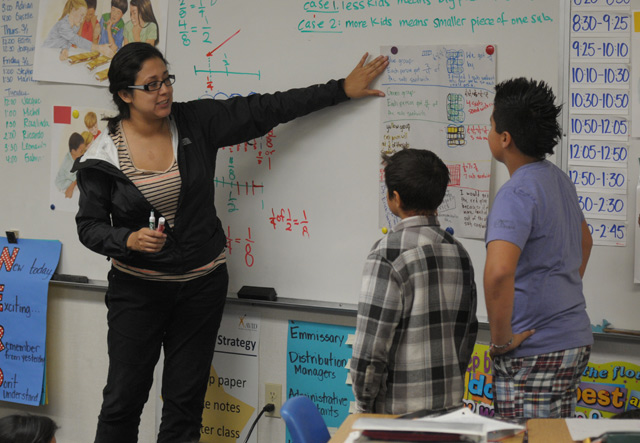
The education scholars James W. Stigler and James Hiebert argue in their book The Teaching Gap that education can benefit more from attention to detail than from a revolution: “By trying to accomplish too much, we have sacrificed opportunities for small, cumulative improvements.” Handall took that advice to heart and embraced the somewhat forgotten teaching method of direct instruction. In the faddish world of educational theory, direct instruction is a decidedly unhip technique. It emphasizes old-fashioned ideas such as highly scripted lesson plans and teacher modeling. But the teachers at McKinley agreed with Handall and doubled down on the idea. As 4th grade teacher Tracy Schifferns summed it up, “I do, we do, you do.” It is straightforward, and it works. Although direct instruction is often misunderstood to be a teacher droning on in front of the class, lectures, in fact, are short and broken up by multiple assessments. The assessments are key because direct instruction, as it is practiced today, necessitates constant revision and reteaching.
For three years running, McKinley’s teachers have worked with outside consultants to script lesson plans in teams and, in so doing, to make those cumulative improvements. The latest consultant, Terri Henning, said, “The staff there are so professional and so willing to do whatever it takes to raise the achievement. … It’s not always the case with every school I’ve worked with over the years.”
Stigler and Hiebert’s 1999 text provides the model followed at McKinley. The book, which is based on analysis of video footage from mathematics classrooms in the U.S., Germany, and Japan, concludes that Japan aces the test. And one of the keys to Japan’s excellence is jugyou kenkyuu, or “lesson study.” “The premise behind lesson study is simple,” they write. “If you want to improve teaching, the most effective place to do so is in the context of a classroom lesson.”
In their last lesson study, the entire staff focused on teaching “inferencing,” or deciphering implied information in a text. After analyzing test data, Handall noticed it was a skill with which his entire student body had trouble. That makes sense because drawing on contextual clues can be especially difficult for McKinley’s demographic. Ashleigh Lemp, a 4th grade teacher who works with remedial readers, explained that a simple word like “lawn” may have no relevance to the everyday existence of her students. These are the types of problems McKinley’s teachers need to solve.
At McKinley, a lesson study is a two-day exercise where teachers from the same grade level script a lesson, observe each other delivering it, and then work to perfect it. These two full-paid days are a rare opportunity for teachers in this cash-strapped district, but it is one that is paying strong dividends. Lesson studies may just make the difference between adequate and exceptional instruction.
Built to Last
Now that the PI beast has been slain, Handall has started the wheels rolling on two intertwined projects: turning McKinley into a STEM (science, technology, engineering, and math) magnet school and forming a partnership with UCSB. This program will be similar to one at the other Westside elementary school, Harding, where UCSB professors and students share research with teachers, help analyze student performance data, conduct literacy enrichment activities, and provide parenting workshops.
According to the most recent Program for International Student Assessment, 17 countries scored higher in math literacy than the U.S., and 12 fared better in science literacy. As technology plays an increasing role in the economy, it behooves our students to close that gap. And the teachers at McKinley, who have begun to attend STEM conferences and write grants, believe they will be the solution.
When asked whether they believe that the district’s first STEM curriculum will begin to reverse white flight, however, they are more circumspect. Of all the problems that Handall has tackled, lack of diversity has proved the most intractable. “It’s like Montgomery, Alabama,” Handall said of Santa Barbara’s elementary schools. “Do we need the National Guard to come in and desegregate our schools?” he asked half facetiously.
Superintendent David Cash believes that one key to increasing diversity in the classroom is increasing diversity among the district staff, which is why he just hired Handall to be the new assistant superintendent of elementary education. To Handall’s supporters, the news was bittersweet. It’s hard to ignore that McKinley’s annual Academic Performance Index score has increased every year Handall has been on staff, jumping 100 points, from 674 to 774, between 2008 and 2011, but it still has not cracked 800, which California deems sufficient. Although Handall is confident that when test scores are released in the fall, his students will have hit that milestone, some on his staff feel as though his work at McKinley is not finished. “I told him it’s not time to leave,” said Carmen Camarillo, who has been an instructional aide at McKinley for 23 years.
Handall — with some combination of earnestness, humbleness, and political savvy — insists that the success of the school rests on the shoulders of the teachers. “This place,” he said “is built to last.”