

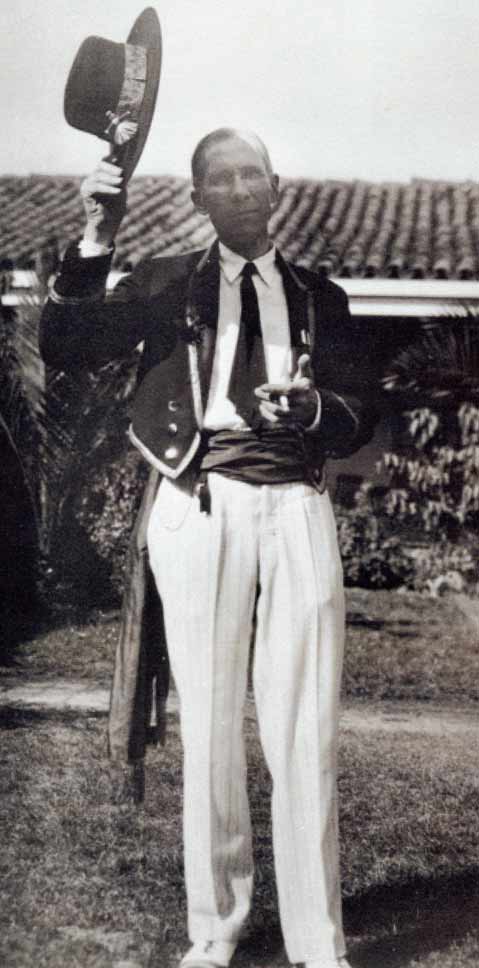
Pearl Chase is frequently credited as the person who envisioned and led Santa Barbara’s post-earthquake reconstruction in Spanish-style architecture. While she certainly supported the idea and had a long history of community beautification efforts, she was quick to point to Bernhard Hoffmann as the one who deserved the acclaim for seizing the moment and leading the way. He was successful, despite the obstacles posed by official short-term thinking, now long-forgotten.
In 1959, Chase wrote an article titled “Bernhard Hoffmann: Community Builder”; she described him as “a practical idealist who worked tirelessly and with farsighted vision to make Santa Barbara a beautiful city, with an architecture in harmony with its historical background and adapted to its distinctive topography, its climate and its delightful location.” She added, “Mr. Hoffmann was indefatigable in his efforts, unflagging in his interest, and wonderfully generous.”
On July 10, 1925, less than two weeks after the earthquake devastated many of the downtown buildings, Bernhard and Irene Hoffmann hosted a “Reconstruction Dinner” at their historic property, Casa de la Guerra. The 75 guests included a cross-section of community members including business leaders, local politicians, planners, and members of civic organizations. At the dinner, drawings were shown and consensus was reached about the way forward: “A consistent architecture would mean an increasing of revenue and a general stimulation of business.”
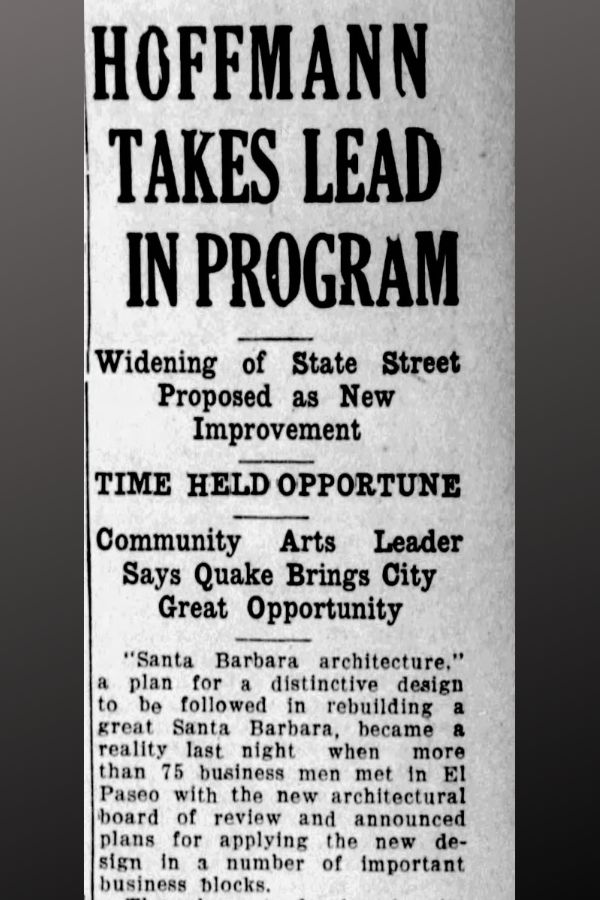
The next morning, the headline of the front-page story read: “Hoffmann Takes Lead in Program.” The article detailed the plan to rebuild downtown in a distinctive design termed “Santa Barbara architecture.” Hoffmann spoke to the opportunity of the moment: “This is no new thing. For years past the leaders of this community have backed the movement toward a distinctive type of architecture in Santa Barbara and experiments have proven it to be an unqualified success. But never before have we had the opportunity to establish the plan throughout the city that the earthquake has afforded us.”
Appointed to the Architectural Board of Review (ABR), he spearheaded (and funded) the Community Drafting Room, which offered architectural assistance to owners of business and residential properties. He also served as a combination spokesperson/promoter of the reconstruction plan to convince the public of the economic and aesthetic benefits — for both residents and visitors — of rebuilding the wrecked downtown with a uniform Spanish-style architecture.
But Hoffmann was fully aware of the grumbling in various sectors of the community over the legitimacy of the ABR. Many members of the business community believed imposing architectural controls violated their freedom, charging it was elitist, overbearing, and too expensive. He described the situation to a friend back east: “The Architectural Advisory game is going quite well, but we are in the position of the man on the surf board, if he stays ahead of the crest of the wave he may reach the beach; if not, he gets a dousing.”
Discontent spread over the plan for an arcaded Spanish-style architecture with uniform signage, lighting, shade on both sides of the downtown business district, and the very notion of the review board. Outspoken Councilmember HL Sweeney characterized the plan as “selfish greed, thirst for political power and the disregard of citizenship and property right.”
Sweeney’s outrage was aided by editorials the Santa Barbara Daily News, owned by the powerful publisher Thomas M. Storke. An example: “The News has criticized the architectural board chiefly because the method of selection of its members in effect took the power out of the hands of the city’s representatives and transferred it to others … unwarranted interference with the rights of property owners and others is improper.”
The usually mild-mannered Hoffmann publicly took the criticism in stride, but he wrote to his friend, architect T. Mitchell Hastings, “Speaking of politics, just at the present time there is the usual acrimonious pre-election discussion raging and the Storkes are playing their usual contemptible role. I wish that I were an advertiser so I could have the satisfaction of withdrawing any connection with the paper.” He solicited and received the support from a variety of powerful figures in publishing, banking and philanthropy; they wrote letters but they had little sway on public opinion.
Hoffmann’s close ally, Dr. Rexwald Brown, a member of the Planning Commission and the head of the Chamber of Commerce, offered a prescient observation: “In 50 years, the citizen then living would pay us homage, but at present we are 10 years ahead of our time.”
Barely six months after the earthquake, newly elected City Council members who were hostile to the planning and approval process voted to abolish the Architectural Board of Review. The act was “to Mr. Hoffmann’s sorrow,” as Pearl termed it. Years later, she admitted, “He was just heartbroken.”
He returned to his leadership of the Community Arts Association and continued to cheer on the efforts of those who moved forward in rebuilding Santa Barbara in a distinctive style. On June 29, 1926, his byline appeared on a full-page article in the Morning Press. In the article, titled “A Year’s Work in Building up ‘City Beautiful,’” he asserted, “The horizon is full of rosy possibilities.” He referred to the termination of his work only obliquely, noting: “In future days the happy results of cooperation and coordination in a general plan without sacrificing anything in the way of individuality, can be had by some such coordination as was brought about through the work of the architectural advisory committee.”
Hoffmann resigned as the chair of the Plans and Planting Committee in 1927, and Pearl stepped into the role she kept until 1973. The Hoffmanns continued to split their time between Santa Barbara and Stockbridge, where they the couple increasingly resumed their civic and philanthropic work.
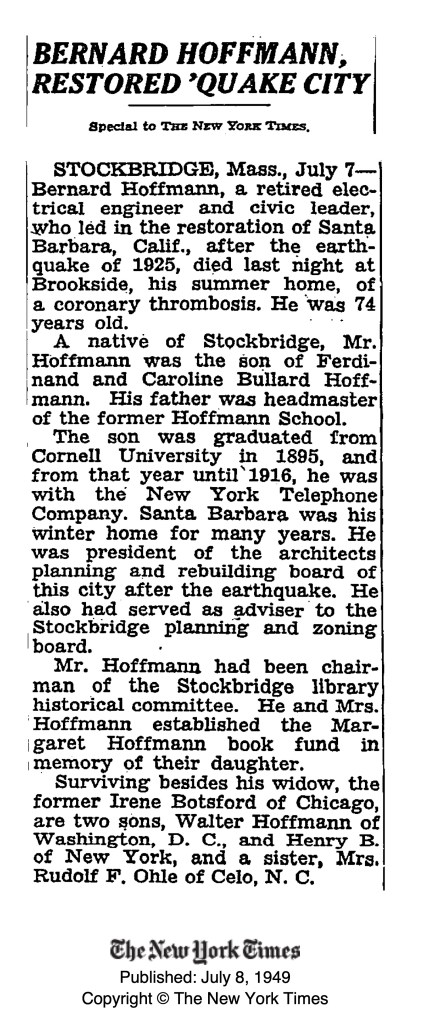
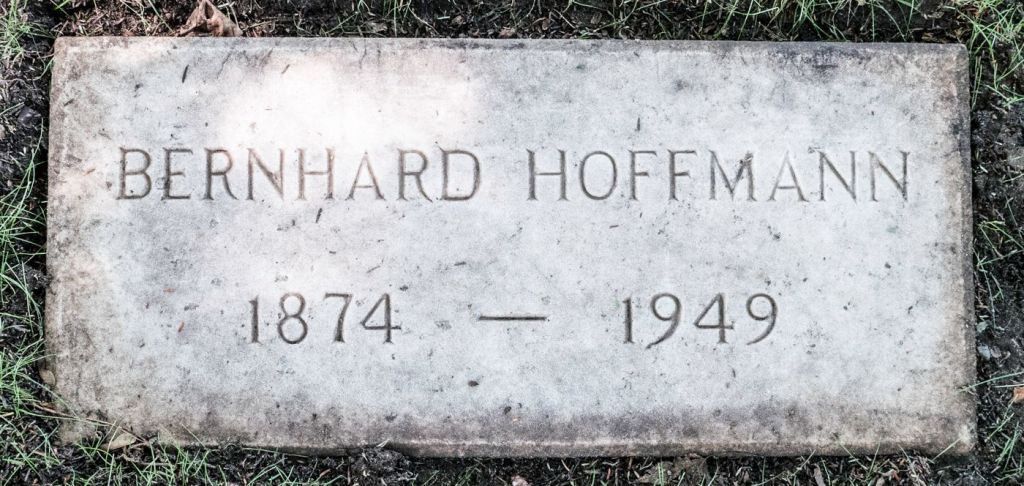
Hoffmann’s visionary leadership in Santa Barbara was hailed outside the city: He was named an Honorary Member of the American Institute of Architects in 1929, and when he died in 1949, he was eulogized in The New York Times as the man who “Restored ‘Quake City.” The obituary in the News-Press noted — quite belatedly, considering Storke’s earlier hounding of Hoffmann’s efforts — “We have not carried on the dream as well as we should. We might, if we really appreciate what he thought out and what he did for this city, try to revive and restrengthen his hopes for his adopted city. He tried to perpetuate the best in the spirit of this city.” Chase observed, “His work has been, and should continue to be, an inspiration to our public officials and to our fellow citizens — newcomers and old-timers alike.”
Cheri Rae is a longtime neighborhood advocate and the author of A String of Pearls: Pearl Chase of Santa Barbara. She is a board member of the Pearl Chase Society, and the longtime editor of the society’s newsletter, “The Capital,” where this article first appeared. Email Cheri at pcs@pearchasesociety.org or visit pearlchasesociety.org.










You must be logged in to post a comment.