

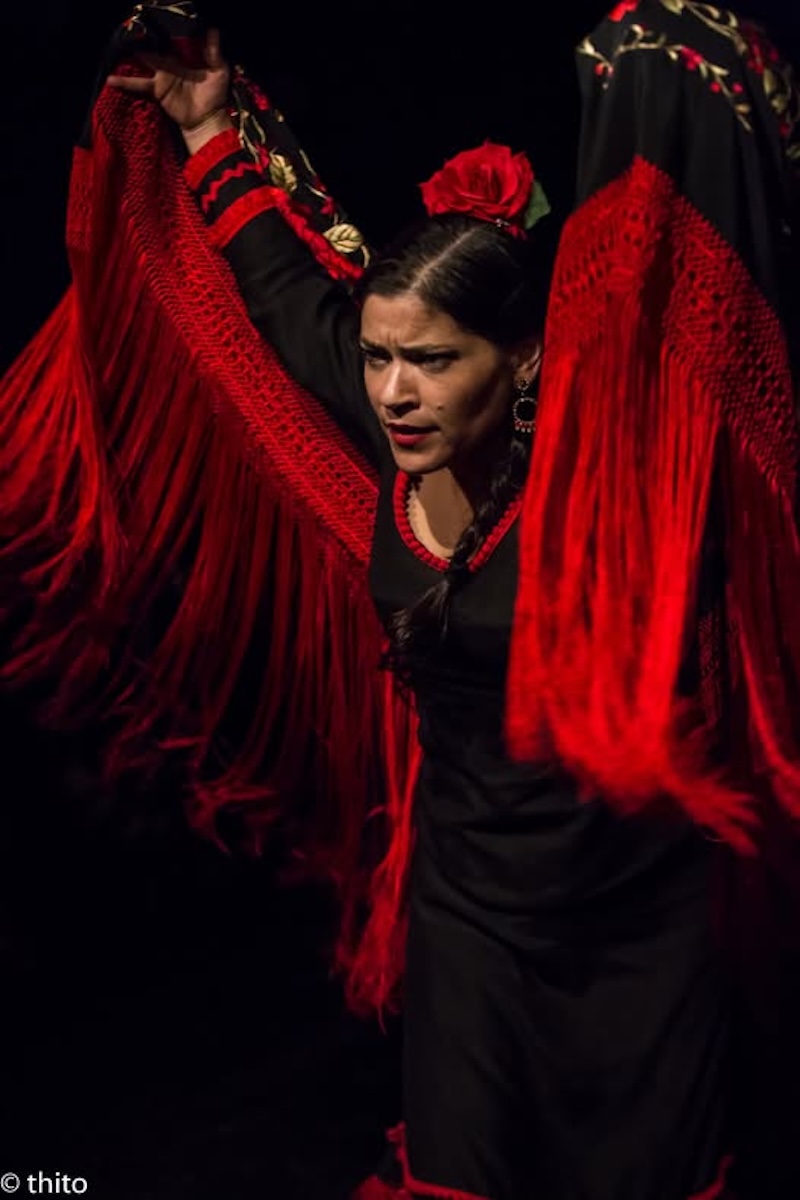
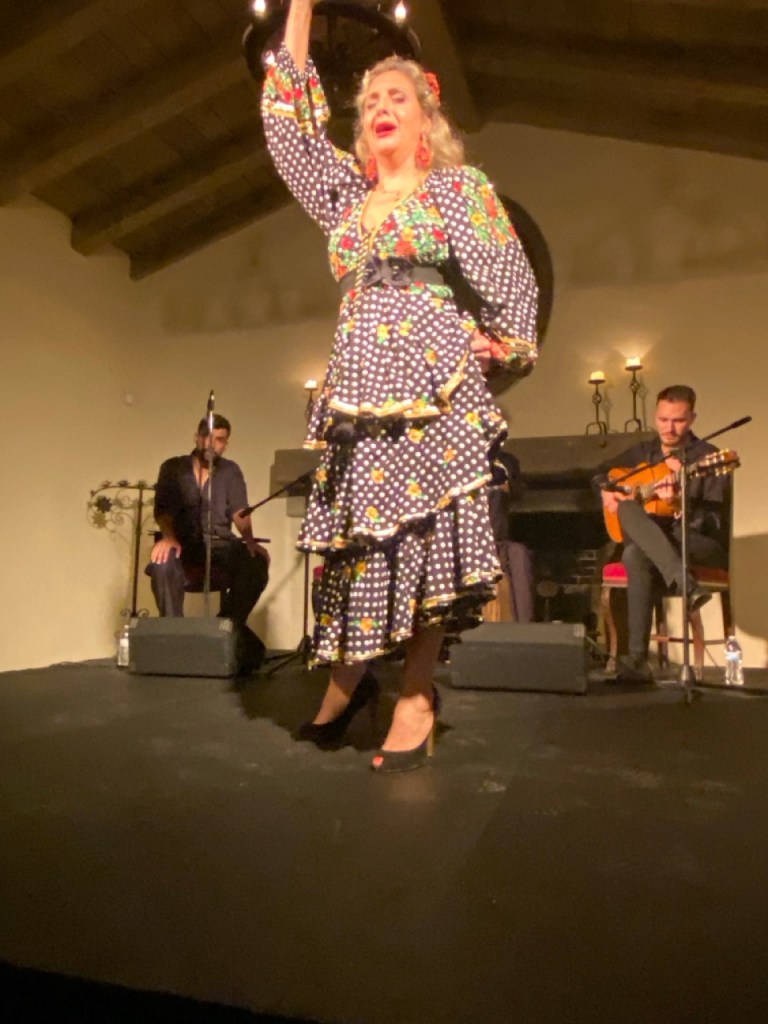
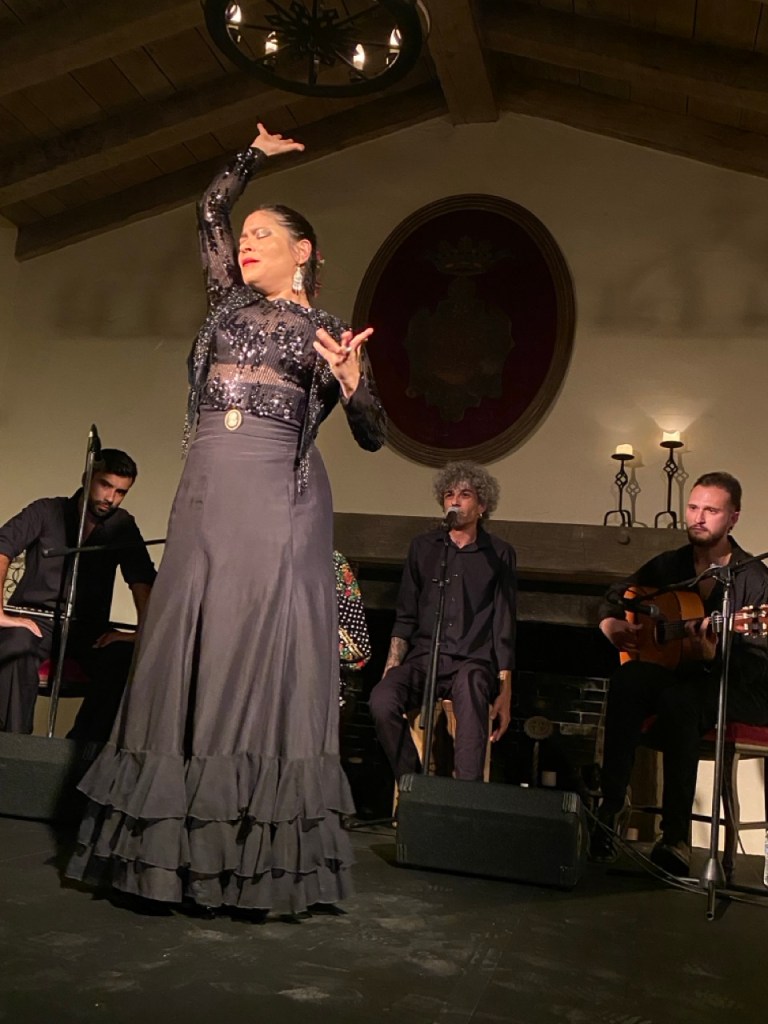
Inside the historic Covarrubias Adobe at the Santa Barbara Historic Museum, Flamenco! Santa Barbara created another breathtaking flamenco showcase on September 4, with guest artists from Spain and Mexico. The performance was supremely fascinating and passionate, with elements of traditional and contemporary flamenco music and dance.
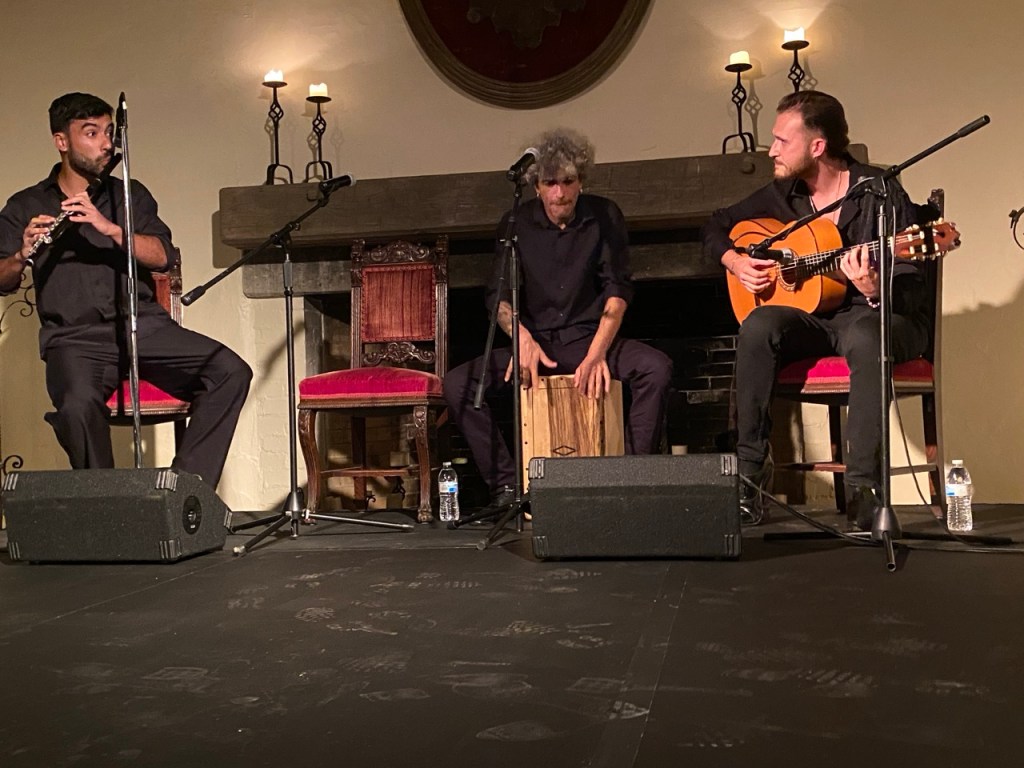
The star cast consisted of singers Pepele Méndez (also cajonero) and his cousin Kina Méndez, guitarist Pablo Heredía, and flautist Gabriel Rodriguez, all from Jerez de la Frontera, in Cadiz, Andalucía, in Southern Spain (considered the birthplace of flamenco) and dancer Marién Luévano from Mexico.
Maestra Maria “La Chacha” Bermudez, artistic director of Flamenco! Santa Barbara, shared that all of these performers had been performing together the previous week in San Diego at the festival Fin de Verano. Asked how she got them to come to Santa Barbara, Bermudez explained, “When Dacia [Harwood, executive director of the Santa Barbara Historical Museum] and I spoke of having an ‘Íntimo’ show at the museum, it was a no-brainer to have Marién Luévano, who I’ve known for many years. We met in Jerez, [when] she was my student. … The flamenco community in Spain is a small one. We all know each other. Kina and Pepele Méndez are from Jerez, the town of my residence when I’m in Spain.”
The concert began with a musical selection featuring Pepele Méndez, Heredía, and Rodriguez. This fascinating piece sounded different from the usual, traditional flamenco music. To my Balkan-trained ears, it felt like I could get up and dance a syrto to it. It was such an interesting opening to a flamenco concert that I had to ask about it.
“The flute brought a different dynamic to this music,” said Bermudez. Since the incorporation of the cajon in the late 1970s, the art [of flamenco] is evolving to more instrumentation, and the flute gives an interesting sound — not specifically a sytro, but a little more Arabic and Mediterranean. Flamenco has all the tonalities of European grassroots — something from Turkey sounds familiar to flamenco.”
Of course there are many Turkish and Arabic maqams (modes, or tunings) that are prominent in flamenco music due to the hundreds of years of Ottoman occupation and intertwining of Islamic and Spanish cultures. The Spanish guitar and European lute developed from the Arabic Oud, and even the jaleo (shout of encouragement) “Olé!” in flamenco comes from the Arabic “Alah!”
Flamenco is not just a performance to be enjoyed; it is a telescope into the rich history of interconnected people over centuries.
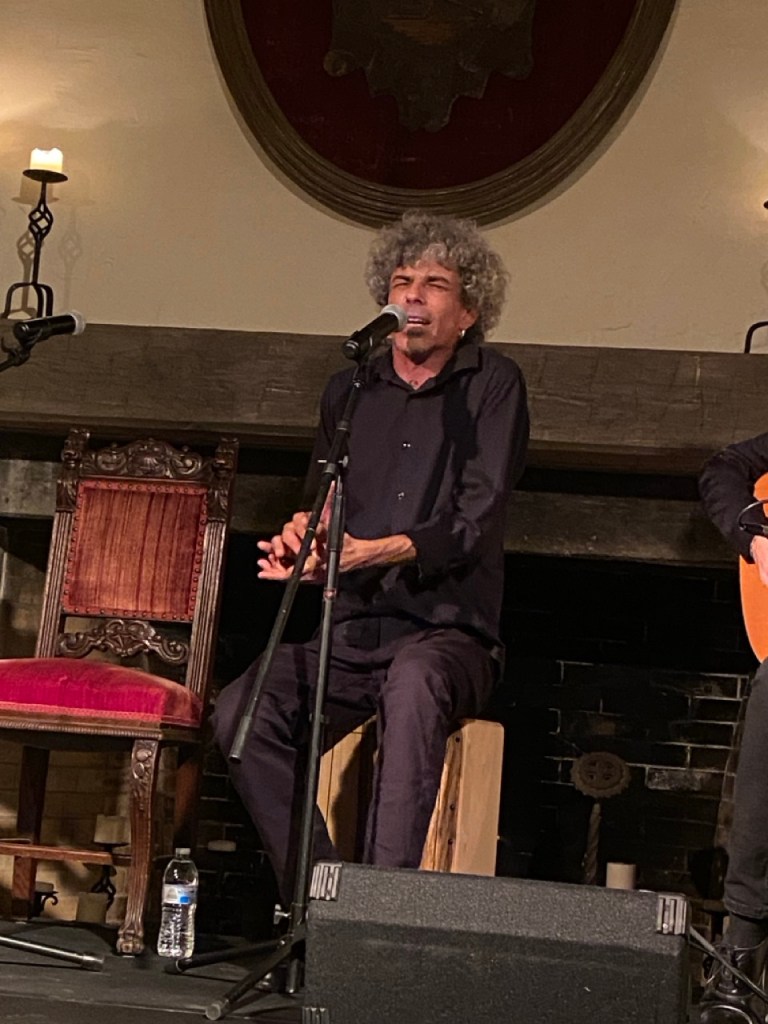
Although studied and performed all over the world today, traditional flamenco ran in the Gitano families of Andalucía, and was passed down from generation to generation. Pepele and Kina Méndez are from the family of the legendary singer La Paquera de Jerez (Francisca Méndez Garrido), from the neighborhood of La Plazuela, in Jerez de la Frontera. Pepele Méndez is known to flamenco enthusiasts of Santa Barbara for his regular appearances at Fiesta and other performances. A pure flamenco cantaor (singer), he has branched out to perform other musical styles including reggae, Latin funk, rock, and jazz; however, his traditional style was most prominent in this performance. His passion reminded me of tarab. Originally a term from Arabic music, tarab refers to the audience’s experience of being pulled into an all-encompassing immersion in the music, drawn into a sense of ecstasy provoked by the singer.
After the musical opening, Pepele brought his cousin, Kina, onto the stage. She entered from the back of the audience, filling the hall with her powerful voice.
Finally, the majestic dancer Marién Luévano entered from the back of the hall. Luévano is known for her distinctive style, incorporating elements of contemporary dance and diverse multicultural music in her performances.
“Marién had some different elements, because of the flute,” which is not a traditional flamenco instrument, but “allowed her to express the dance in a different way. She danced Seguidilla first — a deep song in ¾ time. Her second dance was Alegrías, in 12 beats, similar to Soleares,” said Bermudez. Soleares is considered the most important and fundamental toque (rhythmic form) in flamenco (click here for more information).
Luévano’s performance alternated between slow, stretchy moves and lightning-fast footwork, interspersed with knife-edge precision turns and sudden stops. When she suddenly froze in a pose, the music stopped with her, as if she was conducting the orchestra with her dancing. The musicians’ eyes were intently focused on her every move. When I mentioned this to Bermudez after the show, she said, “Yes! The dancer is the leader. Everyone behind her has to take all of her details, and read her body language. That’s the whole essence of flamenco dance.”
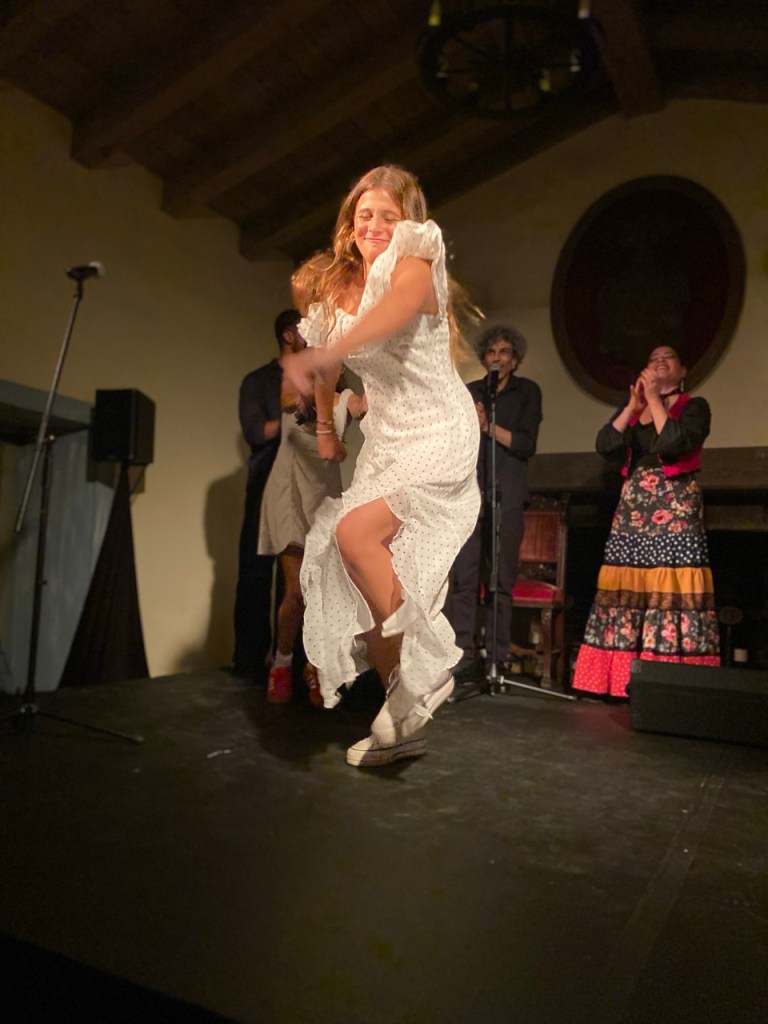
As a finale, Pepele Méndez called three young students, who had been watching intently, up to the stage to improvise with the orchestra, similar to the peñas flamencas. Without a moment’s hesitation, they each got up on stage and danced!
They danced with so much confidence that I asked Bermudez if they had been the Spirit and Junior Spirit of Fiesta. “No!” she said, almost indignantly. “They are just students in our school! This is how we train them.”
Read about the Peñas Flamencas, in which students learn to improvise with the musicians, here and the company of spectacular dancers and their teachers Bermudez and Timo Nuñez here.
For information about upcoming performances, keep an eye on the constantly evolving website of Flamenco! Santa Barbara.
And if you have never studied flamenco, but are ready to start learning from these masters, classes are starting September 15 at the Timo Nuñez Arte Flamenco Studio, with an adult beginner class on Mondays from 7 to 8 p.m.
Related Posts



Premier Events
Fri, Mar 06
2:00 PM
Santa Barbara
Music & Meditation SB – Concert March 6, 2026

Sat, Mar 07
9:00 AM
Carpinteria
El Carro Park Cannabis Career Fair – Carpinteria
Sat, Mar 07
2:00 PM
Santa Barbara
Autobiography of a Yogi, the Legacy of Yogananda

Sun, Mar 08
6:30 PM
Santa Barbara
6th Eco Hero Award Brock Dolman & Kate Lundquist
Mon, Mar 09
6:00 PM
Santa Barbara
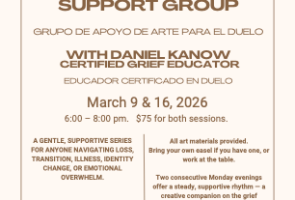
ART 4 GRIEF Support Group
Fri, Mar 06
7:30 PM
Santa Barbara
An Evening with Steep Canyon Rangers
Fri, Mar 06
8:00 PM
Santa Ynez
Funk Band Kool & The Gang at Chumash
Sat, Mar 07
12:00 PM
Santa Barbara
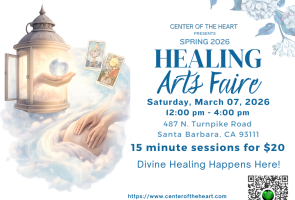
Spring 2026 Healing Arts Faire
Sat, Mar 07
7:00 PM
Carpinteria
The Magic’s In the Music
Sat, Mar 07
7:30 PM
Goleta
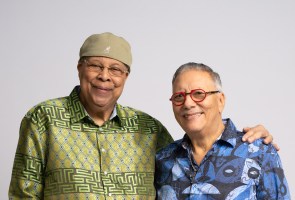
UCSB Arts & Lectures Presents Arturo Sandoval Legacy Quintet
Sat, Mar 07
7:30 PM
Goleta
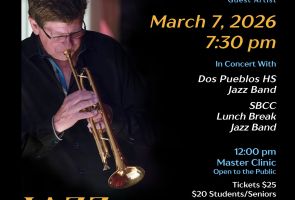
Jazz Concert with Wayne Bergeron
Sun, Mar 08
10:00 AM
Santa Barbara
Fairytale Weekend at the Zoo

Sun, Mar 08
1:00 PM
Santa Barbara
SB Craftivists “Resist with Love KNOT Hate Knit-In
Sun, Mar 08
4:00 PM
Santa Barbara
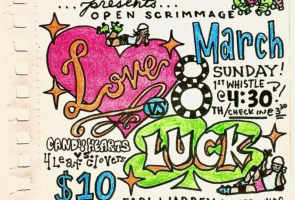
Brawlin’ Betties: Love v. Luck Scrimmage
Sun, Mar 08
7:30 PM
Santa Barbara
SBAcoustic Presents Natalie Gelman & Mark Legget
Fri, Mar 06 2:00 PM
Santa Barbara
Music & Meditation SB – Concert March 6, 2026
Sat, Mar 07 9:00 AM
Carpinteria
El Carro Park Cannabis Career Fair – Carpinteria
Sat, Mar 07 2:00 PM
Santa Barbara
Autobiography of a Yogi, the Legacy of Yogananda
Sun, Mar 08 6:30 PM
Santa Barbara
6th Eco Hero Award Brock Dolman & Kate Lundquist
Mon, Mar 09 6:00 PM
Santa Barbara
ART 4 GRIEF Support Group
Fri, Mar 06 7:30 PM
Santa Barbara
An Evening with Steep Canyon Rangers
Fri, Mar 06 8:00 PM
Santa Ynez
Funk Band Kool & The Gang at Chumash
Sat, Mar 07 12:00 PM
Santa Barbara
Spring 2026 Healing Arts Faire
Sat, Mar 07 7:00 PM
Carpinteria
The Magic’s In the Music
Sat, Mar 07 7:30 PM
Goleta
UCSB Arts & Lectures Presents Arturo Sandoval Legacy Quintet
Sat, Mar 07 7:30 PM
Goleta
Jazz Concert with Wayne Bergeron
Sun, Mar 08 10:00 AM
Santa Barbara
Fairytale Weekend at the Zoo
Sun, Mar 08 1:00 PM
Santa Barbara
SB Craftivists “Resist with Love KNOT Hate Knit-In
Sun, Mar 08 4:00 PM
Santa Barbara
Brawlin’ Betties: Love v. Luck Scrimmage
Sun, Mar 08 7:30 PM
Santa Barbara


You must be logged in to post a comment.