

Exhibitions showcasing professors and teaching artists from a given institution of learning can serve a double-duty function, but observers’ assumptions and predispositions can get tricky. From one perspective, faculty artist forums — such as the intriguing current show Lines of Inquiry at Westmont College’s Ridley-Tree Museum of Art — can seem like a chance to get a glimpse of what’s behind the curricular curtain of a school.
But to whatever degree the art on display at the museum indicates the feel and focus of the present Westmont Art Department, and how these mentoring artists might impact their students’ art, another presiding agenda is at work here. The exhibition is primarily an overview of a necessarily diversified group of artists in their own right, and each with personal directions, styles, and messages to convey.
Said diversity, also a factor baked into the college’s interest in representing different media within its art faculty, is immediately apparent upon entering the entryway gallery space. On one wall, we find the pleasant photography of Brad Elliott, whose written statement, “I’m never not a photographer,” bears out his practice of capturing slices of found scenery. These include an infrared-like image on a trail, and such local visions as beach-centric takes on a lifeguard station and a distant oil rig. Elsewhere, fire rips and ripples through a hillside in “HELP,” with a fitting rough-focused urgency.
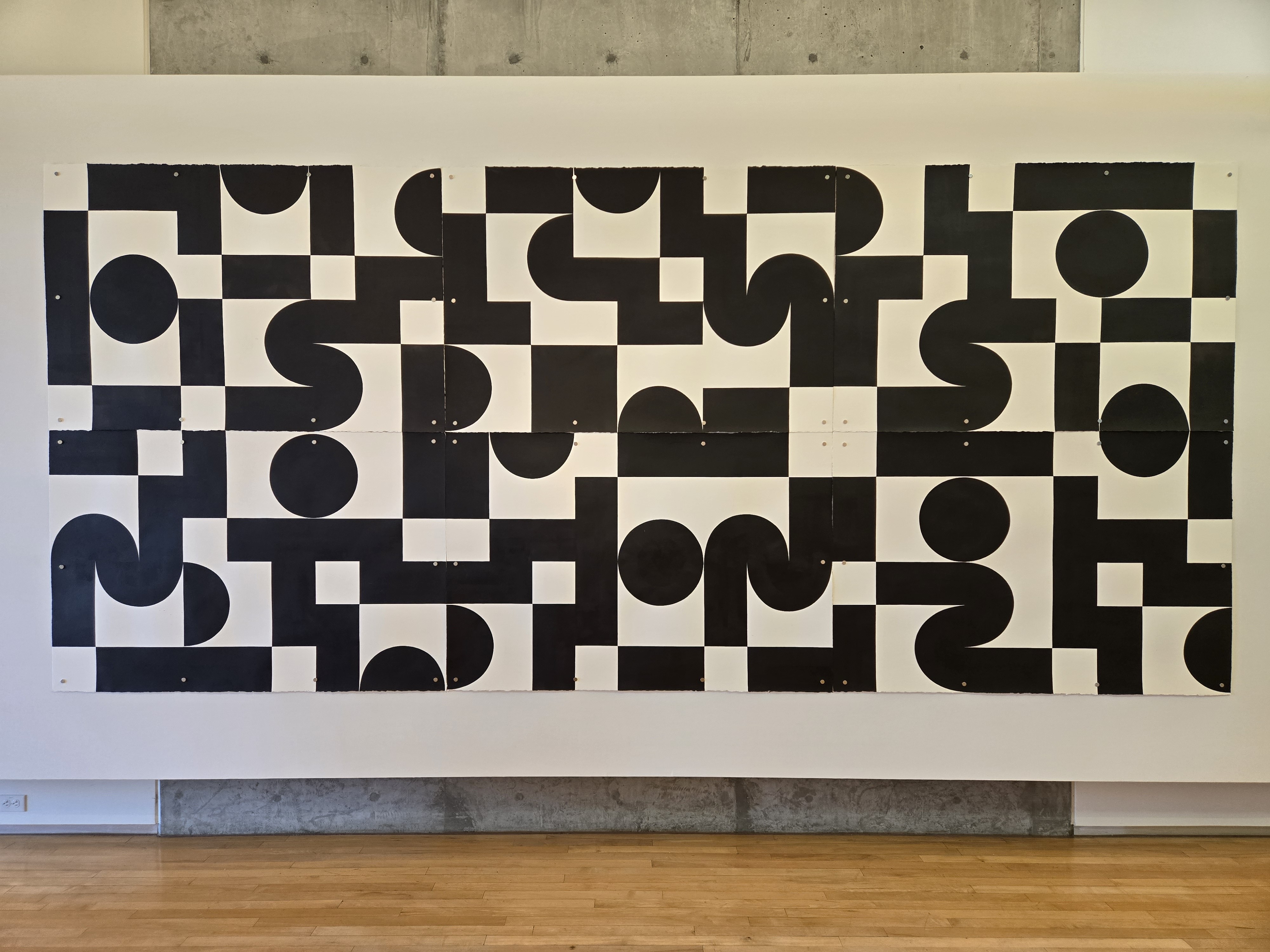
Across the room is the starkly contrasting non-representational mural-like piece “I Cannot Resist Your Joy,” by Nathan Hayden, nearly consuming the wall. It’s a visual dance of geometric black shapes and lines on white, writ large and busy, yet also tinged with a design-savvy gracefulness.
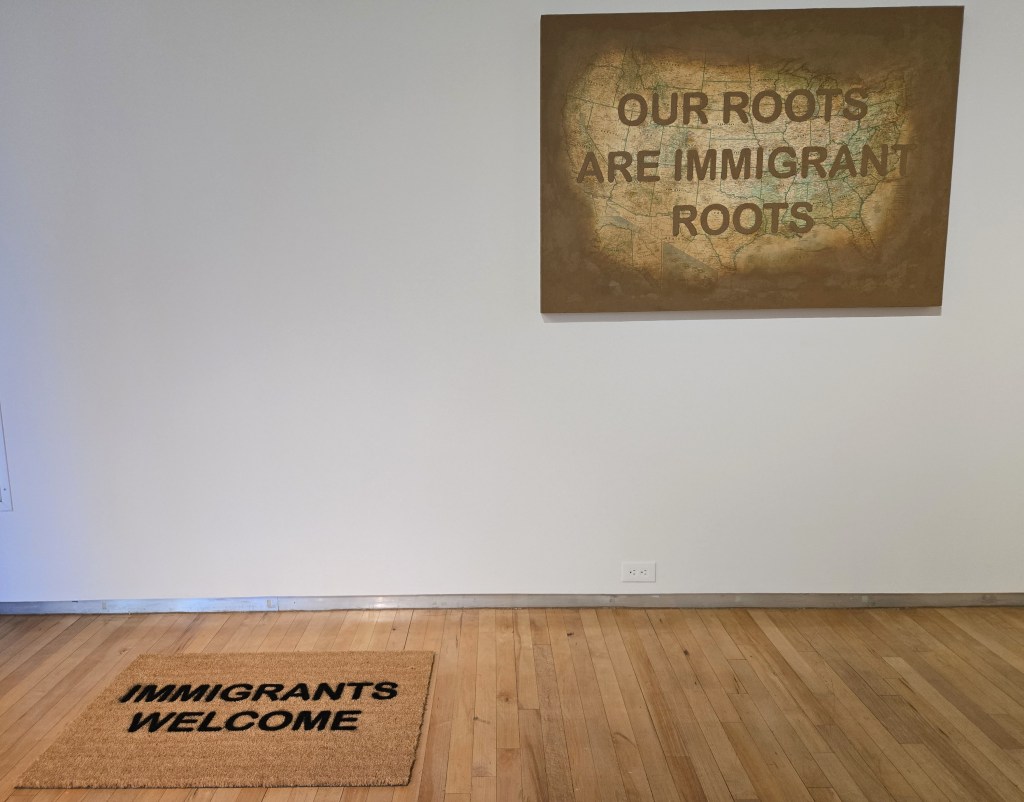
In the main gallery, some of the more alluring and timely work comes from Chris Rupp (also the Museum’s interim director). A U.S. map encircled by a brown, earthy fringe is overlaid with the text “OUR ROOTS ARE IMMIGRANT ROOTS,” and an adjacent piece is essentially a welcome mat with the phrase “Immigrants Welcome” — also the work’s title. Rupp is managing to deliver pressing social messaging in a calm-toned, nonconfrontational way. “Peaceful protest” is a relevant idea and term here, through artistic means.
As he writes, “Reaction is a form of care. It is a refusal to remain silent, and an act of resistance. Through this work, I invite others to not only look, but to feel, question, and perhaps to act.”
Rupp’s peaceable activist spirit contrasts with Scott Anderson’s skilled displays of draftsmanship and design sense. His section of the show reveals the process of illustration and formulation of design, from sketches to the finished, elaborate posters, mostly for Westmont theater productions.
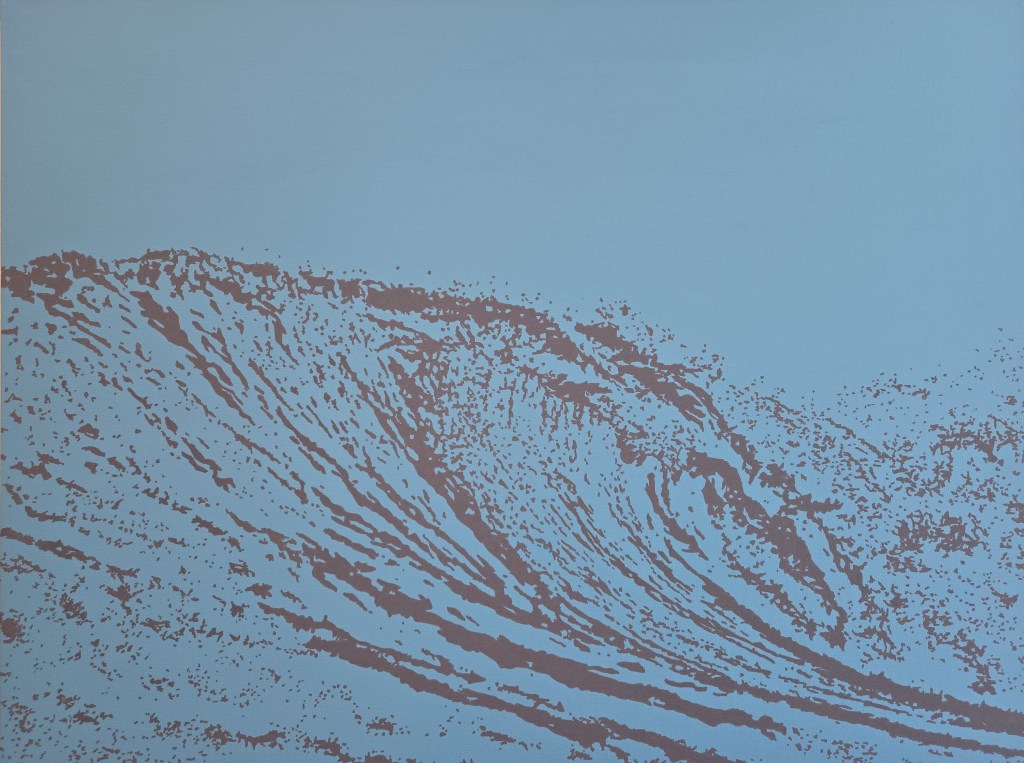
Ryan Ethington burrows into the beauty and power of ocean waves — not in the casual surfer art or seascapes, but in semi-abstracted and color-revised acrylic on canvas paintings. “Wave Crest in Slate” captures the spirit, not the detailed reality, of the force — literal and poetic — of waves.
Body politics and feminist issues are addressed, inventively, in Meagan Stirling’s large “life-size” monoprints via the seven pieces in her “My Flag, My Body” series. Loosely reminiscent of Yves Klein’s provocative conceptual art deploying nude models slathered in paint to create works on paper, but with a very different expressive intention, Stirling uses her own body to press down on inked surfaces. With this intrinsically personal process and statement, the artist seeks to address “women’s historical erasure and the nation’s obsessive attachment to its flag.”

Another starring role in the room is played by the hard-to-categorize artist Nathan Huff (also currently featured in the one-person show Within Wilds, at Sullivan Goss). The notion of “inquiry” is especially pertinent with Huff’s art, and what you see in one show isn’t necessarily what you get in another. With this art batch, the artist presents imagery of the domesticated, backyard nature, sometimes played straight and sometimes nudging into a zone of slight surrealist intent.
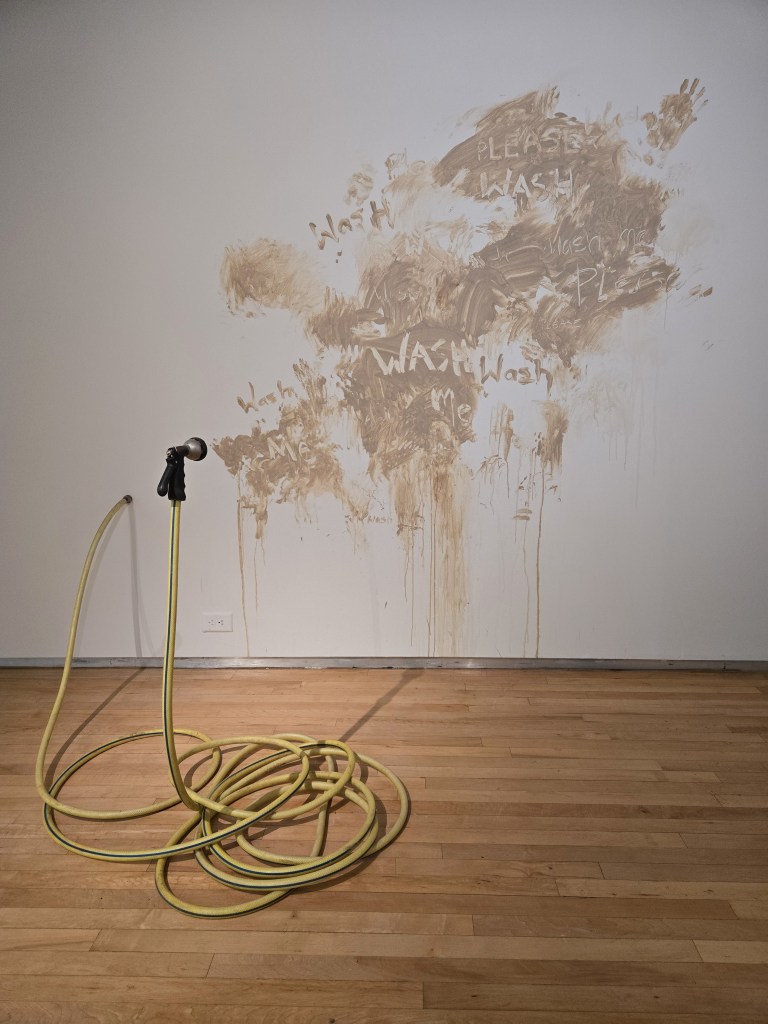
A series of subtle, smartly rendered watercolors focuses on flowers, stacked stones, hammers cannily juxtaposed with butterflies, a close-up of a weed whacker in action and a jumbo stone hovering above a fan (“Levitating Mass”). Magic realist airs slip into 3D with “Wash Me,” with an actual snake-like coiled hose poised to undo the damage of a mud-smeared gallery wall.
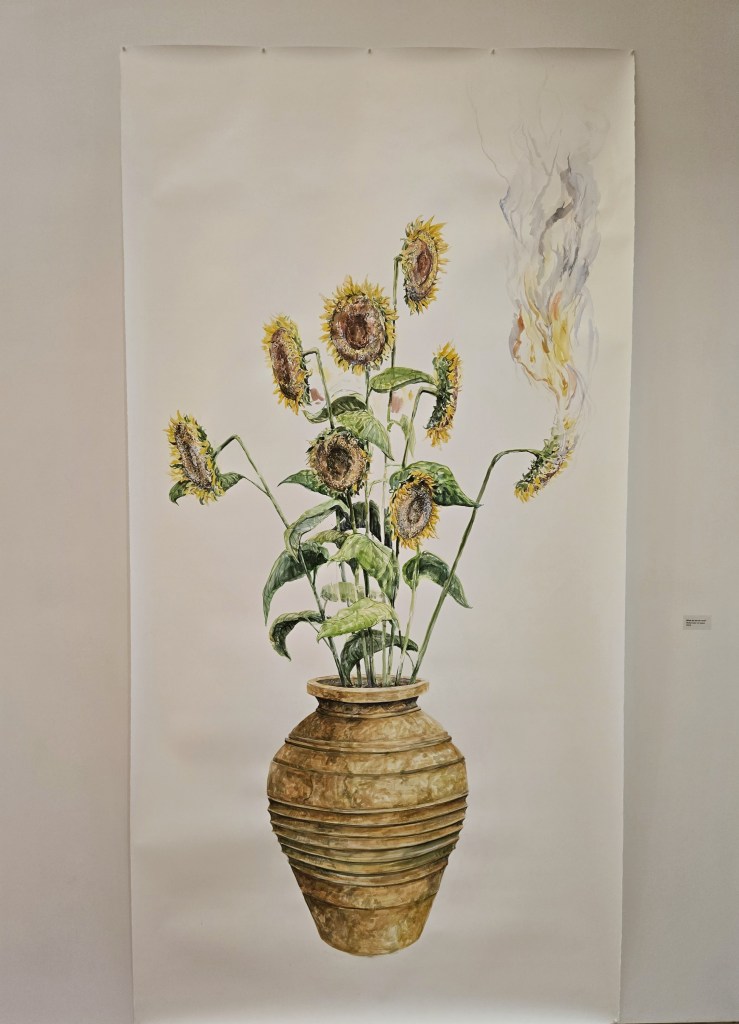
Lines of reality blur, sneakily, in the huge yet elegant sunflower ode “What do we do now?”, a seemingly direct and anomaly-free floral painting, were it not for the startling/amusing fact that one blossom is on fire. A double-take is in order, visually and perceptually.
Overall, Lines of Inquiry is anything but a linear narrative or artistic coalition, and that’s partly what makes the show sing. Diversity is alive and well in the Westmont Art Department.
Lines of Inquiry is on view at Westmont Ridley-Tree Museum of Art (955 La Paz Rd.) through November 1. See westmont.edu/lines-inquiry.
Related Posts

Premier Events
Fri, Feb 20
11:00 AM
Santa Barbara
Santa Barbara Antique & Vintage Show
Sat, Feb 21
11:00 AM
Santa Barbara
Santa Barbara Antique & Vintage Show
Sun, Feb 22
11:00 AM
Santa Barbara
Santa Barbara Antique & Vintage Show
Mon, Mar 09
6:30 PM
Santa Barbara
Science Pub: Cyborg Jellies Exploring Our Oceans
Sat, Mar 28
All day
Santa Barbara
Coffee Culture Fest
Fri, Feb 20 11:00 AM
Santa Barbara
Santa Barbara Antique & Vintage Show
Sat, Feb 21 11:00 AM
Santa Barbara
Santa Barbara Antique & Vintage Show
Sun, Feb 22 11:00 AM
Santa Barbara
Santa Barbara Antique & Vintage Show
Mon, Mar 09 6:30 PM
Santa Barbara
Science Pub: Cyborg Jellies Exploring Our Oceans
Sat, Mar 28 All day
Santa Barbara


You must be logged in to post a comment.