

Fred Ross, Sr. was a pioneer in grassroots labor organization, paving the way for early farmworker unions and gathering a wealth of knowledge he passed on as a mentor to a generation of proteges, including Dolores Huerta and Cesar Chavez.
Ross made a reputation as a self-proclaimed “social justice pyromaniac,” who famously said any good community organizer was “part missionary, part instigator, and part agitator.” His pledge to fight for and alongside the working man crossed racial and cultural boundaries, and his person-to-person approach allowed him to connect with post-Depression migrant refugees from the Midwest, Black laborers in the Jim Crow South, Japanese-Americans interned during WWII, and Mexican farmworkers in the Southwest.
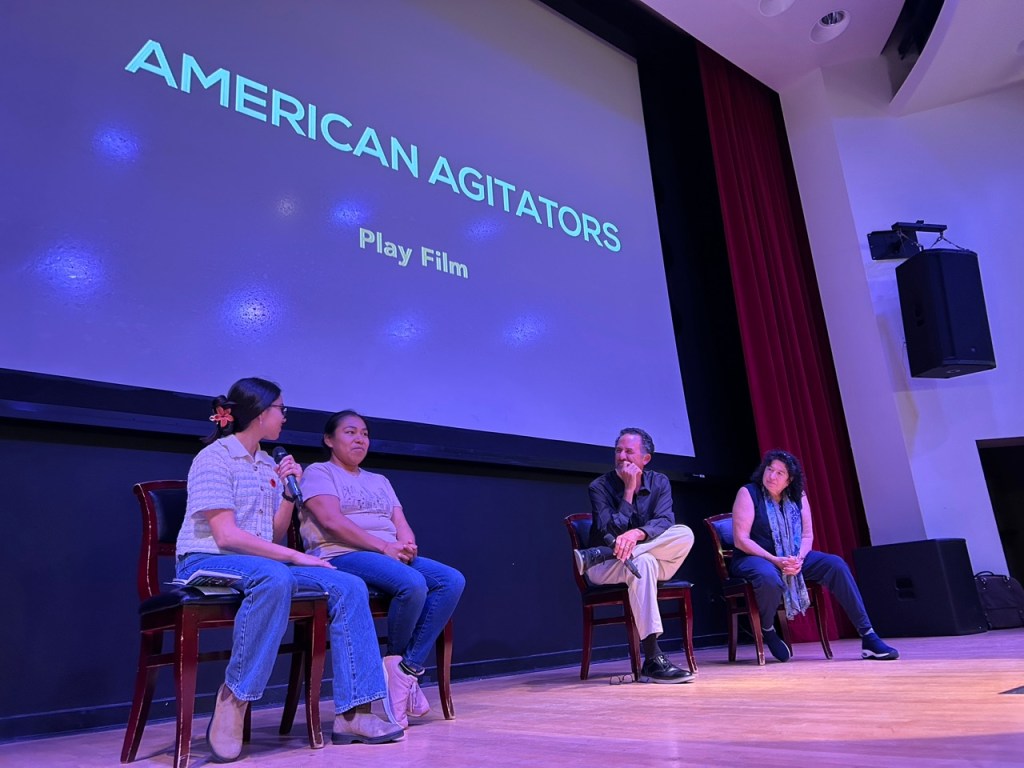
Earlier this month, UC Santa Barbara’s Community Labor Center hosted a night honoring Ross’s life and work, featuring a screening of the documentary American Agitators and a panel discussion with United Farm Workers (UFW) Central Coast organizers and one of the film’s executive producers, Margo Feinberg.
The film was created in collaboration with Ross’s son, Fred Ross, Jr., who followed in his father’s footsteps and became a prominent political organizer in his own right. Together, the father and son compiled their knowledge in a pocket-sized pamphlet “Axioms for Organizors,” which is packed with one-liners about organizing: “Organizing is providing people with an opportunity to become aware of their own capabilities and potential”; “Don’t talk at people — put them to work”; and Ross’s most famous line, “A good organizer is a social arsonist who goes around setting people on fire.”
The younger Ross married Feinberg — who had built a career as a labor attorney — and together they began gathering the footage and interviews to be included in the film. Feinberg said her husband had “always dreamed” of making a film to honor his father. Ross, Jr. was able to see the process of the documentary coming into fruition, but he tragically passed away in 2022 before the film was finished.
American Agitators details the elder Ross’s life and work, starting from his early family life to his first professional work in California farmworker camps in the 1930s to his influence on modern-day union movements. Director Ray Telles uses never-before-seen footage and insight from Ross’s closest family and friends to reveal a fleshed-out portrait of a man who preferred always to stay in the background and off-camera.
Ross had a knack for winning people over with human connection, using one-on-one meetings to build relationships and using those connections to start larger movements. He pioneered the house meetings and one-man-one-vote philosophy that is still central to labor organizations today.
His focus on the power of community led to major court wins, helping end segregation in schools and creating better working and living conditions for several generations of American workers. His behind-the-scenes work helped lead to the election of Los Angeles’s first Latino City Councilmember, Ed Roybal, and his guidance launched the careers of Huerta and Chavez into national prominence.
Feinberg said she hopes the documentary can inspire more youth to consider themselves “American agitators.” She said the film has many parallels to the current struggles for immigrant farmworkers in California, who have been targeted for deportation and rounded up in a way that is eerily similar to the treatment of Japanese-Americans during WWII.
“The stories of Japanese-Americans interned during WWII serve as a direct parallel to the mass deportations being carried out today,” Feinberg said. “I think we can learn from history, and that’s what I hope you take from this film.”
Feinberg said the power of people organizing together is “more relevant now” than ever before. “Even in the darkest of times, organizing can make an impact,” she said.
Esperanza Solana, a Central Coast farmworker and labor organizer who’s worked in the strawberry fields for nearly two decades, spoke of her experience working and organizing with her “compañeros” in the fields. “We speak up for each other because we want a dignified life, fair wages, and respect,” she said.
Solana has worked alongside UFW field organizer Jenny Alvarez to host house meetings — just as Ross did decades ago — to gather workers to register to vote and learn how they can advocate for higher wages and safer working conditions.
Alvarez said it was important to have hope, especially in difficult times. She referred to another Ross axiom: To inspire hope, you must have hope yourself.
“Having hope is something that keeps you chasing the light at the end of the tunnel,” Alvarez said, turning to face Solana (whose first name is the Spanish word for “hope”). “Esperanza is quite literally that hope for me.”
Related Posts






Premier Events

Tue, Mar 31
4:30 PM
Santa Barbara
End Citizens United: Tiffany Muller (ECU) and Gov. Steve Bullock

Wed, Apr 01
6:00 PM
Santa Barbara
Downtown Salsa & Bachata Dancing
Wed, Apr 01
7:30 PM
Santa Barbara
Justin Hayward – The Story In Your Eyes Tour
Thu, Apr 02
2:00 PM
Santa Barbara
S.B. Rescue Mission Annual Easter Feast

Thu, Apr 02
4:00 PM
Santa Barbara
Organic Soup Kitchen’s Souper Bloom Soup Social!

Thu, Apr 02
5:00 PM
Santa Barbara
Exhibit Opening: The Santa Barbara Independent: ‘Covering 40 Years’

Fri, Apr 03
2:00 PM
Santa Barbara
Ensemble Theatre Company Presents “A Night with Janis Joplin”

Fri, Apr 03
5:00 PM
Lompoc
Filipinos’ Contributions to Once Making Lompoc…
Fri, Apr 03
7:30 PM
Santa Barbara
Lahaina: Voices of Change

Sat, Apr 04
9:00 AM
Santa Barbara
Mesa Harmony Garden Spring Plant Sale
Tue, Mar 31 4:30 PM
Santa Barbara
End Citizens United: Tiffany Muller (ECU) and Gov. Steve Bullock
Wed, Apr 01 6:00 PM
Santa Barbara
Downtown Salsa & Bachata Dancing
Wed, Apr 01 7:30 PM
Santa Barbara
Justin Hayward – The Story In Your Eyes Tour
Thu, Apr 02 2:00 PM
Santa Barbara
S.B. Rescue Mission Annual Easter Feast
Thu, Apr 02 4:00 PM
Santa Barbara
Organic Soup Kitchen’s Souper Bloom Soup Social!
Thu, Apr 02 5:00 PM
Santa Barbara
Exhibit Opening: The Santa Barbara Independent: ‘Covering 40 Years’
Fri, Apr 03 2:00 PM
Santa Barbara
Ensemble Theatre Company Presents “A Night with Janis Joplin”
Fri, Apr 03 5:00 PM
Lompoc
Filipinos’ Contributions to Once Making Lompoc…
Fri, Apr 03 7:30 PM
Santa Barbara
Lahaina: Voices of Change
Sat, Apr 04 9:00 AM
Santa Barbara


You must be logged in to post a comment.