
Are These the Droids
We’re Looking For?
A Look at Santa Barbara’s Robot Scene,
from Chinese Restaurants to Retirement Homes
By Matt Kettmann | Photos by Ingrid Bostrom
November 6, 2025
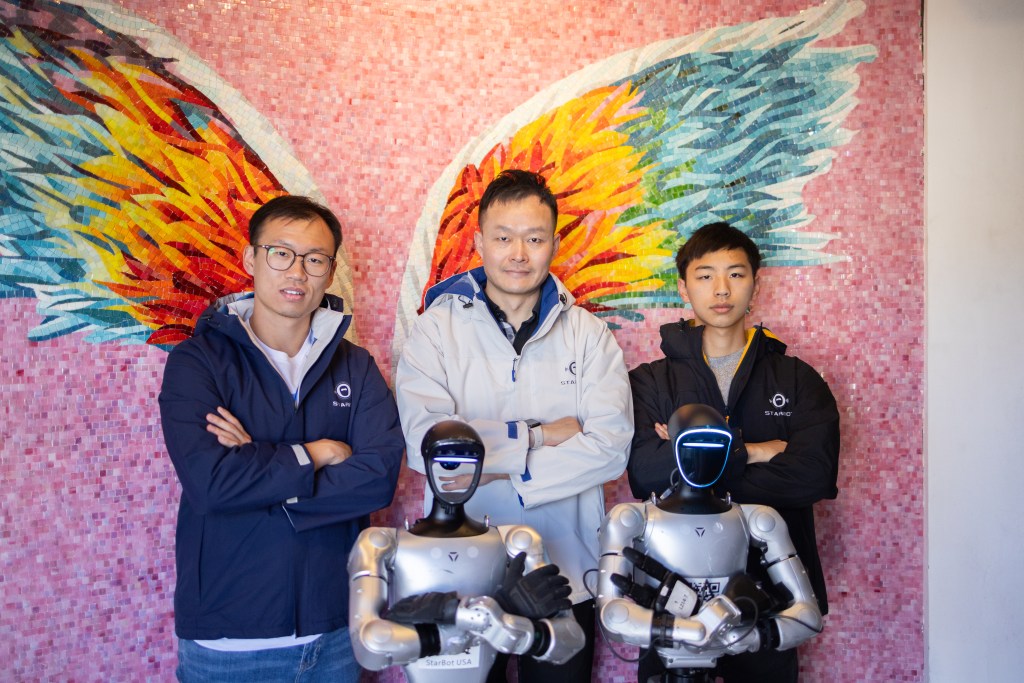
My family is seated in the back corner of Meet Up Chinese, and the slender, shiny robot is standing right next to me, its metal knees slightly bent to stay balanced, its fingers seeming to nervously twitch.
It has no eyeballs on its tiny head, but that flashing blue strip is certainly staring me down. There’s no discernible mouth, but its friendly, cartoonish voice is suggesting we order the restaurant’s “zesty” orange chicken or, if we like spicy, the kung pao, each of which comes with steamed rice. And do we want a drink? Do we want to play rock-paper-scissors?
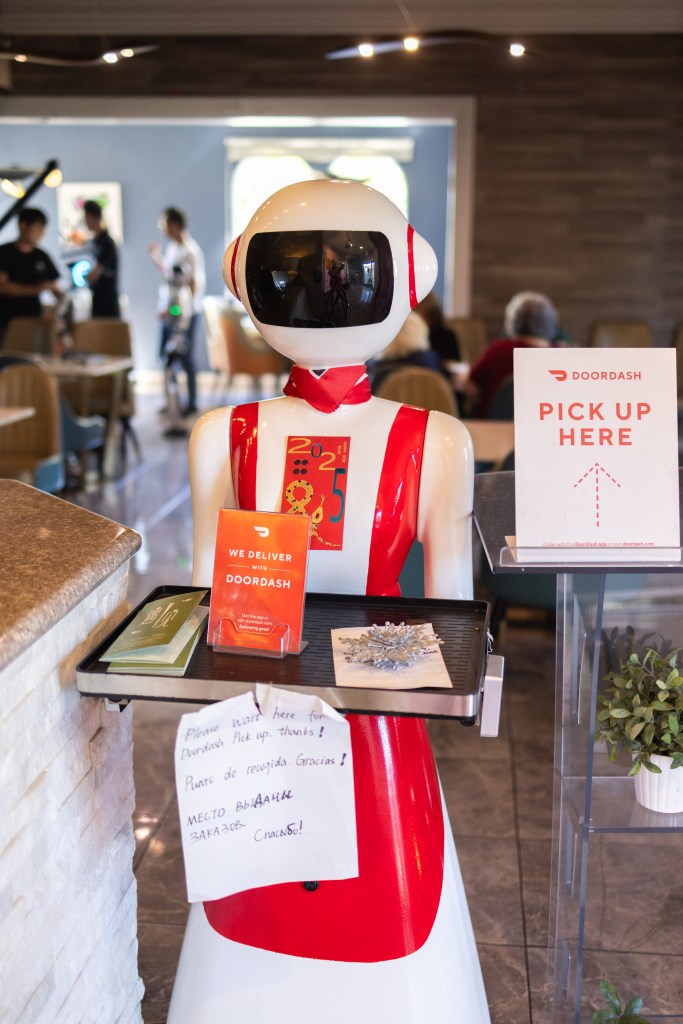
With other families watching in mostly stunned silence, I can tell that it’s probably the first time any of us have witnessed this inherently fascinating, slightly creepy humanoid robot in action. ChaCha, as it’s named, arrived at the Las Positas Road restaurant earlier this year, an upgrade to the wheeled, stiff-armed, tray-holding fembot named Shadow that started bringing food out to customers back in 2022.
Meet Up’s owner Yong Wang saw Shadow as a remedy to the challenges of COVID — her Mandarin name, “Shadu,” translates roughly to “disinfect” — and her novelty did create buzz, catch headlines, and more than triple sales during that tough time. But ChaCha represents an even brighter hope for Wang, and very possibly a new future for all of us.
“In the United States, small business owners are all facing labor shortages and very expensive labor costs — that is the biggest challenge,” said Wang, noting that immigration crackdowns only exacerbate the problems. “You cannot increase the menu price every single year. Your diners will not pay for that.”
Humanoid robots could alleviate some pain for restaurants, but that’s just the start. Wang sees their further potential as hotel porters, security guards, farm workers, and much more.
He’s far from alone. The entire robotics industry is projected to jump from its current $60 billion estimation to more than $200 billion by 2032. More than four million robots already work in factories worldwide, with at least one million maintaining Amazon warehouses alone. They’re increasingly enmeshed in the military, health care, and transportation industries, with way more to come.
The potential for humanoids like ChaCha may be most staggering: Morgan Stanley predicts that more than one billion may be in use globally by 2050, representing a potential $5 trillion market.
Wang is moving fast to get ahead of the competition. Since I first met ChaCha in June, he’s purchased a second Unitree G-1 model (they cost about $50,000); designed a wheeled-but-two-armed model through another company (should arrive any day now); and assembled a team of young engineers, mostly ones he first attracted by showing off the robot last spring at UCSB. They taught the robots to dance and then placed sixth in a hospitality challenge at the inaugural World Humanoid Robot Games, which was held in Beijing in August.
Together, they’ve launched a startup called StarBot Robotics, whose 10 employees work out of offices at both UCSB and the restaurant. They just returned from the Nvidia GTC AI conference in Washington, D.C., last week, booked a booth for the Consumer Electronics Show in Las Vegas in January, and just started wearing their first company jackets. Most critically, StarBot already attracted two clients: one a dental office, the other a citrus company, looking for help with picking fruit.
“It’s amazing how far we’ve come in just half a year,” said Jerry Yang, the 19-year-old UCSB student who’s handled most of the programming and is now StarBot’s chief technical officer.
Almost equally amazing, though, is how far the robots haven’t come, at least in being helpful restaurant employees. They still need significant help to do everything they supposedly do — welcome guests, explain the menu, take orders, and process payments — while true human-replacement tasks such as delivering food and cleaning tables seem very far off.
We all get excited about robots in our future, but are these the droids we’re looking for?
Both Wang and Yang readily admit that there is much work to be done. They hope to have fully functional robot servers in about a year, with significant skill upgrades every couple of months.
The soon-to-arrive wheeled model — which they believe is the first such robot in the world to be used in restaurants — should be a faster programming challenge. Like the Shadows (there are two now), it’s much more stable, not requiring energy or expertise to balance; and like ChaCha, it has arms to pick up and drop off things.
Meanwhile, the speedy, somewhat scary rise of generative AI — in which machines actively learn on their own — will only speed up robot evolution everywhere.
This simultaneous promise and problem of robots at Meet Up directly mirrors the robot world at large. “It’s not as far along as people think,” said Yang of his experience watching the competition at the Beijing games. “Apart from big companies, it’s still very early stages.”
That was reiterated at the Nvidia conference last week, where presenters reminded attendees that, for the last 60 years, the robot has been just around the corner. The question for Meet Up, StarBot, and the rest of us is whether we’re finally turning that corner.
Expert Advice
This story was just going to focus on restaurants, but every time I talked about the Meet Up robots, everyone wanted to know more.
People of all ages and walks of life were both amazed and unnerved by the photos and videos, especially of the ChaChas dancing. I started learning about other robots in town: the roving waiters at Vista del Monte retirement home, the farming robots working Santa Maria strawberry fields, the Octobots robotics club at Dos Pueblos High School.
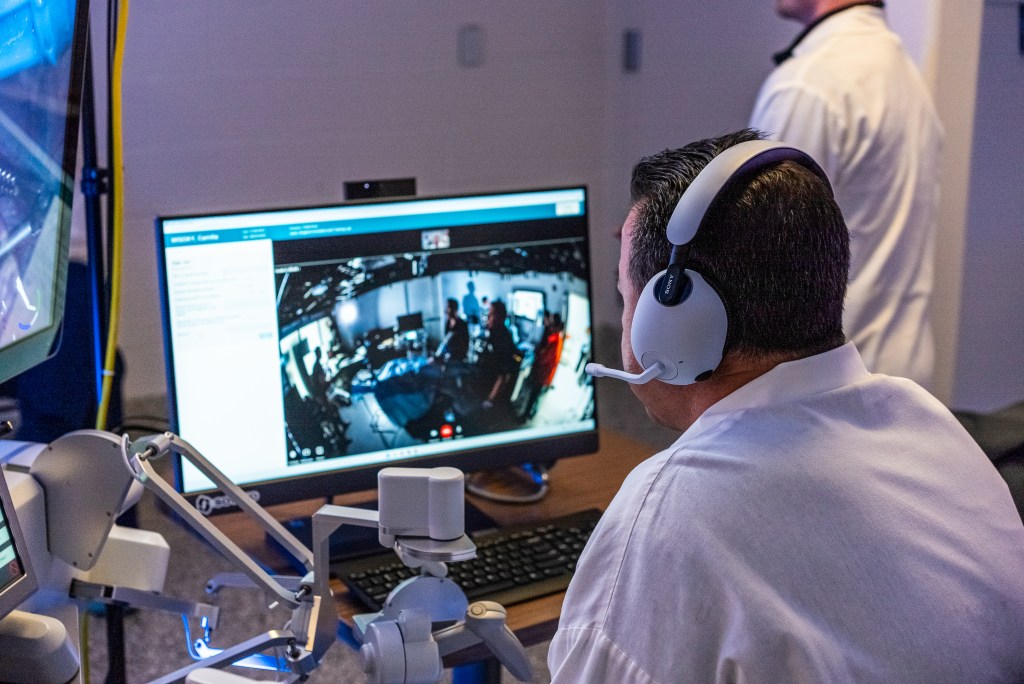
Then I realized that I’d written about robots in Santa Barbara almost 20 years ago when I profiled UCSB grad and robotics pioneer Yulun Wang. Under his company Computer Motion, Wang empowered the world’s first remote robotic surgery ever in 2001, with a doctor in New York City and patient in Strasbourg, France. Then he cofounded InTouch Health, whose robots now rove around hospitals and connect patients to faraway doctors all over the world. His current company is Sovato, which is scaling up the potential for remote robotic surgery.
What did he think about the current state of robots?
He’s been pondering that since he realized robots might be the next big thing after the IBM PC came out in 1981. “Computers are the brain, and robots are what lets the brain affect the physical world,” explained Wang, much like our brains can’t do much without our bodies. “But it’s taken longer to get things to where robots are more ubiquitous.”
A confounding hurdle is that what humans think is hard can be easy for computers, while what we think is easy, such as walking or picking up a cup, turns out to be quite hard for robots. “Getting computers to beat people at very complex things like chess happened a while ago,” explained Wang. “But getting a robot to be as capable as a 3-year-old has been really, incredibly difficult.”
It’s also taken time to identify where robots are viable solutions. They’ve been in restaurants for quite a while now, but because they’d only replace relatively low-cost labor, the investment doesn’t always pencil out. Said Wang, “It’s often easier to get robotic adoption when, like in my case, you’re enabling surgeons.”
Generative AI is “a major step forward,” he explained. “The concept of a personal robotic assistant is very much in the possible range where it wasn’t before.”
The convergence of AI and robots is fueling a resurgence of interest in robots at his alma mater. “Incoming students are wanting robotics,” said Wang of UCSB. “My guess is the high interest is because of AI. That’s a new capacity.”
UCSB’s resident robot expert is Katie Byl, an associate professor of electrical and computer engineering. This polymath — crossword writing for The New York Times, pro blackjack playing with the college crew fictionalized in that Kevin Spacey film 21 — got hooked during her robot battle class at MIT. “It’s like playing with toys,” she said, “but there’s real math and science behind it.”
Though some aspects have taken longer than expected when she started working on robots 20 years ago, Byl remains optimistic about the potential for robots on multiple fronts: exploration of hostile environments, search and rescue, fighting wildfires, warehousing and manufacturing, and particularly health care. That goes for robots in nursing and surgery roles, and for robotic exoskeletons that can help injured people move.
Much of the innovation is now happening at private companies rather than universities, and that’s a good thing. “Whether spaceships or robots or probably, at one point, the lawnmower, the whole goal is to get it out to the industry,” said Byl.
American companies aren’t necessarily in the lead. “A lot of it is happening in China, to a greater degree than what I would have predicted 10 years ago,” said Byl. “It’s very impressive, the amount of robots coming out of there.”
She wonders how comfortable people will be with more robots in our lives, especially the humanoid ones that can elicit fearful reactions. “Everyone wants a robot at home that can help them clean and wash the dishes,” she said. “But it’s going to be interesting whether or not people truly feel comfortable with increased intelligence around them.”
Data will likely be collected, tracked, and monetized, although that doesn’t seem to be bothering those who rely on Alexa and habit-tracking browsers. “Our comfort with the lack of privacy is growing,” said Byl.
She’s less optimistic about restaurant waiters revolutionizing the world anytime soon. “I feel like the waiters and waitresses of the world have pretty good job security right now,” she said. “What they’re doing is actually pretty challenging, whether it’s taking orders or setting out silverware. If you want a robot to do the same task right now, it’s painfully slow.”
For Young and Old
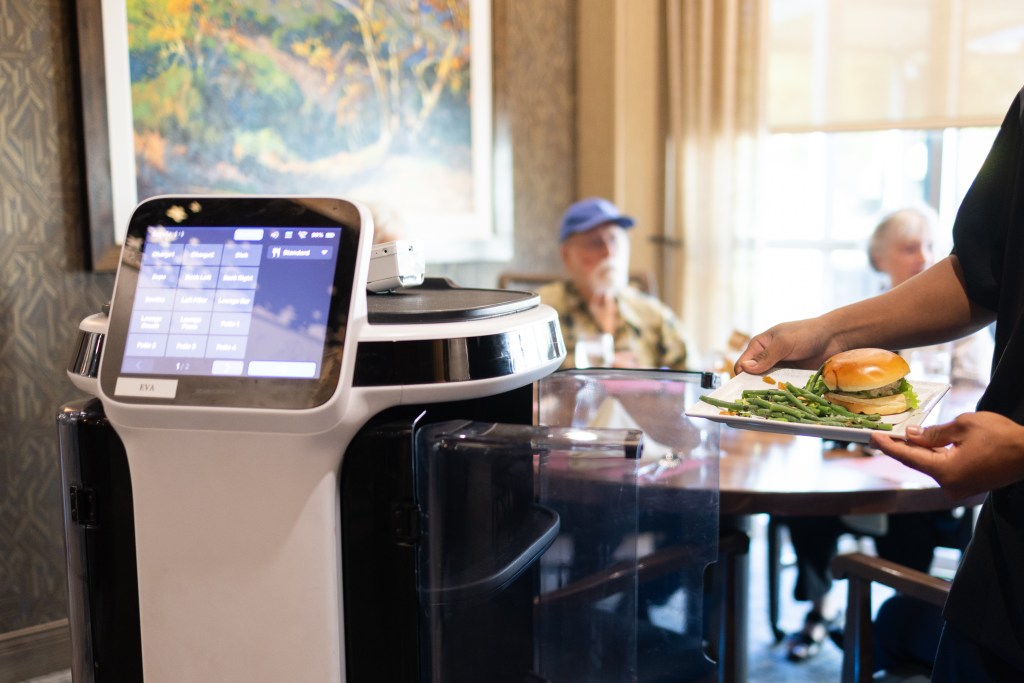
Don’t tell that to Wall-E and Eve, the two robots roaming the dining room at the Vista Del Monte retirement community in Santa Barbara’s Hidden Valley neighborhood. Their job is very straightforward: deliver hot food (while keeping it hot in their robot bellies) to the tables that ordered it, where human servers will drop off each plate, and then they return to the kitchen for the next round. They’ve been a big help and hit with residents.
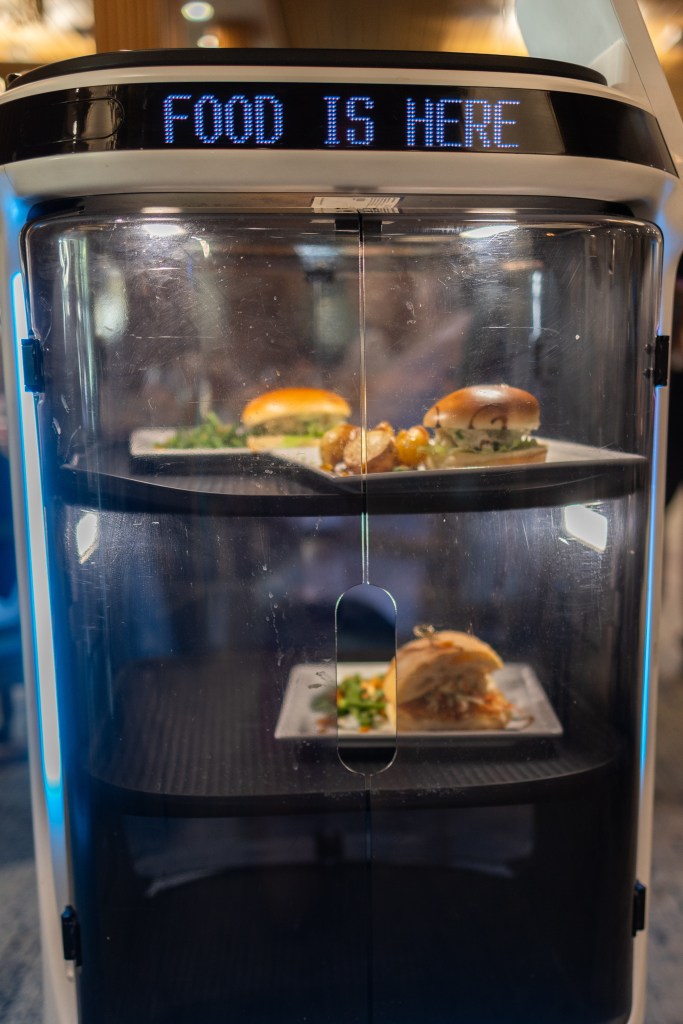
“It just really helps elevate the hospitality, and reduces the amount of time someone might be waiting for an order to be taken,” said Wendy Cafferky, Vista Del Monte’s head of sales and marketing, explaining how it frees up the servers. “They’ve just been a really good fit.”
There’s been a lot of adoption of new technologies across the senior living industry, especially for Vista del Monte’s nonprofit owner Front Porch. “Vista del Monte is very forward-thinking when it comes to technology and wanting to be on the forefront,” Cafferky said, noting that 70 percent of the residents are former educators who witnessed tech take over schools. “These are the people who can really appreciate that.”
Residents recognize the robots’ impact too. “When we get our food, he serves the whole table,” said Barbara Thorne of how the entire table’s food is delivered at once. “He doesn’t serve one person and come back later.”
And they provide a great deal of entertainment. “We enjoy their little melody,” said Mitzi McCarthy of the songs they play while rolling around, including the occasional “Happy Birthday” when appropriate. Added Martha Saatjian, “It’s fun to see how they negotiate when they’re about to collide!”
Robots are also making inroads in the Central Coast’s agricultural empire. The San Luis Obispo company Tric Robotics builds tractors that use ultraviolet light and vacuums to fight pests on strawberry farms in Santa Maria. They raised $5.5 million in seed money this past summer, and now have 12 robots and 27 full-time employees working at five different farms.
Down in Carpinteria, another company named Productive Robotics builds “cobots” (collaborative robots) that aid in myriad manufacturing tasks, from welding and milling to packaging and testing. They’ve been doing so since 2010, when they transitioned from building robotic cameras that shot some of Hollywood’s classic space and sci-fi flicks.
There are certainly other robotics-related companies around town, and expect more to come, because the next generation is fired up about their potential. That’s what I saw last month at an open house for Dos Pueblos High’s robot team Octobots, whose more than 50 students build a new robot to compete against other schools in a unique set of challenges each spring.
Robots were a beloved part of the renowned Dos Pueblos Engineering Academy until 2016, and the Octobots brought the energy back to campus upon forming in 2022. There are now about 3,500 teams — and 100,000 participants — from 28 countries involved in the FIRST Robotics Competition (FRC), and the Octobots have nearly made the world championships in Houston the past two years.
The season starts in early January, when teams gather to watch a livestream revealing what this year’s challenge is. “It’s dead quiet,” explained Zeo Pereira, a senior at DP and the Octobots captain. “Then when it stops, everyone starts talking, and it goes on ’til the evening.” The first challenge is just deciphering the rulebook, and then they have about eight weeks to build a robot from scratch that can complete complex tasks that replicate real-world scenarios. Last year’s, for instance, simulated aspects of helping coral reefs and algae in underwater environments.
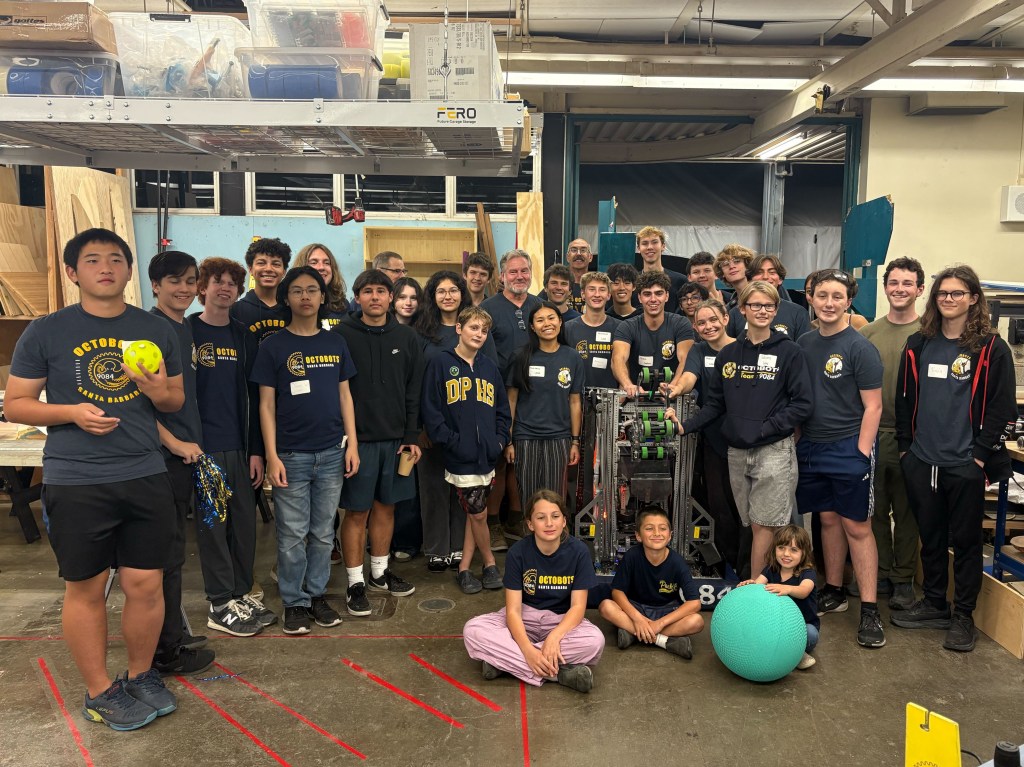
The Octobots robotics team at Dos Pueblos High nearly qualified for the last two world championships. | Credit: Courtesy 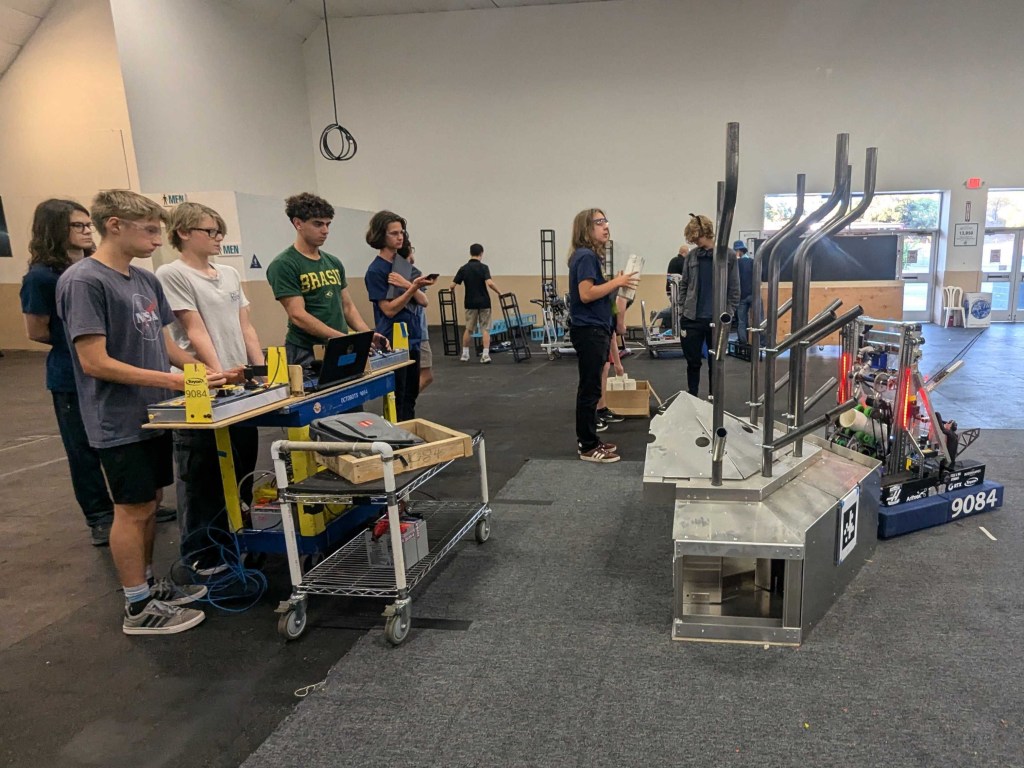
The Octobots robotics team at Dos Pueblos High nearly qualified for the last two world championships. | Credit: Courtesy 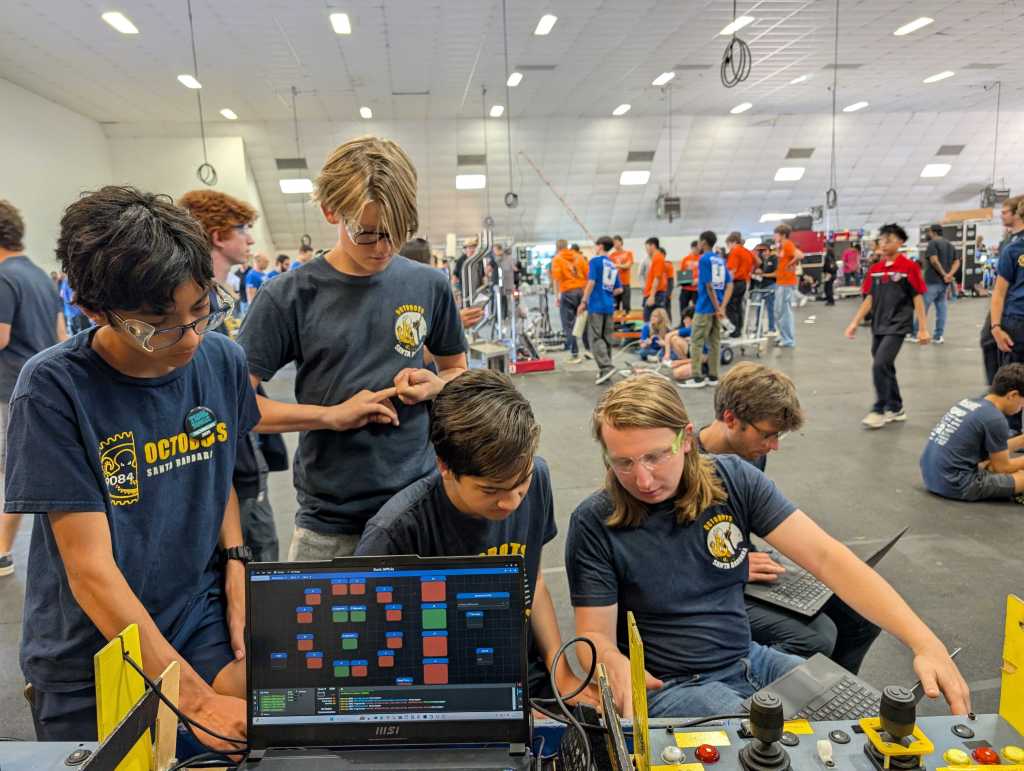
The Octobots robotics team at Dos Pueblos High nearly qualified for the last two world championships. | Credit: Courtesy
Pereira came to DP from Anacapa School as a sophomore, so he was unable to join the engineering program that’s for incoming freshmen only. But he always loved engineering and building things, so Octobots filled that niche. It is a major time commitment: three hours after school every day during the season, and then another five or so hours every weekend.
“I’ve been telling all of my friends to come join,” he said, noting that not all teammates are engineers, as some focus on marketing or on the business side of raising the tens of thousands of dollars required to support the program. “People don’t realize that Octobots is not just robotics.”
But he’s more certain than ever of his path. “I want to be a mechanical engineer,” he said. “I definitely know that’s what I want to do.”
ChaCha vs. The Lemon
Yong Wang didn’t know anything about restaurants or robots before he dove headfirst into each.
The first leap was when the Shanghai-raised entrepreneur took over the Stone Age restaurant on Milpas Street from a friend who was moving to Texas in 2018. “I had no idea about the restaurant business,” said Wang, who first came to the United States in 2008. “I don’t cook at all.” He’d once worked for both a cruise ship and a hotel, but most recently was running his own import-export company out of Irvine.
Six months later, he was ready for a bigger place, and one closer to the Asian students at UCSB, which is how he came to take over the former Empress Palace on Las Positas. He brought in live music and curated a menu that mixes Chinese-American fare with authentic dishes from his homeland. Then came COVID.
“We were failing. I had to figure it out, and robots were the way,” said Wang. “People were very happy with that. The diners, their grandsons and granddaughters, they all came to see the robot.”
When the humanoid robot arrived this past January, he was even more in the dark than when starting the restaurant. “I’d never seen a humanoid robot in my life,” he said. “We had to train the robot by ourselves. I didn’t even know that.”
Less than a year later, with the help of his StarBot team, the horizons look limitless. They’re now dialing in what’s needed for robots that can patrol the perimeters of buildings 24/7, for robots that can pluck lemons off of trees, for robots that can check-in hotel guests, take them and their bags to the room, and deliver a new bathrobe when needed.
But the basic restaurant training continues. On a recent Friday, I watched ChaCha try to pick up a bright yellow lemon and can of Coca-Cola, which it first identified as a green apple and red cup. StarBot’s head of engineering Ricky Wu explained that some of the delay and confusion is because each command and thought process is being sent up to the internet and then coming back. Once they complete their own local server, the flow should be much faster and accurate. That’s just one of the many riddles to come.
Though ChaCha couldn’t take our order or drop off our food that day, the friends who joined me for a later lunch of smashed cucumbers, dry-spicy chicken, king mushroom with bok choy, pork belly with jalapeño, and Coke-soaked chicken wings didn’t seem to mind. We were eating excellent Chinese food while watching the future in front of our eyes. Yes, that future is still flailing a bit, but I’m betting that ChaCha and the StarBot team will one day figure it all out.


ChaCha can do some things at Meet Up, but there’s much to learn. | Credit: Ingrid Bostrom



You must be logged in to post a comment.