

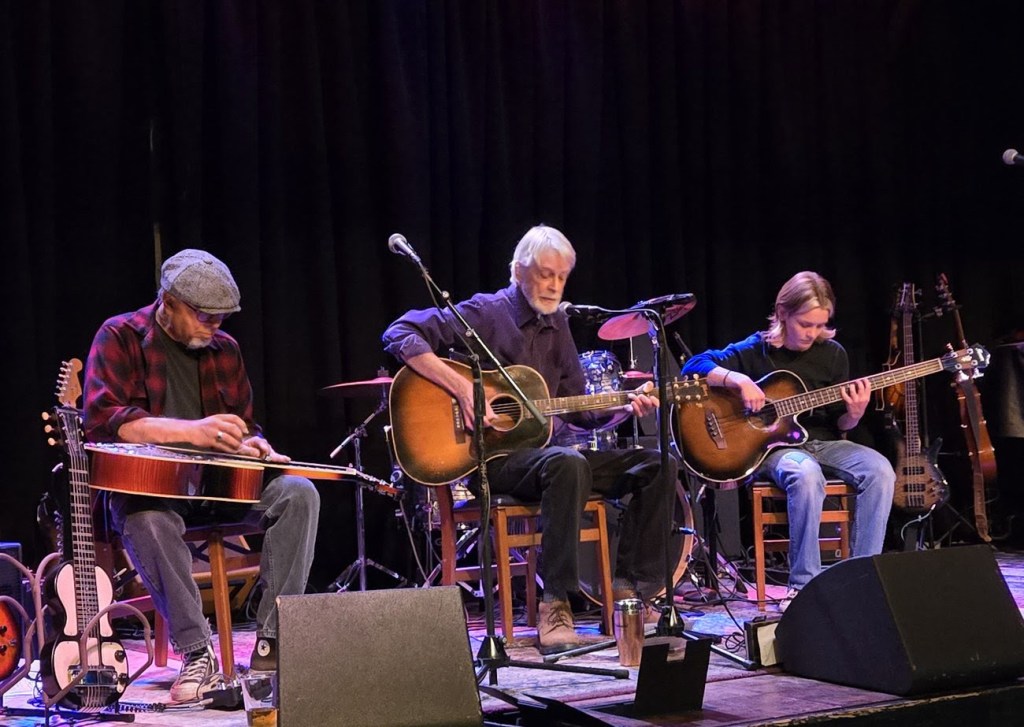
Jensen’s Music is gone, long live Jensen’s. The almost mythical independent music store, founded by Chris Jensen 51 years ago, played its final chord several weeks ago, but its powerful presence lingers on in memory and in actual, evolving musical form. That was the underlying message delivered from the SOhO stage on Sunday.
At this homegrown gala booked on short notice, a packed house — liberally strewn with musicians, music teachers, former employees, and peripheral respect-payers — assembled to pay tribute to the man with a plan and a store to the stars and the everypeople. (To clarify, the famed De la Vina property still maintains its lesson plans, but the retail/hangout component is history.)
Naturally, at a Jensen’s tribute, there would be music, and plenty of it, by musicians who worked and taught at or otherwise habituated in the relaxed hang zone of the store over the decades. All expressed respect and affection for Jensen and his wife, Cecilia, and some went further in their praise. Josh Jenkins commented, “It was so much more than a guitar shop. It’s a store that could literally save your life.” John Lyle joined in on that chorus, professing, “Jensen’s saved my life.” (He used his strong, clear voice in song later in the show, on the stuff of “Harvest Moon,” and “Dear Prudence.”) As Lyle said in his tribute, the likes of David Crosby, Michael McDonald, and Brad Paisley (not to mention Jack Johnson) would come by the store. “You never knew what was going to happen,” said Lyle.
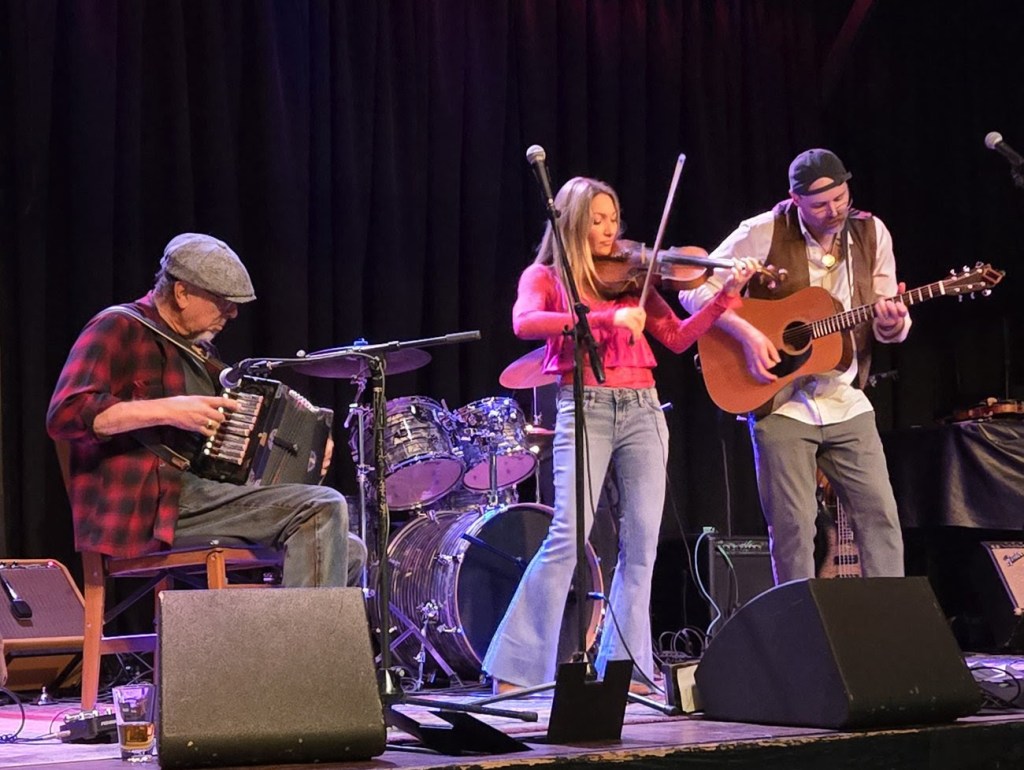
Jenkins, guitarist-singer-mandolinist with youthful roots at Jensen’s, was emcee for the event, announcing upfront that it would be “a Grand Ole Opry–style show, with tunes and some talking, with a restaurant attached.” He also reminded folks that a collection was being taken up for the Jensen’s retirement fund GoFundMe campaign (link here).
Jenkins served up some fiddle tunes with another proud Jensen’s musician/teacher Laura Nelson (here with the Folk Orchestra of Santa Barbara this weekend, see below), and the show’s secret sauce, stage right, Bill Flores on dobro and lap steel. The list of musicians included fine guitarist-singer (and Jensen’s teacher) Michael Frey, Tom Phillips, Barney and Rosie Tower, and Dennis Russell.
Santa Barbara’s go-to harpist Laurie Harp recalled working at another grassroots-y music store in town, Folk Mote. “At times, when it’s difficult to have a brick-and mortar store,” she said, “it’s great to have had these two great stores in town.”Singer Annie Eastwood, a folky veteran of the Santa Barbara music scene, summed up what made Jensen’s special in her testimony: “You were the heart, you were the hearth.”
Weekend Update
A veritable bevy of tasty options has landed on this weekend’s cultural calendar, offering multiple good reasons to get out of the house. The eclectic music-lover’s weekend planner could open with opera, of which we get small but substantive portions in a given year in Santa Barbara: Opera Santa Barbara (OSB) kicks off its season with the tragic magic of Mascagni’s Cavalleria rusticana at the Lobero, on Friday night, November 7, and Sunday afternoon (see story here). The weekend should close with a visit to the Marjorie Luke Theatre on Sunday evening with the second installment of this year’s ¡Viva el Arte de Santa Bárbara! Series, featuring the wondrous Guatemalan in Los Angeles Gaby Moreno (see story here). Yes, it’s free for the taking in, with free Mexican pastries to follow.
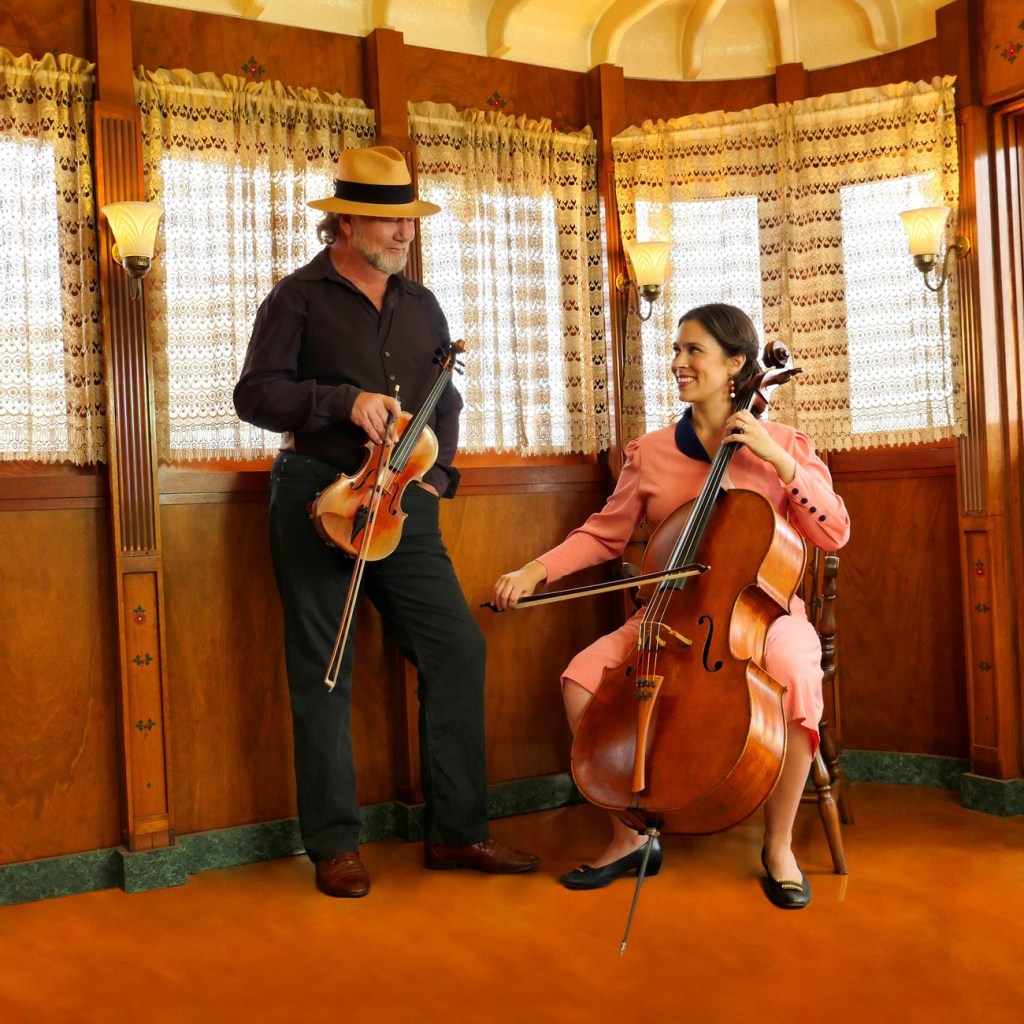
But wait, there’s more in store. This is also the weekend when leader Adam Phillips’ grand Folk Orchestra of Santa Barbara puts up its big tent with one of the most special projects of its season, featuring a return visit from famed Scottish fiddler Alasdair Fraser and Californian cellist Natalie Haas. Phillips and his 28-member ensemble will logically lean into the winds of Celtic repertoire this time out, from Friday through Sunday, at Trinity Episcopal Church, Marjorie Luke Theatre, and Los Olivos’s St. Marks-in-the-Valley, respectively.
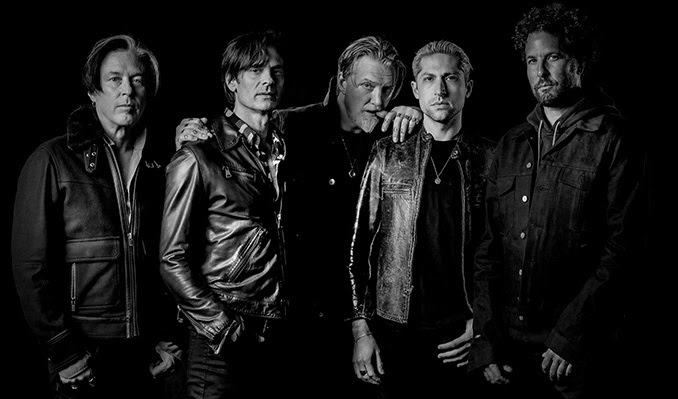
For some serious modern rock fiber, head over to the Arlington Theatre to catch the Queens of the Stone Age (a k a QOTSA), whose Santa Barbara Bowl shows have been stunners. Under the faux star of the Arlington, QOTSA brings along a custom experience — newly arranged songs and conceptual packaging for The Catacombs Tour, described as a limited series of very special one-night-only evenings at a curated selection of North America’s most historic theaters. The Arlington is nothing if not historic and the stuff of living legend.
On the Organ Beat
Fans of organ music — of both the grand pipe type and Hammon B-3 grit — had much to celebrate two weekends back. On Saturday night at Campbell Hall, Cory Henry cooked up some powerful gospel-jazz stew on the timeless theme of “Amazing Grace,” on B-3 as opener (and cameo guest) with the Blind Boys of Alabama.
On Sunday morning, wizardly organist Thomas Mellan, an internationally known musician from Los Angeles presently appearing as house organist for the First United Methodist Church, gave us a fun and fine post-church mini-recital with a holy and Halloween themed program. Among other matters, John Carpenter’s Halloween cozied up to the famous Bach workout Toccata in D minor.
But the real musical meat of the program came with an organ transcription of maverick Alexander Scriabin’s “Black Mass,” from his Piano Sonata No. 9. Scriabin’s flirtations with tensed tonalities and pre-echoes of modernity came through dramatically in the broad textural palette of the organ’s possibilities.
Mellan returns in fuller recital form this Saturday, November 8, for a free Santa Barbara Music Club show on the Methodist Church’s formidable instrument, which dates back a century in its original form. Here, he will play organ transcriptions of piano music by Liszt, Chopin, and lesser-known French composer Charles-Valentin Alkan, as well as the organist’s own composition “Nocturne.”
The concert flyer taps the cheeky and now familiar description of Mellan as “The World Renowned Bad Boy of Organ Music.” But he is also a nice guy and a monster behind the controls of the king of instruments. Did we mention that the recital is free?
Review-lets While You Wait
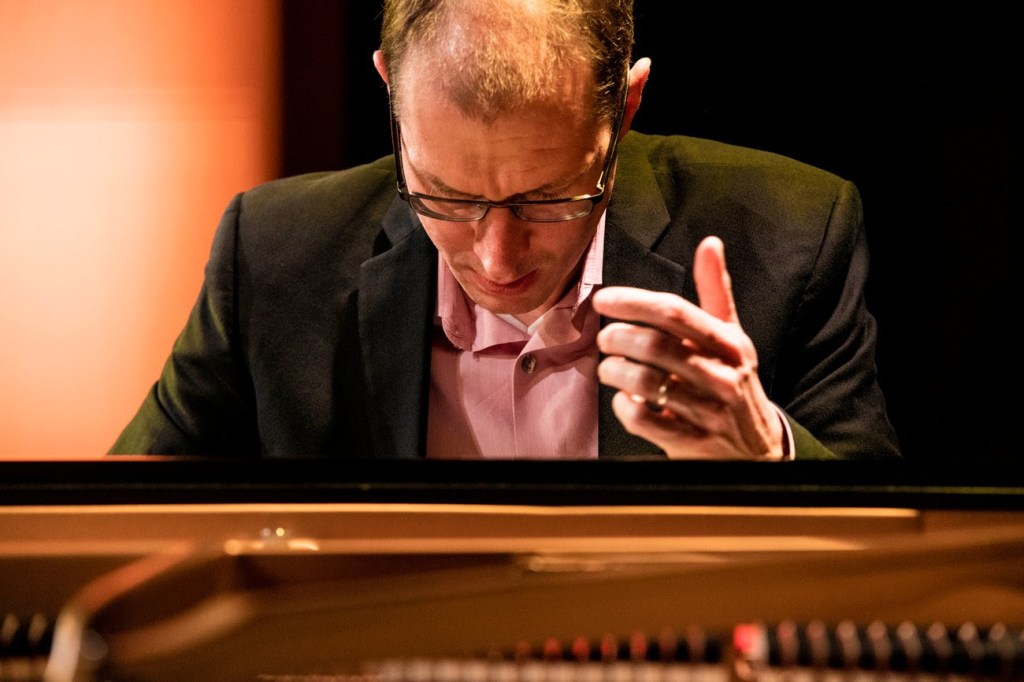
Camerata Pacifica joined the (accidental?) crosstown Beethoven blowout this year and season, with the opening gestures of an ambitious three-year presentation of all 32 Beethoven piano sonatas, as played by the impressive pianist Gilles Vonsattel at Hahn Hall last week. He’s in some lofty company in the ears of local classical music heads, including Víkingur Oláfsson, who recently heard put forth a commanding take on the Sonata No. 109 — the centerpiece of a program built around Beethoven — and Jeremy Denk, who performed a three-night Beethoven sonata spectacular in this very hall, in the Music Academy of the West festival. Meanwhile, Santa Barbara Symphony is planning a marathon of Beethoven piano concertos in its January concert.
Lest we fear overkill, the question begs: Can there be too much passionate and articulately played Beethoven in our midst? Vonsattel, who quickly convinced us of his passion and technical articulation cred, started big, with the notoriously challenging and sublime “Hammerklavier” Sonata (Op. 106). He had the necessary moves and arcing intelligence to bear, from the burnished gravitas of the adagio through the infamous pyrotechnical gush of the finale, a crazy fugal movement.
Also on the program was the easy-does-it palate cleanser of Mozart’s Serenade in E-flat, and a Vonsattel return, with the bittersweet capper of Chopin’s Nocturne No. 11 in G minor, to which he brought proper sensitivity and an almost spacious approach.
Itzhak Perlman, the seasoned violin virtuoso and one of the handful of household name classical musicians out there, brought his stellar klezmer medicine show back to The Granada Theatre last week, courtesy of UCSB Arts & Lectures. Through the now 30-year-old package In the Fiddler’s House, fans of klezmer were invited to a slice of heaven. In the ranks was music director Hankus Netsky and members of Brave Old Combo, the Klezmer Conservatory Band, and more. Early on, Netzky explained, with tongue only half in cheek, “We’re inviting you to a Jewish wedding tonight.”
Being in the camp of klezmer agnostics — who love it in small doses — the two-hour extravaganza felt to me a bit like staying too long at the fair. But the musical goods, pumped up with minor chords galore and the paradoxically mournful yet jubilant spirits, and blessed with accomplished musicianship onstage, was inarguably top drawer.
The bad news: Andy Statman, celebrated klezmer purveyor and double-threat on mandolin and clarinet, was MIA due to an accident. The upside: One of the surprise “discoveries” of the concert was surrogate mandolinist Patrick McGonnable (a nice Jewish boy), whose fiery fine improvisational tête-à-têtes with Perlman were high points of the night.





You must be logged in to post a comment.