

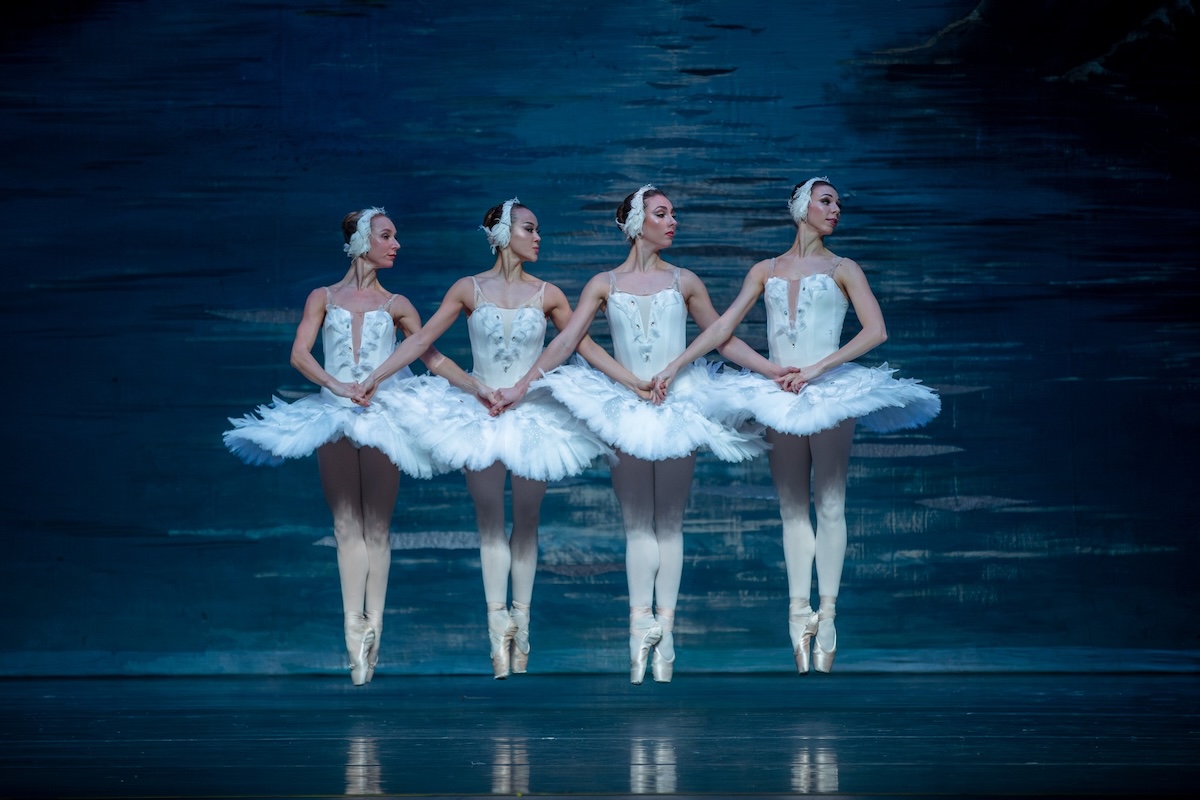
Spectacular dancing, gorgeous new costumes, hand-painted scenery and a hand-picked international cast with principal dancers from Ukraine, Tajikistan, and Armenia made the December 5 production of Swan Lake at the Arlington Theatre truly memorable. The dancers of International Ballet Stars (IBS), directed by the husband-wife team Artem Yachmennikov and Ekaterina Vaganova-Yachmennikova, are chosen from a wide range of countries, all winners of prestigious ballet competitions in Europe, the U.K, and the U.S., and coming from national ballet companies across the globe.

Their extensive North American tour, managed by Classical Arts Entertainment, began in October 2025 and will end in May 2026. The cast of more than 40 dancers is accompanied by a large staff who handles the costumes, sound, lighting, scenery, makeup, and accommodations. There is even a dedicated chef who manages their daily meals. How do they do it? According to co-director Vaganova-Yachmennikova, they receive no funds from any government and have no sponsors, but fund everything through their own organization.
As one would expect, with such pedigreed dancers, the dancing was impeccable. Swan Lake is one of the most challenging of all classical ballets, not just for the principals, but also for the demanding range of choreography for the swans and the folkloric soloists. The whole company was spectacular, indeed.
The dual role of Odette, the pure White Swan Queen, and Odile, the demonic Black Swan is, without a doubt, the most difficult role for a ballerina in all of classical ballet. Ilona Baitler, principal dancer from Dnipro, Ukraine, danced this dual role perfectly, with impeccable technique, tremendous endurance, and flawless character portrayal. Baitler moved seamlessly from being the beautiful, fragile, almost pitiful Odette to being the cruel and deceptive seductress Odile. She executed the famous 32 fouettes en pointe in the second act perfectly, even throwing in a double a few times!
Prince Siegfried was danced by Oleksii Kniazov, from Kramatorsk, Ukraine. A principal dancer with the Kharkiv National Ballet, Kniazov started studying ballroom as a child, before ballet. Aside from being a spectacular soloist, Kniazov stood out to me as a particularly attentive partner, perhaps because of his early ballroom training.
The court jester, danced by Edgar Samvelyan of Armenia, absolutely stole the show in the court scenes of each act. His high jumps and virtuoso turns, combined with his broadly humorous portrayal made him stand out, sometimes upstaging the Prince. Vaganova-Yachmennikova described him as “extremely organic on stage,” and said that he “often brings new ideas to each performance.” Reading between the lines, I think this means he has permission to improvise on stage, which makes his performance all the more special.


Akbar Khujaberdiev, from Tajikistan, danced the role of von Rothbart, the evil sorcerer. His appearance was striking and his performance spectacular. His exotic features and intense expression made his character simultaneously beautiful and frightening.
The two court scenes — Prince Seigfried’s coming-of-age celebration and the celebration in which he must choose a bride — have charming folkloric dances, which were beautifully danced in exquisite, colorful costumes. Particular mention should be given to the two couples who danced the Spanish variations in Act II: Sergei Zdanschi and Daniel Ivanov of Moldova, with Taisiia Shevchenko of Ukraine and Milena Brown from the U.S. — especially the ladies, whose backbends were so deep, they clashed their fans on the ground behind their heads.

The Four Cygnettes — Little Swans — deserve special mention as well. The famous Cygnettes’ variation is deceptively difficult because the four dancers must be perfectly synchronized, not only with their footwork and jumps, but their heads must move as one, in perfect time with the music. Shuko Tayma (Japan), Maria Vasiuk (Ukraine), Kasia Wola (Poland), and Ide Yumeko (Japan) were impeccably synchronized Cygnettes, eliciting applause and cheers from the audience. Any female who has studied ballet to any degree of seriousness has most likely learned this variation at some point in her studies, and knows just how very difficult it is to make four bodies move as one! Bravo to the Cygnettes of IBS.
Swan Lake has a fascinating history. The true origin of the story is unknown, but it supposedly originated in Russian and German fairy tales. In most versions of the story, the evil sorcerer von Rothbart has cursed a group of maidens to live as white swans by day, taking human form only at night. The curse can only be broken by the true love of a man who has never loved before. On the evening of his coming of age, Prince Siegfried falls in love with Odette and declares his love for her. Not wanting to release his curse, Rothbart uses his daughter Odile to trick Siegfried into asking for her hand in marriage, thus preventing the curse from being broken. In the end, Odette drowns herself in the lake in order to be free, and Siegfried follows her. The two are only united in death, and the curse is broken as Siegfried and Odette ascend to heaven.
Not so in this version. In true Santa Barbara fashion, the IBS version had a happy ending: In a stupendous battle Prince Siegfried rips off one of von Rothbart’s wings and kills him, thus breaking the curse. The ballet ends with the two lovers being united in life. According to producer Ekaterina Vaganova, this happy ending was created by Vladimir Bourmeister, a Soviet choreographer, in 1952, and many companies have chosen to use this ending. I have never seen any version of Swan Lake in which the lovers did not die, but I must say it was refreshing. I had the thought that such a happy ending would be totally in character with our own virtuoso, tradition-defying dance company, State Street Ballet, who created The Little Mermaid with a happy ending!
International Ballet Stars, based in Miami, Florida, will be returning May 8, 2026, for a performance of Sleeping Beauty at The Granada Theatre, and an outreach program called We Dance, whereby local ballet students can audition for a chance to participate as extras in their shows.
Related Posts








Premier Events

Thu, Apr 02
5:00 PM
Santa Barbara
Paintings by Michael Vilkin at ART & SOUL GALLERY

Sat, Apr 04
9:00 AM
Santa Barbara
Mesa Harmony Garden Spring Plant Sale

Thu, Apr 09
7:00 PM
Santa Barbara
Journey Within: Wisdom & Meditation with Gurudev
Fri, Apr 10
2:00 PM
Santa Barbara
Music & Meditation SB – Concert April 10, 2026

Wed, Apr 01
6:00 PM
Santa Barbara
Downtown Salsa & Bachata Dancing

Wed, Apr 01
7:30 PM
Santa Barbara
Justin Hayward – The Story In Your Eyes Tour

Thu, Apr 02
2:00 PM
Santa Barbara
S.B. Rescue Mission Annual Easter Feast

Thu, Apr 02
4:00 PM
Santa Barbara
Organic Soup Kitchen’s Souper Bloom Soup Social!

Thu, Apr 02
5:00 PM
Santa Barbara
Exhibit Opening: The Santa Barbara Independent: ‘Covering 40 Years’

Fri, Apr 03
2:00 PM
Santa Barbara
Ensemble Theatre Company Presents “A Night with Janis Joplin”

Fri, Apr 03
5:00 PM
Lompoc
Filipinos’ Contributions to Once Making Lompoc…

Fri, Apr 03
7:30 PM
Santa Barbara
Lahaina: Voices of Change
Sat, Apr 04
9:00 AM
Santa Barbara
Mesa Harmony Garden Spring Plant Sale

Sat, Apr 04
9:00 AM
Santa Barbara
Passport Fair, hosted by Congressman Salud Carbajal
Thu, Apr 02 5:00 PM
Santa Barbara
Paintings by Michael Vilkin at ART & SOUL GALLERY
Sat, Apr 04 9:00 AM
Santa Barbara
Mesa Harmony Garden Spring Plant Sale
Thu, Apr 09 7:00 PM
Santa Barbara
Journey Within: Wisdom & Meditation with Gurudev
Fri, Apr 10 2:00 PM
Santa Barbara
Music & Meditation SB – Concert April 10, 2026
Wed, Apr 01 6:00 PM
Santa Barbara
Downtown Salsa & Bachata Dancing
Wed, Apr 01 7:30 PM
Santa Barbara
Justin Hayward – The Story In Your Eyes Tour
Thu, Apr 02 2:00 PM
Santa Barbara
S.B. Rescue Mission Annual Easter Feast
Thu, Apr 02 4:00 PM
Santa Barbara
Organic Soup Kitchen’s Souper Bloom Soup Social!
Thu, Apr 02 5:00 PM
Santa Barbara
Exhibit Opening: The Santa Barbara Independent: ‘Covering 40 Years’
Fri, Apr 03 2:00 PM
Santa Barbara
Ensemble Theatre Company Presents “A Night with Janis Joplin”
Fri, Apr 03 5:00 PM
Lompoc
Filipinos’ Contributions to Once Making Lompoc…
Fri, Apr 03 7:30 PM
Santa Barbara
Lahaina: Voices of Change
Sat, Apr 04 9:00 AM
Santa Barbara
Mesa Harmony Garden Spring Plant Sale
Sat, Apr 04 9:00 AM
Santa Barbara


You must be logged in to post a comment.