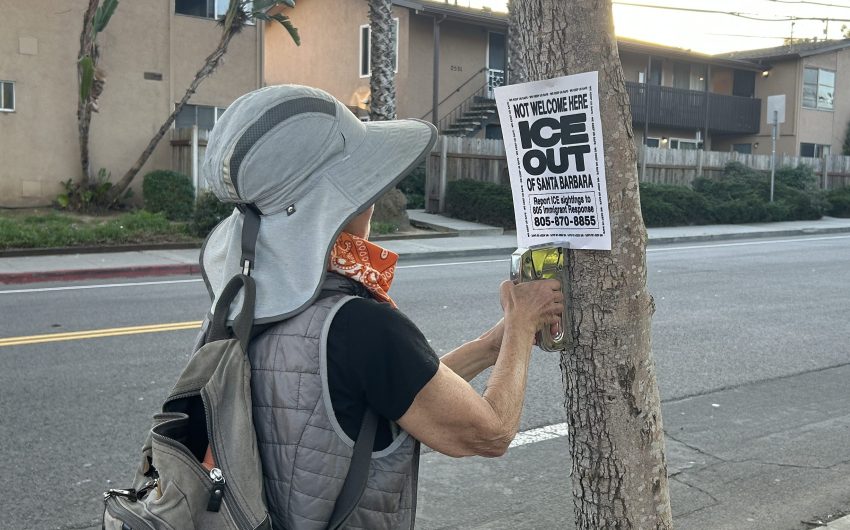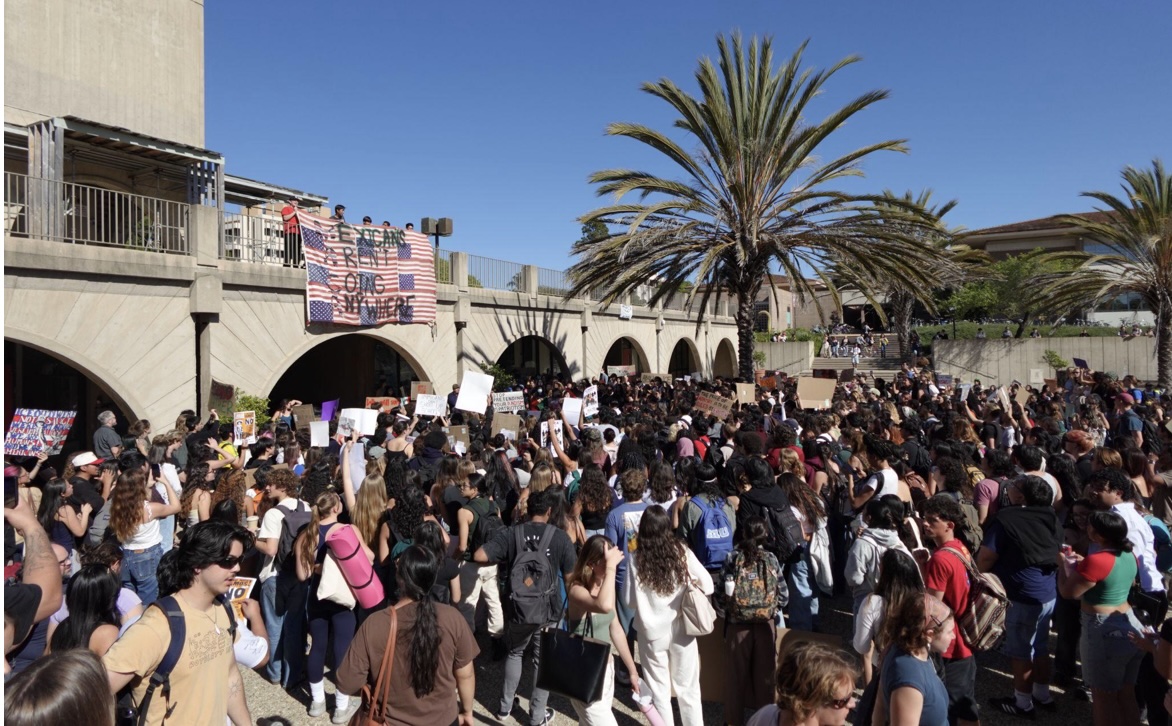
More than 300 UC Santa Barbara students gathered on Wednesday at the campus’s Eternal Flame to carry out a walkout and protest against Immigration and Customs Enforcement (ICE) and current government policies they say endanger immigrant communities in Santa Barbara County.
Holding signs reading “Immigrants Are Welcome Here” and “ICE Out,” students chanted slogans including “Chinga la migra.” Volunteers distributed face masks to help participants avoid identification, as well as flyers with chants, protest signs, and water and snacks. Compared with previous years, organizers said this year’s turnout makes it one of the largest immigration-focused protests on UCSB’s campus and among colleges in the region.
Cesar Vasquez, a Rapid Response organizer for San Luis Obispo and Santa Barbara counties, addressed the crowd, urging students to stand closer together and remain united. He spoke about recent ICE detentions in the region, emphasizing that the walkout was meant to show solidarity with community members and families affected by the arrests who could not be present.
“Today, we’re here for the families and the people who cannot stand here with us,” Vasquez said. “We’re mad. We’re sad. But we have to channel that energy to protect our people.”
Vasquez said more than 1,600 people have been detained by ICE across Santa Barbara, Ventura, and Santa Maria in recent months, recalling several local detentions that have impacted families in the area.
The gathering paused for a moment of silence to honor those affected. During the silence, several students became visibly emotional, some embracing one another while others bowed their heads or held hands. When the protest resumed, participants held hands and chanted, “La migra, la policía, la misma porquería.”
“No matter where you come from, what you look like, or what you sound like, this is affecting all of us,” Vasquez told the crowd.
Shortly after 12:30 p.m., students marched toward Campbell Hall, led by a group of folklórico dancers dressed in traditional Mexican attire. Throughout the walkout, the crowd grew as students joined along the route, with participants chanting in unison and raising signs as they moved through campus. Drums and music accompanied the march, while organizers periodically reminded students to stay together and look out for one another. As they danced at the front of the march, the crowd chanted, “El pueblo unido jamás será vencido” and “No hate, no fear, immigrants are welcome here.”
“This is a way to use my voice,” said UCSB student Marlen Rodriguez. “My parents are immigrants, and I come from an immigrant family. If I’m here, it’s because we want to share our voice and protect our community.”
The protest continued in front of Campbell Hall, where some students climbed trees and raised their signs. Several participants took turns speaking through a megaphone, calling on the university to take action.
“We demand that UCSB protect our students from the hands of ICE,” one student said. Another student said that one of their parents had been detained and deported by ICE weeks earlier. “It’s about humanity at this point,” the student said. “We are human beings, and if we stick together, we’ll be okay.” The crowd cheered as bystanders joined the protest.
Afterward, Mexican corridos played as students danced and chanted while marching past the main library and toward Storke Tower, continuing the walkout across campus.
Vasquez urged students to take action beyond the walkout, saying protests alone would not stop ICE activity in the community. “Protesting and reposting will never be enough,” he said. “That doesn’t mean you shouldn’t get involved; it just means you have to do more than just protest.” He encouraged attendees to support families directly, attend community trainings, and respond to ICE activity when it occurs through SBResiste, 805 UndocuFund, and Ice Out of Goleta. Vasquez also emphasized the importance of community solidarity over reliance on government institutions. “For too long, we’ve been looking at the system,” he said. “We need to look at each other, because we’re here for each other.”
Several speakers also called on the community to take action, emphasizing that collective unity was necessary to support one another. They said that because they felt government institutions were not adequately protecting immigrant communities, residents would need to rely on mutual support and shared responsibility to ensure one another’s safety.
“This is for our communities, our neighbors, and our loved ones,” Vasquez said.