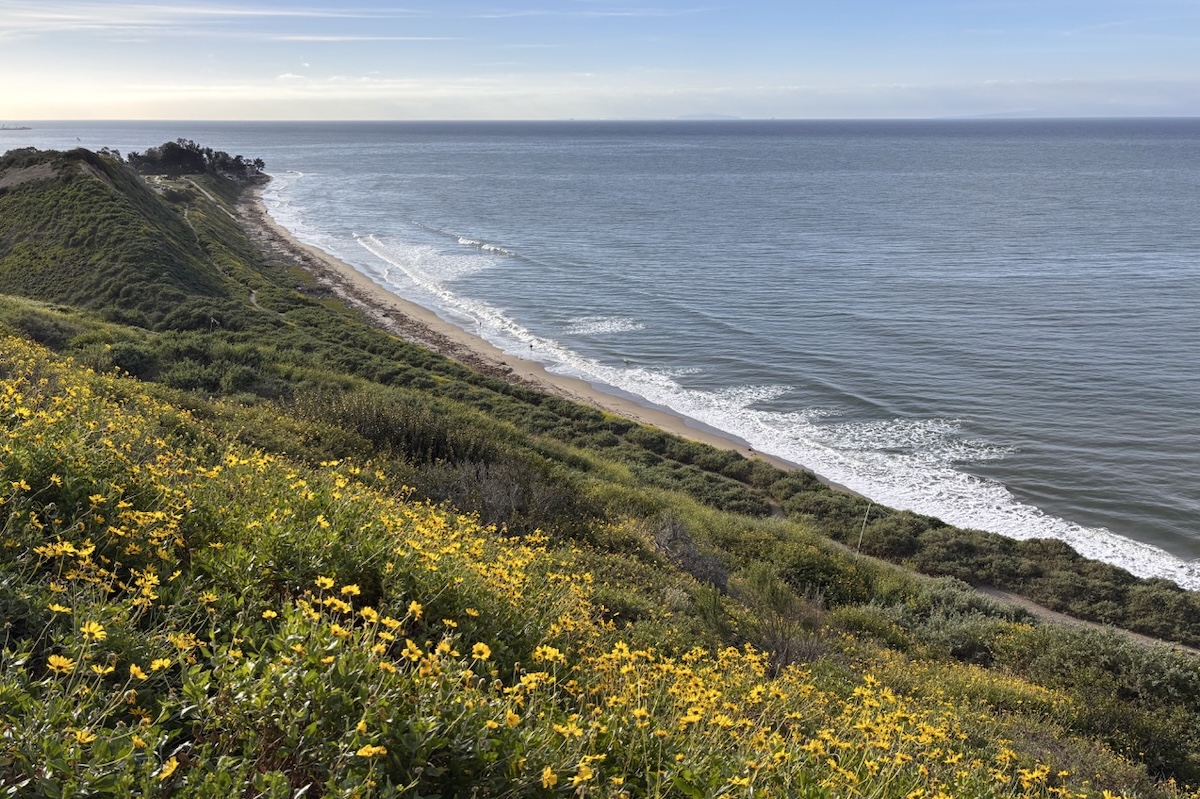
On Sunday, February 22, the Santa Barbara County Trails Council will lead a five-mile “living heritage hike” from Rincon Beach County Park to Santa Claus Lane, tracing the path of the 1775-76 Juan Bautista de Anza expedition as it entered Santa Barbara County 250 years ago.
The hike marks the day Anza’s party camped just past Rincon Point after moving up the coast with 240 settlers, including families, livestock, and soldiers. Their destination: Alta California. Their legacy: complicated.
“It’s a discussion about migration,” said Mark Wilkinson, executive director of the Santa Barbara County Trails Council, describing the programming planned for the hike. “We will imagine what the expedition members were thinking and compare that with personal stories of ‘migration’ to Santa Barbara County.” Wilkinson said participants will also stop at two Chumash interpretive signs “to discuss the impact of European colonization on the native population.”
Wilkinson framed the route as a kind of moving classroom — a “living heritage” walk. “One way of looking at the Anza Trail is as an open-air museum that acknowledges its past,” he said, while also offering “an opportunity to acknowledge the region’s layered histories … the profound and enduring impacts of colonial expansion on Indigenous communities.”
To understand why the trail still draws attention 250 years later, you have to zoom out — and then zoom way back in.
John Johnson, curator emeritus of anthropology at the Santa Barbara Museum of Natural History and president of the board of the Santa Barbara Mission Archive Library, said the Anza expedition remains historically significant not only because of what it set in motion, but because of what it documented along the way.
“One of the great things about that expedition is there were diaries that were kept — especially the diary of Father Pedro Font,” Johnson said.
Font’s observations, Johnson said, offer a rare, detailed snapshot of Chumash life before it was “changed forever.”
“Font’s diary is very detailed about Chumash culture,” Johnson said. “So one of the great things about [it] … is a firsthand look at what Chumash culture was like.”
Johnson described Font’s accounts of Chumash maritime technology with obvious respect, including the ocean-going plank canoes — tomols — that so impressed Spanish observers.
But Johnson did not pitch the anniversary as an uncomplicated celebration. “We look back and say, this was a precipice of dramatic cultural change.”
By the time Anza’s settlers arrived, some Chumash communities were hiding women and children from soldiers. Earlier colonial encounters had included violence and sexual assault.
“Font calls them out,” Johnson said of the soldiers. “He describes what had happened.”
Within a decade, missions would be established in Chumash territory. European diseases — smallpox, measles — would follow. By 1900, the Chumash population, once estimated between 22,000 and 25,000 people across roughly 150 villages, had been reduced to a few hundred.
When asked how historians navigate commemorating a colonial expedition without laundering the consequences that followed, Johnson was direct: “All of that has to be acknowledged and recognized,” he said.
Chumash Response: ‘Thank You for Considering the First People of the Region’
The Santa Ynez Band of Chumash Indians was contacted for comment but an interview could not be completed before deadline. However, communications director Mike Traphagen pointed to an American Indian Alaska Native Tourism Association (AIANTA) travel guide highlighting tribal experiences along the Anza trail.
That 2025 guide emphasizes that the trail runs through Indigenous homelands and includes traditional place names, with AIANTA CEO Sherry Rupert quoting tribes’ message to visitors as: “We are still here.”
The Santa Barbara County Anza trail guide notes that the expedition’s coastal route passed through Chumash country, and that colonists recorded trading for local goods and food along the way.
For the Trails Council hike, the structure will link the expedition’s movement northward with present-day stories — pairing history with the question hanging underneath it: what it meant, who it affected, and what it cost.
The hike begins at Rincon Beach County Park at 10 a.m. on Sunday, February 21. Details on logistics and participation are available through the Santa Barbara County Trails Council.
Editor’s Note: The Santa Ynez Band of Chumash Indians was contacted for comment prior to publication, and an interview was scheduled but could not be completed before deadline.