Among other things, Baz Luhrmann’s unexpectedly fabulous EPIC: Elvis Presley in Concert may turn out to be this year’s most powerful pop music historical corrective. Forget what you think you know and feel about Elvis’s fabled and supposedly ill-fated Vegas years, viewed by many as the sad twilight and sell-out phase of a proto-rock ‘n’ roll legend. Here is a persuasive alternative view, with a bounty of evidence to prove its case.
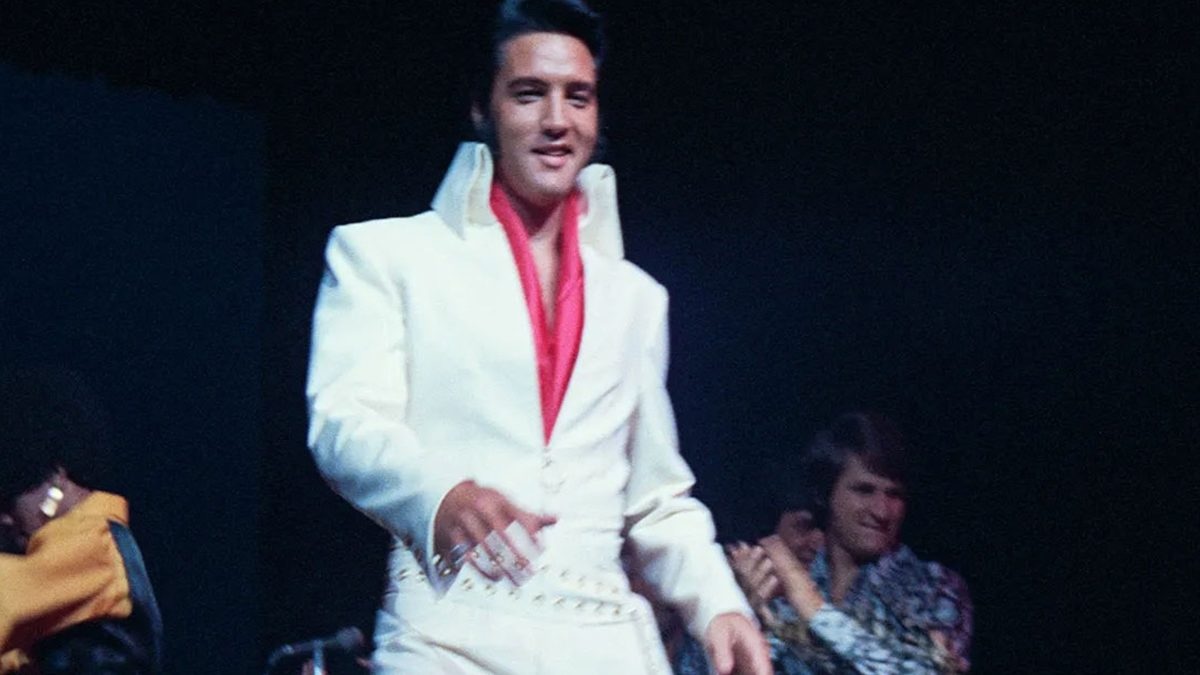
There is Elvis on the Strip, with his jumbo sideburns, gaudy costumes and spangly shades predating Sir Elton’s collection, and his natural way of working his dimply charm and freely kissing the ladies — on the mouth — during his showroom spectacles. But more importantly, what he delivers in those showrooms is the work of an artist with a great passion and gift for what he does, while locking in with his ace band (including the great Telecaster master James Burton, who gets in some tasty licks during the film).
Tellingly, no attention is paid to the king’s unseemly demise at Graceland in 1977. Tabloid-style muck is off the table here: The focus is on a great American artist’s work, in living color and begging for our love and reappraisal.
Luhrmann’s epic effort is a serendipitous ripple from the work he did on his fine biopic Elvis, with Austin Butler as the king and our man Tom Hanks in a semi-villainous role as the corrupt, misguiding corrupt manager Col. Tom Parker. During that production, Luhrmann came across a wealth of footage of the Vegas years from an obscure site in Kansas — though without sound — and a recording of Elvis talking about his life, all brought to life through a two-year process of extensive reconstruction, and seamlessly woven with the director’s virtuoso touch as a montage magician.
By painstakingly piecing together this hidden treasure of pop culture iconography, Luhrmann takes his rightful place alongside another Australian feature director lured into the documentary world, Peter Jackson, who pulled off a different yet similar passion project with his Beatles opus Get Back. In both films, the filmmakers trolled through and refurbished piles of archival material to create weirdly vivid “we are there” recreations of the excitement in the rooms — Vegas showrooms and rehearsal rooms for Elvis and the Get Back–era studio for the Beatles.
Whereas Elvis attempted to tell the whole story of his history, EPIC features an abridged bio sequence up top as a prelude, and it is an economical cinematic wonder unto itself. Luhrmann creates a dense-yet graceful-montage of clips, material to tell his story from early fame through his superficial Hollywood period (“I thought they were going to give me a chance to act,” says Elvis, “but that didn’t happen”).
In 1969, enter the Vegas years, the primary concern in this film. In his early days, when facing controversy and conservative scorn, he was asked, “Do you call that singing?” “Well, I’ve sold millions of records. I guess somebody calls it singing.” And his singing and performing powers continued on the Strip, despite what naysayers maintain.
While the central spotlight here is on Elvis’s Vegas years — which, incidentally, spanned 1,100 shows between 1969 and 1976 — his life story and musical sources also manage to be folded into the story, through interview snippets and even the film’s strategically curated song list. The Man from Memphis digs into full band — with horns and background singers — versions of items from his strong gospel roots (“How Great Thou Art,” “Oh Happy Day”), country (“Always on My Mind,” “Polk Salad Annie”), and his own classic book (“Hound Dog,” “Little Sister”).
He sings “Never Been to Spain” and riffs on other countries he hadn’t visited — perhaps a subtle nod to his manager’s cruelly restrictive mandate, a strong plot point in the biopic Elvis.
In the rehearsal scenes, he runs through his loving take on various Beatles tunes, a scene which reminds us that in a famous meeting with President Richard Nixon in the White House in 1970, he cast a wary eye on the Beatles’ unfair overshadowing of American pop music.
As an apt film climax, Elvis goes the extra mile during his antic version of “Suspicious Minds,” with its key line “caught in a trap, can’t hold back.” He repeats the phrase like a chant, and restlessly roams the stage, caught in the trap of his life and fame, teasingly tweaking the band’s dynamics. All the while, he keeps his firm grip on the crowd’s attention — in that room that night, and, by proxy, we in the theater, 50 years later.
Elvis is back, baby. We thought we knew him. Now we know him more fully.
EPIC: Elvis Presley in Concert is currently playing at SBIFF McHurley Film Center. Click here for showtimes. View trailer here.