

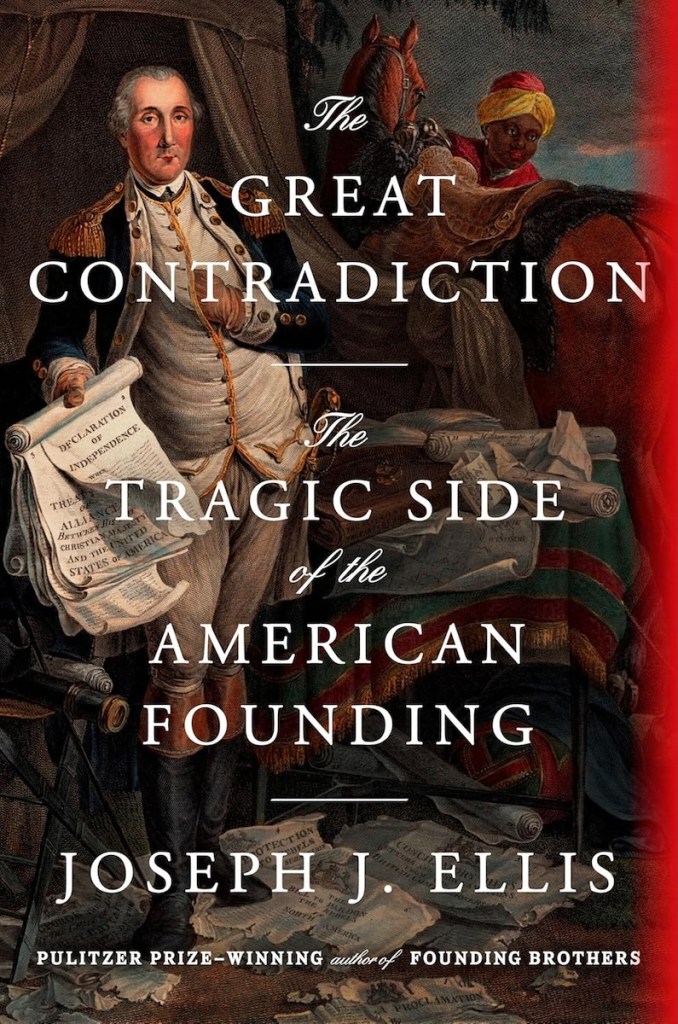
There’s something depressing about the fact that renowned historian Joseph J. Ellis felt the need to write The Great Contradiction: The Tragic Side of the American Founding. After all, the two great injustices he focuses on — the enslavement of African Americans and the forced removal of and violence visited upon Native Americans — are hardly news. And yet, 250 years after the Second Continental Congress adopted the Declaration of Independence, a time when an acknowledgement of these wrongs should be central to our heritage, there are plenty of people who would downplay, deny, or wish them away altogether.
The majority of The Great Contradiction is devoted to the political wrangling and doublespeak that allowed a group of men supposedly dedicated to the Declaration’s famous “self-evident” claim that “all men are created equal” to enshrine, in the Constitution, the enslavement of a significant portion of the new country’s population. That hypocrisy was especially glaring in the southern states. According to the 1790 census, the “free white” population of Virginia was 442,117, while the enslaved population numbered 292,627. And in South Carolina, there were 140,178 whites living off the free labor of 107,094 enslaved people, more than forty percent of the population. No wonder Charles Pinckney, a representative of the future Palmetto State, insisted that “South Carolina can never receive the [Constitution] if it prohibits the slave trade.”
Even though Ellis makes clear that the United States might never have existed at all if it weren’t for the many compromises it took to ratify the Constitution, it’s hard to stomach some of the resulting chicanery, including the provision that each enslaved person be counted as three-fifths of a white person for purposes of the allocating seats in the House of Representatives and apportioning federal taxes. It’s particularly disheartening to read that the fugitive slave law, which required escaped slaves to be returned to their owners even if they reached a northern state, was “passed unanimously, without debate.” Ellis speculates the reason for this was that “the delegates were all tired, several had already escaped the Philadelphia heat, a bare quorum remained, and they all wanted to go home.” More to the point, “the northern states cared more about preserving the union than they cared about ending slavery, while the priorities of the states in the deep south were precisely the opposite.”
Wow. One cheer for democracy.
Ellis acknowledges that “the failure to end slavery commands more space [in The Great Contradiction] than the failure to avoid Indian removal,” reasoning that “there is no question that the debate over slavery had a much greater impact on the political and ideological values created at the American founding.” The lone chapter he devotes to the topic does recognize that “the American victory in 1783 proved an unmitigated calamity” for the Native American population, “from which history would provide no rescue.” But it’s clear that, from the Founding Fathers’ perspective, the removal of people who had been living on the land for millennia is largely a nuisance, the Romantic myth of the “noble savage” notwithstanding. Ellis ultimately argues that, in the absence of “political institutions and legal precedents” devoted to the well-being of Native Americans, “ultimate authority resided outside of government altogether, with those ordinary American citizens seeking a better life and a parcel of land to the west. In that sense, Indian removal was the inevitable consequence of unbridled democracy in action.”
Again, this hardly seems like a cause for Semiquincentennial celebration.
Indeed, that phrase, “the inevitable consequence of unbridled democracy in action,” rings chillingly true today, as America struggles to retain any merit that may have accrued over the past two and a half centuries. Whatever happens to us, though, The Great Contradiction makes it clear that the United States was troubled — and trouble — from the very start.
This review originally appeared in the California Review of Books.









You must be logged in to post a comment.