
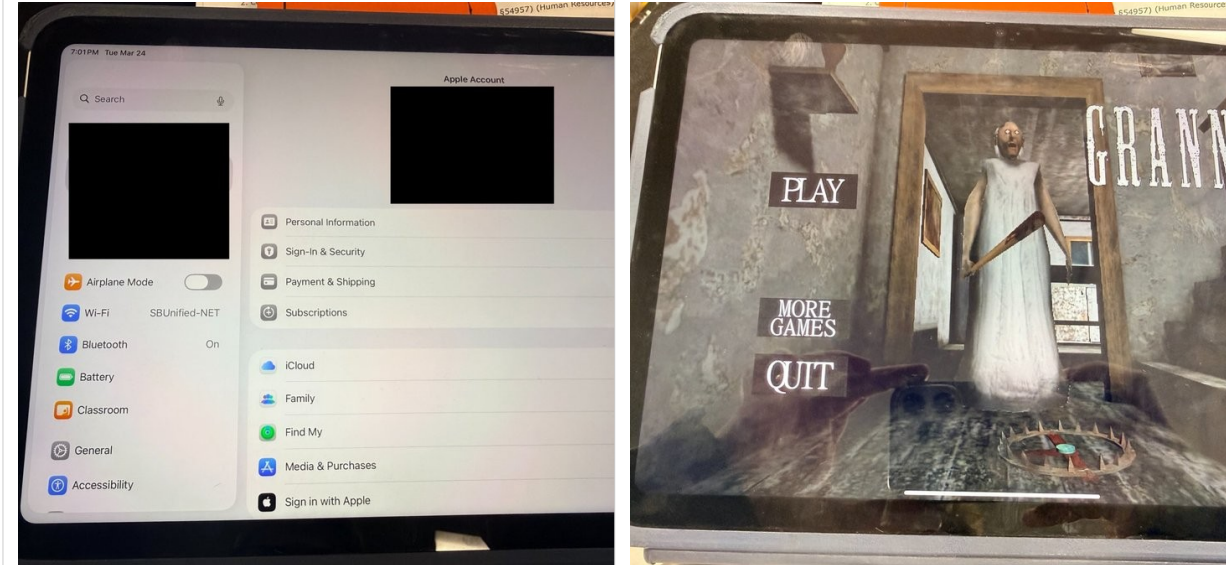
Two weeks ago, inside a local elementary school classroom, a 10-year-old girl witnessed something no child should encounter in the middle of a school day. On a school-issued iPad, she watched another student play a game called Granny — an indie horror title filled with morbid imagery and jump scares. In the game, a decaying, corpse-like grandmother stalks the player through dim hallways, beating them with a bloody baseball bat if they fail to elude her.
For a young child, it’s nightmare fuel.
In the days that followed, the girl — whose identity is being withheld — struggled to sleep. Her parents described nights spent comforting their sobbing daughter, traumatized by what she had seen “at school, during school hours, on a school iPad.” It’s not just what she saw that alarmed them. It’s that it was even accessible in the first place.
In a letter to the superintendent of the Santa Barbara Unified School District, the girl’s father emphasized that he did not blame her teacher or the school. Instead, he framed it as a systemic issue.
“Neither you nor anyone else knows what our children are doing with district property in our schools during school hours,” he wrote. “Are they playing horror games? Gambling? Communicating with anonymous adults? Watching porn? We don’t know, and neither do you.”
What happened to his daughter has become so common that it’s earned a name: “tablet trauma.” Even when schools put up firewalls and filters, students find ways to circumvent them. All they have to do is consult social media or ChatGPT, which can explain — in surprisingly simple terms — how to bypass security measures placed on their devices.
The incident reflects a broader transformation in American education: the rapid rise of educational technology, or “EdTech.” Pixels have steadily infiltrated classrooms, but screen use skyrocketed during the COVID-19 pandemic. Districts are now dealing with the hangover: Digital devices are as ubiquitous in classrooms as textbooks once were.
Nationwide, nearly 90 percent of students are issued a Chromebook or iPad. Typing has increasingly replaced handwriting, with screens becoming central to everything from daily assignments to exams.
Supporters of EdTech argue that these tools enhance learning by making it more interactive, efficient, and creative. But critics say the pendulum has swung too far, and too fast.
If a classroom is a garden, excessive screen use is not a fertilizer, they argue. It’s an herbicide. Some likened it to giving kids a new, untested drug, and treating them as guinea pigs without considering the potential side-effects.
A growing body of research suggests that screens are harmful to young children. Prolonged screen use has been linked to anxiety and depression, shortened attention spans, and delays in social and emotional development. Some global studies have shown that when technology use in the classroom goes up, test scores go down. Learning on a device often involves less “friction” — fewer moments of struggle that can be essential for comprehension and retention.
This movement against EdTech is playing out on a local stage as parents push to rewire the Santa Barbara Unified School District, citing their children’s own struggles.
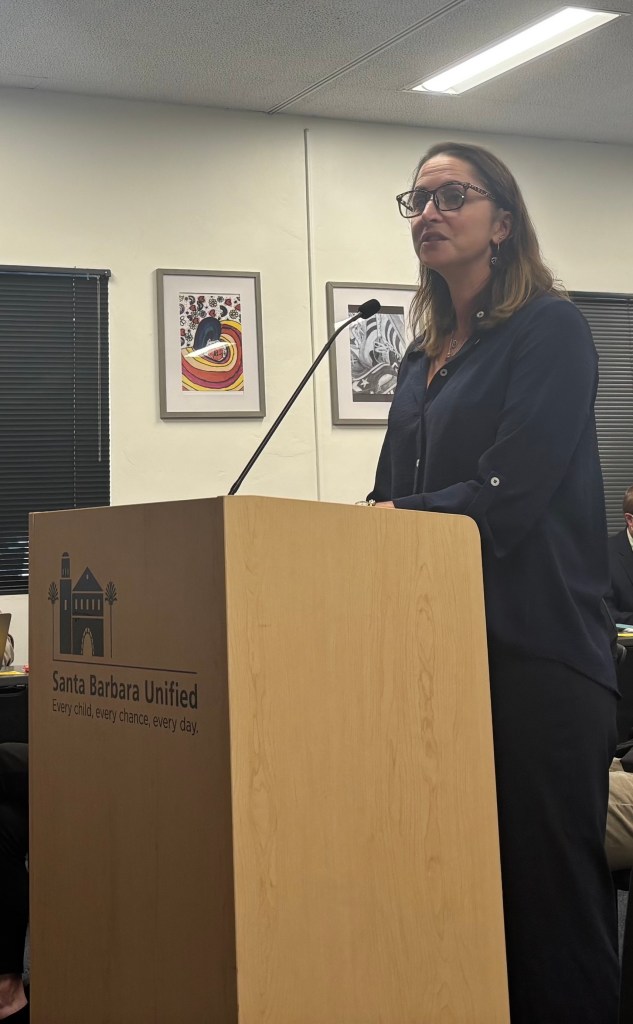
Autumn McFarland, a parent with a master’s in educational psychology, noticed changes in her 13-year-old daughter’s behavior about 10 weeks into the school year. She’s a bright kid, McFarland says — she’s in sports, she babysits, and she plays the violin. But last fall, she started to show signs of fatigue, irritability, and anxiety.
As a 7th-grader, her daughter was issued an individual iPad as part of the district’s 1:1 device assignments.
“When we found out our daughter was going to do everything on an iPad, we were shocked,” McFarland said.
While technology use begins as early as kindergarten in the district, students are not assigned their own device until 3rd grade. From 7th to 12th grade, they are expected to take the devices home for homework and projects.
But McFarland’s daughter wasn’t only using her school-issued iPad to do her homework. When McFarland and her husband reviewed their daughter’s screen history through district-provided access, they discovered she had been sneaking the iPad upstairs at night and watching YouTube Shorts — short-form video content similar to that found on Instagram and TikTok. She would scroll for hours, often staying awake until midnight or later. Even her teacher observed a shift in her behavior: sleep deprivation, mood changes, and anxiety.
Once her parents intervened, her condition improved. But it left them deeply unsettled about how easily this school-issued device could be used for harm.
Tech companies Meta and YouTube were just found negligent in a court of law for fostering mental distress in young users, as a result of designing their platforms to be addictive. The platforms are compared to cigarettes and slot machines — designed for the same kind of dopamine reward system, with harmful consequences, such as anxiety and depression.
“Technology is both a tool and a weapon,” McFarland told the school board last Tuesday. “Distributing weaponized tools to children without proper safeguards is not a neutral act.”
McFarland and her husband had no choice but to bring this “drug” into their home, she said. There is no “opt-out” option for the school iPads. At home, the McFarlands maintain strict limits on screen use. But the introduction of a school-issued iPad complicated those boundaries.
“We have guardrails on all our devices,” she said, “but the school iPad, we have no ability to put guardrails on.”
Her concerns mirror those of other parents in the district. For students with attention-related challenges, such as ADHD, focusing on schoolwork is significantly more difficult on a device. One parent described it as a “constant battle” to keep her son on task.
“I tried very hard to find a school that didn’t rely so heavily on iPads — it was nearly impossible,” she said. “This isn’t about blaming teachers or resisting progress. It’s about recognizing that not all students can thrive in a system that depends so heavily on the devices that are designed to distract.”
Another parent, Kathryn Birch, noted that while her daughter performs well academically, her most frequent use of her school-issued iPad has been for streaming content. Concerned about her younger son’s ability to succeed in a screen-heavy environment, she decided to enroll him in a private middle school, with less reliance on technology — a growing trend among families.
Birch has also been active in efforts to limit smartphone use among kids, promoting a pledge for parents to wait until at least 8th grade before giving children smartphones.
Many schools have already taken steps to limit smartphone use during the day, implementing “off and away” policies and even using signal-blocking pouches to enforce the rule. But it’s contradictory, parents point out: If smartphones are distracting, how are school-issued devices any different?
“You don’t want our cell phones at school,” Birch said, “and we don’t want your devices at home.”
Students themselves are also beginning to weigh in on the conversation. According to a survey by the district’s student advisory council, high schoolers acknowledge that technology can be useful — especially for writing-heavy courses and visual projects — but also find it highly distracting. Some voiced a preference for paper-based assignments in certain subjects.
Among all the concerns surrounding EdTech — too many to deep-dive into here — security issues are the first fires to put out. The district currently employs multiple safeguards, including content filters, firewalls and device monitoring. But parents say they don’t always work.
Simon Bentley, a parent and IT consultant, conducted his own assessment of the district’s systems, revealing multiple vulnerabilities. Students have been able to bypass filters, download unauthorized apps, shop online, access AI tools, and engage in email chains between students laced with bullying. In one instance, Bentley was able to log out of a school-issue iPad account and log into his own Apple account without resistance.
“This stuff is easy to work around — and kids are smart,” Bentley said. “It doesn’t take a certified hacker to do it.”
In response, the district is taking action. It started with a tech-use committee that transformed into the “Balanced Learning and Technology Task Force,” which involves parents and is working to address security issues and broader concerns around screen use. Planned changes after the last task force meeting on March 17 include stronger protections, removal of web browsers such as Safari, blocking of gaming and entertainment sites, and more structured, purpose-driven use of technology in the classroom, including eliminating screens as a “reward” or for unstructured “free time.”
The district also plans to reconfigure all elementary school iPads over spring break, implementing device-level safeguards that are harder for students to bypass. Rob Cooper, director of Educational Technology Services, said the goal is to have students return from spring break with devices that are “safer than ever.” At the district, they have a $6.4 million Educational Technology Services budget and a 21-person strong IT team, which will be all-hands-on-deck.
“We’re making it a priority because it is. It’s a national trend,” Cooper said. “This is not unique to Santa Barbara — there has been a rise in the popularity of students getting around content filters … but we also recognize that we have to keep up with it.”
Parents have made their position clear: They are not anti-tech. They just want learning to be safe, effective, and transparent.
In addition to the district’s immediate actions, parents are also pushing to limit screen exposure. They want device-free lunch periods, a full audit of classroom tech, and higher security — including blocking YouTube and keeping iPads at school or locking them down at a certain time so they become unusable after hours.
In Birch’s words, they are looking for “intentional tech” or tech that serves, not leads. The district claims that goal is shared.
“We’re really focusing on that tech with intent in our school district,” Cooper said.
When asked whether he could see a day where their schools returned to primarily analog learning, Cooper said, “It’s difficult to know what education will look like in five to 10 years from now … who’s to say?”
The next task force meeting around tech use in district schools is scheduled for April 20.
Related Posts










Premier Events

Thu, Apr 02
5:00 PM
Santa Barbara
Paintings by Michael Vilkin at ART & SOUL GALLERY

Sat, Apr 04
9:00 AM
Santa Barbara
Mesa Harmony Garden Spring Plant Sale

Thu, Apr 09
7:00 PM
Santa Barbara
Journey Within: Wisdom & Meditation with Gurudev

Fri, Apr 10
2:00 PM
Santa Barbara
Music & Meditation SB – Concert April 10, 2026

Wed, Apr 01
6:00 PM
Santa Barbara
Downtown Salsa & Bachata Dancing

Wed, Apr 01
7:30 PM
Santa Barbara
Justin Hayward – The Story In Your Eyes Tour
Thu, Apr 02
2:00 PM
Santa Barbara
S.B. Rescue Mission Annual Easter Feast

Thu, Apr 02
4:00 PM
Santa Barbara
Organic Soup Kitchen’s Souper Bloom Soup Social!

Thu, Apr 02
5:00 PM
Santa Barbara
Exhibit Opening: The Santa Barbara Independent: ‘Covering 40 Years’

Fri, Apr 03
2:00 PM
Santa Barbara
Ensemble Theatre Company Presents “A Night with Janis Joplin”

Fri, Apr 03
5:00 PM
Lompoc
Filipinos’ Contributions to Once Making Lompoc…

Fri, Apr 03
7:30 PM
Santa Barbara
Lahaina: Voices of Change
Sat, Apr 04
9:00 AM
Santa Barbara
Mesa Harmony Garden Spring Plant Sale

Sat, Apr 04
9:00 AM
Santa Barbara
Passport Fair, hosted by Congressman Salud Carbajal
Thu, Apr 02 5:00 PM
Santa Barbara
Paintings by Michael Vilkin at ART & SOUL GALLERY
Sat, Apr 04 9:00 AM
Santa Barbara
Mesa Harmony Garden Spring Plant Sale
Thu, Apr 09 7:00 PM
Santa Barbara
Journey Within: Wisdom & Meditation with Gurudev
Fri, Apr 10 2:00 PM
Santa Barbara
Music & Meditation SB – Concert April 10, 2026
Wed, Apr 01 6:00 PM
Santa Barbara
Downtown Salsa & Bachata Dancing
Wed, Apr 01 7:30 PM
Santa Barbara
Justin Hayward – The Story In Your Eyes Tour
Thu, Apr 02 2:00 PM
Santa Barbara
S.B. Rescue Mission Annual Easter Feast
Thu, Apr 02 4:00 PM
Santa Barbara
Organic Soup Kitchen’s Souper Bloom Soup Social!
Thu, Apr 02 5:00 PM
Santa Barbara
Exhibit Opening: The Santa Barbara Independent: ‘Covering 40 Years’
Fri, Apr 03 2:00 PM
Santa Barbara
Ensemble Theatre Company Presents “A Night with Janis Joplin”
Fri, Apr 03 5:00 PM
Lompoc
Filipinos’ Contributions to Once Making Lompoc…
Fri, Apr 03 7:30 PM
Santa Barbara
Lahaina: Voices of Change
Sat, Apr 04 9:00 AM
Santa Barbara
Mesa Harmony Garden Spring Plant Sale
Sat, Apr 04 9:00 AM
Santa Barbara


You must be logged in to post a comment.