
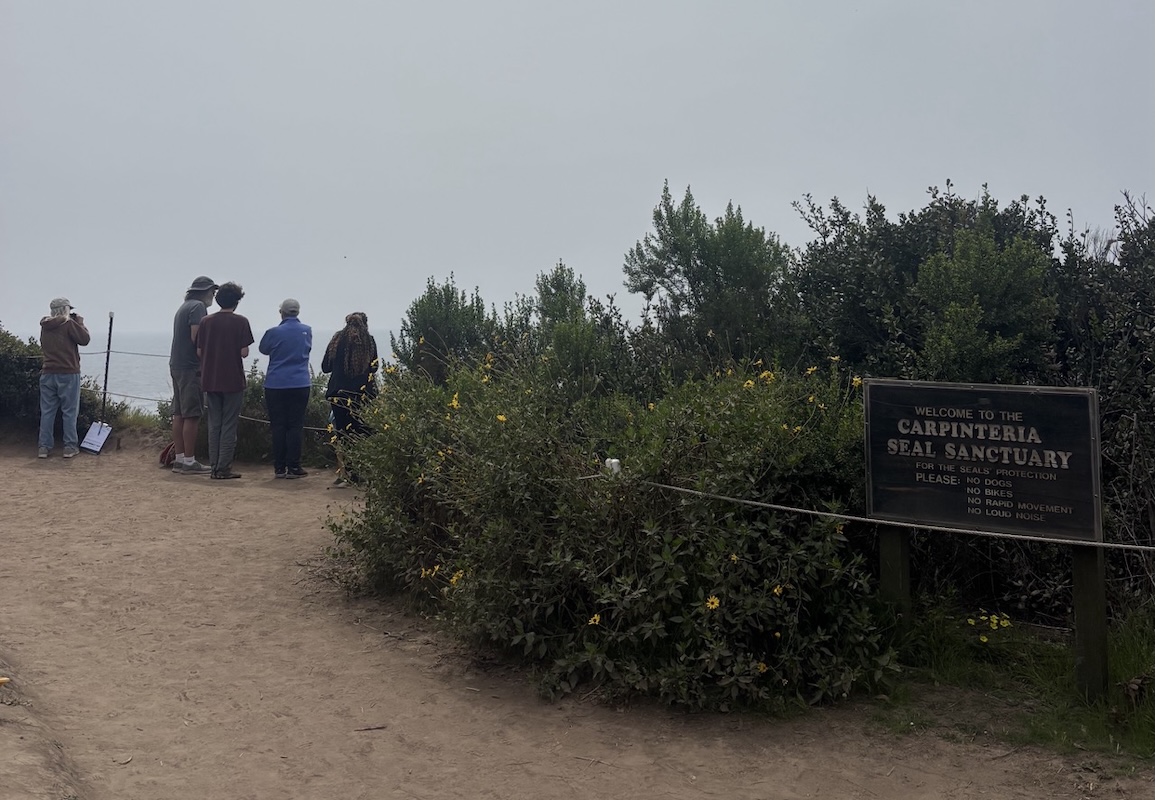
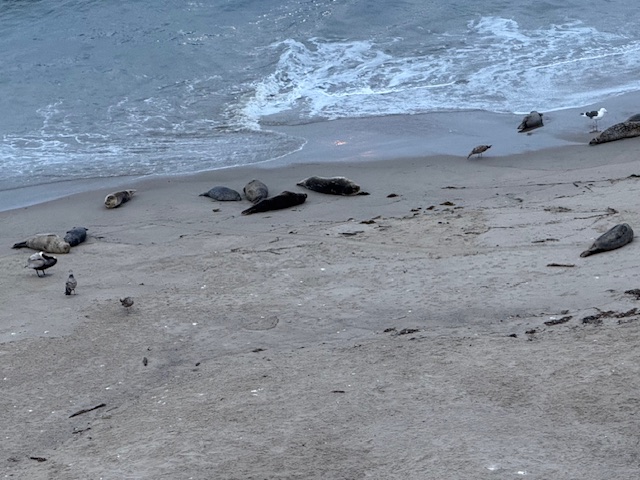
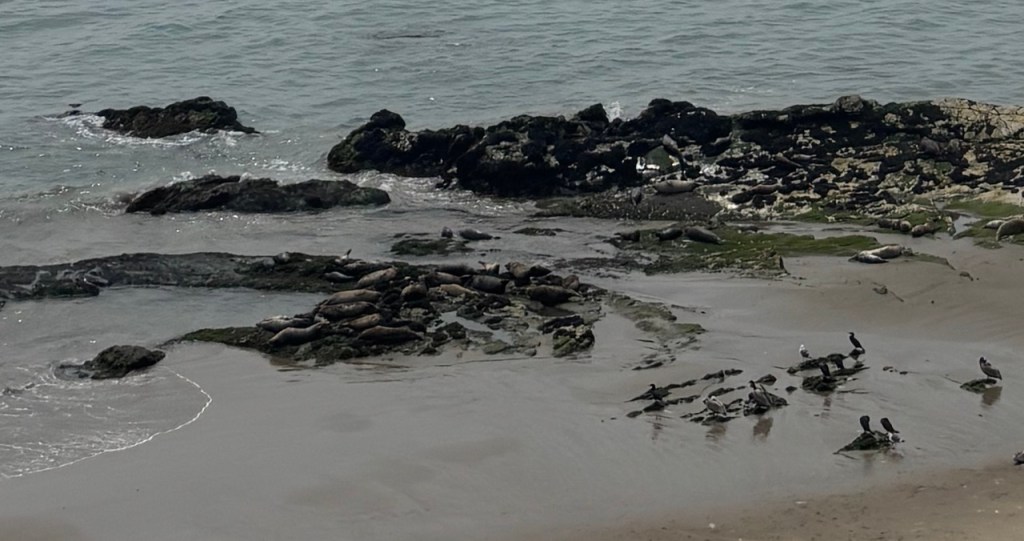
The 1,500 feet of beach containing Carpinteria’s harbor seal rookery is one of the two remaining breeding and pupping grounds left on the mainland in Southern California. Most days, it contains fewer than 100 seals. In 2004, 365 seals were counted.
While harbor seals are not endangered, their beach rookeries may be. Carpinteria’s Save Our Seals (SOS) nonprofit formed around 2021 out of a concern that the seals’ habitats along the coast were rapidly disappearing. The group’s Seal Watch volunteer program is in the middle of its November-to-May monitoring of the beach to keep beachgoers and dogs from disrupting the rookery during low tide. Currently, SOS is seeking volunteers to assist its public education efforts at the Overlook, up on the Carp Bluffs off the Coastal Vista Trail.
Harbor seals have established rookeries for more than 100 years in Carpinteria, said Susan Mailheau and Randall Moon, who are members of Save Our Seals. Harbor seals have site fidelity to their birthplace, living out their life cycle of 25-30 years wherever they were born, underlining the importance of preserving and protecting the rookery. The beach itself serves to help the marine mammals thermoregulate year-round, digest their food, sleep, and prepare to dive. The sandy shore is important to seasonal processes, such as mating, giving birth, summer molting, and generating milk to feed their young.
“The problem with our harbor seals is that the land that has been so perfectly suited to them for over 100 years has now become quite popular for beachgoing walkers, visitors, for people in town, and their dogs,” said Mailheau, who is a veterinarian.
She and Moon are also members of the Harbor Seal Advisory Committee, which was formed by the city of Carpinteria to investigate the decline in seals in fall 2021. Save Our Seals formed to educate about the conclusions of the Advisory Committee, while encouraging the community to protect and preserve the Carpinteria harbor seal colony.
The beach that houses the rookery closes December 1 to May 31 to protect seals during pupping season. In 2024, the Advisory Committee recommended that the city close the beach for three full years to see if the seal population increased. Both the California Coastal Commission and the city refused, stating a closure wasn’t warranted. The Advisory Committee continues to seek approval of a three-year test period, nonetheless. Humans and dogs are the major cause of heightened stress hormones and the survival pattern among harbor seals, Mailheau and Moon believe, arguing that science and first-hand observation support the contentions.
“When they are stressed their reproductive system is impaired and not functioning as well, with this year alone having half the pups we normally have,” Mailheau said.
Save Our Seals is a member of the Carpinteria Valley Association, a preservationist group that is one year older than the city itself. The Carpinteria Sea Watch collects data of how many seals its volunteers see, as well as the number of humans visiting the overlook, trying to educate as many people as possible by distributing pamphlets and responding to trespassers.
One volunteer at the Carpinteria Seal Watch has seen the colony go from 400 to about 100 during the 18 years she’s been observing them. Jeanne, who declined to give her last name, said she’d been doing a two-hour shift every Monday for almost two decades. She emphasized that harbor seals have the most amazing survival technique, which she found remarkable. Less positive is the reaction she sometimes gets from the public.
“We see people walking on the beach and ignoring us telling them to stop. One man even waved back at us and continued walking,” Jeanne said.
During the summer the only law in place is the Federal Marine Mammal Act, which imposes up to $10,000 in fines or up to one year in prison for disturbing the seals. A disturbance includes feeding or getting too close to the seals, as well as one caused by dogs, with dog owners being liable for their animal’s behavior.
Another threat to the rookery is the Bluffs themselves, undeveloped land attractive to a variety of project proposals over the years. Mailheau worries that the seals will be driven out if the current proposal — a housing proposal north of the rookery on the Carpinteria Bluffs — gets a good reception at an open house next week. So far, all the development proposals, which range from an oil refinery in 1968 to a hotel in 2022, have failed to materialize due to community opposition and environmental concerns such as the nearby rookery.
“If 200 houses go in immediately north of that area the seals will be driven out,” Mailheau said.
To become a volunteer at the rookery overlook this summer, contact Save Our Seals on their website via SaveCarpSeals.com. Training is provided.






You must be logged in to post a comment.