

Researcher Ralph Appy and a team of students from Occidental College were casting finely knit nets from the shores of Coronado Island in San Diego. They were looking for rays and skates to harvest parasites for their research. But that spring afternoon, they found something rare.
As the students were sorting through their catch, one of them noticed a seagull eyeing something in the sand. “She went over to see what fish had gotten out of the net, and there was a seahorse!” Appy said.
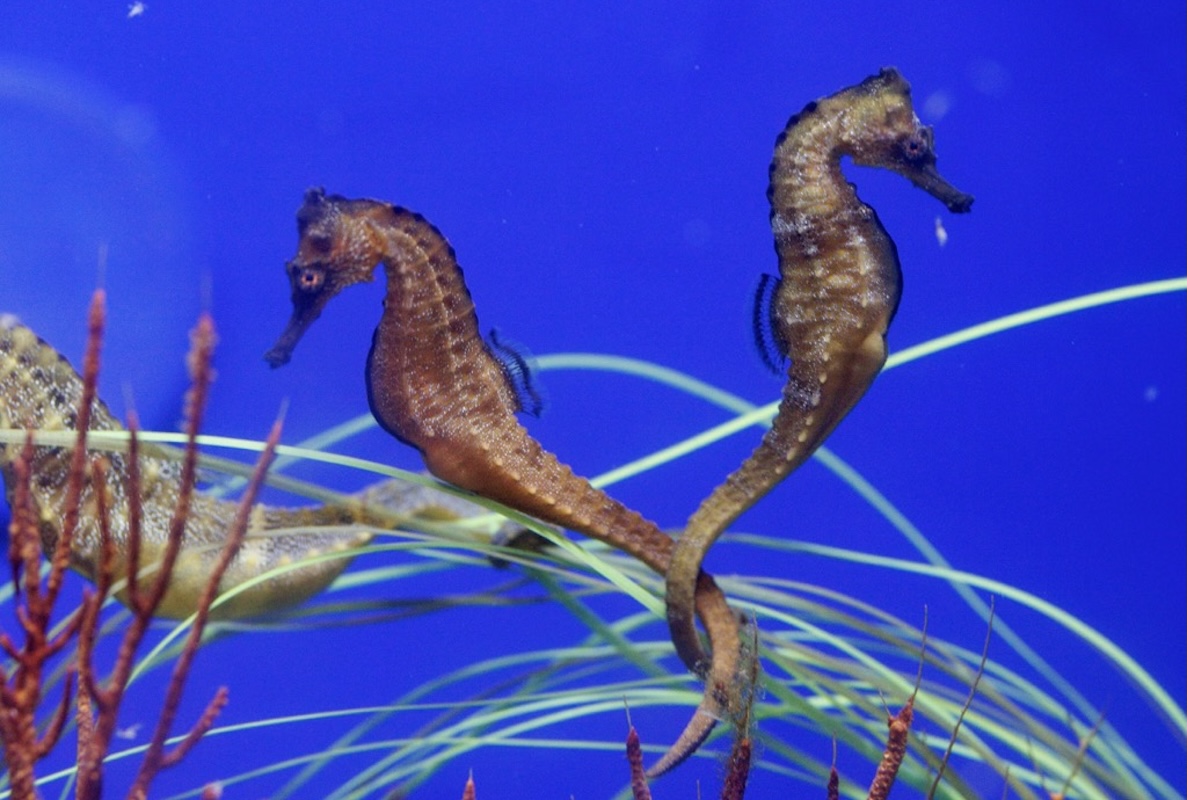
It was a Pacific seahorse, one of the world’s largest species of seahorse that can reach up to 14 inches in length. And thankfully, despite being pecked at by a gull, she was still alive.
Appy struck gold twice that day; earlier on a boat trawl of similar waters, he had found another seahorse, this one a male.
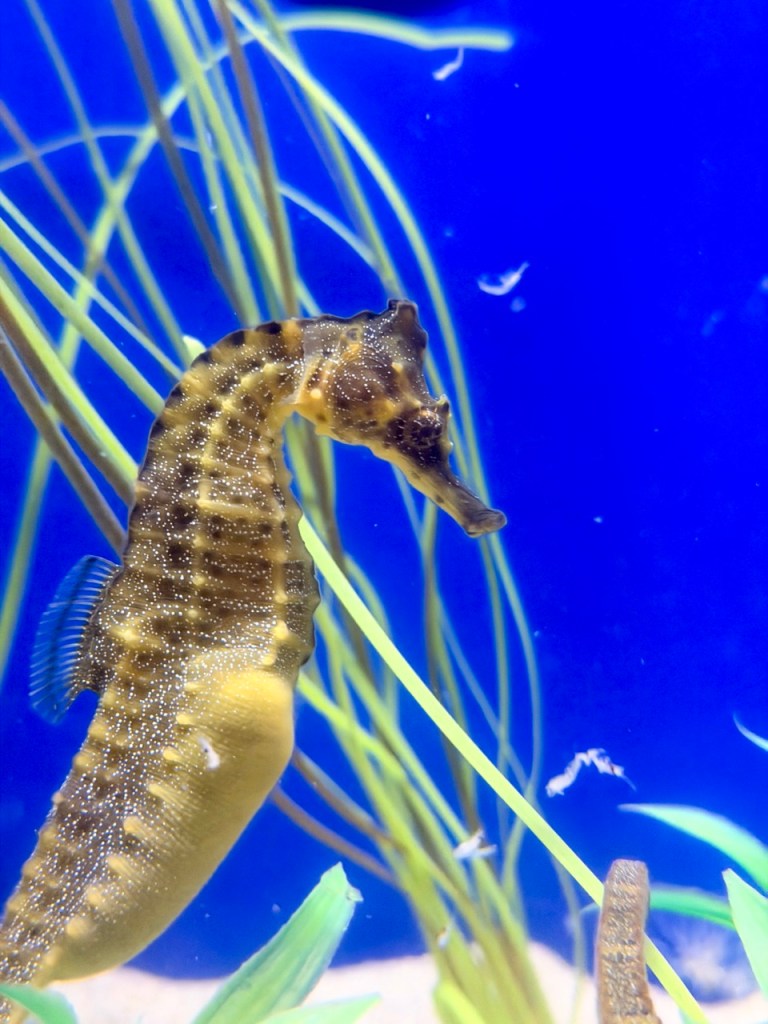
Pacific seahorses, also known as giant seahorses, are found in coastal waters ranging from the southern end of Peru to Long Beach. These elusive creatures, California’s only native species, are hard to come by in the wild, making them an exciting find for aquarists.
The species prefers a warmer water temperature, and as new residents of the Santa Barbara Museum of Natural History Sea Center, they are helping bring awareness to climate-induced changes taking place in the Santa Barbara Channel. With a monogamous breeding pair established at Cabrillo Marine Aquarium in San Pedro, nine of their offspring are now on display here for the public to enjoy.
After finding the pair last spring, Appy fastened a rope to the bottom of a bucket to give the animals some comfort in their holding tank, something they could wrap their uniquely prehensile tails around on the trip. He then started cruising up the freeway in the Fastrack lane, trying to make it to the Cabrillo aquarium before staff closed up for the day.
“I was especially fast,” he said, with the precious cargo gently rumbling in the backseat. Appy got to a two-lane passing zone, and went to pass a slower vehicle in front of him, when he noticed a highway patrol officer with a radar gun pointed in his direction.
Appy started immediately rehearsing what he would say if the officer pulled him over: “I have babies here in the car that need to be delivered!” Thankfully, no speeding tickets were administered, and the pair of seahorses made it safely to their new home.
A “Red List” compiled by the International Union for Conservation of Nature marks the species as vulnerable, noting declining populations of adult animals in the wild. Overfished in Mexico, these animals are dried and shipped to Asia to be used in traditional Chinese medicine. Consuming seahorses is believed to have a Viagra-like effect on men and help with ailments such as asthma and certain skin conditions, although no clinical studies have confirmed this.
Appy delivered the seahorses to Olivia Cleek, an aquarist in Cabrillo’s aquatic nursery where endangered and threatened species from up and down the coast are raised. The bony fish almost immediately paired up and commenced their elegant mating dance, pirouetting around one another and intertwining tails.
Together, they had their first batch of around 500 babies, and a few months later, they had more than 2,000 more. “It was insane,” Cleek said, describing it as a “baby explosion.”
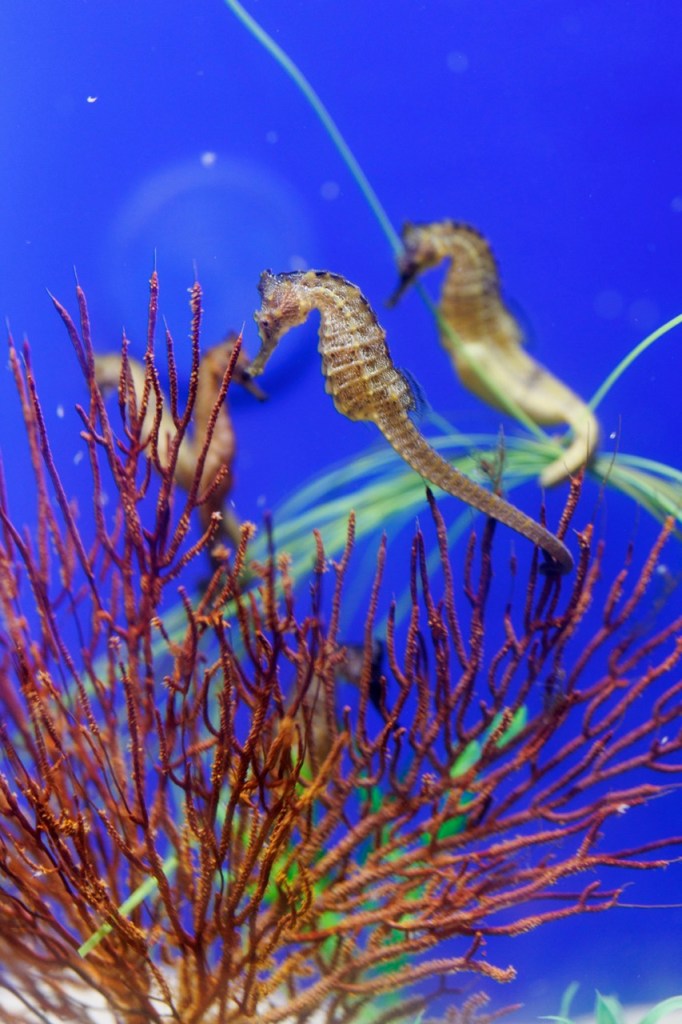
Cleek and her team had to scoop out the tiny offspring, miniature replicas of their parents, and put them into Kreisel tanks — an aquarium with a circular flow that is typically used for jellyfish. They were fed microscopic live rotifers (a type of zooplankton) and brine shrimp until they reached about two months old, when they transitioned to frozen foods.
“We just had so many,” said Cleek. “So honestly, we were just like, ‘Anyone who wants them, please take them.’”
Some of the brood ended up at Aquarium of the Pacific in Long Beach, some at Birch Aquarium at Scripps, and nine made their way to the Sea Center on Stearns Wharf. They are part of the exhibit Dive In: Our Changing Channel, which highlights Santa Barbara’s coastal flora and fauna, and how the waters are shifting due to climate change.
Max Rudelic, a senior aquarist at the Sea Center, is now their caretaker. He says guests are captivated by these animals. “I see kids really get inspired,” he said.
The Pacific seahorse is seen as a signal species, Rudelic explained. “This isn’t something you’d normally see here,” he said. “If you do, that’s concerning.” Witnessing these animals in the Santa Barbara Channel would mean something is pushing them north, whether it is a lack of food, increasing water temperatures, or habitat loss.
The Sea Center’s new seahorses are now starting to pair up and have babies of their own. When asked about the viability of sibling seahorses procreating, Cleek said it’s not ideal, “but for the most part, if you have one accidental batch of sibling babies, it’s not terrible.”
Rudelic is now working on building additional tanks to raise the babies. “If we can possibly donate them to other aquariums to educate people about the area, that would be ideal,” he said.
Learn more at sbnature.org.
Related Posts


Premier Events
Thu, Apr 02
5:00 PM
Santa Barbara
Paintings by Michael Vilkin at ART & SOUL GALLERY

Thu, Apr 09
7:00 PM
Santa Barbara
POSTPONED – Journey Within: Wisdom & Meditation with Gurudev – POSTPONED
Fri, Apr 10
2:00 PM
Santa Barbara
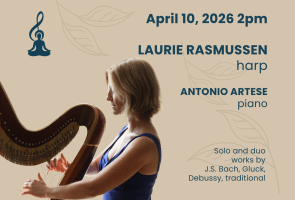
Music & Meditation SB – Concert April 10, 2026

Fri, Apr 03
2:00 PM
Santa Barbara
Ensemble Theatre Company Presents “A Night with Janis Joplin”

Fri, Apr 03
5:00 PM
Lompoc
Filipinos’ Contributions to Once Making Lompoc…
Fri, Apr 03
7:30 PM
Santa Barbara
Lahaina: Voices of Change

Sat, Apr 04
9:00 AM
Santa Barbara
Mesa Harmony Garden Spring Plant Sale

Sat, Apr 04
9:00 AM
Santa Barbara
Passport Fair, hosted by Congressman Salud Carbajal

Sat, Apr 04
9:30 AM
Santa Barbara
The Great Egg Hunt
Sat, Apr 04
5:00 PM
Santa Barbara
Classical Guitar at Art & Soul

Sun, Apr 05
10:00 AM
Santa Barbara
Easter Brunch at Brass Bear

Tue, Apr 07
7:30 PM
Solvang
ABRA Cadabra – ABBA Tribute Band
Wed, Apr 08
11:00 AM
Santa Barbara
True Story of Fremont Foxen & the San Marcos Pass
Thu, Apr 02 5:00 PM
Santa Barbara
Paintings by Michael Vilkin at ART & SOUL GALLERY
Thu, Apr 09 7:00 PM
Santa Barbara
POSTPONED – Journey Within: Wisdom & Meditation with Gurudev – POSTPONED
Fri, Apr 10 2:00 PM
Santa Barbara
Music & Meditation SB – Concert April 10, 2026
Fri, Apr 03 2:00 PM
Santa Barbara
Ensemble Theatre Company Presents “A Night with Janis Joplin”
Fri, Apr 03 5:00 PM
Lompoc
Filipinos’ Contributions to Once Making Lompoc…
Fri, Apr 03 7:30 PM
Santa Barbara
Lahaina: Voices of Change
Sat, Apr 04 9:00 AM
Santa Barbara
Mesa Harmony Garden Spring Plant Sale
Sat, Apr 04 9:00 AM
Santa Barbara
Passport Fair, hosted by Congressman Salud Carbajal
Sat, Apr 04 9:30 AM
Santa Barbara
The Great Egg Hunt
Sat, Apr 04 5:00 PM
Santa Barbara
Classical Guitar at Art & Soul
Sun, Apr 05 10:00 AM
Santa Barbara
Easter Brunch at Brass Bear
Tue, Apr 07 7:30 PM
Solvang
ABRA Cadabra – ABBA Tribute Band
Wed, Apr 08 11:00 AM
Santa Barbara


You must be logged in to post a comment.