
For Governor: Tom Steyer
An Extended Look at the Santa Barbara Independent‘s
Endorsement for Tom Steyer for Governor
By Indy Staff | May 17, 2026
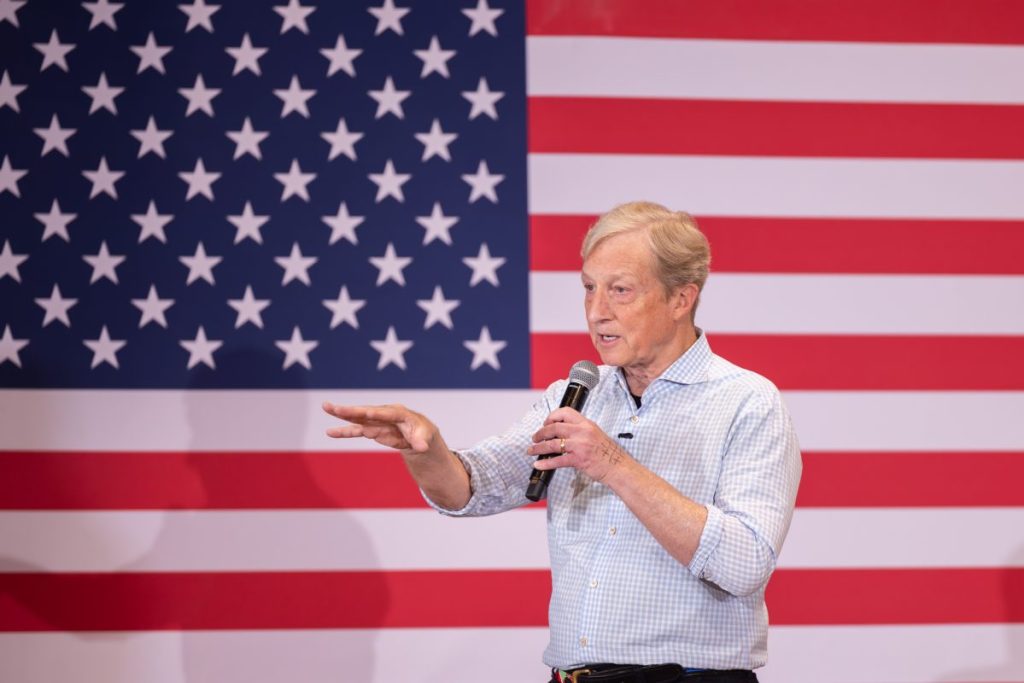
No more hand-wringing. We are endorsing Tom Steyer for governor. Yes, the billionaire. And yes, the hedge fund billionaire who has never held any elective office.
In evaluating candidates seeking executive office, we look for passion, vision, determination, street smarts, and a degree of ruthlessness. We see all of that in Steyer and not nearly enough of it in former cabinet secretary, former State Attorney General, and former Congressmember Xavier Becerra, the only other candidate in this race to which we gave serious consideration.
We need no reminding about the narcissistic wreckage that can be wrought by dilettante billionaires with delusions of grandeur and other personality disorders. In recent years, Santa Barbara has just barely survived two.
In 1992, Michael Huffington, the carpetbagging son of a legendary Texas oil wildcatter, moved to Santa Barbara and spent $28 million of his own money winning Santa Barbara’s congressional seat. It turned out, however, that two years later, after doing almost nothing as a congressman, he concluded he needed a more exalted position and ran for the U.S. Senate and came within a whisker of beating Dianne Feinstein.
We just barely dodged a bullet.
Shortly afterward, another billionaire, Wendy P. McCaw, moved to Santa Barbara bought Santa Barbara’s daily newspaper. She subsequently ran the paper into the ground, but not before inciting a mutiny by her own staff and inspiring a debilitating boycott by the community at large for her transgressions against basic decency. Unresolved litigation from that meltdown is still smoldering today.
We — and the community at large — learned the hard way that billionaires need to be approached with extreme caution.
Here’s what we can say about Steyer.
Since 2010, he’s been putting his money where his mouth was on behalf of common sense progressive causes. When the state legislature passed a landmark climate change bill to regulate the release of greenhouse gases, the oil industry and the Koch brothers came unglued. Together, they launched a statewide initiative — Prop 23 — to limit the environmental bill’s impact. Steyer, then a hedge fund owner, joined forces with George Shultz, then a nationally prominent Republican and former White House cabinet member under multiple presidents, and together they soundly defeated the oil industry measure by a vote of 61.5 percent. Steyer spent $10 million of his own money in that effort.
Two years later, Steyer bankrolled a measure to plug a tax loophole that gave companies doing business in California a significant tax incentive to relocate their headquarters out of state. He spent $30 million on that one. It won — again by 61 percent — adding $1 billion a year to the state’s coffers.
In 2016, Steyer was back, this time to increase the state tax charged per carton of cigarettes by $2. He spent $11 million. It won. The measure generated $1 billion in new state revenues, but Steyer said the real motivation was to encourage smokers to quit.
In 2017, Steyer spent $7.5 million to bankroll a massive eight-state voter registration and get-out-the-vote drive targeting younger voters.
In 2020, Steyer ran for president in the Democratic primary, spending $250 million of his own money to wage campaigns in three states before dropping out. That same year, he endorsed a measure in California — Prop 15 — to plug a massive tax loophole in how the state of California taxes the transfer of commercial real estate, but his money was mostly spent on his obviously doomed presidential effort. Even without Steyer’s deep pockets, Prop 15 was well-bankrolled. But the opposition was even more so. The measure went down in defeat but by the relatively narrow margin of 52 to 48 percent.
Which leads us to now. On the campaign trail, Steyer is talking about resurrecting a variant of Prop 15 to address the same glaring loophole. He claims this could generate $22 billion in revenues that the cash-strapped state — facing a structural deficit of $10 billion to $35 billion — could use to pay for critically needed housing and healthcare.
This loophole bears some explanation: Prop 13, the 1978 state law intended to protect seniors from losing their homes to galloping property tax increases also has a loophole allowing commercial property owners to make out like bandits. The state Board of Equalization estimates almost half the taxable market value from commercial real estate sales goes untapped — the market value of that inventory is estimated to be worth $4.69 trillion, but only $2.46 trillion of that value is taxable. On an annualized basis, the board estimates the state could generate an additional $24 billion a year. In Santa Barbara County, only 34 percent of the county’s total market value is subject to county assessments and taxation.
Of all the candidates running, Steyer is the only one pledging to plug this loophole. To date, he has not said how his eventual proposal would differ from the one that was defeated in 2020 or how small business owners could be shielded from the inevitable trickle-down sticker shock their landlords would pass along. But he is the only candidate to identify meaningful new revenue streams.
The Republican candidates talk about waste fraud and abuse; no doubt there’s plenty. The other Democrats talk about increased government efficiency. And yes, that’s critical. But all the savings these efforts combined might generate are nowhere near enough to help with the state’s housing crisis.
When it comes to housing, Steyer is the only candidate who routinely hammers home the obvious profound truth: California mayors do not oppose housing because they’re NIMBY, elitist, tree-huggers. They oppose housing because new housing generates an increased demand and need for government services for which no revenue source has been identified. Other candidates talk about punishing cities into submission; Steyer acknowledges the pressing financial burden additional housing imposes on local governments.
We could talk about the other candidates in some detail, but right now, it’s more important to highlight why we think Steyer is worthy of your vote. We’re confident he knows what he doesn’t know, and as governor, will appoint the people who do. What he does know is how to get things done.
No Cash from Steyer
To be clear, Tom Steyer hasn’t given the Independentone cent. Nor has his campaign for governor taken out any ads in our paper. I mention this because we’ve received some communications expressing concern. Our endorsements are not for sale. Sometimes, we make mistakes. But if we do, we make them honestly. We struggled with our Steyer endorsement. It took us two weeks to figure out our own minds. As of this writing, Steyer has famously — or infamously, depending upon your vantage point— poured roughly $200 million of his own money into his campaign for California governor; of that, he’s now spent more than $132 million. To repeat, none of that has come our way. I state this because Steyer has come under attack for paying social media influencers to come out in favor of him. As many readers know, these influencers have not disclosed that they’d been paid by Steyer. Once again, the lines are getting blurred. In traditional political ads — TV and radio ads, mailers, newspaper advertisements — such disclosures are legally mandated by campaign finance law. But those laws have failed to keep pace with the relatively new media universe of social influencers. But this lack of disclosure by and about Steyer’s surrogates has raised questions in the mind of some readers: Did the Independent receive any compensation for our endorsement of Steyer? We can assure you we did not. Not one cent. —Nick Welsh, Executive Editor
For the rest of the Santa Barbara Independent‘s June 2 election endorsements, see here.



You must be logged in to post a comment.